







Navigating the ecosystem of Microsoft 365 can sometimes feel like traversing a digital labyrinth, especially when you are tasked with managing permissions or recovering lost data. Whether you are an IT administrator trying to retrieve files from a former employee’s account or a collaborator needing to give user access to another users OneDrive, understanding the mechanics of cloud permissions is vital.
In this comprehensive guide, we will explore the nuances of OneDrive management, from basic sharing to advanced administrative overrides. Furthermore, we will delve into professional data recovery solutions like PandaOffice Drecov to ensure that no file is ever truly lost.
Understanding the Importance of OneDrive Permissions and Recovery
OneDrive has become the backbone of modern remote work. However, with great convenience comes the complexity of “siloed” data. Frequently, users find themselves locked out of critical folders because a colleague is on leave or a file was accidentally deleted before being shared. Knowing how to give user access to another users OneDrive is not just a convenience—it is a critical business continuity skill.
When we talk about data recovery in the context of OneDrive, we aren’t just talking about clicking “Undo.” We are talking about a multi-layered approach involving:
- Standard sharing protocols.
- Administrative delegation.
- Third-party recovery tools for permanent deletions.
How to Give Access to OneDrive to Another User for Seamless Collaboration
Before diving into the high-level administrative tasks, let’s start with the most common scenario: a standard user wanting to share their own folders with a peer. This is the primary method to give access to OneDrive to another user without needing specialized IT permissions.
- Step 1: Locate the Folder or File. Open your OneDrive folder via File Explorer (Windows) or Finder (Mac). Alternatively, log in to the OneDrive Web Portal. Right-click the specific item you wish to share.
- Step 2: Access the Sharing Menu. Select the “Share” option. A dialog box will appear. Here, you can specify exactly who should receive access.
- Step 3: Configure Permission Levels. This is a crucial step. You can choose between “Can Edit” or “Can View.” To effectively give user access to another users OneDrive for collaborative projects, “Can Edit” is usually preferred.
- Step 4: Send the Invitation. Enter the email address of the recipient. You can also “Copy Link” if you prefer to send the access via a private chat like Microsoft Teams or Slack.
Pro Tip: Always use the “Specific People” setting to ensure the link cannot be forwarded to unauthorized parties. This keeps your data recovery perimeter secure.
Access Users OneDrive as Admin: The IT Professional’s Approach
In many corporate environments, a user might leave the company, or an emergency might require an administrator to step in. In these cases, you need to access users OneDrive as admin to retrieve files or reassign ownership. This process is handled through the Microsoft 365 Admin Center.
- Step 1: Sign in to the Admin Center. Navigate to the Microsoft 365 Admin Center. You must have Global Admin or SharePoint Admin roles to proceed.
- Step 2: Locate the Active User. Go to Users > Active Users. Search for the name of the person whose OneDrive you need to access. Click on their name to open the properties pane.
- Step 3: Generate a Personal Site Link. Select the OneDrive tab in the user’s profile pane. Under “Get access to files,” click on “Create link to files.”
- Step 4: Access and Recover. Click the generated link. You now have full permissions to access users OneDrive as admin. From here, you can download files, move them to a shared SharePoint site, or give user access to another users OneDrive by adding a new owner to the folder.
Warning: Accessing a user’s private files should always be done in compliance with your company’s privacy policy and GDPR/CCPA regulations.
Advanced Data Recovery with PandaOffice Drecov
Sometimes, the files you need aren’t just “unshared”—they are gone. Perhaps a user emptied their recycle bin, or a sync error caused local files to vanish. This is where PandaOffice Drecov becomes your most valuable asset. While Microsoft provides a “Restore your OneDrive” feature, it often falls short if the deletion happened beyond the 30-day window or involves complex file corruption.
PandaOffice Drecov is a professional-grade data recovery tool designed to scan deep into your storage media to pull back lost partitions, deleted documents, and corrupted media files.
⚠ Warning: Install it on a drive different from the one where your data was lost to prevent overwriting.
Step 1: Select the Scan Location
Launch the application. You will see a list of drives. Since OneDrive usually mirrors files to a local path (typically C:\Users\[Username]\OneDrive), select the C: Drive or the specific partition where your OneDrive folder resides.

Step 2: Run the Deep Scan
Click “Scan.” PandaOffice Drecov will begin a sector-by-sector analysis. This is more effective than standard recovery because it looks for file signatures that the operating system has marked as “free space.”
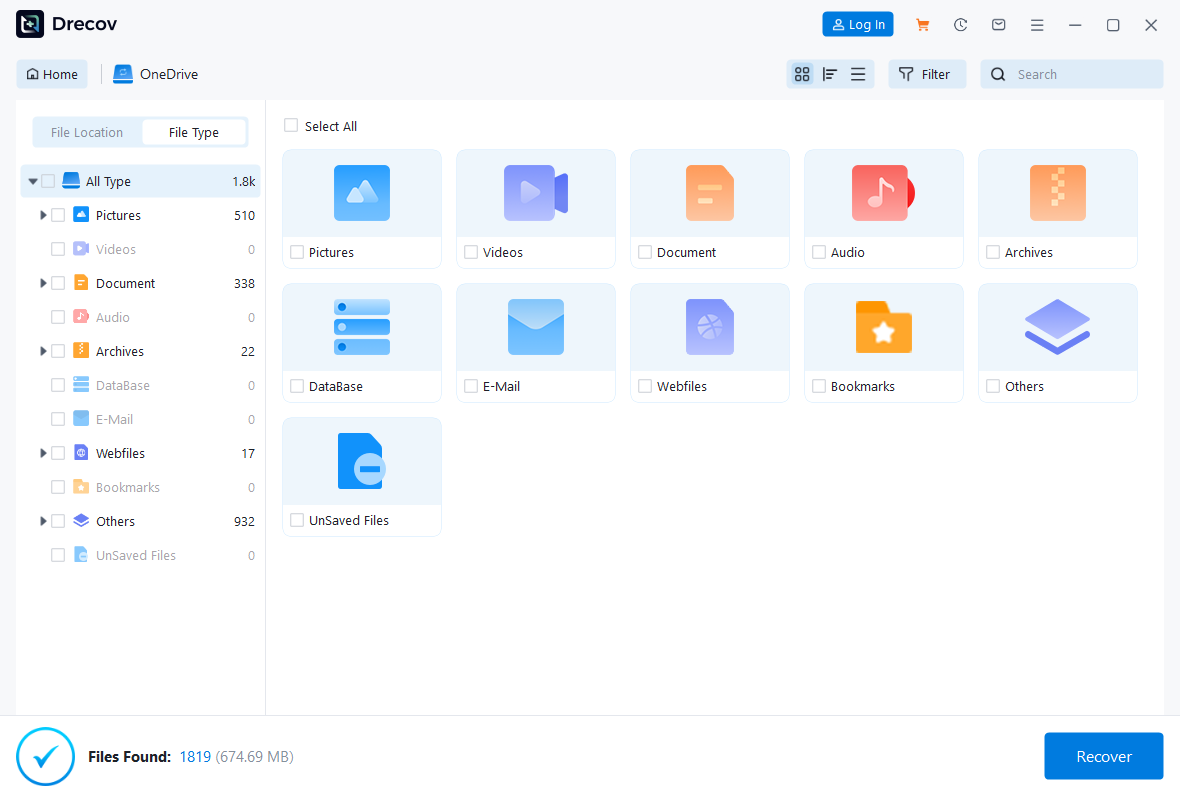
Step 3: Filter and Preview
Once the scan is complete, use the search bar to look for the specific file names or extensions (e.g., .docx, .xlsx). The software allows you to preview files before recovery to ensure they aren’t corrupted.
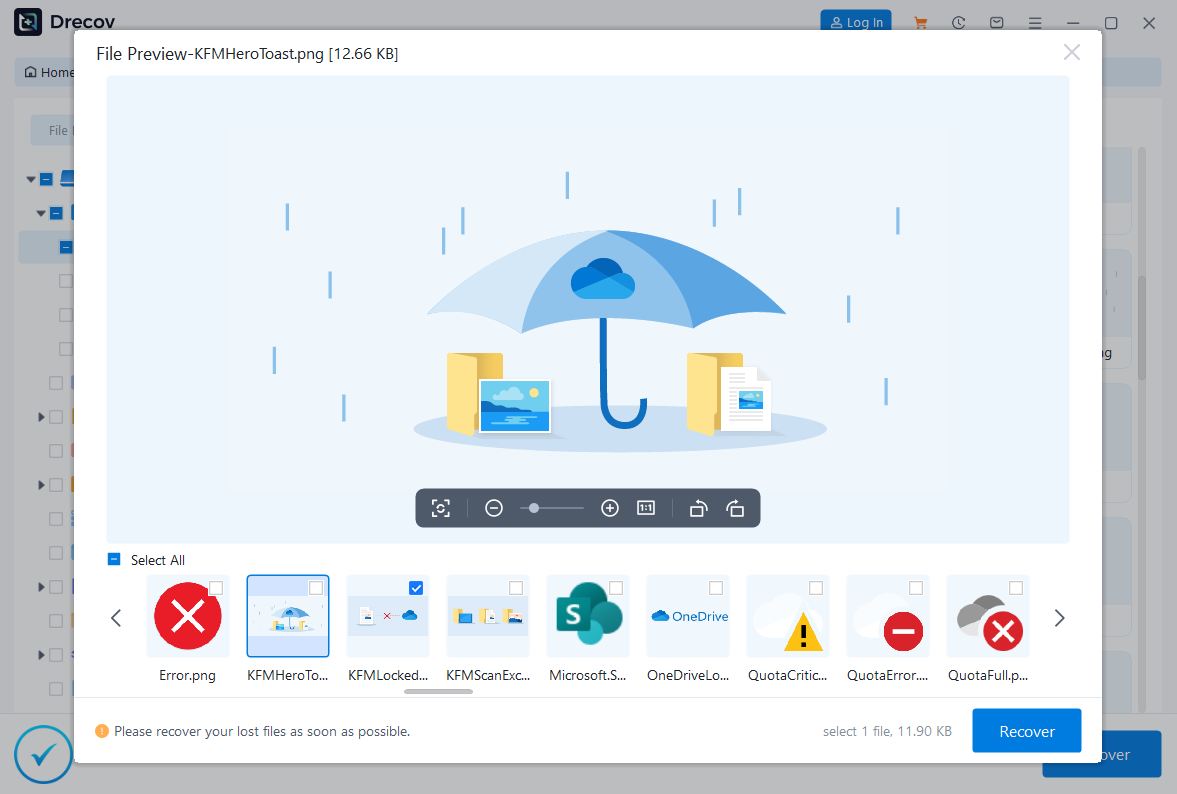
Step 4: Execute Recovery
Select the files you wish to restore and click “Recover.” Warning: Never save the recovered files back to the same drive they were lost from. Use an external USB drive or a different partition to prevent overwriting the data you are trying to save.
Common Obstacles When You Give User Access to Another Users OneDrive
Even with the right steps, you might encounter hurdles. Understanding these can save hours of troubleshooting.
The “Access Denied” Error
This usually occurs if the administrative link has expired or if the user’s license has been removed. If you are trying to access users OneDrive as admin and see this, ensure the user still has an active SharePoint license assigned to them in the Admin Center.
Sync Conflicts
When you give access to OneDrive to another user, they might try to sync the folder locally. If two people edit the same file simultaneously without an internet connection, OneDrive creates a “duplicate” file with the computer’s name appended. To avoid this, always ensure “File Collaboration” is turned on in the OneDrive settings.
Retention Policies
If your organization has strict retention policies, files might be moved to a “Preservation Hold Library.” If you cannot find a file even after you give user access to another users OneDrive, check the SharePoint site associated with that user’s personal URL.
Maintaining Your OneDrive Ecosystem
Data recovery is much easier when you have a proactive maintenance strategy. Beyond knowing how to give user access to another users OneDrive, you should be familiar with the following technical workflows:
- Audit Logs: Regularly check the Microsoft Purview (Compliance) center to see who has accessed which files. This helps in identifying when a file was moved or deleted.
- Version History: Before resorting to heavy-duty recovery tools, right-click any file in OneDrive and select “Version History.” Microsoft stores older versions of files for up to 500 versions by default.
- Storage Quotas: If a user cannot receive shared files, it might be because their OneDrive is full. Admins can increase the limit from 1TB up to 5TB for most Enterprise plans.
Deep Dive: The Registry and OneDrive Paths
For the power users and IT technicians, sometimes the GUI isn’t enough. You may need to verify where OneDrive is storing data on a local machine to help PandaOffice Drecov find the right sectors.
The local path for OneDrive is stored in the Windows Registry. You can find it here:
HKEY_CURRENT_USER\Software\Microsoft\OneDrive
The value “UserFolder” will give you the exact string of the directory. If you are troubleshooting a sync issue while trying to give access to OneDrive to another user, clearing the cache in %localappdata%\Microsoft\OneDrive\onedrive.exe /reset is often the “magic fix.”
Further Reading on OneDrive Management
Effectively managing your cloud storage involves more than just sharing. To become a true expert in data integrity and OneDrive optimization, consider exploring our other specialized guides:
- If you find that your cloud storage is becoming cluttered or you need to stop syncing specific data, learn how to disable a folder from OneDrive and recover lost files.
- Dealing with persistent “Save As” bugs? Check out our fix for when Windows save as default location is stuck on OneDrive.
- If you’ve decided to move away from the service entirely, follow our step-by-step guide on how to uninstall OneDrive on Windows and Mac.
OneDrive Access and Recovery FAQs
To further assist you in mastering the ability to give user access to another users OneDrive, we have compiled the most common questions encountered by IT administrators and end-users alike. These answers provide quick troubleshooting tips and strategic insights.
1. Can I give user access to another users OneDrive if the original owner has already been deleted?
Yes, but you must act quickly. When a user license is removed, Microsoft 365 retains the OneDrive data for a default period of 30 days (this can be extended up to 3650 days in the SharePoint Admin Center). During this “retention” phase, an administrator can still access users OneDrive as admin via the “Deleted Users” section in the Admin Center and assign site collection ownership to another employee. If the retention period has passed, you will likely need a professional recovery tool like PandaOffice Drecov to scan the local machine where the files were last synced.
2. What is the fastest way to give access to OneDrive to another user without an admin account?
If you are the owner of the files, the fastest way is to use the “Share” button directly in File Explorer or the OneDrive web interface. Simply enter the recipient’s email address and select “Can Edit.” However, if you are not the owner and do not have admin rights, you cannot unilaterally give access to OneDrive to another user. In this case, you must request the owner to share the specific folder or ask your IT department to grant you “Delegate” permissions through the Microsoft 365 portal.
3. Why can’t I access users OneDrive as admin even though I have the URL?
If you have the personal site URL but still receive an “Access Denied” or “403 Forbidden” error, it is usually because your admin account has not been added to the Site Collection Administrators list for that specific OneDrive. To fix this:
- Step 1: Go to the SharePoint Admin Center.
- Step 2: Navigate to More Features > User Profiles > Manage User Profiles.
- Step 3: Search for the user, click the dropdown next to their name, and select Manage Site Collection Owners.
- Step 4: Add your admin email to the list. This will allow you to bypass all private settings.
4. Does giving user access to another users OneDrive sync all their private files?
When you give access to OneDrive to another user, you can choose to share either a specific file, a single folder, or the entire root directory. If you grant “Full Control” at the root level, the recipient will indeed see everything. To maintain privacy, it is best practice to share only the specific project folders required. If you are an admin and need to recover data, it is often safer to download the specific files and transfer them rather than granting permanent sync access to the entire account.
PandaOffice Drecov is designed to recover data that has been deleted, formatted, or lost due to system errors on physical storage. If your “access denied” issue is purely a permission setting on the Microsoft cloud server, the software cannot “hack” the cloud permissions. However, if the files were once synced to your local hard drive and then disappeared because your access was revoked or the folder was un-synced, PandaOffice Drecov can scan your local sectors to retrieve the cached versions of those documents.
Conclusion
Mastering the ability to give user access to another users OneDrive is a fundamental skill for any digital collaborator or IT administrator. Whether you are using the standard sharing interface to give access to OneDrive to another user or utilizing the M365 Admin Center to access users OneDrive as admin, the goal is always the same: ensuring data is available to those who need it.
In the event of accidental deletion or system failure, remember that tools like PandaOffice Drecov provide a safety net that goes beyond standard cloud trash cans. By combining smart administrative habits with powerful recovery software, you can ensure your data remains secure, accessible, and resilient.






