







If you’re here, chances are you opened OneDrive expecting your files to sync smoothly… and instead, something feels off. Maybe files aren’t uploading, syncing is stuck, or you’re seeing strange error messages. Naturally, the first question that comes to mind is: “is onedrive down?”
The truth is, OneDrive outages do happen—but not as often as people think. In many cases, the issue isn’t a global outage but something local, like a sync glitch, internet hiccup, or configuration problem. The tricky part? From a user’s perspective, both situations can feel exactly the same.
So instead of guessing, let’s break this down properly. By the end of this guide, you’ll know how to check if OneDrive is actually down, how to fix common issues, and how to master professional data recovery methods using tools like PandaOffice Drecov data recovery software.
What Does “OneDrive Down” Really Mean?
When people say “is onedrive down,” they usually mean one of two things:
- A global outage — Microsoft’s servers are experiencing issues, affecting many users worldwide.
- A local problem — Something is wrong on your device, network, or account configuration.
These two scenarios look similar on the surface, but they require completely different solutions. A global outage might prevent syncing across all devices, while a local issue could affect just your computer. That’s why the first step is always diagnosis—because fixing the wrong problem wastes time and adds frustration.
OneDrive server status today: How to Verify an Outage
Before you dive into complex technical fixes, you must determine the OneDrive server status today. Knowing whether the problem is on Microsoft’s end or your own will save you hours of unnecessary troubleshooting.
Step 1: Consult the Official Microsoft Service Health Portal
The most accurate source of truth is the Microsoft Service Health dashboard. This page provides real-time data on all Microsoft 365 services. If the status indicator for OneDrive is red or yellow, then is onedrive down for real, and you simply have to wait for their engineers to deploy a fix.
Step 2: Check Community-Driven Status Sites
Sometimes, official dashboards take a few minutes to catch up with a sudden crash. Websites like DownDetector or IsDown.app aggregate user reports. If you see a massive spike in the graph for “OneDrive,” it confirms that other users are asking at the exact same time as you.
Step 3: Test the Web Version
A common trick is to try logging into OneDrive.com via an Incognito or Private browser window. If the website loads and your files are visible there, the server is likely fine. This means the problem is restricted to your local sync app.
OneDrive “not connected” error windows 11: Troubleshooting Local Issues
If the official status says everything is green, but your taskbar icon is grayed out or showing a red “X,” you are likely dealing with the OneDrive “not connected” error windows 11. This is a frequent headache for users on the latest OS, often caused by credential conflicts or network timeouts.
Step 1: Restart the OneDrive Process
Often, the sync engine simply hangs.
- Right-click the OneDrive icon (the cloud) in the system tray.
- Select the Gear icon and click Quit OneDrive.
- Open the Start menu, type “OneDrive,” and relaunch the app.
Step 2: Reset OneDrive via Command Line
If a simple restart fails, you can force a reset of the app’s internal cache. This does not delete your files; it just refreshes the connection.
- Press Win + R to open the Run dialog.
- Type or paste:
%localappdata%\Microsoft\OneDrive\onedrive.exe /resetand hit Enter. - If the app doesn’t restart automatically after a minute, open it manually.
Step 3: Check Windows Credentials
Windows 11 sometimes “forgets” your login token.
- Search for Credential Manager in the Start menu.
- Go to Windows Credentials.
- Look for any entries labeled “OneDrive” or “MicrosoftAccount:user=…” and remove them.
- Restart OneDrive and sign in again. This forces a fresh, secure connection to the server.
How to access OneDrive files when offline: Ensuring Data Availability
One of the biggest risks is the fear of losing access to critical documents during a deadline. Learning how to access OneDrive files when offline is essential for business continuity.
Step 1: Use the “Always Keep on This Device” Feature
OneDrive uses “Files On-Demand” by default, meaning files are only downloaded when you open them. To ensure availability:
- Open your OneDrive folder in File Explorer.
- Right-click your most important folders.
- Select Always keep on this device. The icon will change from a blue cloud to a solid green circle with a white checkmark.
Step 2: Configure Offline Access on Mobile
If you use the OneDrive app on iOS or Android:
- Open the app and find your file.
- Tap the three dots (…) next to the file name.
- Toggle the Make Available Offline switch.
Step 3: Check the “Locally Available” Status
Regularly check your status icons. A white circle with a green border means the file is “locally available” because you opened it recently, but Windows might delete the local copy to save space. Only the solid green circle guarantees you can work even if is onedrive down.
Advanced Data Recovery: Using PandaOffice Drecov data recovery software
Sometimes, the problem isn’t just that OneDrive is down; it’s that files disappeared during a failed sync or were accidentally deleted while the service was glitching. When the Recycle Bin is empty and the “Restore your OneDrive” feature fails, you need a professional-grade tool like PandaOffice Drecov data recovery software.
This software is designed to scan your local hard drive for the “ghost” fragments of files that OneDrive once managed. Because OneDrive stores local caches, PandaOffice Drecov can often reconstruct files even if the cloud version is corrupted or inaccessible.
⚠ Warning: Do not install the software on the same drive partition where the lost files were located. This prevents “overwriting” the very data you are trying to save.
How to Recover Lost OneDrive Files with PandaOffice Drecov
Follow these steps carefully to maximize your recovery success rate.
Step 1: Select the Scan Location
Launch the program. On the main interface, you will see a list of drives. Select the drive where your OneDrive folder is located (usually the C: drive). Click Scan.

Step 2: Filter and Preview Files
As the scan progresses, PandaOffice Drecov will categorize found data by file type (e.g., .docx, .jpg, .pdf).
- Key Point: Use the “Filter” function to search for specific file names or extensions.
- Preview: You can double-click files to preview them. If you can see the preview, the file is 100% recoverable.
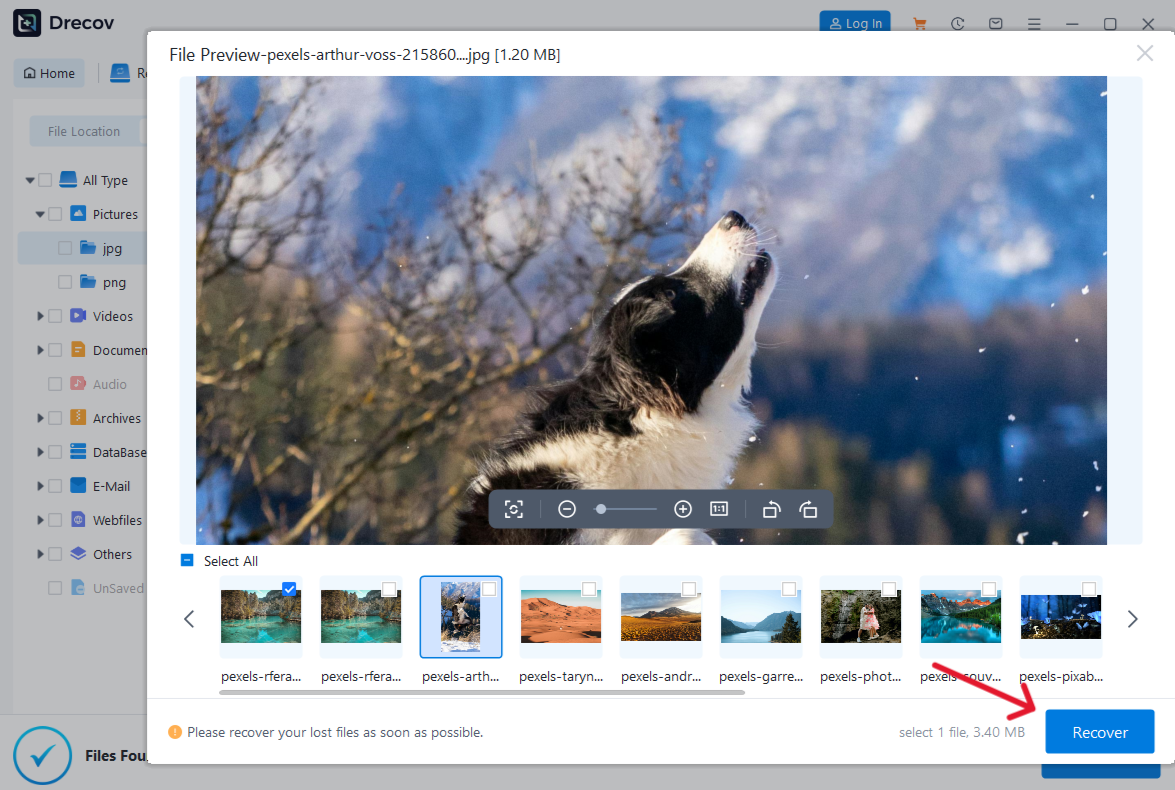
Step 3: Execute Recovery
Select the checkboxes next to the files you need. Click the Recover button and choose a safe destination—such as an external USB drive—to save the restored data.
Essential Post-Recovery Steps
Once you have successfully retrieved your data using PandaOffice Drecov, you might want to reconfigure how OneDrive interacts with your system to prevent future mishaps. Here are some useful resources:
- If you find that specific folders are causing sync loops, learn how to disable a folder from OneDrive to keep your local files safe.
- If the app continues to malfunction on Windows 11, you may need a guide on how to remove OneDrive from File Explorer to clean up your workspace.
- For those who decide to switch to a different cloud provider entirely, here is how to completely remove OneDrive personal from my computer safely.
Common Signs That OneDrive Might Be Down
Even without checking official sources, certain symptoms strongly suggest a service issue. Look for these patterns:
- Syncing Stops Across All Devices: If your files aren’t syncing on your PC, phone, and tablet simultaneously, it is almost certainly a server-side problem.
- Web Interface Failures: If you see “503 Service Unavailable” or “404 Not Found” when trying to log in via a browser, the backend is struggling.
- API Errors in Office Apps: If Word or Excel says “Upload Failed” or “Sign-in Required” repeatedly despite you being logged in, the authentication server might be unreachable.
When It’s NOT OneDrive Down (Most Common Scenarios)
In reality, most “outages” are actually local errors. Before panicking, check these “usual suspects”:
- Internet Connectivity: An unstable Wi-Fi connection can cause OneDrive to enter a “reconnecting” loop.
- Storage Limits: If your OneDrive is 100% full, it will stop syncing immediately. This often looks like an outage.
- Large File Bottlenecks: A single 20GB file trying to upload on a slow connection can “clog” the sync queue for all other files.
How to Stay Productive During a OneDrive Outage
Waiting for Microsoft to fix a server can be agonizing. However, if you are prepared, an outage shouldn’t stop your workflow.
- Switch to Local Saving: Change your default “Save” location in Word/Excel to “This PC” instead of “OneDrive.”
- Use Manual Uploads: If the desktop app is broken but the web version works, manually drag and drop files into the browser.
- Collaborate via Offline Copies: If you are working on a team project, email the latest version of the file to your colleagues rather than relying on the shared sync folder.
Frequently Asked Questions
1. How often does OneDrive experience global outages?
Major global outages are rare, usually occurring once or twice a year, and are typically resolved within 2 to 4 hours.
2. Can I use PandaOffice Drecov if my files were deleted from the cloud?
Yes. Because OneDrive keeps local copies of your files on your hard drive, PandaOffice Drecov can scan your local sectors to find and recover files even if they were wiped from the cloud server.
3. Why does my OneDrive say “Up to date” but my files aren’t there?
This is often a configuration issue where the app is signed into a different Microsoft account, or the folders you are looking for have been “unselected” in the Sync Settings.
4. Does resetting OneDrive delete my data?
No. Using the /reset command only clears the application settings and forces it to re-index your files. Your actual documents remain untouched on your hard drive.
Conclusion
So, is onedrive down? Usually, the answer is “no,” but the frustration is very real. By checking the OneDrive server status today, resolving the OneDrive “not connected” error windows 11, and knowing how to access OneDrive files when offline, you turn a tech disaster into a minor inconvenience.
And remember, if the worst happens and your data seems lost in the digital void, tools like PandaOffice Drecov data recovery software provide a powerful safety net. Stay proactive, keep your local backups current, and never let a server outage stand between you and your work.






