







Disk partitioning remains one of the most important aspects of storage management. Whether you’re installing a new operating system, organizing files, or preparing a drive for multiple uses, understanding partition types can help you make informed decisions.
Many users encounter terms such as primary partition, logical partition, extended partition, MBR, and GPT when configuring storage devices. While modern GPT disks have simplified some limitations, the distinction between partition types still matters, especially when working with older systems, migrating data, or managing MBR disks.
This guide explores primary partition vs logical partition concepts in detail, explains how each partition type works, compares their advantages and limitations, and provides practical methods for creating, converting, and managing partitions safely.
Understanding Primary and Logical Partitions
What Is a Primary Partition?
A primary partition is a disk partition that can directly host an operating system and be marked as active for booting purposes. Historically, primary partitions were the primary way computers organized storage on Master Boot Record (MBR) disks.
When a computer starts, the firmware looks for a bootable partition. On traditional MBR systems, this bootable partition must be configured as a primary partition. As a result, operating systems such as Windows were commonly installed on primary partitions.
Characteristics of a primary partition include:
- Can store operating system files
- Can be marked active
- Recognized directly by the operating system
- Available on both MBR and GPT disks
For example, a typical Windows installation might place system files on a primary partition named C:.
On an MBR disk, users can create up to four primary partitions. This limitation influenced how storage layouts were designed for many years.
Although GPT disks have largely removed this restriction, understanding primary partitions remains important for compatibility and migration scenarios.
What Is a Logical Partition?
A logical partition exists within an extended partition on an MBR disk. It was introduced to overcome the four-partition limitation imposed by the MBR architecture.
Instead of creating additional primary partitions, users create one extended partition and then divide that space into multiple logical partitions.
Logical partitions are commonly used for:
- Data storage
- Backup volumes
- Multimedia libraries
- Separate workspaces
- Secondary operating systems
Unlike a primary partition, a logical partition cannot be directly marked active on an MBR disk. However, it can still store files and applications effectively.
For example:
Disk 0
├── Primary Partition (C:)
├── Primary Partition (Recovery)
├── Extended Partition
      ├── Logical Partition (D:)
      ├── Logical Partition (E:)
      └── Logical Partition (F:)
This structure allows users to create many storage volumes without exceeding MBR limits.
How Disk Partitioning Works on MBR and GPT Drives
To understand logical vs primary partition concepts, it’s important to distinguish between MBR and GPT partitioning schemes.
MBR (Master Boot Record)
Features include:
- Maximum of four primary partitions
- Supports extended partitions
- Supports logical partitions
- Limited to 2TB disk capacity
GPT (GUID Partition Table)
Features include:
- Supports many more partitions
- No extended partition requirement
- Improved redundancy
- Better support for large drives
Modern GPT disks technically do not use the traditional primary-versus-logical distinction. However, the terminology remains common because millions of systems still use MBR disks or legacy configurations.
Why Partition Types Still Matter Today
Some users assume partition types are obsolete because GPT has become widespread. In reality, partition design still affects:
- Operating system installation
- Multi-boot environments
- Legacy hardware compatibility
- Data organization
- Disk conversion projects
For example, when upgrading an older workstation or recovering data from an MBR drive, understanding partition primary or logical concepts becomes essential.
Storage professionals, IT administrators, and advanced users regularly encounter these situations, making partition knowledge a valuable skill.
Primary Partition vs Logical Partition: Key Differences Explained
Bootability and Operating System Support
One of the most significant differences involves boot functionality.
A primary partition can contain boot files and be designated as the active partition.
Typical examples include:
- Windows system partition
- Linux boot partition
- Recovery environment
Logical partitions generally cannot serve as the active boot partition on traditional MBR systems.
As a result, operating system installations often begin with a primary partition.
For users asking about primary partition vs logical partition, boot capability is often the deciding factor.
Partition Number Limitations
MBR imposes a strict limit of four primary partitions.
Possible layouts include:
Option A
Primary
Primary
Primary
Primary
or
Option B
Primary
Primary
Primary
Extended
The extended partition can then contain multiple logical partitions.
Without logical partitions, users would quickly run out of available partition entries.
This limitation was the primary reason logical partitions were introduced.
Storage Organization and Flexibility
Logical partitions provide greater flexibility for organizing large amounts of data.
Examples include:
- Separate partitions for photos
- Dedicated game libraries
- Backup repositories
- Project storage areas
A logical partition can be created, resized, or repurposed without affecting system partitions.
Businesses often separate operating system files from user data to simplify maintenance and recovery procedures.
This flexibility is a major advantage in the logical partition vs primary partition debate.
Performance Comparison Between Partition Types
Many users believe primary partitions perform faster than logical partitions.
In modern systems, performance differences are generally negligible.
Factors that influence performance more significantly include:
- SSD versus HDD
- File system type
- Drive health
- Available free space
Under normal conditions, both partition types provide similar read and write speeds.
Therefore, performance should rarely be the primary factor when deciding between partition options.
Security and Data Management Considerations
Partition separation can improve data organization and security.
For example:
C: Operating System
D: Business Files
E: Backups
F: Media Storage
If Windows requires reinstallation, data stored on separate partitions may remain unaffected.
Both primary and logical partitions support modern file systems and permissions.
The key advantage lies in organization rather than inherent security differences.
Primary Partition vs Logical Partition Comparison Table
| Feature | Primary Partition | Logical Partition |
|---|---|---|
| Bootable | Yes | Typically No |
| Active Status | Yes | No |
| MBR Limit | Maximum Four | Multiple Allowed |
| Located Inside Extended Partition | No | Yes |
| Operating System Installation | Common | Less Common |
| Data Storage | Yes | Yes |
| Flexibility | Moderate | High |
This comparison highlights the practical differences users encounter when choosing a partition type.
When to Choose a Primary or Logical Partition
Best Scenarios for Using a Primary Partition
A primary partition is usually the best choice when:
- Installing Windows
- Installing Linux boot files
- Creating recovery environments
- Configuring dual-boot systems
- Preparing system drives
Because operating systems depend on reliable boot structures, primary partitions remain the preferred option for system-related tasks.
Many manufacturers also create hidden recovery partitions as primary partitions.
When deciding whether to create partition primary, consider whether the partition must support boot operations.
When a Logical Partition Makes More Sense
Logical partitions excel in storage-focused environments.
Examples include:
- Video archives
- Music collections
- Project workspaces
- Backup storage
- Shared file repositories
Since logical partitions avoid consuming valuable primary partition slots, they are often more efficient for data management.
For users storing large amounts of non-system data, logical partitions typically offer the most practical solution.
Primary or Logical Partition for Windows Installation
Windows installations traditionally prefer primary partitions.
Benefits include:
- Direct boot support
- Simplified setup
- Broad compatibility
- Easier troubleshooting
While modern GPT systems have changed some underlying mechanics, Windows installation tools still create partitions that function similarly to traditional primary partitions.
Therefore, if your goal is operating system deployment, a primary partition is usually recommended.
Partition Logical or Primary for Data Storage
When the purpose is simply storing files, both partition types work effectively.
However, logical partitions often provide advantages such as:
- Better partition allocation
- Reduced consumption of primary partition slots
- Easier storage expansion planning
For most home users, logical partitions are perfectly suitable for storing documents, media, and backups.
⚠️Warning: Before modifying existing partitions, verify that important files are backed up to prevent accidental data loss.
When to Choose a Primary or Logical Partition
Partition Primary or Logical for Multi-Boot Systems
Multi-boot environments require careful planning because multiple operating systems may coexist on a single disk.
A common example is:
Disk 0
├── Windows Partition
├── Linux Root Partition
├── Recovery Partition
└── Data Partition
Historically, MBR disks relied heavily on primary partitions for operating system installations. As the number of operating systems increased, users often turned to extended and logical partitions to overcome partition limits.
Today, GPT-based systems have simplified multi-boot configurations, but partition planning still matters. Keeping operating systems separate from personal data can make maintenance easier and reduce the risk of accidental data loss during upgrades.
When evaluating partition primary vs logical options for a multi-boot setup, the system partition should generally remain boot-capable, while additional storage volumes can be used for shared data.
How to Create, Convert, and Manage Partitions
Method 1: Create Partition Primary Using Windows Disk Management
Test Environment
- Windows 11 Pro 24H2
- 1TB MBR Disk
- Administrator Account
Windows Disk Management provides a graphical way to create partitions without using command-line tools.
Steps:
- Press Windows + X.
- Select Disk Management.
- Locate unallocated space.
- Right-click the space.
- Choose New Simple Volume.
- Follow the setup wizard.
- Assign a drive letter.
- Format the partition.
If the disk still has available primary partition entries, Windows creates a primary partition automatically.
This method is suitable for users who want to create partition primary using a visual interface rather than command-line utilities.
Method 2: Create a Logical Partition from Extended Space
Test Environment
- Windows 10 22H2
- 500GB MBR Hard Drive
When an MBR disk already contains several primary partitions, creating a logical partition may be the most practical option.
Steps:
- Open Disk Management.
- Locate available extended partition space.
- Right-click the free space.
- Select New Logical Drive or equivalent option depending on system configuration.
- Assign a drive letter.
- Format the volume.
Example structure:
Extended Partition
├── D:
├── E:
└── F:
Logical partitions provide flexibility for organizing large amounts of data without consuming additional primary partition entries.
This is a common approach when deciding between partition logical or primary for storage expansion.
Method 3: Convert a Logical Partition to a Primary Partition Using DiskPart
Test Environment
- Windows 11 Pro
- MBR SSD
- Administrator Privileges
Sometimes users need a primary partition for operating system installation or migration purposes.
Steps:
- Back up important files.
- Open Command Prompt as Administrator.
- Launch DiskPart:
diskpart
- Display disks:
list disk
- Select the disk:
select disk 0
- Identify the target partition:
list partition
- Delete and recreate the partition if required.
Because MBR partition structures have limitations, conversion often involves deleting and rebuilding partitions.
⚠️Warning: Converting partitions may erase existing data if backups are not created beforehand.
Method 4: Change a Primary Partition into a Logical Partition
Test Environment
- Windows 10 Pro
- Secondary HDD
In some situations, users need additional logical volumes and have already reached the primary partition limit.
A typical workflow involves:
- Backing up partition contents.
- Removing the existing partition.
- Creating an extended partition.
- Creating a logical partition within the extended space.
- Restoring data.
This approach is often used when reorganizing storage layouts for large data collections or development environments.
Understanding primary or logical partition requirements before redesigning a disk layout can help avoid unnecessary restructuring later.
Method 5: Recover Data Before Partition Changes with PandaOffice Drecov
Test Environment
- Windows 11
- NVMe SSD
- External Backup Drive
Partition modifications always carry some degree of risk.
Unexpected events such as:
- Power failures
- User mistakes
- Software interruptions
- Disk errors
can result in missing files or inaccessible partitions.
Before performing major partition changes, many users choose to verify that important files are recoverable.
A recommended workflow is:
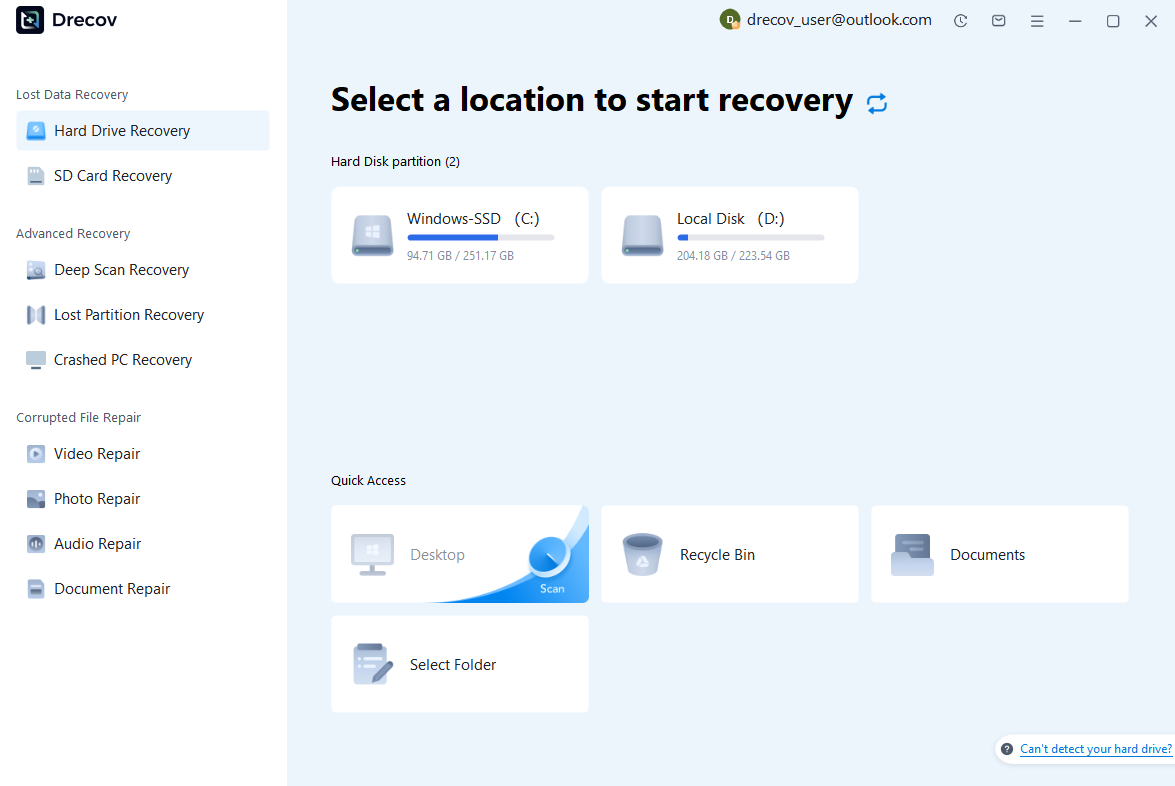
Step 1: Scan the Storage Device (SD Card / Hard Drive / USB)
Connect your device (SD card, HDD/SSD, or USB drive) to your computer and launch PandaOffice Drecov. Select the target device and start the scan. The software will perform a quick scan and deep scan to detect lost or deleted data.
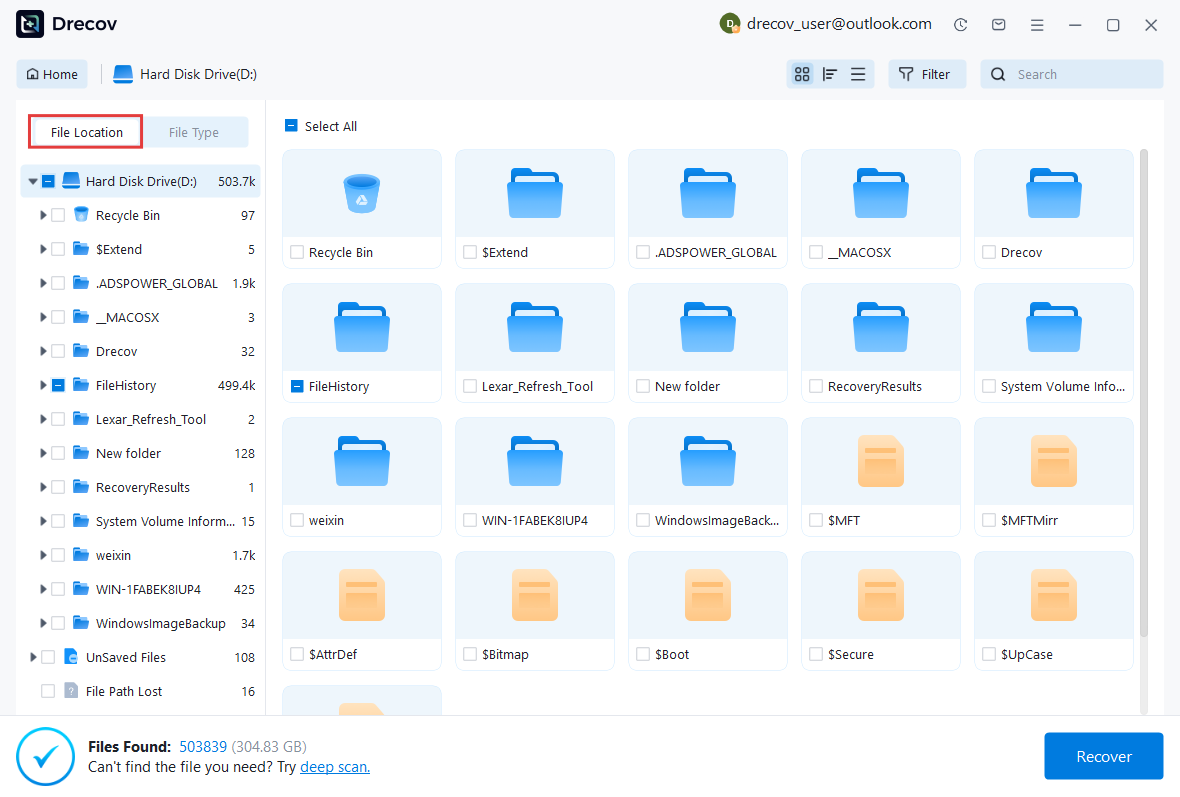
Step 2: Locate and Preview Lost Files
After scanning, browse the detected files and use the preview feature to check recoverable data. You can preview documents (Word, Excel, PDF), photos, and videos to ensure file integrity before recovery.
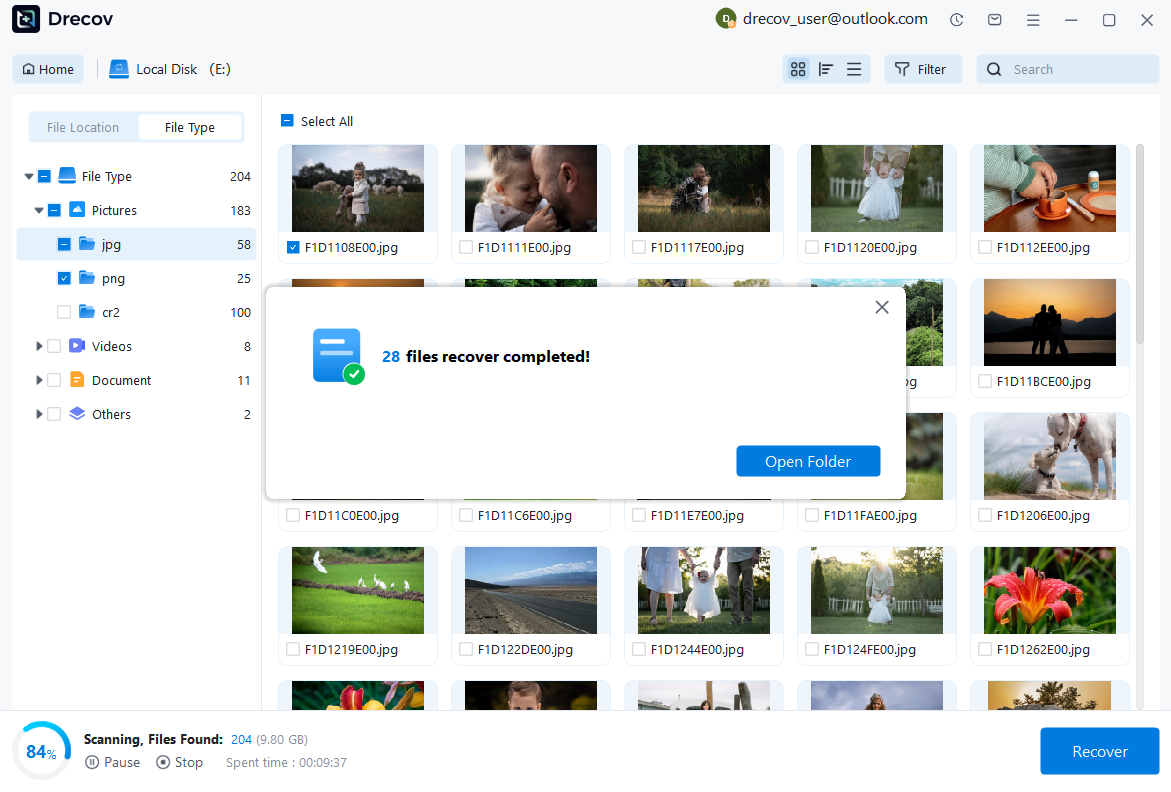
Step 3: Recover and Save to a New Location
Select the files you want to restore and click recover. Save all recovered data to a different drive or location (not the original device) to avoid overwriting lost data.
Why Choose PandaOffice Drecov Recovery Software?
PandaOffice Drecov offers a fast, secure, and user-friendly solution for recovering lost files across multiple scenarios. Whether you need email recovery, ZIP File Recovery, format data recovery, or help to recover deleted drafts Outlook, the software provides reliable recovery performance for both personal and business users.
PandaOffice Drecov supports recovery from formatted hard drives, SSDs, USB drives, SD cards, and external storage devices. Its advanced scanning engine can locate deleted archives, damaged ZIP files, lost Outlook drafts, and accidentally removed documents with high accuracy. For users searching for how to find deleted messages in Teams, PandaOffice Drecov can also help recover exported chat files, attachments, and related local cache data when available.
Key advantages include:
- Deep scan technology for complex data loss situations
- Support for emails, archives, videos, photos, and office documents
- Recovery from accidental deletion, formatting, corruption, and system crashes
- Easy preview before restoring files
- Compatible with Windows and multiple storage devices
Unlike complicated enterprise recovery tools, PandaOffice Drecov keeps the recovery process simple. Users can scan, preview, and restore files in just a few steps without technical expertise.
Whether you are dealing with lost Outlook drafts, corrupted ZIP archives, formatted drives, or missing communication data, PandaOffice Drecov provides an efficient and practical recovery experience designed to minimize downtime and protect important files.
Disk imaging ensures that even partially corrupted drives can be preserved. This is often the safest approach before attempting any aggressive repair operations for fix bad sectors on hard drive situations.
Method 6: Convert an MBR Disk to GPT to Remove Partition Limits
Test Environment
- Windows 11
- UEFI-Compatible Motherboard
- 2TB SSD
Modern systems increasingly use GPT rather than MBR.
Benefits include:
- More partition support
- Improved reliability
- Better support for large drives
- Modern firmware compatibility
Microsoft provides a conversion utility:
mbr2gpt /validate
After validation:
mbr2gpt /convert
Following conversion, the traditional MBR restrictions associated with primary and logical partitions are largely eliminated.
Many users upgrading modern PCs choose GPT specifically to simplify storage management.
⚠️Warning: Verify UEFI compatibility before converting an MBR system disk to GPT.
Common Problems During Partition Management
Cannot Create More Than Four Primary Partitions
This issue occurs frequently on MBR disks.
Because MBR supports only four primary entries, users may encounter errors when attempting to create additional partitions.
Solutions include:
- Creating an extended partition
- Using logical partitions
- Converting the disk to GPT
The latter option is often the most future-proof solution for modern hardware.
Logical Partition Not Appearing in File Explorer
A partition may exist but remain inaccessible.
Common causes include:
- Missing drive letter
- File system corruption
- Offline partition status
- Improper formatting
Open Disk Management and verify that the partition has an assigned drive letter.
If necessary, assign a new letter and refresh the system.
Partition Becomes RAW After Conversion
A RAW partition indicates that Windows cannot recognize the file system.
Possible causes include:
- Interrupted conversion
- File system damage
- Hardware errors
Before reformatting, investigate recovery options if important data remains on the partition.
In many cases, the files themselves still exist even though the partition appears inaccessible.
Operating System Fails to Boot After Changes
Boot problems can occur when:
- System partitions are modified
- Active partition settings change
- Boot files become damaged
Common recovery tools include:
bootrec /fixmbr
bootrec /fixboot
bootrec /rebuildbcd
These commands help restore boot functionality on Windows systems.
Insufficient Unallocated Space Errors
Partition creation requires available space.
Users frequently encounter allocation problems when free space is fragmented.
Possible solutions include:
- Shrinking existing partitions
- Moving partition boundaries
- Removing unused volumes
Careful planning can prevent these issues before they occur.
How to Verify Partition Type in Windows
To check whether a partition is primary or logical:
- Open Disk Management.
- Locate the target disk.
- Review partition details.
- Examine the graphical layout.
Windows typically indicates whether a partition resides within extended partition space.
This verification helps administrators confirm storage configurations before making changes.
⚠️Warning: Avoid deleting unknown partitions, especially recovery or system-reserved volumes.
Frequently Asked Questions About Logical vs Primary Partition
Logical vs Primary Partition: Which Is Better?
Neither partition type is universally better.
Primary partitions are generally preferred for operating systems and boot-related tasks.
Logical partitions are often better for organizing large amounts of data.
The best choice depends on your specific requirements.
Can Windows Be Installed on a Logical Partition?
Traditional Windows installations on MBR systems generally rely on primary partitions for boot files.
For maximum compatibility, primary partitions remain the recommended choice for Windows installations.
How Many Primary Partitions Can an MBR Disk Have?
An MBR disk supports a maximum of four primary partitions.
Alternatively, one of those entries can be used as an extended partition containing multiple logical partitions.
Should I Choose Primary Partition or Logical Partition for Data Storage?
For general file storage, logical partitions are often sufficient.
Documents, videos, photos, and backups can be stored effectively on either partition type.
Can a Logical Partition Be Converted Without Losing Data?
Some specialized partition-management tools may support non-destructive conversions.
However, creating a backup before attempting any conversion is strongly recommended.
Does GPT Still Use Logical Partitions?
Not in the traditional MBR sense.
GPT manages partitions differently and removes the need for extended partitions and logical partitions.
However, the terminology remains widely used in discussions about disk management.
How Do I Check Whether a Partition Is Primary or Logical?
The easiest method is to open Disk Management and inspect the partition structure.
Third-party partition utilities can also provide detailed information regarding partition type and layout.
Final Thoughts on Choosing the Right Partition Type
Key Takeaways About Primary Partition and Logical Partition
Understanding partition architecture helps users make better storage decisions.
Important points include:
- Primary partitions support boot operations.
- Logical partitions provide additional storage flexibility.
- MBR limits the number of primary partitions.
- GPT removes many traditional partition restrictions.
- Data protection should always be prioritized before modifications.
These concepts remain relevant despite advances in storage technology.
Selecting the Best Option for Your Storage Needs
If your goal involves operating system installation, a primary partition is typically the preferred choice.
If your objective is organizing files, backups, or media collections, logical partitions often provide greater flexibility.
Evaluating current and future storage requirements before creating partitions can save significant time later.
Future-Proofing Your Disk Layout with GPT
As storage capacities continue to grow, GPT has become the standard partitioning scheme for modern systems.
Advantages include:
- Support for larger drives
- More partitions
- Improved reliability
- Better compatibility with current hardware
For most new computers, GPT offers the simplest and most scalable solution.
By understanding the differences between primary partition and logical partitions, users can confidently choose the most appropriate storage configuration for both current needs and future expansion.






