







A Windows 10 blank window usually means the desktop has loaded but one application cannot draw its interface or display its content. It is not the same as a black screen before sign-in. Begin by checking whether the problem follows the app, your Windows account, the graphics path, or one particular file. Do not reset or reinstall the program until you know where it stores unsynced work.
Windows 10 blank window: safe diagnosis
People use “blank window” for several different failures. An app may show a solid white canvas while its menus still respond. Another window may be transparent, frozen, or empty only after opening a document. Sometimes the interface is normal but the document area contains no visible text. These clues lead to different repairs.
If the taskbar, desktop, and other programs are also missing, use a startup or display diagnosis instead. This article assumes Windows is usable and at least one application window is affected. That boundary prevents an app reset from distracting you from a system-wide graphics or boot problem.
Preserve evidence before closing the app
Take a screenshot, note the app name and version, and record what you clicked immediately before the window turned blank. Check Task Manager for “Not responding,” but do not repeatedly end the process if the app may still be saving a large project. When possible, wait briefly and use the program’s normal close command. A forced close can discard unsaved state.
Use Four Tests to Locate the Fault
Change one variable at a time. Restarting Windows, clearing every cache, updating drivers, and reinstalling the application together may make the symptom disappear, but it also hides the cause. The following matrix produces more useful evidence.
| Test | Result | Likely layer | Next move |
|---|---|---|---|
| Open another file or page in the same app | Only one item is blank | Document, media, permission, or file damage | Duplicate the item and test the copy |
| Open the same content in another viewer | Content appears normally | Original app configuration or rendering | Use app-specific fixes |
| Sign in with another Windows account | App works there | User profile, cache, or per-user setting | Protect local app data, then rebuild narrowly |
| Disable hardware acceleration inside the app | Window renders after restart | GPU driver or accelerated composition | Update or roll back the graphics driver carefully |
A screenshot offers another clue. If the saved screenshot contains the same white rectangle when viewed on another device, the application likely rendered a blank surface. If the screenshot looks correct elsewhere but the physical display does not, investigate display composition, overlays, the cable, or the monitor path. This test is not perfect, but it separates two commonly confused branches without changing data.
Fix One Blank App Without Erasing Its Local State
Restart the process, then test a clean launch
Save reachable documents first. Close the program normally, confirm its process has ended, and reopen it without immediately loading the last workspace. If the app offers a safe mode or supports launching without add-ons, use that option. A clean launch can identify an extension, panel, or damaged session without deleting the entire profile.
Next, resize and move the window. Disconnect a secondary display only after moving important windows back to the primary screen. An application can remember off-screen coordinates or a layout created at a different scale. Windows key combinations for moving a window are safer than deleting preference folders.
Test cache and profile causes in a reversible order
First rename, rather than delete, the application’s cache folder if the vendor documents that approach. Keep the renamed copy until bookmarks, templates, presets, downloads, and unsynced drafts have been verified. A cache is often expendable; an application-data directory may not be. Treat those locations differently.
If the app works in another Windows account, compare per-user permissions and settings. Do not copy an entire damaged profile over the working one. Move only known documents or exported settings after testing. For Store apps, Windows may offer Repair and Reset options. Repair is generally the less destructive test. Reset can remove local application data, sign-in state, and preferences, so inventory those items first.
When Graphics Acceleration Produces a White Window
Browsers, creative tools, communication clients, and many Electron-based apps use the GPU to compose their interfaces. A driver update, remote-desktop session, graphics switch, or overlay can leave one program drawing an empty surface while Windows itself remains responsive.
If the app exposes a hardware-acceleration setting, disable it only as a diagnostic test and restart the program. Improvement indicates a rendering path problem; it does not prove the graphics card is physically failing. Check whether the symptom began after a driver change. A current driver from the PC or GPU manufacturer may help, while a rollback may be more appropriate when the failure started immediately after an update.
Avoid using registry cleaners or random command bundles. They change unrelated state and make a clean comparison impossible. Also distinguish a blank canvas from missing content: changing graphics settings cannot restore a deleted project, zero-byte document, or incomplete download.
Protect App Files Before Repair, Reset, or Reinstall
Before a destructive app action, identify where the program keeps documents, autosaves, projects, templates, and exports. Look in the location configured inside the app, the Documents and Downloads folders, and any known project directory. Cloud synchronization deserves a separate check: confirm the account, sync status, online recycle bin, and version history instead of assuming the visible local folder is the only copy.
This check is especially useful for Windows 10 blank window. Copy readable files to another healthy drive. Open several copies there and confirm they contain current work. Do not treat a filename or normal icon as proof. If a file is zero bytes, the application cannot reconstruct its former content from that empty entry. If the drive disappears, clicks, repeatedly disconnects, or slows dramatically during simple copying, stop software troubleshooting. Continued reads can worsen a physical-storage problem; imaging or professional recovery is safer.
Microsoft documents Repair and Reset options for Windows apps. Repair is not available for every program, and Reset is a later step when less invasive checks fail. Preserve local work first because the exact data affected depends on the application.
Recover Missing Local Work With Drecov Before Changing the App
If the window is merely white while all project files remain accessible, data recovery is unnecessary. Use Drecov when a local document, autosave, downloaded attachment, photo, video, archive, email store, or project file has actually disappeared or become inaccessible. PandaOffice Drecov is Windows data recovery software for PCs, HDDs, SSDs, external drives, USB devices, SD cards, and memory cards. Its read-only recovery mode searches without repairing the source. Quick Scan, Deep Scan, filters, preview, and Lost Partition Recovery help locate candidates, but the program does not repair graphics drivers, rebuild an application, fix physical media, decrypt protected files, or guarantee overwritten data.
⚠ Warning: Install it on a drive different from the one where your data was lost to prevent overwriting.
Prepare a healthy external drive with enough free space. Install and run Drecov from a Windows volume other than the one that held the missing files. Avoid downloads, updates, cache clearing, app reinstallations, and other writes to the source. SSD deletion may trigger TRIM, which can reduce recoverability; repeated scanning cannot reverse that process.
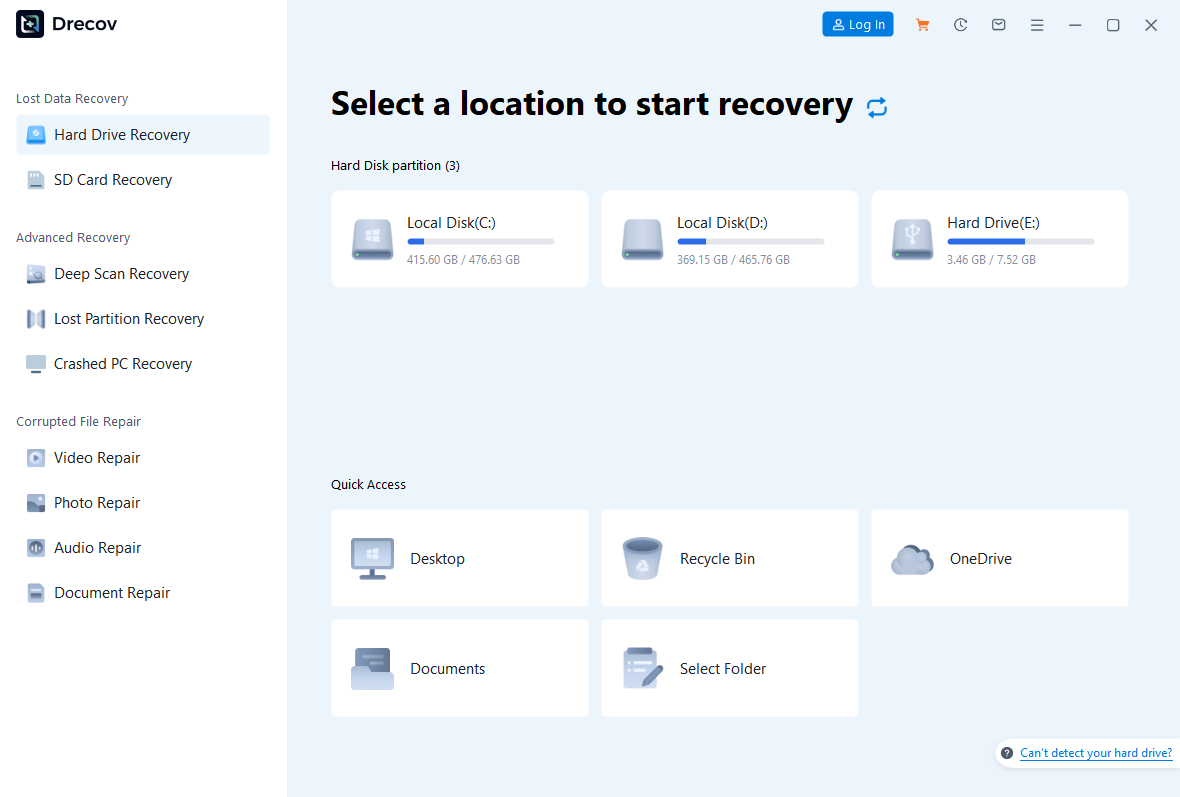
Step 1: Open Drecov and select the original app-data location
Choose the partition or device where the missing project, download, or autosave existed. Use the former path and capacity to identify it. If the partition itself vanished, select Lost Partition Recovery rather than creating or formatting a replacement partition.
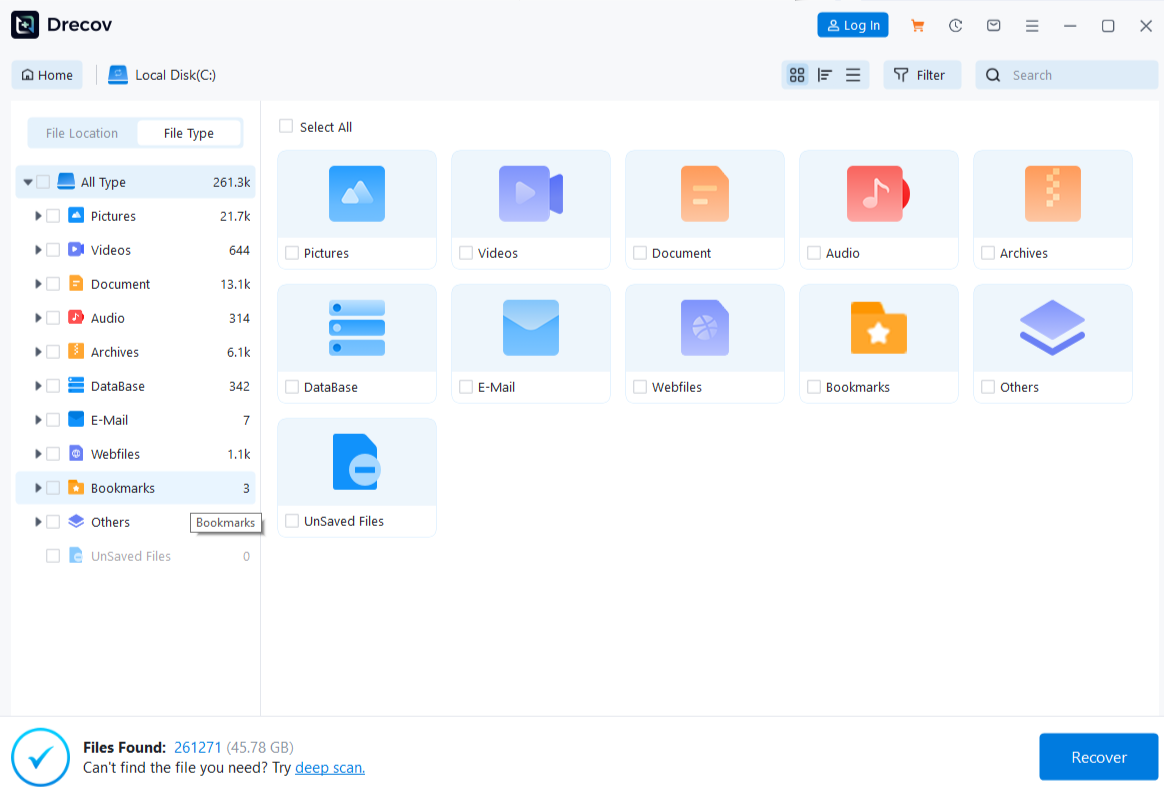
Step 2: Run Quick Scan and inspect familiar paths
Begin with Quick Scan. Filter by the relevant file type, filename, date, and former application folder. Compare modified times and sizes with what you remember. Search both the expected project path and likely autosave or download locations.
Step 3: Use Deep Scan only on stable storage
If Quick Scan misses important candidates and the source remains consistently detected, continue with Deep Scan. Stop when the device drops offline, makes unusual sounds, overheats, or produces severe read errors. Drecov cannot make failing hardware safe.
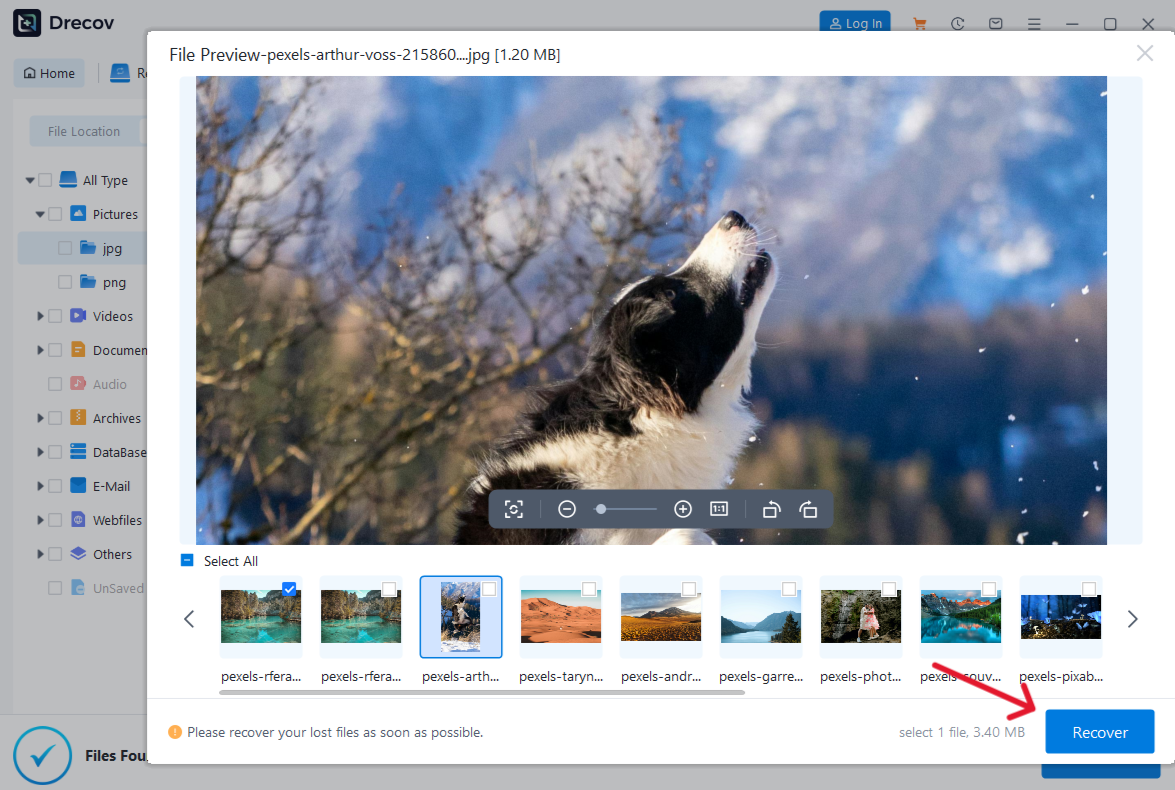
Step 4: Preview candidates, recover elsewhere, and verify
Preview representative supported files before selecting a larger set. Preview confirms that a displayed sample can be decoded; it cannot certify every page, frame, layer, linked asset, or archive member. Recover chosen items to the prepared healthy drive, never to the source. If the output is not in the expected destination, check Drecov Folder or Recovery Folder. Open a sample in its normal application and verify content, dates, duration, or page count before repairing or resetting the blank app.
⚠ Warning: Install it on a drive different from the one where your data was lost to prevent overwriting.
Verify the Fix Instead of Assuming It Worked
Repeat the exact action that produced the empty window. Open the same content, then a second known-good item. If disabling one extension solved the problem, re-enable unrelated extensions and confirm stability. If a renamed cache was responsible, keep its backup until presets and local work have been checked. When a graphics change helps, restart Windows and test more than one window before calling the issue resolved.
Useful related reading includes the Drecov, a focused explanation of Windows data recovery, and practical ways to recover deleted files.
FAQ About Blank Application Windows
Why is only one Windows 10 app showing a white window?
The app may have a damaged cache, incompatible extension, saved off-screen layout, profile-specific setting, or accelerated-rendering problem. Test another file and another Windows account before resetting it.
Will restarting Explorer fix a blank app?
It may help when shell integration or desktop composition is stuck, but it does not repair a damaged app profile or restore missing content. Save reachable work before restarting processes.
Should I choose Repair or Reset?
Use Repair first when Windows offers it. Reset is broader and may remove local state. Back up documents, presets, templates, and unsynced work before selecting it.
Can Drecov fix the white window itself?
No. Drecov recovers genuinely missing or inaccessible files from supported Windows storage. App settings, graphics drivers, and display problems require their own diagnosis.
When should I stop troubleshooting at home?
Stop direct scans and repeated restarts when storage clicks, disconnects, overheats, or reports serious read errors. Seek imaging or professional recovery if important data exists only there.
Conclusion
A Windows 10 blank window becomes easier to solve once you separate a single-file problem from an app profile or graphics-rendering failure. Use reversible tests, preserve local app data, and choose Repair before Reset when appropriate. If projects or downloads are genuinely missing, recover them with Drecov to another healthy drive and verify the results before reinstalling the app or making broader Windows changes.
⚠ Warning: Install it on a drive different from the one where your data was lost to prevent overwriting.





