







Losing an important browser tab can be incredibly frustrating—especially when you’re in the middle of research, work, or online shopping. Fortunately, if you’re using Google Chrome, there are several simple and effective ways to reopen closed tabs quickly. In this comprehensive guide, we’ll walk you through everything you need to know about the chrome reopen closed tab feature, including shortcuts, settings, and advanced recovery methods.
Why You Might Need to Reopen Closed Tabs in Chrome
Accidentally closing a tab happens more often than you think. Whether it’s due to a misclick, system crash, or browser restart, losing a tab can interrupt your workflow. Here are a few common scenarios where the chrome reopen closed tab function becomes a lifesaver:
- You accidentally click the “X” button on a tab while moving your mouse.
- Your browser crashes unexpectedly due to high RAM usage or a faulty extension.
- You close a window with multiple tabs open, thinking you had saved your work.
- You restart your computer for an update without realizing your session wasn’t saved.
Thankfully, Chrome provides multiple ways to recover closed tabs, ensuring you never lose important information permanently.
The Fastest Way: Keyboard Shortcut to Reopen Closed Tabs
The quickest method to reopen a closed tab in Chrome is by using a keyboard shortcut. This is the “gold standard” for power users who want to maintain their flow without touching the mouse.
- Windows/Linux:
Ctrl + Shift + T - Mac:
Command + Shift + T
This shortcut instantly restores the last closed tab. Even better, you can press it multiple times to reopen closed tabs in the order they were closed. If you closed a whole window, this command will even bring back the entire window along with all its previous tabs.
Why This Method Works Best
- Instant recovery: No need to navigate complex menus.
- No need to search: It brings back exactly what was lost seconds ago.
- Recursive: Works even after multiple tabs are closed sequentially.
If you remember just one method for the chrome reopen closed tab process, make it this keyboard shortcut.
How to Restore Tabs Chrome Using the Right-Click Menu
If you prefer using your mouse over keyboard shortcuts, Chrome has built an intuitive way to access your recently closed items directly from the interface. Learning how to restore tabs chrome via the tab bar is an essential skill for casual browsing.
Step-by-Step Guide for the Tab Bar Method
- Step 1: Look at the top of your Chrome window where your open tabs are listed.
- Step 2: Find an empty space on the tab bar (to the right of your last open tab).
- Step 3: Right-click on that empty space.
- Step 4: From the context menu that appears, click on “Reopen closed tab”.
This action functions identically to the keyboard shortcut but is often more comfortable for users who are already navigating with a mouse. If you have recently closed a full window, the option will change to “Reopen closed window,” allowing for a bulk recovery of your workspace.
Open Closed Tabs on Chrome via Browsing History
Sometimes, the tab you need wasn’t closed just seconds ago; perhaps it was closed an hour ago, and the shortcut method would require too many presses to reach it. In such cases, knowing how to open closed tabs on chrome through the history manager is much more efficient.
Using the History Menu
- Step 1: Click the three-dot menu (vertical ellipsis) in the top-right corner of the Chrome window.
- Step 2: Hover your cursor over the “History” option.
- Step 3: A sub-menu will appear showing “Recently Closed” tabs. You can click any individual site listed here to restore it.
- Step 4: If the tab is older, click “History” again at the top of that sub-menu (or press
Ctrl + H) to open the full history page.
Searching for Specific Tabs
Once you are in the full history view, you can use the search bar at the top to find a specific keyword or website name. This is particularly helpful when the chrome reopen closed tab shortcut fails because too much time has passed or too many other tabs have been opened and closed since the loss.
How to Open a Closed Tab in Chrome on Mobile Devices
We often forget that mobile browsing is just as prone to accidents as desktop browsing. Whether you are using an iPhone or an Android device, the process of how to open a closed tab in chrome is slightly different but equally accessible.
Steps for Android and iOS:
- Step 1: Open the Chrome app on your smartphone or tablet.
- Step 2: Tap the three-dot menu icon (located at the top right on Android and bottom right on iOS).
- Step 3: Select “Recent Tabs” from the list.
- Step 4: You will see a list of “Recently closed” tabs. Simply tap the one you wish to restore.
Furthermore, if you have Chrome sync enabled, you can see tabs that are currently open on your desktop or other devices. This cross-platform integration makes the chrome reopen closed tab feature incredibly robust for users on the go.
Advanced Data Recovery: Using PandaOffice Drecov Data Recovery Software
While the built-in Chrome features are excellent for standard accidental closures, they sometimes fail. For instance, if your hard drive crashes, if you’ve cleared your browsing history, or if your Chrome profile becomes corrupted, the standard “Recent Tabs” list will be empty. In these high-stakes scenarios, you need professional-grade assistance like PandaOffice Drecov data recovery software.
PandaOffice Drecov is a powerful tool designed to recover lost files, including the specific local database files where Chrome stores your session data and history. If you’ve lost your tabs because of a system-wide failure, follow these steps to use PandaOffice Drecov data recovery software to get your data back.
⚠ Warning: Install it on a drive different from the one where Chrome is installed (usually the D: drive if Chrome is on C:). This prevents the software from overwriting the very data you are trying to recover.
Step 1: Select the Location for Scanning
Launch the application. You will see a list of drives and specific folders. Since Chrome stores its session data in the User AppData folder, select your C: Drive.

Step 2: Run a Deep Scan
Click the “Scan” button. PandaOffice Drecov will perform a thorough analysis of the disk sectors. It looks for deleted or corrupted files like “Current Session,” “Last Session,” and “Web Data.”

Important Warning: Do not close the software or restart your computer during the scan process, as this could lead to file fragmentation and make the chrome reopen closed tab data unrecoverable.
Step 3: Filter and Preview Files
Once the scan is complete, use the search or filter function within the software to look for files named “Session” or “Tabs”. The software allows you to preview the file metadata to ensure you are recovering the most recent version.
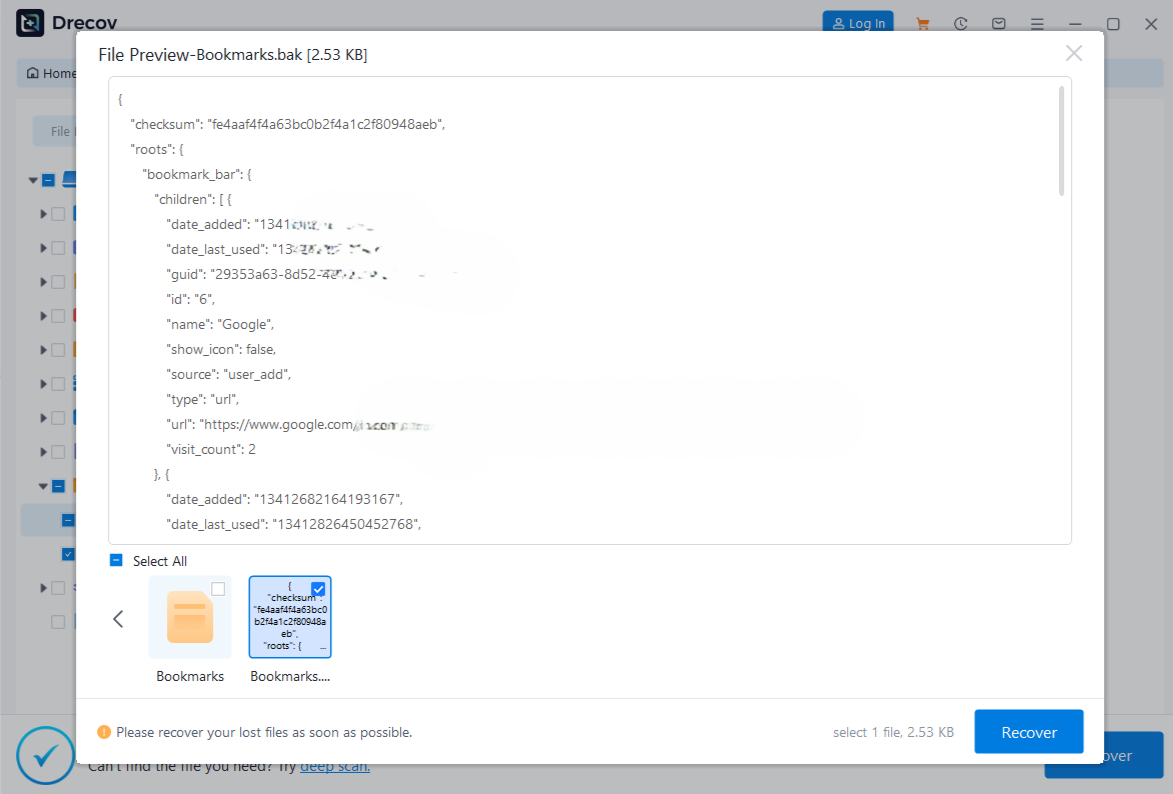
Step 4: Recover and Restore
Select the relevant files and click “Recover”. Save these files to an external drive. Once recovered, you can manually place them back into the Chrome User Data folder to restore your previous state.
Internal Resources for Data Safety
Once you have mastered the chrome reopen closed tab techniques, you might want to look into other ways to protect your digital life. Whether it is managing your software versions or recovering other types of lost data, staying informed is key.
- If you are concerned about the cost of professional tools, you might want to read about Recuva free version limitations to see how it compares to premium recovery options in 2026.
- Lost more than just browser tabs? Learn how to recover a deleted draft in Outlook to keep your communications safe.
- For those who prefer keeping local copies of online content to avoid losing them, check out our 2026 guide on downloading videos from Firefox.
Restoring Tabs After a Browser Crash
Sometimes, Chrome closes unexpectedly. When this happens, the standard chrome reopen closed tab shortcut might not work immediately because the browser didn’t close “cleanly.”
Method 1: The Restore Prompt
When you relaunch Chrome after a crash, a small bubble usually appears in the top-right corner stating, “Chrome didn’t shut down correctly.”
- Step 1: Click the “Restore” button in that pop-up.
- Step 2: Chrome will automatically reload all tabs and windows that were active at the moment of the crash.
Method 2: Force Restore via Settings
If you missed the pop-up, you can still find the session in your history. Additionally, to prevent future losses, you should enable the “Continue where you left off” setting.
- Step 1: Go to Chrome Settings.
- Step 2: Click on “On startup” in the left sidebar.
- Step 3: Select the radio button for “Continue where you left off”.
By enabling this, every time you close and open Chrome, your tabs are automatically preserved, effectively automating the chrome reopen closed tab process.
Using Extensions for Better Tab Management
For users who handle dozens of tabs simultaneously, relying solely on native features might be risky. Several Chrome extensions can enhance your ability to reopen closed tabs and manage your digital workspace more effectively.
- Session Buddy: This is perhaps the most popular tool for tab recovery. It automatically saves your open tabs and allows you to restore them even after a total system failure.
- OneTab: If your browser is slowing down, OneTab collapses all your tabs into a single list. If you accidentally close the OneTab page, you can still find it in your history.
- Tabli: This extension provides a searchable list of all open tabs across all windows, making it easier to find and reopen closed tabs that might have been lost in the clutter.
You can find these tools on the Chrome Web Store. Using an extension provides a secondary layer of protection that goes beyond the basic chrome reopen closed tab command.
Advanced Technical Method: Recovering Tabs from Local Session Files
If you are technically inclined and the standard chrome reopen closed tab methods aren’t working, you can attempt to manually recover tabs from the local storage files on your computer. Chrome keeps two main files for this: Current Session and Last Session.
Operational Steps:
- Step 1: Close Chrome completely. Ensure no background processes are running in the Task Manager.
- Step 2: Navigate to the following path on Windows:
%LOCALAPPDATA%\Google\Chrome\User Data\Default(Note: If you use multiple profiles, “Default” might be “Profile 1”). - Step 3: Find the files named “Current Session” and “Current Tabs”.
- Step 4: If you have a backup or a version recovered by PandaOffice Drecov, rename the “Last Session” file to “Current Session” and “Last Tabs” to “Current Tabs”.
- Step 5: Relaunch Chrome. The browser will treat the “Last Session” as the current one and attempt to reopen closed tabs automatically.
Common Pitfalls: When Reopening Tabs Fails
Despite the many ways to reopen a closed tab in chrome, there are situations where recovery is impossible through standard means:
- Incognito Mode: Chrome does not save browsing history or session data for Incognito tabs. Once an Incognito window is closed, those tabs are gone forever. No amount of clicking chrome reopen closed tab will bring them back.
- Clearing Browsing Data: If you manually clear your “Browsing history” and “Cached images and files,” you also wipe the record that Chrome uses to restore tabs.
- Overwritten Sessions: Chrome typically only saves the “last” session. If you close a window, open a new one, and then close that one too, the data for the first window might be overwritten.
In these instances, your only hope lies in specialized recovery software like PandaOffice Drecov, which can sometimes find the “deleted” fragments of these session files on your hard drive before they are physically overwritten by new data.
Comparing Recovery Methods
| Method | Speed | Difficulty | Best For |
| Ctrl + Shift + T | Instant | Very Easy | Immediate accidental closure |
| History Menu | Fast | Easy | Tabs closed earlier in the day |
| On Startup Setting | Automatic | Easy | General browser restarts |
| PandaOffice Drecov | Moderate | Intermediate | System crashes & deleted files |
| Manual File Edit | Slow | Advanced | Corrupted browser profiles |
Frequently Asked Questions
Can I reopen a tab after I’ve closed the entire Chrome browser?
Yes. When you reopen Chrome, you can either use the Ctrl + Shift + T shortcut or look under the History menu’s “Recently Closed” section. If you have “Continue where you left off” enabled, they will open automatically.
How many tabs can Chrome remember?
Chrome generally keeps a history of the last 25–50 closed tabs in its “Recently Closed” cache, but your full history (Ctrl + H) can keep track of thousands of pages for up to 90 days.
Is there a way to reopen a tab I closed yesterday?
The shortcut Ctrl + Shift + T usually only works for the current session. To reopen closed tabs from a previous day, you must use the History page (Ctrl + H) and search by date.
What if my tabs disappeared after a Windows update?
Windows updates often force a restart which can clear temporary session data. In this case, checking the “Recently Closed” section under History is your best bet, or using PandaOffice Drecov to find the session files from before the update.
Conclusion
The ability to reopen closed tabs is an essential skill in the modern digital age. Whether you use the lightning-fast Ctrl + Shift + T shortcut, navigate through the history menu, or utilize the advanced recovery capabilities of PandaOffice Drecov data recovery software, you no longer have to fear the accidental click of an “X” button.
By understanding the underlying mechanics of how Chrome stores your session data, you can browse with confidence. Remember to enable “Continue where you left off” in your settings, keep a recovery tool like PandaOffice Drecov handy for emergencies, and always bookmark your most critical pages. With these tools in your arsenal, your research and work are safer than ever before.






