







USB port Code 43 means a driver told Windows that the connected device failed in some way. The message does not prove the physical port is defective. Test the same device with a known-good cable, another port, and another computer before reinstalling drivers. If the affected device is storage and it disconnects, freezes, clicks, or reports the wrong capacity, protect data before further resets or scans.
Separate the USB Device From the Host Port
Microsoft’s Device Manager error-code reference states that Code 43 is reported when a controlling driver notifies Windows of a device failure. That failure can originate in the device, cable, hub, power path, firmware, driver, or host controller. Cross-testing one variable at a time is faster than reinstalling everything.
| What you observe | What it suggests | Safest next move |
|---|---|---|
| One device fails on every PC | Device, cable, or device firmware | Protect data and use vendor diagnostics |
| Several devices fail on one port | Port or controller path | Use another direct port and inspect hardware |
| Works without the hub | Hub power or compatibility | Replace or externally power the hub |
| Storage appears with wrong capacity | Bridge or media instability | Stop resets and do not initialize |
| Code returns after driver reinstall | Hardware or firmware remains suspect | Check vendor support and cross-test |
| Device works after cold shutdown | Controller or power state was stuck | Monitor for recurrence before trusting storage |
Use Device Identity to Separate Host and Peripheral Faults
For usb port code 43, use the matching observation, make one reversible change, and then retest the original symptom.
If You See: One device fails on every PC
Device, cable, or device firmware becomes the leading explanation, but the observation does not justify a destructive change by itself. Protect data and use vendor diagnostics.
When the Result Is: Several devices fail on one port
This result shifts attention toward port or controller path. Use the narrow response: use another direct port and inspect hardware.
What Works without the hub Changes
The practical implication is hub power or compatibility. The next action should therefore be limited to this branch: replace or externally power the hub.
Do Not Misread: Storage appears with wrong capacity
It can indicate bridge or media instability, yet it does not prove every other component is healthy. Start with stop resets and do not initialize.
The Safe Branch for Code returns after driver reinstall
Here, hardware or firmware remains suspect deserves priority over broad system repair. Check vendor support and cross-test.
Escalation Point: Device works after cold shutdown
Treat this as a sign of controller or power state was stuck. Beg
Protect Files Before Repeated USB Resets
For a flash drive, external SSD, hard drive, phone storage, or card reader, copy important readable files before uninstalling devices or repeating power cycles. The USB drive detection article covers the storage-specific checks. Do not format or initialize a previously used device to clear Code 43; those actions write storage metadata without solving a power, cable, or electronics fault.
Troubleshoot Code 43 From Outside In
Remove Hubs and Replace the Cable
Connect directly to a known-good USB port. Use the original or correctly rated cable, especially for high-power drives and phones. A charge-only or damaged cable can produce confusing enumeration failures.
Perform a True Cold Power Reset
Shut Windows down, disconnect power where appropriate, remove the USB device, wait briefly, and restart before reconnecting. This clears some controller states without touching stored data.
Reinstall Only the Reported Device
In Device Manager, uninstall the affected device, then scan for hardware changes as Microsoft documents. Do not remove unrelated controllers in bulk, and obtain any required driver from the hardware maker.
Check Firmware and Power Requirements
Use vendor diagnostics and documented firmware only after backups. High-draw external drives may need their supplied adapter or a powered hub. Do not update firmware through an unstable connection.
Treat Storage Instability as a Recovery Case
If the device stays detected with correct capacity, recover data before format or repair. If it repeatedly disconnects or produces severe read errors, use controlled imaging or a professional service.
Recover Data When Code 43 Affects Stable USB Storage
After the Code 43 connection problem is isolated, PandaOffice Drecov can help if a USB storage device is consistently recognized but its files are missing or inaccessible. Drecov cannot clear Code 43, repair a USB controller, or restore damaged electronics. Recovery should begin only through a known-good port, cable, and power path.
⚠ Warning: Install it on a drive different from the one where your data was lost to prevent overwriting.
Step 1: Select the Storage Device Only After It Is Stable
Open Drecov on Windows and select the affected USB drive or a stable image of it. Confirm the model and capacity before scanning. If the device returns to an unknown state, resets repeatedly, heats up, or freezes the computer, disconnect it and stop software attempts.

Step 2: Scan According to What Disappeared
Quick Scan is the first choice for a recent deletion or a volume that has just lost normal access. Deep Scan is appropriate when the expected folders do not appear, partition records are missing, or logical damage prevents normal browsing. Do not use a longer scan to test unstable hardware.
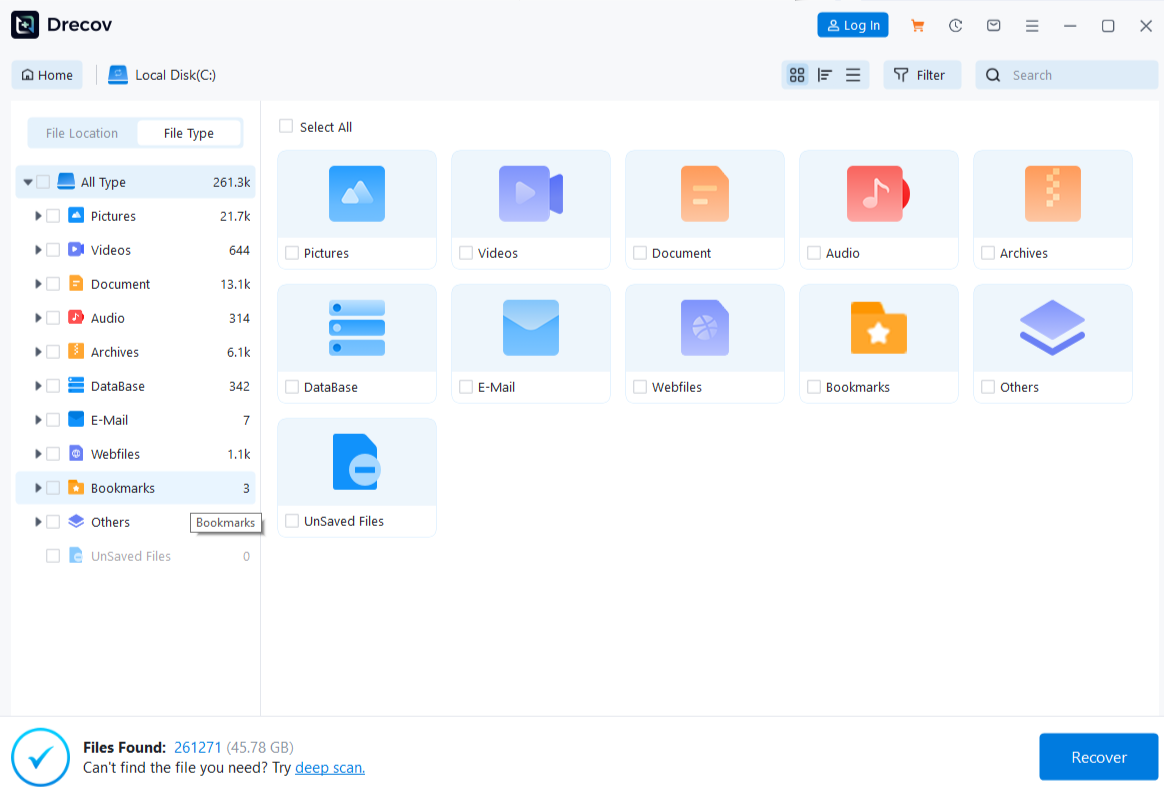
Step 3: Inspect Files and Recover Through a Healthy Path
Filter the results by type, date, name, or former path and preview representative files. Save them to a different healthy disk, not to the USB source. Review the Drecov folder or Recovery folder if the former directory tree cannot be reconstructed, then reconnect once to verify that the hardware fix remains stable.

Confirm the Fix Across Ports and Restarts
Reconnect the device after a full restart, transfer a nonessential test file, safely eject it, and repeat the test on another known-good port. Open recovered files from the separate destination. The USB freezing article helps when Code 43 is accompanied by stalls, while the healthy-destination article explains why recovery output must not return to the suspect USB device.
- Calling Code 43 a port failure without testing the device elsewhere
- Using a charge-only or damaged cable for data
- Uninstalling every USB controller before protecting files
- Formatting storage to clear a Device Manager message
- Scanning a device that cannot remain connected
Device Manager’s location path and hardware IDs are useful clues. If the same peripheral reports Code 43 on two known-good computers, suspicion follows the device or its cable. If several known-good peripherals fail only on one physical port, inspect that host port and controller branch. A device that works through USB 2.0 but fails through a SuperSpeed connection may expose a cable, connector, hub, power, or high-speed signal problem rather than a missing file-system driver.
For storage, also check whether Windows identifies the correct model and capacity. “Unknown USB Device” is an enumeration failure; a correctly identified disk with an inaccessible volume is a later storage-layer problem. Do not repeatedly uninstall controllers while a drive is transferring data, and do not format a volume merely because Explorer cannot open it. After one change, cold-restart if appropriate, reconnect through a direct port, and confirm the device survives safe removal and a second connection before trusting the result.
USB Code 43 Questions
Does Code 43 mean my USB port is broken?
Not necessarily. The connected device or its driver reported a failure. Cross-test the device, cable, port, and computer.
Should I uninstall the USB driver?
Reinstall the specifically affected device after basic connection tests. Use manufacturer drivers when Windows requests one.
Can insufficient power cause Code 43?
Yes. A weak hub, wrong cable, or missing external power can prevent reliable enumeration, especially for storage devices.
Can Drecov fix Code 43?
No. It can recover files only when supported USB storage is stable and recognized. It does not repair ports, cables, or electronics.
When should I stop troubleshooting?
Stop when the device overheats, smells burned, disconnects repeatedly, reports severe errors, or cannot retain correct identity and capacity.
Confirm That Enumeration Remains Stable
Once Code 43 disappears, check more than the Device Manager icon. Safely remove the device, restart Windows, and reconnect through the same known-good path. Confirm that its hardware identity, model, capacity, and assigned volume remain consistent. For storage, open several noncritical files and perform a small copy to a separate destination. Do not begin a long write test on the only copy of valuable data. If the device alternates between a proper name and Unknown USB Device, or if the code returns after movement of the cable, treat the connection as unresolved and stop direct recovery attempts.
Keep the working cable and port combination documented until important files have been copied and verified from separate storage. Retest once after a normal restart before trusting it again.
Conclusion
USB port Code 43 troubleshooting should establish whether the failure follows the peripheral, cable, hub, port, or host controller. Do not scan storage until Windows identifies it consistently through a safe connection. If files remain unavailable after stability returns, Drecov can recover them to another healthy drive. Persistent enumeration failure, heat, resets, or electrical damage remains a hardware problem outside recovery software.






