







Getting Familiar with Disk Partition Structures
What Is MBR and How Does It Work?
When setting up a hard drive or SSD, one of the first decisions involves selecting a partition style. Many users encounter terms such as mbr vs guid, master boot record or guid, and guid or mbr during Windows installation or disk initialization. Understanding these concepts is essential because the partition style affects storage capacity, boot compatibility, and system performance.
MBR, short for Master Boot Record, is one of the oldest partitioning standards still in use today. It was introduced in the early 1980s and became the default partition structure for PCs for decades.
The MBR structure stores partition information and boot code within the first sector of the drive. During system startup, the BIOS reads this information and begins the operating system boot process.
Key characteristics of MBR include:
- Supports disks up to 2TB
- Allows a maximum of four primary partitions
- Compatible with older BIOS systems
- Widely supported across legacy hardware
Although MBR remains functional, its limitations become more noticeable as storage capacities continue to grow. Modern computers often rely on newer partition technologies capable of supporting larger drives and additional partitions.
Understanding how MBR works provides a useful foundation for evaluating whether it remains suitable for your storage environment.
What Is a GUID Partition Table?
A GUID Partition Table (GPT) is the modern replacement for the older Master Boot Record structure. When comparing guid partition table vs mbr, GPT offers several significant improvements designed to support current hardware and operating systems.
GUID stands for Globally Unique Identifier. Instead of relying on the older MBR partition map, GPT uses unique identifiers to manage partition information across the disk.
Many users searching for gpt guid partition table information are attempting to understand why modern operating systems increasingly recommend GPT over MBR.
GPT offers several advantages:
- Supports disks larger than 2TB
- Allows many more partitions
- Includes redundant partition tables
- Provides improved data integrity checks
- Works with UEFI firmware
Unlike MBR, GPT stores partition information in multiple locations on the drive. This redundancy improves reliability because damaged partition tables can sometimes be reconstructed from backup copies.
Modern versions of Windows, macOS, and Linux all support GPT. In fact, many current computers are configured to use GPT by default due to its scalability and improved reliability.
As storage technology evolves, GPT continues to serve as the preferred partitioning method for most new systems.
What Is GUID Partition Map and Why Is It Important?
Many users ask what is guid partition map when managing disks on macOS or working with modern storage devices.
A GUID Partition Map is Apple’s terminology for GPT-based partitioning. While the name differs slightly, the underlying concept remains largely the same. Both structures use globally unique identifiers to organize and manage partitions on a storage device.
The GUID Partition Map plays several important roles:
- Organizes partition information
- Supports large-capacity drives
- Enables modern boot environments
- Improves partition reliability
- Supports advanced recovery features
On Apple systems, GUID Partition Map is often required for installing macOS on internal drives. External drives may also use this partition structure to maximize compatibility and functionality.
Unlike older partition systems, GUID-based structures are designed with modern storage capacities in mind. As hard drives and SSDs continue increasing in size, GPT-based technologies provide the flexibility required for future expansion.
For users managing large storage arrays or modern operating systems, understanding GUID Partition Maps helps simplify disk configuration decisions.
Comparing MBR and GUID Partition Technologies
GUID vs MBR: Core Differences Explained
The discussion surrounding guid vs mbr often centers on functionality, compatibility, and future-proofing. While both partition styles serve the same fundamental purpose, they approach storage management differently.
MBR uses a traditional partition table located at the beginning of the drive. GPT uses multiple partition tables and incorporates redundancy for additional protection.
Key differences include:
| Feature | MBR | GPT |
|---|---|---|
| Maximum Disk Size | 2TB | More than 2TB |
| Primary Partitions | 4 | Typically 128+ |
| Boot System | BIOS | UEFI |
| Redundant Tables | No | Yes |
| Error Detection | Limited | Enhanced |
The comparison of master boot record vs guid often favors GPT for modern systems because it removes many limitations associated with older hardware standards.
However, MBR still remains useful for specific compatibility scenarios, particularly when older operating systems or legacy BIOS firmware are involved.
Choosing between the two requires understanding both the hardware and software requirements of the target system.
Storage Limits and Partition Capabilities
Storage capacity remains one of the most important factors when comparing mbr vs guid partition configurations.
MBR can only address approximately 2TB of disk space. Any capacity beyond this limit becomes unusable without alternative partitioning methods.
As storage devices continue growing in size, this restriction becomes increasingly problematic.
GPT solves this issue by supporting vastly larger capacities. While practical limits depend on operating systems and hardware implementations, GPT can theoretically support extremely large storage devices.
Additional partition flexibility is another advantage.
MBR supports:
- Four primary partitions
- Three primary partitions plus one extended partition
GPT typically supports over one hundred partitions without requiring extended partition structures.
This simplifies storage management and allows users to create multiple partitions for operating systems, applications, backups, and recovery environments.
For users managing large drives or complex storage configurations, GPT generally provides a more flexible solution.
⚠️ Warning: Initializing a disk with the wrong partition style during setup may require repartitioning later, which can result in data loss if backups are not available.
Boot Compatibility and System Requirements
Boot compatibility represents another critical difference between partition styles.
When evaluating master boot record or guid partition table, users must consider firmware support.
MBR is designed for BIOS-based systems. Older computers rely on BIOS firmware to load boot information from the Master Boot Record.
GPT is designed primarily for UEFI systems. UEFI provides numerous improvements, including:
- Faster startup times
- Improved security
- Larger disk support
- Enhanced hardware compatibility
Windows 11, for example, requires UEFI and generally expects GPT partitioning for system drives.
Many modern motherboards support both BIOS compatibility mode and UEFI mode. This flexibility allows users to operate either partition style depending on configuration requirements.
However, mixing firmware modes and partition styles can cause installation or boot problems.
Understanding the relationship between firmware and partitioning helps avoid compatibility issues during operating system deployment.
Choosing Between MBR and GUID for Your Drive
Method 1: Check Whether a Disk Uses MBR or GUID
Before converting a drive, users should determine its current partition style.
Test Environment
- Windows 11 Pro 24H2
- 1TB NVMe SSD
- Secondary 4TB HDD
- Disk Management utility
Steps to Check Partition Style
- Press Windows + X.
- Select Disk Management.
- Locate the target disk.
- Right-click the disk label.
- Choose Properties.
- Open the Volumes tab.
- Review the Partition Style field.
The result will display either:
- Master Boot Record (MBR)
- GUID Partition Table (GPT)
This method provides a quick way to verify disk configuration before making changes.
Users planning upgrades or operating system installations should always confirm partition styles beforehand.
Method 2: Convert MBR to GUID Using Windows Tools
Many users upgrade storage devices and later discover that GPT offers advantages for larger drives and UEFI systems.
Test Environment
- Windows 11 Pro
- 4TB HDD
- UEFI-enabled motherboard
- Backup completed
Steps to Convert MBR to GPT
- Open Command Prompt as Administrator.
- Launch DiskPart.
- Select the target disk.
- Clean the disk if necessary.
- Convert the disk to GPT.
- Create new partitions.
- Restore data from backup.
Windows also provides MBR2GPT for certain supported conversion scenarios.
⚠️ Warning: Always back up important data before converting partition styles, as some conversion methods erase existing partitions.
Part 2
Choosing Between MBR and GUID for Your Drive (Continued)
Method 3: Convert GUID to MBR for Legacy Systems
Although GPT has become the preferred partition style for modern computers, some situations still require MBR. Older operating systems, legacy BIOS firmware, and certain specialized hardware platforms may not fully support GPT-based disks.
When deciding between mbr or guid, compatibility requirements often determine the best option.
Test Environment
- Windows 10 Pro
- 500GB SATA HDD
- Legacy BIOS motherboard
- External backup drive
Steps to Convert GPT to MBR
- Back up all important files.
- Open Disk Management.
- Delete existing partitions on the target disk.
- Right-click the disk label.
- Select Convert to MBR Disk.
- Create new partitions.
- Restore backed-up files.
Alternatively, DiskPart can perform the conversion through Command Prompt.
Typical DiskPart workflow:
- Launch Command Prompt as Administrator.
- Type:
diskpart - List available disks:
list disk - Select the desired disk:
select disk X - Remove existing partitions:
clean - Convert to MBR:
convert mbr
Once completed, the drive can be used with legacy BIOS-based systems.
Many users researching master boot record or guid are often dealing with older hardware where GPT boot support is unavailable. In such cases, MBR remains the practical solution despite its capacity limitations.
Method 4: Recover Data Before Partition Conversion with PandaOffice Drecov
Partition conversion can occasionally lead to unexpected issues, especially if the process is interrupted by power loss, software conflicts, or user error. Before changing partition structures, it is wise to recover or back up valuable files.
Test Environment
- Windows 11 Pro
- 2TB SSD
- GPT partition structure
- PandaOffice Drecov latest version
Steps to Protect Data Before Conversion
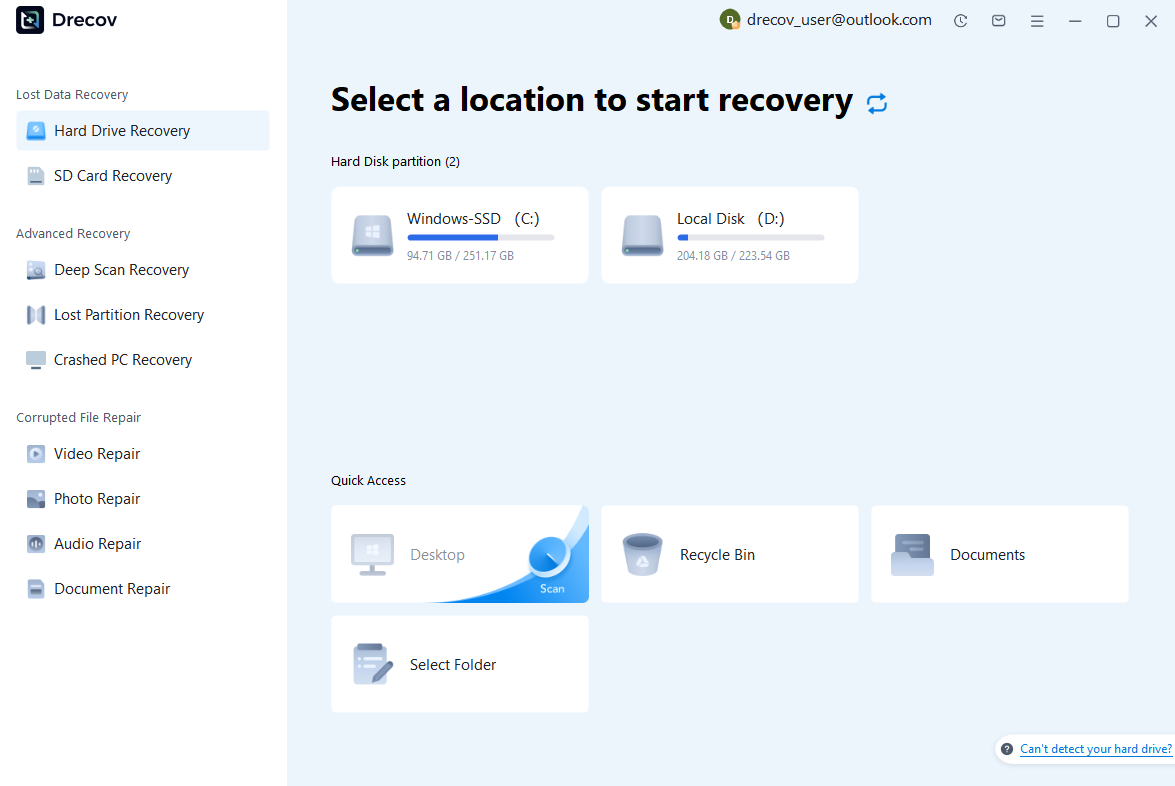
Step 1: Scan the Storage Device (SD Card / Hard Drive / USB)
Connect your device (SD card, HDD/SSD, or USB drive) to your computer and launch PandaOffice Drecov. Select the target device and start the scan. The software will perform a quick scan and deep scan to detect lost or deleted data.
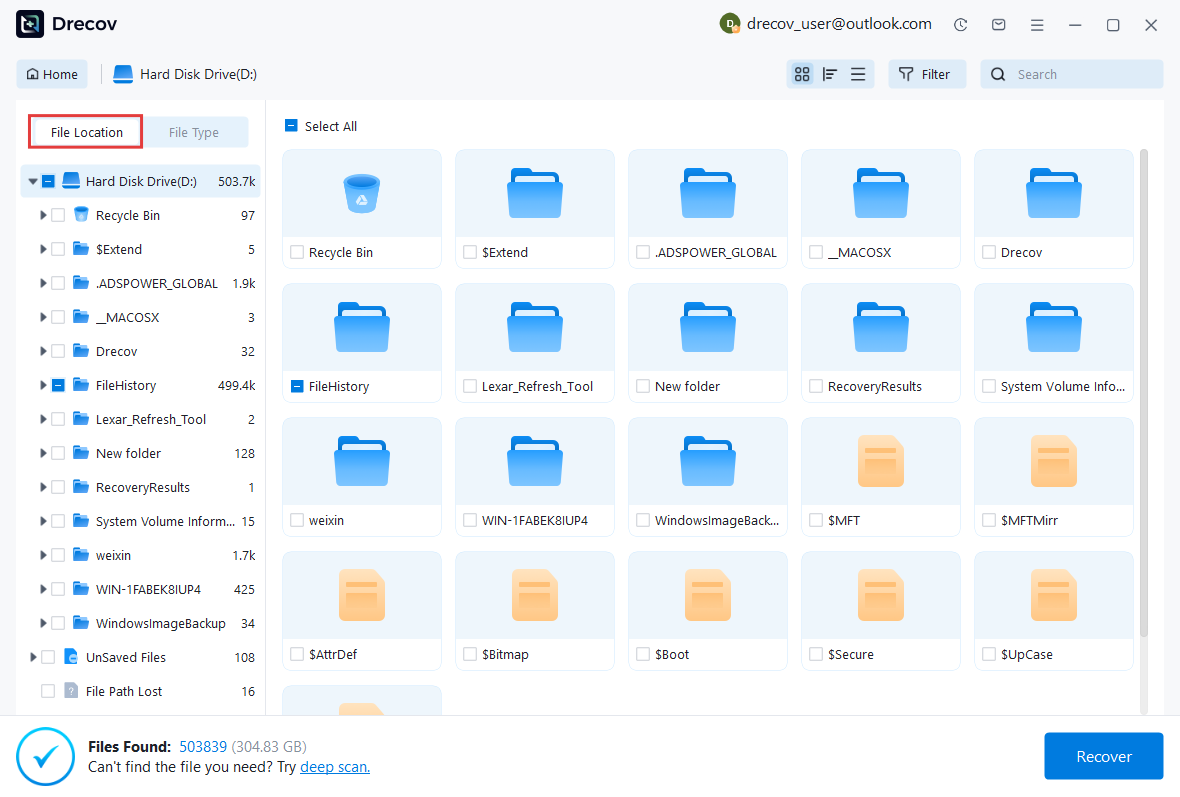
Step 2: Locate and Preview Lost Files
After scanning, browse the detected files and use the preview feature to check recoverable data. You can preview documents (Word, Excel, PDF), photos, and videos to ensure file integrity before recovery.
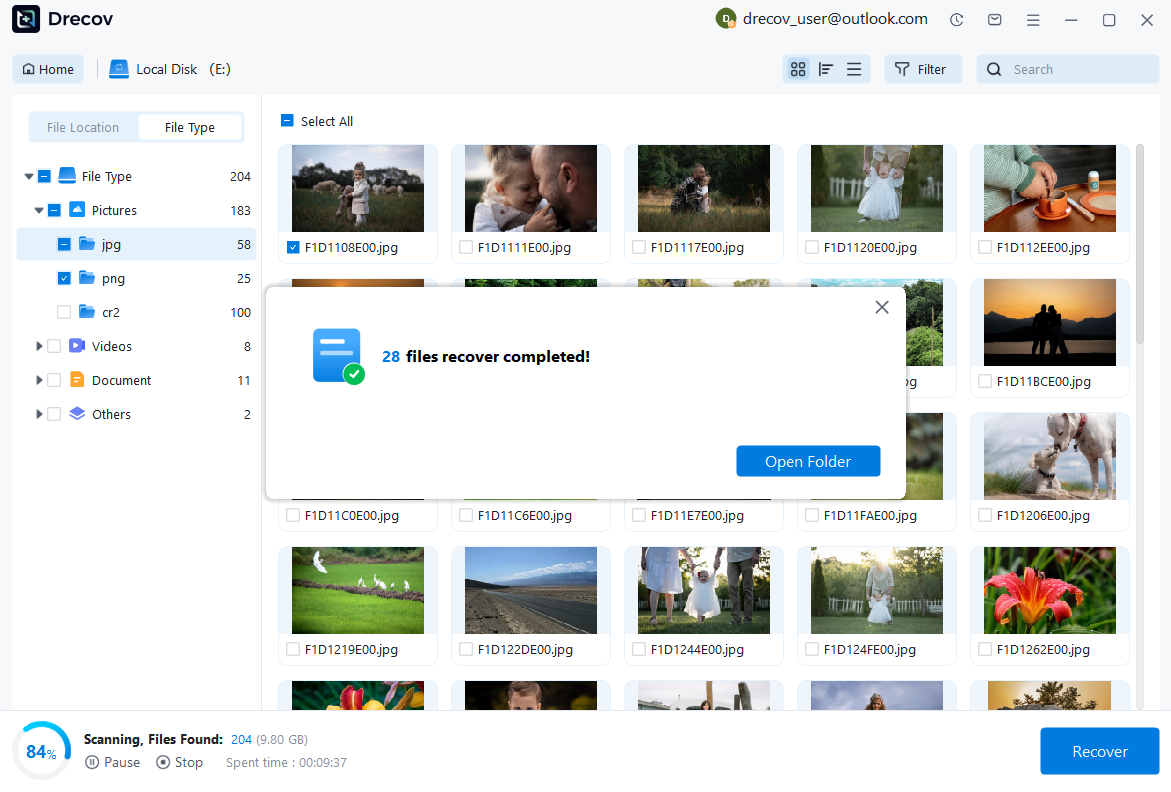
Step 3: Recover and Save to a New Location
Select the files you want to restore and click recover. Save all recovered data to a different drive or location (not the original device) to avoid overwriting lost data.
Why Choose PandaOffice Drecov Recovery Software?
PandaOffice Drecov offers a fast, secure, and user-friendly solution for recovering lost files across multiple scenarios. Whether you need email recovery, ZIP File Recovery, format data recovery, or help to recover deleted drafts Outlook, the software provides reliable recovery performance for both personal and business users.
PandaOffice Drecov supports recovery from formatted hard drives, SSDs, USB drives, SD cards, and external storage devices. Its advanced scanning engine can locate deleted archives, damaged ZIP files, lost Outlook drafts, and accidentally removed documents with high accuracy. For users searching for how to find deleted messages in Teams, PandaOffice Drecov can also help recover exported chat files, attachments, and related local cache data when available.
Key advantages include:
- Deep scan technology for complex data loss situations
- Support for emails, archives, videos, photos, and office documents
- Recovery from accidental deletion, formatting, corruption, and system crashes
- Easy preview before restoring files
- Compatible with Windows and multiple storage devices
Unlike complicated enterprise recovery tools, PandaOffice Drecov keeps the recovery process simple. Users can scan, preview, and restore files in just a few steps without technical expertise.
Whether you are dealing with lost Outlook drafts, corrupted ZIP archives, formatted drives, or missing communication data, PandaOffice Drecov provides an efficient and practical recovery experience designed to minimize downtime and protect important files.
Disk imaging ensures that even partially corrupted drives can be preserved. This is often the safest approach before attempting any aggressive repair operations for fix bad sectors on hard drive situations.
This precaution is especially useful when dealing with older drives or disks that already contain file system inconsistencies.
Users often focus on the technical aspects of guid partition table vs mbr conversion but overlook data protection. Recovering important files beforehand significantly reduces risk.
Whether converting from GPT to MBR or from MBR to GPT, maintaining a verified backup remains one of the safest practices.
⚠️ Warning: Never perform partition conversion during unstable power conditions. Unexpected interruptions can damage partition tables and result in data loss.
Practical Scenarios for MBR and GUID Usage
When MBR Remains a Good Choice
Despite the growing popularity of GPT, MBR still has practical uses.
When discussing master boot record or guid partition table, many users assume GPT is always better. In reality, MBR remains useful in several scenarios.
MBR may be appropriate when:
- Using older BIOS firmware
- Running legacy operating systems
- Working with disks under 2TB
- Supporting older hardware environments
- Maintaining compatibility with specialized equipment
Many industrial systems and older business computers continue operating successfully with MBR.
In these situations, converting to GPT may offer limited benefits while introducing compatibility challenges.
Additionally, some recovery environments and maintenance utilities developed years ago may function more reliably with traditional MBR disks.
While MBR is no longer considered the future of partitioning technology, it continues serving specific use cases effectively.
When GUID Partition Tables Are Recommended
Most modern systems benefit from GPT-based partitioning.
Users evaluating guid or mbr for new storage devices will generally find GPT to be the preferred option.
GPT is recommended for:
- Windows 11 installations
- UEFI-based systems
- Large-capacity hard drives
- Modern SSD deployments
- Multi-partition environments
- Enterprise storage solutions
The ability to support large storage capacities is one of GPT’s strongest advantages.
Additional benefits include:
- Multiple partition support
- Backup partition tables
- Improved reliability
- Better scalability
- Enhanced boot functionality
Because GPT eliminates many MBR limitations, it has become the standard partition style for contemporary computing environments.
For most new computers purchased within the last several years, GPT provides the best balance of compatibility and functionality.
How Modern Systems Benefit from GPT Architecture
The comparison of master boot record vs guid becomes particularly clear when examining modern hardware.
UEFI firmware works closely with GPT to deliver improvements that were difficult or impossible under traditional BIOS systems.
Benefits include:
- Faster boot times
- Enhanced security features
- Support for Secure Boot
- Better support for large drives
- Improved partition management
The redundancy built into GPT also contributes to reliability. Because partition information is stored in multiple locations, recovery options may remain available even if one partition table becomes damaged.
Many users searching for gpt guid partition table information are preparing to install Windows 11 or upgrade storage devices. In these situations, GPT is typically the recommended choice.
The modern computing ecosystem increasingly assumes GPT usage, making it a future-oriented solution for new hardware deployments.
⚠️ Warning: Installing an operating system in the wrong firmware mode can create boot failures even when the partition structure is otherwise correct.
Frequently Asked Questions About MBR and GUID
Should I Choose MBR or GUID for a New SSD?
For most new SSD installations, GPT is recommended.
Modern motherboards support UEFI firmware, and current operating systems are optimized for GPT environments.
Users debating mbr vs guid for a new SSD generally benefit from GPT because it provides:
- Better scalability
- More partitions
- Improved reliability
- Full compatibility with Windows 11
MBR should primarily be considered when compatibility with older hardware is required.
Can I Convert Between Partition Styles Without Losing Data?
Some conversion tools allow non-destructive conversion under certain circumstances.
For example, Microsoft provides MBR2GPT for supported Windows systems.
However, not every scenario supports in-place conversion.
To minimize risk:
- Create backups first.
- Verify drive health.
- Confirm firmware compatibility.
- Test recovery options before proceeding.
Data protection should always take priority over convenience.
What Is the Difference Between Master Boot Record and GUID?
The discussion surrounding master boot record vs guid focuses on architecture and capabilities.
MBR:
- Older partition standard
- 2TB storage limit
- Four primary partitions
- BIOS-based booting
GUID/GPT:
- Modern partition structure
- Large-capacity support
- Many partitions
- UEFI compatibility
- Redundant partition tables
These differences explain why GPT has become the default choice for modern systems.
Is GUID Required for Windows 11?
In most cases, yes.
Windows 11 requires UEFI firmware and Secure Boot support. Because UEFI systems are designed to work with GPT, Windows 11 installations typically use GPT-partitioned system drives.
Users researching mbr master boot record oder gpt guid partition table before upgrading to Windows 11 should verify both firmware settings and partition style compatibility.
Converting to GPT may be necessary before installation if the system drive currently uses MBR.
Final Thoughts on MBR vs GUID Partition Styles
Key Advantages of Each Partition Format
The comparison between guid partition table vs mbr reveals that both partition styles continue serving useful purposes.
MBR advantages:
- Legacy compatibility
- Simple structure
- Support for older operating systems
- Broad historical adoption
GPT advantages:
- Large storage capacity support
- More partitions
- Improved reliability
- UEFI compatibility
- Better scalability
Neither partition style is universally superior in every environment. The correct choice depends on hardware requirements, operating system compatibility, and future upgrade plans.
Selecting the Best Option for Your Storage Needs
When deciding between guid vs mbr, consider the following questions:
- Is the computer using UEFI or BIOS?
- Does the drive exceed 2TB?
- Will Windows 11 be installed?
- Are legacy systems involved?
- Is long-term scalability important?
For most modern users, GPT provides the greatest flexibility and future compatibility.
However, MBR continues to play an important role in legacy environments where older hardware and software requirements remain in place.
By understanding the differences between mbr vs guid partition, users can make informed storage decisions that maximize performance, compatibility, and reliability while reducing the risk of future migration challenges.






