







Today’s small businesses are run on software. From Google Workspace to Slack, Notion to Stripe, SaaS tools have allowed us to run, scale, and collaborate without a large IT department.
But there is a hidden cost to this convenience: complexity.
Every new subscription we add a function. And risk.
For most small businesses, SaaS security doesn’t become a priority until after a breach has occurred. By then, sensitive client data has already been exfiltrated through a missed permission or unused account. According to CISA, misconfiguration and over-privileged accounts are among the most frequent causes of cloud data exposure for small business operations.
This article covers the overlooked risks of SaaS sprawl and provides a practical framework to secure your business through 2026.
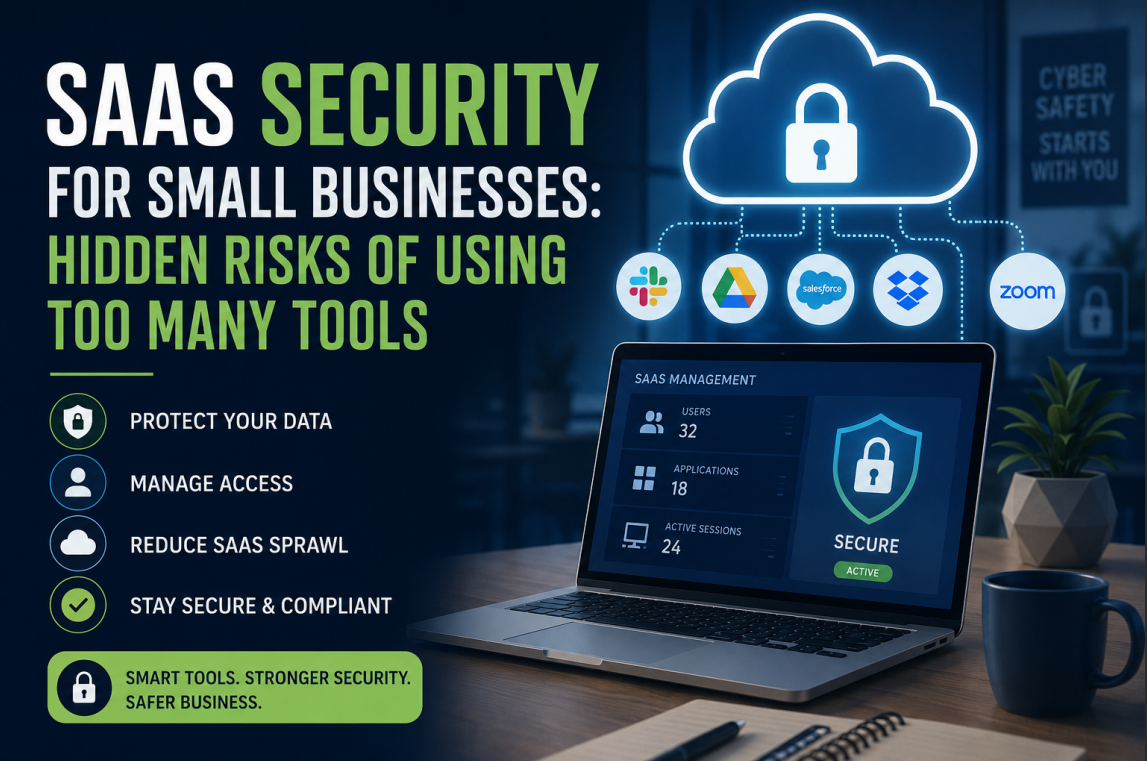
Why SaaS Adoption Creates New Security Gaps
The average small business now relies on 8-15 different SaaS applications. While each tool ostensibly provides a point of increased functionality, cumulatively these applications create 4 critical vulnerabilities.
1. Permission Sprawl Across Platforms
Many SaaS applications ask for extensive permissions during their initial setup. “Connect to your Google Drive.” “Read your calendar contacts.” “Access your customer database.”
While each individual permission may seem innocuous, collectively they mean that the compromise of a single SaaS application could grant attackers access to your email, files, and customer data. NIST recommends using the principle of least privilege across all of your cloud services, and most businesses are simply unable to understand this without centralized control. This is especially common in situations where the business chooses functionality over security. If selecting a new piece of software, one should start with platforms built for secure teamwork: read our guide to the Best Secure Collaboration Tools for Freelancers Without an IT Team (2026) for vetted options that are user friendly and secure.
Businesses should also consider having a reliable data recovery solution in place. PandaOffice Drecov can help recover lost or deleted files when unexpected data loss occurs.
2. Orphaned Accounts and Poor Offboarding
When someone leaves an organization, the business will typically deactivate their company email. However what remains unaddressed are their numerous SaaS application credentials for tools like Slack, CRM, task management software and design applications. Inactive accounts persist as a risk across all SaaS platforms and open your business to continued exposure.
The FTC states that unmanaged accounts are one of the leading risk factors that lead to small business data breaches.
During our SaaS security audits, an average of 30% of user accounts were associated with former employees or contractors.
3. The Weakest Link Effect
Your organization may enforce 2FA on Google Workspace and Microsoft 365, but attackers don’t exploit your most secure defenses. They attempt to penetrate your least secure application. One weak password or lack of 2FA on one SaaS application and their access continues unimpeded through it. CISA warns that attackers consistently look for the weakest connection point.
4. Uncontrolled data replication
SaaS integrations work best when information is shared easily and seamlessly, such as a file stored in Google Drive being available in Notion and triggered in Slack when completed or backed up to another third-party storage service. The side-effect of this seamless sharing is duplicated copies of business-critical data stored in numerous locations under numerous sets of privacy controls. This creates problems for compliance and for disaster response. These issues are addressed by NIST 800-63.
A Real-World Example
A 15 person marketing agency had implemented 12 distinct SaaS tools when an employee connected a free file transfer app to Google Drive as a way of sharing a work in progress document with a client. After 3 months, data held by the file transfer application was compromised by malicious actors who were also able to leverage access to obtain client contracts and financial documents stored in Google Drive. The organization did have endpoint security, but did not have SaaS security awareness or have access reviews in place.
The 4-Step Framework to Secure Your SaaS Stack
Elimination is generally not the ideal solution, but governance is necessary. Below are 4 steps guided by CISA and NIST which your small business should take in securing its use of SaaS:
Step 1: Maintain an up-to-date SaaS inventory.
Have one place that lists all your business’s SaaS applications, who owns it, its billing owner, the classification of the data within it and your administrators for each platform. If it can’t be found, it can’t be secured.
Step 2: Run a third party access audit quarterly.
Access your Google or Microsoft Admin control and examine “Connected Apps”, “API Access.” Revoke any unused or overly-permissioned apps.CISA considers Quarterly audits of your connections to be a baseline recommendation.
Step 3: Implement identity and access controls.
Enable two-factor authentication (2FA/MFA) on all essential SaaS applications (required by NIST as one key component of identity security). Use Single Sign-On (SSO) wherever possible to centralize authentication and offboarding. Create an offboarding checklist that can be used to revoke all SaaS access rights.
Step 4: Create a software adoption approval process.
Before adding a new SaaS tool to your technology stack, develop guidelines and requirements such as the business need, information that it will store/access, and whether or not the software includes SSO/MFA support. This prevents shadow IT.
Conclusion
SaaS has successfully democratized access to complex tools that small businesses need to thrive, but has distributed risk over dozens of services. SaaS security does not require restriction for the sake of limiting productivity, but rather visibility and control. Using an inventory, regular audits, and identity-based access controls as laid out here in accordance with CISA and NIST guidelines, your small business can avoid security issues caused by preventable vulnerabilities.
Security is no longer about a firewall; it’s about the security of every door your business has opened to the cloud.






