







For what are differential backups, protect the original data first. Differential backups copy data that changed after the most recent full backup. Monday’s differential may contain Monday’s changes; Friday’s differential contains every relevant change since that same full backup, including Monday’s. A normal restore therefore needs the full backup plus the latest usable differential. This design often makes restoration simpler than a long incremental chain, but each new differential tends to become larger until another full backup resets the base.
what are differential backups: safe diagnosis
A differential copy has meaning only in relation to its base. In a typical file-backup schedule, the base is the latest full backup. Every later differential represents the accumulated changes since that point. Deleting Tuesday’s differential does not necessarily prevent restoration from Thursday’s, because Thursday’s copy should already include changes since the full base. Losing the full base, however, can make all dependent differentials unusable as a complete restore set.
This principle appears in several backup systems, although exact behavior and terminology depend on the product. Microsoft describes a SQL Server differential backup as data changed since the preceding full data backup and notes that restoration requires its base. The official differential backup documentation is database-specific, but it clearly illustrates the base-and-difference relationship. Always check the manual for the product that created your backups before deleting chain members.
A backup file is also not automatically a complete archive that any application can open. Some systems store catalogs, manifests, encryption data, or separate media metadata. The file extension alone may not reveal whether a backup is full, differential, incremental, or merely an index. Preserve the original folder structure and catalog files until you complete a test restoration. The distinction between backup creation and later file recovery is also illustrated in the EaseUS Todo Backup review.
Watch How the Backup Set Changes During a Week
Imagine a 500 GB working set with a full backup on Sunday. Users change 20 GB on Monday, another 15 GB on Tuesday, and 10 GB on Wednesday. A simplified Monday differential contains the 20 GB changed since Sunday. Tuesday’s may contain the Monday changes plus Tuesday’s changes, and Wednesday’s may include all changes since Sunday. Actual size can differ because files may change repeatedly, compression varies, and the product may track blocks rather than entire files.
This cumulative behavior has two consequences. First, the daily job often grows as the week progresses. Second, the restore path remains comparatively short: restore Sunday’s full backup, then apply the chosen differential. You do not normally need every earlier differential between those two points.
Now compare an incremental schedule. Monday’s incremental records changes since Sunday. Tuesday’s records changes since Monday’s backup, and Wednesday’s records changes since Tuesday’s. Daily jobs may remain smaller, but a traditional restore may require the full backup and each required incremental in sequence. A missing or damaged link can affect later recovery points.
| Backup type | What it usually captures | Typical restore inputs | Main tradeoff |
|---|---|---|---|
| Full | All selected data | One full set | Largest backup job, simplest dependency |
| Differential | Changes since the latest full base | Full base plus latest chosen differential | Copies grow between full backups |
| Incremental | Changes since the preceding backup in the chain | Full base plus required incrementals | Small jobs, more chain dependencies |
Choose a Method by Restore Conditions, Not Labels
Use differential backups when restoration simplicity matters
A differential schedule can suit a small organization that wants frequent recovery points without maintaining a long sequence for each restore. It can also fit systems where the change rate remains moderate between full backups. Administrators still need enough storage for later, larger differentials and enough time to create them.
Use incremental backups when the backup window is tight
Incremental jobs can reduce daily data transfer and storage consumption. They may be useful over slow links or with large data sets. The price is greater dependence on catalog integrity and the required chain. Modern products sometimes synthesize new full backups or hide chain assembly behind the interface, so verify how your chosen system restores in practice.
Use full backups where independence is worth the cost
Repeated full backups consume more time, bandwidth, and capacity, yet each completed set is comparatively self-contained. A small data set or high-value archive may justify that simplicity. Full copies also provide periodic new bases that limit the growth of differentials.
The correct question is not which method wins universally. Ask how much data changes, how long the system can spend backing up, how quickly it must restore, how many recovery points you retain, and what happens if one storage device fails. A backup strategy that meets the backup window but misses the required recovery time is incomplete.
Build a Differential Schedule That Can Survive Failure
Separate the base from a single point of failure
Do not keep the only full base and every differential on one drive. A power event, theft, ransomware incident, or device failure can remove the entire chain at once. Keep an additional copy on separate media or in a suitably protected remote location. The external-drive backup checklist explains why the destination and restore test matter as much as the copy operation.
Define retention as complete restore sets
A folder full of recent-looking files is not a retention policy. Identify which full base each differential uses. Retain the base for as long as any dependent recovery point is needed. When aging out old backups, remove an entire confirmed-obsolete chain rather than selecting files by size or date alone.
Protect catalogs, credentials, and encryption keys
Some backup products need a catalog database or manifest to locate data efficiently. Encrypted sets require the correct password or key. Store recovery instructions and key escrow separately from the protected computer, with access controls appropriate to the data. A backup that nobody can decrypt during an outage is not a usable recovery plan.
Test restoration, not just job completion
It helps diagnose what are differential backups without changing the source data. Choose representative files, a folder with permissions, a large archive, and an application-specific data set. Restore them to an isolated destination. Open the results and record the full base, differential, software version, and elapsed operational steps. Do not infer recoverability from a green job icon alone.
When Backup Files Are Missing or Accidentally Deleted
This check is especially useful for what are differential backups. First distinguish a failed backup job from a deleted backup file. If the job never produced a differential, file-recovery software cannot create the missing changes. If an existing backup container was deleted from a local disk, external drive, USB device, or memory card, stop writing to that source. Check the Recycle Bin, storage snapshots, version history, replicas, and the backup application’s repository view before scanning.
Drecov is Windows data recovery software for logical-loss cases on PCs, hard drives, SSDs, external drives, USB devices, SD cards, and memory cards. It offers read-only recovery mode, Quick Scan, Deep Scan, filtering, preview, and recovery to a selected healthy destination. Lost Partition Recovery can search when a partition entry has disappeared. Drecov cannot reconstruct a differential that was never created, replace a missing encryption key, repair physically damaged media, or guarantee recovery of overwritten backup containers.
⚠ Warning: Install it on a drive different from the one where your data was lost to prevent overwriting.
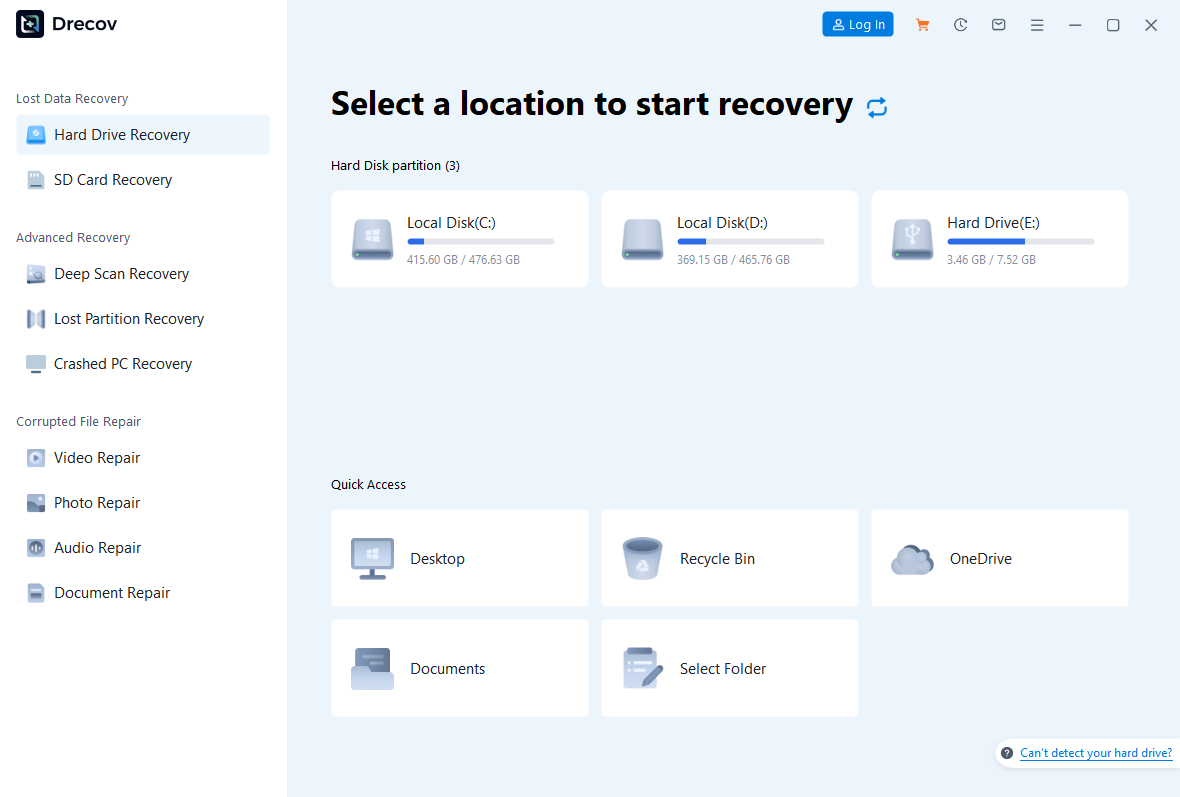
Step 1: Open Drecov and select the original repository location
Connect a separate healthy destination with sufficient capacity. Do not install Drecov on the partition that held the deleted backup. Open it and choose the original repository volume. If the entire repository partition disappeared, use Lost Partition Recovery rather than formatting or recreating it.
Step 2: Run Quick Scan
Start Quick Scan and look for the backup container, catalog, manifest, and related files. Preserve the directory relationships where the product depends on them. A recovered container without its matching catalog may require a separate import procedure.
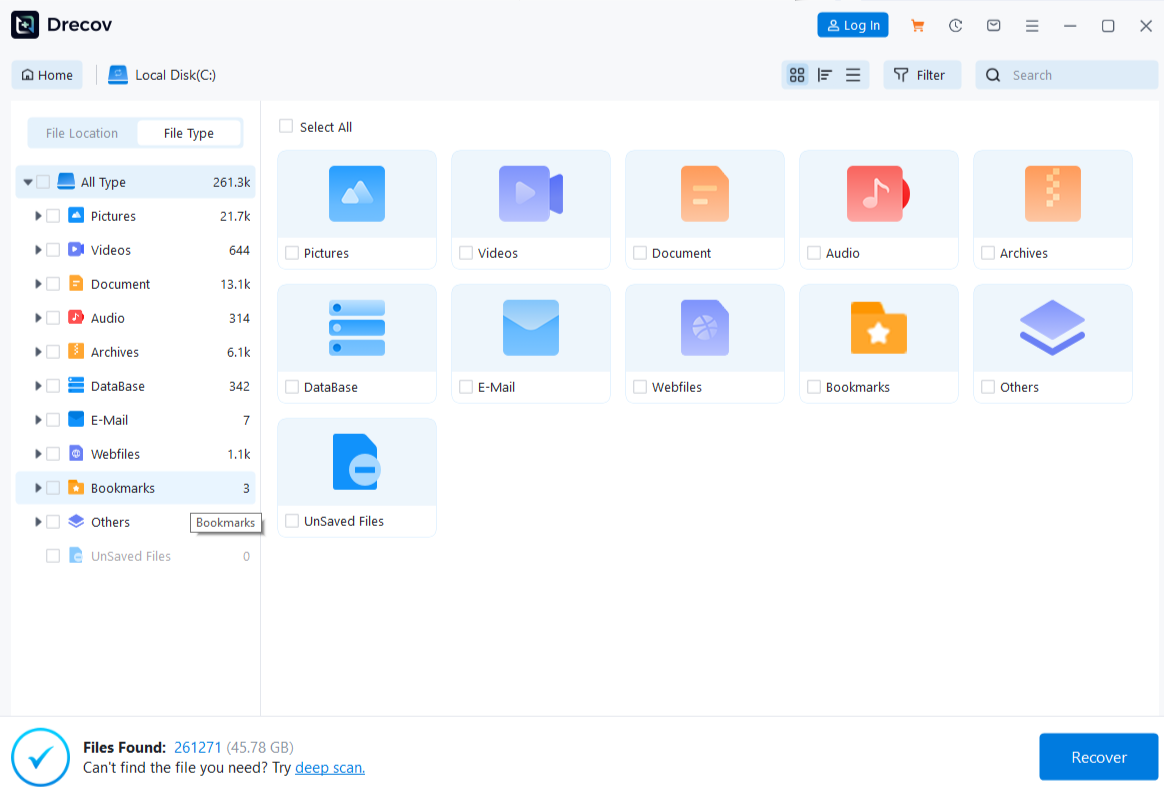
Step 3: Use Deep Scan on a stable source
If Quick Scan misses the required files and the device is stable, continue with Deep Scan. Stop if the source disconnects, reports severe read errors, or becomes physically unreliable. Repeated direct scans are inappropriate for failing hardware.
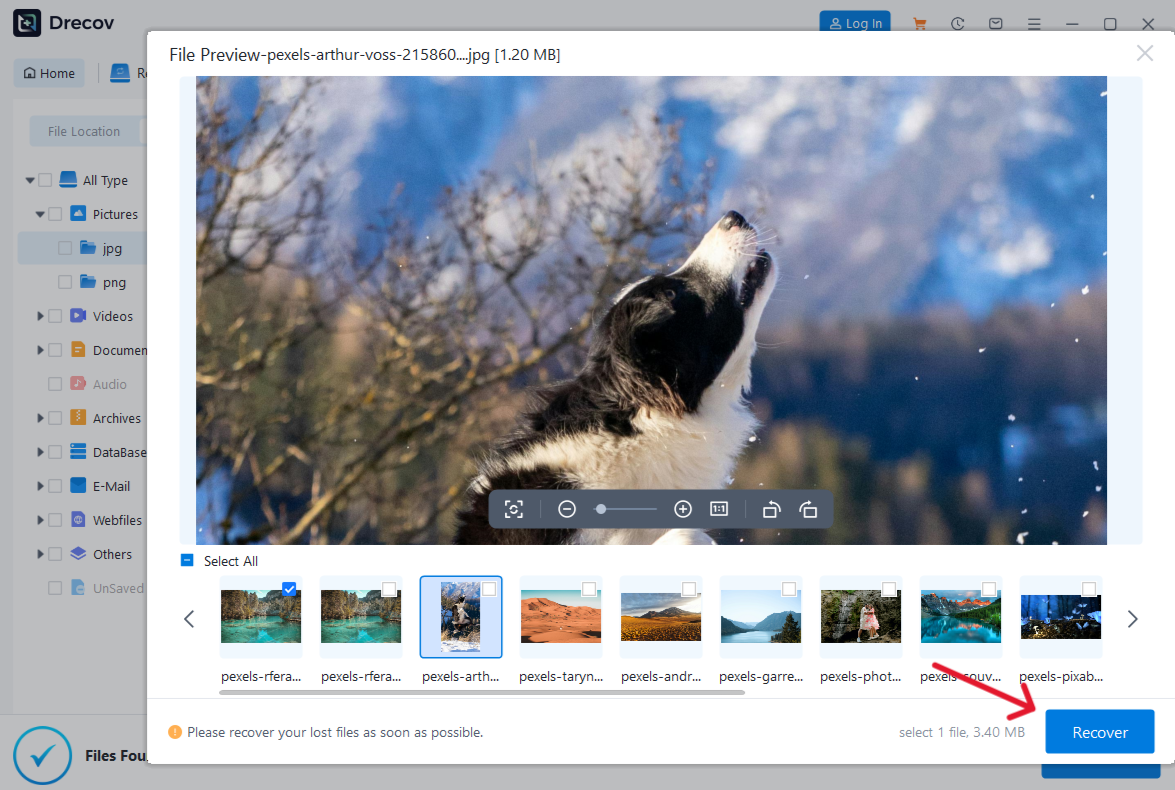
Step 4: Filter and preview what the format allows
Filter by former path, name, extension, size, and date where available. Preview supported files, but understand that proprietary backup containers may not have an ordinary preview. In that case, plausible size and header recognition are only selection clues; the creating backup application must perform the real validation.
Step 5: Recover elsewhere and validate the chain
Save selected files to the healthy destination, never the source repository. Check the Drecov Folder or Recovery Folder if output is not in the expected directory. Then import or open a copy with the original backup software. Perform a test restore and verify files before changing the source. The Drecov homepage is the appropriate product entry point.
⚠ Warning: Install it on a drive different from the one where your data was lost to prevent overwriting.
What are differential backups FAQs
Does each differential need the previous differential?
Usually no. It normally needs its full base, not the preceding differential. Confirm the behavior of your specific product.
Why does the differential get larger every day?
It accumulates changes since the full base. A new full backup starts a new base and typically resets that accumulation.
Can I delete older differentials?
You may be able to remove earlier differentials after verifying a later recovery point, but never remove the required full base. Follow the product’s repository-management process instead of deleting files blindly.
Is a differential backup the same as synchronization?
No. Sync often propagates current changes, including deletions, while a managed backup retains recovery points and chain metadata according to policy.
Do I still need an off-site copy?
Yes. Backup type does not protect a single location from theft, disaster, ransomware, or simultaneous device failure. The Windows backup utility overview provides additional context for built-in choices.
Conclusion
Differential backups trade growing daily copies for a shorter restore dependency: the full base and the selected differential. That can be an excellent balance, but only when the base, catalogs, credentials, and secondary copies are protected. Define required recovery points, test an actual restoration, and retire backups as complete chains. If a local repository file is truly deleted, use Drecov on the stable source before new writes overwrite it, then validate the recovered set with the application that created it.
⚠ Warning: Install it on a drive different from the one where your data was lost to prevent overwriting.





