







For pdf too large to email, protect the original data first. The safest response to a large-PDF delivery problem starts with evidence, not a destructive shortcut. Email providers and organizations impose different message limits, and encoding makes an attachment larger during transport. A file just below the advertised limit may still be rejected. Record the exact PDF size and the sender’s error. Confirm whether the restriction comes from the mail client, sender server, recipient server, or organizational policy. Preserve the original PDF and related source documents, record the state of the drive or folder that held the original PDF, and change one variable at a time so the result remains understandable.
For current platform behavior and command details, consult the Microsoft Outlook attachment-size guidance. Preserve the current state before applying any modifying instruction.
pdf too large to email: safe diagnosis
Save a protected copy before optimization. Work on a duplicate so failed compression, page deletion, or conversion cannot damage the only original. Open the PDF, search text, review page count, and inspect representative images. A corrupt file and an oversized healthy file require different solutions.
Read the exact rejection and compare the PDF’s size with both sender and recipient limits. Email encoding increases transmitted size, so a file near the published ceiling may fail. A corporate gateway can also impose a lower policy than the public mail service.
Preserve the Original and Check the PDF
Scanned pages are usually image-heavy. Reducing resolution and choosing suitable compression can save more space than changing ordinary text. Do not reduce every page to unreadable quality. Check small text, signatures, diagrams, barcodes, and print requirements after export.
Duplicate the original before optimization. Open the copy, confirm page count, search text, inspect signatures and diagrams, and note whether it is scanned or digitally generated. Scanned image pages usually offer the largest safe reduction through appropriate resolution and compression.
Adjacent tasks require their own checks: PDF not working diagnosis covers the first neighboring issue, recover deleted documents addresses a different decision, and choose an image file format applies when the situation has already moved into data loss. For a large-PDF delivery problem, use a linked procedure only when its symptoms match rather than combining several fixes at once.
Reduce Image Weight Without Ruining Readability
Splitting works well when chapters or exhibits can be understood separately. Use clear filenames and state the number and order of parts in the email. A cloud link avoids attachment limits but changes access control. Set the intended recipients, expiration, download permission, and organization policy before sending.
Export a review copy and compare small text, photographs, line art, barcodes, and print quality. Remove embedded thumbnails, unused layers, or editing data only with a trusted PDF tool. Do not flatten forms or signatures unless the recipient accepts that change.
Split the Document When Sections Stand Alone
Standard ZIP compression often has little effect on PDFs that already contain compressed images and streams. Password-protected archives may also be blocked by security systems. Remove hidden attachments, unused layers, embedded thumbnails, or editing history only with a trusted PDF tool and only after preserving the source.
When sections stand alone, split the PDF into clearly numbered parts and mention the total count in the message. Otherwise, upload the intact original to an approved service and restrict the link by recipient, expiration, and download policy.
Use a Secure Link for Large or Sensitive Files
Ask the recipient whether a lower-resolution review copy is acceptable or whether the original must be transferred through an approved secure service. After delivery, confirm that the recipient can open the complete document. A sent status proves transmission, not usability or completeness.
ZIP often saves little because PDF images and streams are already compressed, and password-protected archives may be blocked. Confirm that the recipient can open the delivered file and see every page. A sent status alone does not prove a usable handoff.
Separate a Temporary Symptom From a Lasting Fix
A temporary success during a large-PDF delivery problem after reconnecting, restarting, or clearing one condition shows that the pathway can work; it does not prove the cause is gone. Repeat the same task with the drive or folder that held the original PDF, then verify the original PDF and related source documents from beginning to end. Note whether the improvement survives a cold restart or safe reconnection.
If a large-PDF delivery problem follows one application, file type, port, or account, keep the scope narrow. Compare one known-good example for a large-PDF delivery problem and inspect the relevant setting before changing system-wide storage. Broad cleanup, formatting, or partition work is not justified by this isolated a large-PDF delivery problem symptom.
When a large-PDF delivery problem follows the drive or folder that held the original PDF across ports or computers, preserve data and retire the device after verification. When a large-PDF delivery problem stays with one computer, investigate that machine’s software, firmware, connection path, and storage layout. This distinction prevents unnecessary work on healthy media.
This check is especially useful for pdf too large to email. Only move toward compressing, splitting, or exporting another delivery copy after the recovered or copied set has been opened and sampled. Keep notes about an accidental overwrite, page deletion, or cleanup, because recurrence after a repair often reveals an unstable source or an automated process that the first change did not address.
Reduce the Chance of Another A Large-Pdf Delivery Problem
It helps diagnose pdf too large to email without changing the source data. Keep one verified copy of the original PDF and related source documents outside the drive or folder that held the original PDF, and decide how often it must be updated from the amount of work you can afford to lose. Label storage used for a large-PDF delivery problem clearly and remove it safely when applicable. Preserve encryption keys associated with the drive or folder that held the original PDF, note unusual errors, and retire it when disconnections or verification failures recur.
Document the settings and test that resolved a large-PDF delivery problem. After an update, migration, or hardware change, repeat that test before deleting the previous backup of the original PDF and related source documents. If an accidental overwrite, page deletion, or cleanup occurs again, compare the new evidence with the saved baseline rather than immediately repeating compressing, splitting, or exporting another delivery copy. The resulting a large-PDF delivery problem record shortens diagnosis without turning every warning into an invasive repair project.
Recover Files Affected by a large-PDF delivery problem
Drecov is Windows data recovery software for PCs, USB drives, SD cards, memory cards, hard drives, SSDs, and external drives. In a large-PDF delivery problem, its read-only workflow is relevant after an accidental overwrite, page deletion, or cleanup, provided the drive or folder that held the original PDF remains stable and recognizable. Quick Scan, Deep Scan, filtering, preview, and recovery to a selected healthy destination separate the search for the original PDF and related source documents from compressing, splitting, or exporting another delivery copy. Drecov does not fix physical hardware or restore overwritten bytes.
⚠ Warning: Install it on a drive different from the one where your data was lost to prevent overwriting.
Step 1: Open Drecov and select the source involved in a large-PDF delivery problem
Stop writing to the drive or folder that held the original PDF and prepare another healthy device with enough free space. Do not install Drecov on the partition that held the original PDF and related source documents. Open the program and identify the drive or folder that held the original PDF by capacity and context before selecting it. If the drive or folder that held the original PDF disconnects, clicks, changes capacity, or produces severe read errors, stop direct scanning and seek imaging or professional recovery.

Step 2: Start Quick Scan for the missing material
Run Quick Scan first and look specifically for the original PDF and related source documents. Browse the former paths and categories where the original PDF and related source documents belonged rather than selecting every result immediately. This initial pass can locate recently lost entries without changing the drive or folder that held the original PDF.
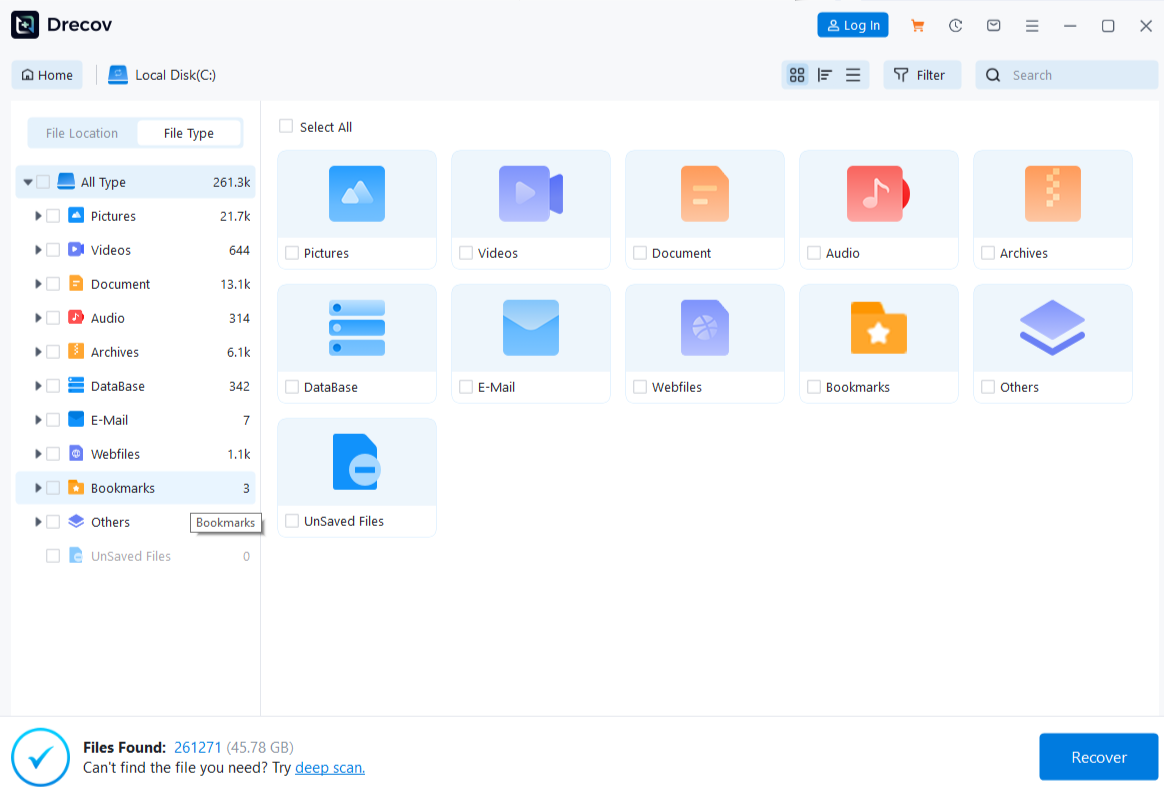
Step 3: Use Deep Scan only if this source remains stable
If Quick Scan does not locate the required material and the drive or folder that held the original PDF remains stable, continue with Deep Scan. The deeper search may find content whose original folder record is gone, but it cannot reconstruct areas overwritten after an accidental overwrite, page deletion, or cleanup.
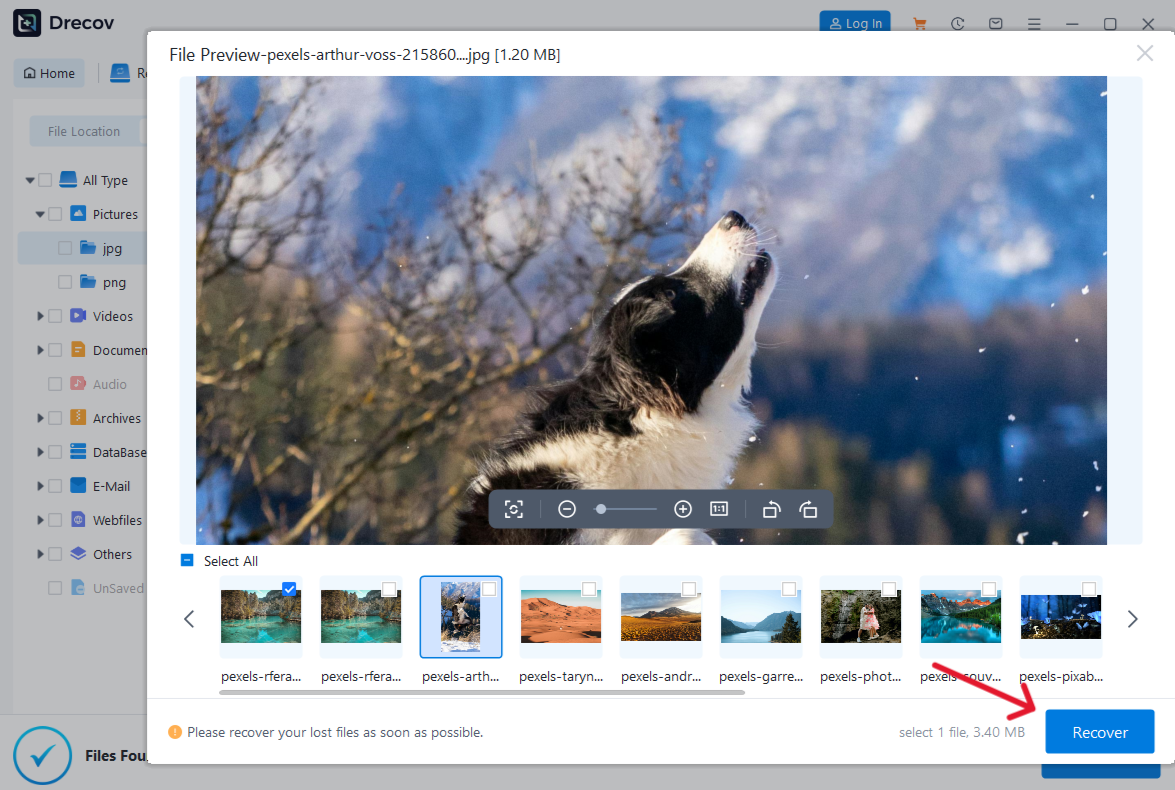
Step 4: Filter and preview files relevant to a large-PDF delivery problem
Filter by file type, filename, former path, size, or date where those details are available. Preview several examples of the original PDF and related source documents. A successful preview of the original PDF and related source documents shows that a sample can be decoded; it does not certify every page, frame, linked item, or archive member.
Step 5: Recover to a healthy destination and verify the result
Recover selected items to the prepared healthy device, never to the drive or folder that held the original PDF. If the original PDF and related source documents are not where expected, check the Drecov folder or Recovery folder. Open samples, compare expected sizes and dates, and leave the drive or folder that held the original PDF unchanged until the important results are verified. Only then consider compressing, splitting, or exporting another delivery copy.
⚠ Warning: Install it on a drive different from the one where your data was lost to prevent overwriting.
Questions About Emailing Large PDFs
Why is a PDF below the limit rejected?
Email encoding increases message size, and the recipient or company gateway may enforce a lower limit.
Does ZIP make a PDF much smaller?
Usually not, because PDF contents are commonly compressed already.
What should I compress first?
Optimize high-resolution scanned images while preserving readable text, diagrams, signatures, and required print quality.
Is a cloud link safer?
It can be when access is restricted, expiration is set, and the service meets organizational privacy rules.
Should I delete pages from the original?
No. Preserve the original and make a separate delivery copy or clearly numbered split files.
Choose Delivery by Quality, Privacy, and Recipient Access
Ask the recipient whether a lower-resolution review copy is acceptable or whether the original must be transferred through an approved secure service. After delivery, confirm that the recipient can open the complete document. A sent status proves transmission, not usability or completeness. For a large-PDF delivery problem, the safest plan protects the original PDF and related source documents first, verifies each result, and changes only the layer identified by the evidence.
⚠ Warning: Install it on a drive different from the one where your data was lost to prevent overwriting.





