







Music has always been an essential part of human culture, and technology has transformed the way we create, learn, and experience it. One of the most innovative tools in this intersection of music and technology is google chrome music lab. This free, web-based platform allows users of all ages and skill levels to explore music, experiment with sounds, and learn about musical concepts interactively. In this guide, we will explore everything about google chrome music lab, including its features, benefits, uses, and how it can inspire creativity in 2026 and beyond.
However, as many digital creators and educators know, working extensively on web-based platforms can sometimes lead to unexpected data loss. Whether you accidentally close a browser tab, clear your cache without thinking, or experience a sudden system crash while recording your latest experiment, losing your creative progress is deeply frustrating. Therefore, alongside our deep dive into this musical ecosystem, this comprehensive guide will also equip you with the essential technical knowledge required to preserve and retrieve your digital files.
What is Google Chrome Music Lab?
The google chrome music lab is an online platform designed to make music accessible, fun, and educational. Launched by Google, it leverages modern web technologies like the Web Audio API to allow users to experiment with music directly in the browser. Unlike traditional music software that may require complex installation and steep learning curves, google chrome music lab works on any modern browser, making it perfect for students, educators, hobbyists, and professionals.
The primary goal of google chrome music lab is to teach music concepts in an interactive, playful way. Users can create melodies, explore rhythms, visualize sound waves, and even understand the science behind music without needing prior musical knowledge. Because it operates entirely within the cloud and local browser memory, understanding how your computer processes these audio experiments will help you appreciate both the music itself and the underlying digital files that keep your creations safe.
How to Use Google Chrome Music Lab
Using google chrome music lab is simple and requires no software installation. Here’s how to get started:
- Step 1: Open Chrome Music Lab. Visit the official link at Chrome Music Lab. The platform works best on Google Chrome but remains fully compatible with other modern browsers.
- Step 2: Choose an Experiment. Explore the grid list of experiments and select one that interests you, such as the widely praised Song Maker. Each experiment includes simple visual indicators to help you get started immediately.
- Step 3: Experiment and Create. Start interacting with the experiment by tapping, dragging, or playing notes. Adjust settings like tempo, instruments, and scale to customize your creation.
- Step 4: Save and Share. Some experiments, like Song Maker, allow users to save compositions. You can save your project to generate a specific cloud link. You can then share your creations with friends, classmates, or on social media.
Tips for Maximizing Your Experience
- Start Simple: Begin with basic experiments like Song Maker or Rhythm to familiarize yourself with the interface before moving to complex tools like Oscillators.
- Experiment Often: Try different instruments, scales, and rhythms to discover unique sounds and unexpected melodies.
- Collaborate: Share your unique generated links and get feedback from friends or online music communities.
- Use Headphones: For a more immersive experience and to hear subtle sound details, panning, and frequency changes.
- Explore Tutorials: Look up community-created guides that show you how to recreate popular pop songs or video game themes within the Song Maker grid.
Advanced Uses for Music Enthusiasts
For those with a deeper interest in music, google chrome music lab can be used creatively beyond basic learning:
- Electronic Music Production: Use the Song Maker or Oscillators experiments as a foundation for composing electronic loops, which you can later record into a digital audio workstation (DAW).
- Sound Design: Explore unique sound patterns and manipulate frequencies for sound design projects, observing the real-time changes on the Spectrogram.
- Multimedia Art Projects: Combine Kandinsky and other visual experiments with music to create multimedia art presentations or interactive school displays.
- Classroom Experiments: Teachers can design interactive cross-curricular lessons combining physics (Sound Waves) and art (Kandinsky) to teach complex musical concepts comprehensively.
The Hidden Risk: Digital Data Loss in Web Browsing
While exploring the google chrome music lab, it is easy to forget that everything running inside your browser relies on local temporary files, browser cache structures, and active memory allocation. If you are recording audio using the Voice Spinner, or if you have hours of unsaved notes sitting on your Song Maker grid, your hard work hangs in a delicate balance.
Data loss can strike unexpectedly due to a variety of routine scenarios:
- Accidental closing of tabs or unexpected browser crashes (
STATUS_BREAKPOINTerrors). - Automatic browser updates that restart your computer overnight.
- Manual clearing of Chrome cookies and temporary internet files.
- Local storage corruption or accidental deletion of exported audio tracks from your local hard drive.
If you have ever lost a beautifully crafted track or lost access to saved bookmark links of your favorite creations, you know how devastating it feels. Fortunately, data recovery techniques exist to rescue your files from almost any disaster. Below, we break down different recovery methods arranged by technical complexity, ranging from basic browser tricks to utilizing professional data recovery software.
Method 1: Recovering Lost Project Links via Chrome History and Bookmarks
When you click “Save” in the google chrome music lab Song Maker, the platform does not download an actual project file to your hard drive. Instead, it generates a unique, text-based URL link that contains your encoded musical notation. If you forgot to copy this link or accidentally closed the window before saving it to your notes, you can try to retrieve it using built-in browser features.
Step 1: Check Your Browsing History
If you recently closed the tab containing your specific project link, you can look it up in your chronological browsing history.
- Open your Google Chrome browser.
- Press the hotkey shortcut Ctrl + H (Windows) or Cmd + Y (Mac) to open the History tab.
- Look for entries starting with
musiclab.chromeexperiments.com/Song-Maker/song/. The long string of numbers and characters at the end of that URL is the exact key to your unique musical creation. - Click on the link to reload your project.
Step 2: Reopen Closed Tabs Directly
If the accident literally just occurred a moment ago, Chrome has a built-in command to instantly undo a closed tab.
- Ensure your browser window is active.
- Press the hotkey combination Ctrl + Shift + T (Windows) or Cmd + Shift + T (Mac).
- Chrome will automatically reopen the last closed tab, frequently preserving the state of the page along with your unsaved google chrome music lab configuration.
Step 3: Check and Restore Missing Chrome Bookmarks
If you had saved your music links as bookmarks but they disappeared due to a profile sync error, you can check Chrome’s local backup file.
- Press Windows Key + R to open the Run dialog box.
- Type
%localappdata%\Google\Chrome\User Data\Defaultand press Enter. - In the directory that opens, look for two files named
BookmarksandBookmarks.bak. - If your bookmarks were recently lost, close all Chrome windows, rename
BookmarkstoBookmarks.old, and then renameBookmarks.baktoBookmarks. When you relaunch Chrome, your saved project links should reappear.
Method 2: Restoring Lost Audio Exports Using Windows System Tools
Many users like to export their google chrome music lab creations as .wav audio files or save them as digital files inside their local computer folders. If you accidentally deleted an exported audio track or saved over an active music folder, Windows provides built-in system protection utilities that can revert files back to an earlier state.
Step 1: Search and Restore from the Recycle Bin
When you delete a downloaded audio file from your system, Windows does not wipe the sectors immediately. It moves the file record to a temporary holding zone.
- Double-click the Recycle Bin icon on your desktop.
- In the upper-right search bar, type
.wavor search for the wordmusiclabto filter out unrelated items. - Right-click the deleted audio file and select Restore. The file will instantly return to its original download folder.
Step 2: Utilize Windows File History
If you had File History configured on your computer prior to losing your files, you can roll back your specific music folder.
- Open the file explorer and navigate to the folder where you normally save your music exports.
- Right-click an empty space inside the folder or right-click the folder itself, then select Properties.
- Click on the Previous Versions tab at the top of the properties menu.
- Look through the list of automatically generated timestamps. Select a version from earlier in the week when your files were perfectly intact.
- Click Restore to overwrite the current folder state, or click Open to manually drag the specific lost audio file out to safety.
Method 3: Advanced File Retrieval via Professional Data Recovery Software
When files are bypassed from the Recycle Bin (using Shift + Delete), or when a local drive partition becomes corrupted or formatted, standard system tools will fail to see the data. This happens because the operating system marks those sectors as “free space” and makes the files invisible, even though the raw binary data still resides safely on the hard drive platter or flash memory chips.
To dig deep into these hidden sectors and reconstruct broken file headers, you must deploy professional software capable of bypassing filesystem indexes.
Comprehensive Data Restoration with PandaOffice Drecov data recovery software
For deep logical errors, accidental drive formatting, or critical file deletion scenarios, utilizing PandaOffice Drecov data recovery software provides an exceptionally reliable path to file retrieval. This specialized tool functions by implementing a strict read-only deep scan of your storage device, mapping out fragmented file headers without altering or corrupting the existing data footprint. It is highly optimized for retrieving creative media, including document notes, browser databases, cache segments, and specific audio formats like WAV, MP3, and MIDI.
⚠️ Critical Warning: Never download or install data recovery software onto the exact same drive partition where the data loss occurred. If you accidentally deleted files from your C: drive, download and install the program on your D: drive or an external storage device instead. Failing to do this can completely overwrite the invisible blocks of data before you ever get a chance to scan them.
Follow these carefully broken down steps to scan your computer and rescue your lost files:
- Step 1: Select the Target Location for System Analysis. Select your main system storage partition (usually labeled Local Disk C:). Once your target location is clearly highlighted, click the primary Scan button situated in the bottom right corner of the dashboard panel.

- Step 2: Allow the Dual-Engine Scanning Process to Run. The tool will automatically launch a high-speed Quick Scan to sweep through your master file tables and catch recently deleted directory structures. You can monitor found files in real-time without needing to wait for the entire multi-gigabyte scan to finish.

- Step 3: Filter, Sort, and Preview the Found Files. Click on Type, expand the Audio folder, and select WAV or MP3 to instantly filter out irrelevant system files. Double-click any discovered audio file to open the Unlimited Preview window. This feature lets you listen to the audio playback directly within the app, ensuring the file is completely healthy and uncorrupted before proceeding.
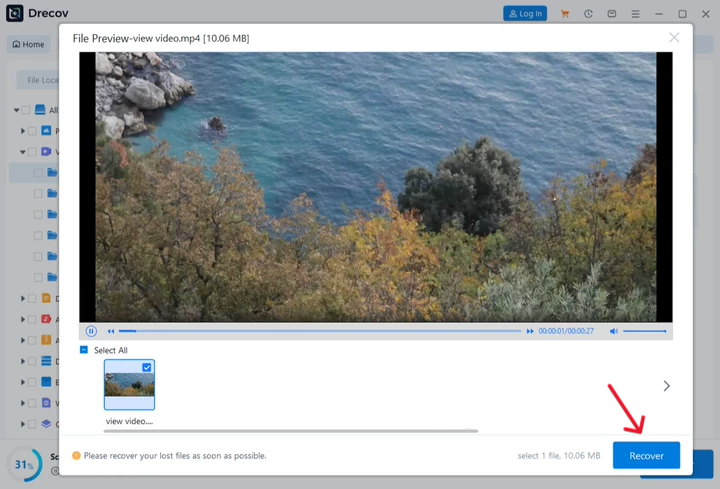
- Step 4: Execute the Secure Data Recovery Process. Mark the checkboxes next to the specific files, documents, or music links you intend to rescue. Click the prominent Recover button to open the path configuration dialogue box. Choose an entirely separate physical drive (such as an external USB flash drive or a secondary hard drive partition) as your recovery destination folder. Click OK to let the program rewrite the reconstructed data blocks safely. Once the transfer completes, your files are fully restored and ready for use.
Post-Recovery: Managing and Securing Your Digital Assets
Now that you have mastered these diverse data recovery procedures, you can explore several closely related digital maintenance strategies to ensure your general browser workspace stays pristine. If you have successfully recovered your files using the steps above, you may find these additional technical walkthroughs helpful for securing your other web resources:
- For those who frequently use web applications and want to safeguard their navigation paths, learn how to get your google chrome bookmarks back to keep all your creative web links perfectly organized.
- If a broader system glitch or problematic software update caused your browser data to vanish entirely, see this detailed guide on how to restore computer to an earlier date on windows using systemic system restore configurations.
- If you regularly work with audio-visual creations across different web media platforms, expand your troubleshooting skill set by reading our definitive guide on how to recover video files from formatted memory cards or damaged directories.
Conclusion
The google chrome music lab represents an exceptional tool that masterfully combines modern web technology, artistic creativity, and open-source education. Whether you are a beginner looking to learn music theory, a student experimenting with complex rhythms, or a professional teacher seeking interactive lessons for your classroom, this accessible platform provides endless avenues for exploration. Its intuitive visual style and diverse experiment library make it an absolute must-try ecosystem for anyone passionate about audio production.
At the same time, operating in modern digital environments requires keeping data security and file management in mind. By understanding how web audio links function, utilizing browser shortcuts, configuring Windows backup infrastructure, and knowing when to leverage powerful specialized utilities like PandaOffice Drecov data recovery software, you ensure that your unique digital art remains fully protected against unexpected system errors. Dive back into the platform, let your creative inspiration run wild, and enjoy making music online with total peace of mind!






