







In the digital age, our web browsers are more than just windows to the internet; they are personalized libraries of information. Whether you are a student, a professional, or a casual surfer, your bookmarks represent hours of curation. However, technology is never infallible. Data loss can occur due to sync errors, software corruption, or hardware failure. Learning how to export bookmarks from chrome is a fundamental digital literacy skill that ensures your carefully organized links remain safe and accessible.
This guide provides a deep dive into the mechanics of bookmark management, backup strategies, and advanced recovery techniques for 2026.
Why Exporting Chrome Bookmarks Is Important
Backup and Data Security
Let’s be real for a second—your bookmarks are more valuable than you think. They’re not just random links. They’re your go-to tools, your favorite articles, your research shortcuts, and sometimes even your entire workflow. Losing them? That’s like losing a personalized map of the internet you’ve been building for years.
Exporting bookmarks from Chrome gives you a safety net. Think of it like saving a backup copy of your contacts or photos. If your browser crashes, your device gets lost, or something goes wrong with syncing, you still have access to everything. You’re not starting from scratch.
There’s also a growing awareness around data ownership. More users are realizing that relying purely on cloud sync isn’t always enough. Having a local backup file means you’re in control. You decide where your data goes and how it’s stored. It’s a small step, but it gives you a surprising amount of peace of mind. And honestly, it only takes a minute. One simple export can save hours—maybe even days—of frustration later.
Migration to New Devices or Browsers
Imagine this: you just bought a new laptop. It’s faster, cleaner, exciting. But then you open your browser… and nothing’s there. No bookmarks. No shortcuts. Just a blank slate. That’s where knowing how to export chrome bookmarks to another computer becomes incredibly useful.
Instead of relying on account sync (which sometimes fails or isn’t enabled due to privacy settings), you can manually transfer everything using a single file. It’s like packing your digital essentials into a suitcase and unpacking them wherever you go. It’s not just about moving between devices either. Maybe you’re switching from Chrome to another browser like Firefox or Brave. Exporting bookmarks ensures you don’t lose your digital footprint during that transition.
What Happens When You Export Chrome Bookmarks
File Format Explained (HTML)
When you export bookmarks from Chrome, the browser creates a file in HTML format. Now, if that sounds technical, don’t worry—it’s actually pretty simple. An HTML file is basically a structured webpage that contains all your bookmarks as clickable links. You can open it in any browser, and it will display your bookmarks neatly organized, just like a mini website.
This format is universal. Because it follows standard web protocols, you can import it into virtually any browser on the market. Furthermore, you can store it on a USB drive or cloud storage without worrying about compatibility issues.
What Data Gets Included
When you learn how to export bookmarks from chrome, it is vital to understand what the package contains. Chrome includes:
- Bookmark names: The titles you gave your saved links.
- URLs: The actual web addresses.
- Folder structure: The hierarchy you created to organize them.
However, the export file does not include passwords, browsing history, or browser extensions. It is a streamlined file focused purely on your navigation links.
Method 1: Export Bookmarks Using Chrome Bookmark Manager
This is the standard, most reliable method used by professionals. It utilizes the built-in interface provided by Google.
Step-by-Step Instructions
- Step 1: Open your Google Chrome browser on your desktop.
- Step 2: Click the three-dot menu (Customize and control Google Chrome) in the top-right corner.
- Step 3: Hover over Bookmarks and Lists and select Bookmark Manager. Alternatively, you can use the hotkey Ctrl + Shift + O on Windows or Cmd + Option + B on Mac.
- Step 4: Once the Bookmark Manager tab opens, look for the second three-dot menu located in the top-right corner of the blue (or dark mode) bar, just below the main browser address bar.
- Step 5: Select Export bookmarks from the dropdown menu.
- Step 6: A “Save As” window will appear. Name your file (e.g.,
bookmarks_2026.html) and click Save.
Where the File Is Saved
By default, Chrome allows you to choose the destination. Most users choose the Downloads folder or the Desktop. A pro tip for 2026: always save a copy to a secondary location, like a cloud drive or an encrypted USB, to ensure that a local hardware failure doesn’t take your backup down with it.
Method 2: Export Bookmarks via Chrome Settings
Alternative Access Method
If you are already deep in your browser settings, you don’t need to exit to find your bookmarks.
- Step 1: Go to Chrome menu → Settings.
- Step 2: On the left sidebar, click on Appearance.
- Step 3: Ensure Show bookmarks bar is toggled on.
- Step 4: Right-click any empty space on the Bookmarks bar and select Bookmark Manager.
- Step 5: Follow the export steps mentioned in Method 1.
How to Import Exported Bookmarks
Importing Back into Chrome
If you have a fresh installation, bringing your links back is easy:
- Open Bookmark Manager.
- Click the three-dot menu and select Import Bookmarks.
- Locate your HTML file and click Open.
Importing to Other Browsers
Most browsers, including Mozilla Firefox and Microsoft Edge, have an “Import from HTML” option in their settings. This cross-compatibility is why the HTML format remains the industry standard.
Export Bookmarks on Different Devices
Windows and Mac
The process for how to export bookmarks from chrome is identical across Windows and macOS. The only nuance is the file system interface (Explorer vs. Finder).
Chromebook Limitations
On ChromeOS, the browser is the operating system. While you can export the HTML file, the system is designed to favor Google Sync. If you are offline, you must ensure you save the HTML file to the “My Files” local folder rather than a cloud-only folder to maintain an offline backup.
Advanced Recovery: When Bookmarks Go Missing
Sometimes, a manual export isn’t an option because the data is already gone. This is a common occurrence where users report chrome bookmarks gone after update 2026. Updates can occasionally glitch, wiping the local profile folder or desyncing the Google account.
Where are chrome bookmarks stored locally?
Before panicking, you can check the local storage path on your computer. Chrome stores bookmark data in a file named Bookmarks (no extension) and a backup named Bookmarks.bak.
- Windows Path:
C:\Users\<YourUsername>\AppData\Local\Google\Chrome\User Data\Default - macOS Path:
~/Library/Application Support/Google/Chrome/Default/
If you find the Bookmarks.bak file, you can sometimes rename it to Bookmarks to restore lost data. However, if these files are deleted or overwritten, you need professional data recovery software.
Method 3: Recovering Deleted Bookmarks with PandaOffice Drecov
If you didn’t have a backup and your local files are missing, PandaOffice Drecov data recovery software is the most effective solution for retrieving lost browser data. This tool scans the deep sectors of your hard drive to find deleted HTML files or the original Chrome database files.
⚠ Warning: Install it on a drive different from the one where your data was lost to prevent overwriting.
Step-by-Step Recovery with PandaOffice Drecov
- Step 1: Select the Location. Launch the software. Select the local disk (usually the C: drive) where your Chrome profile was stored.

- Step 2: Run the Scan. Click “Scan.” The software will perform a Quick Scan followed by a Deep Scan to locate fragments of the
Bookmarksfile or previously exported HTML backups.
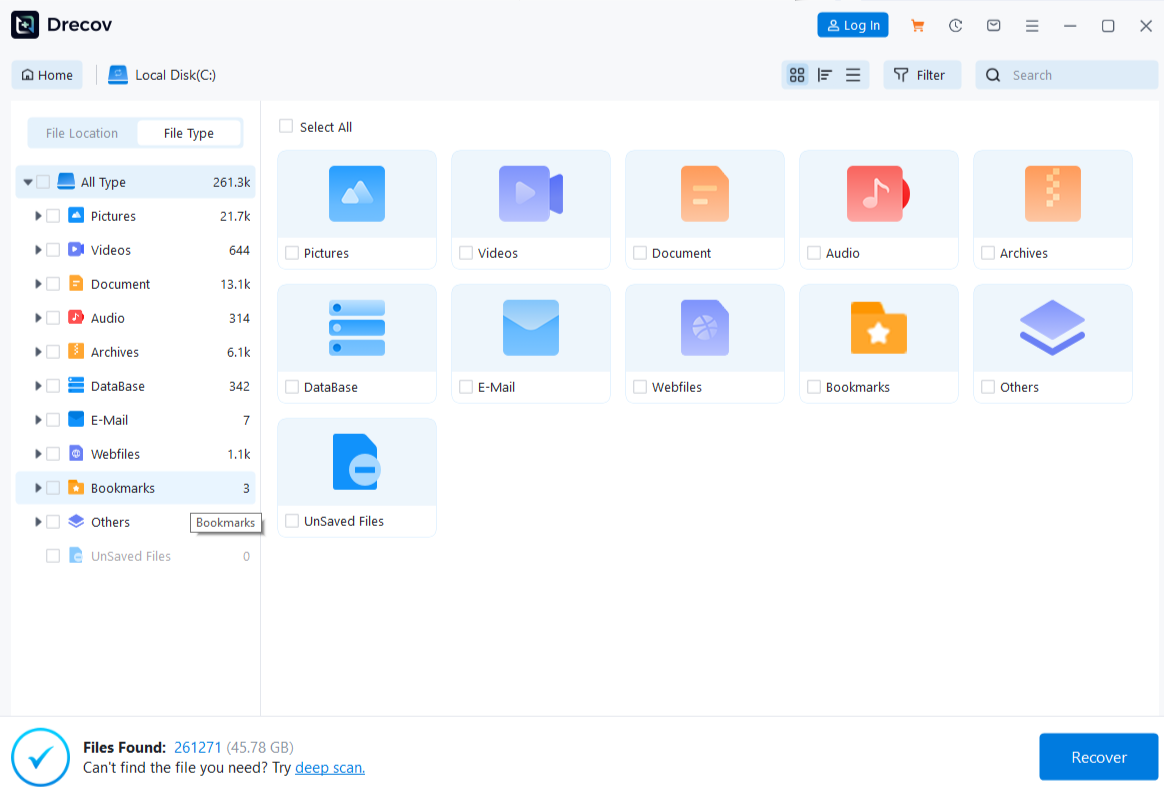
- Step 3: Filter and Preview. Use the search bar in PandaOffice Drecov to search for “Bookmarks” or “.html”. You can preview found files to ensure they contain your links.
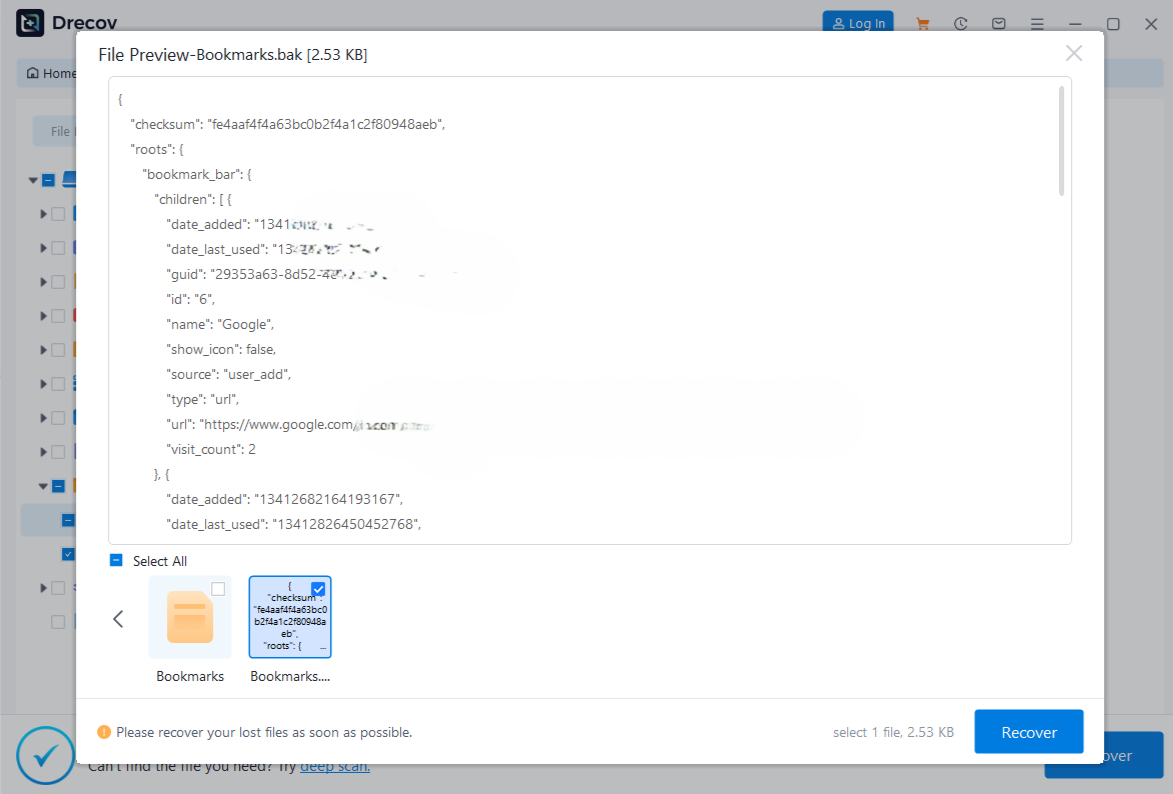
- Step 4: Recover. Select the files you want to retrieve and click the Recover button. Save them to an external drive or a different partition.
Warning: Once you realize bookmarks are missing, stop using the computer immediately. New data (like browser cache) can overwrite the deleted files, making recovery impossible.
- Learn how to download video from browser (Firefox 2026 Guide)
- Step-by-step guide to repair USB drive and recover data
- How to delete recently closed tabs in seconds
Chrome Sync vs Manual Export
Key Differences
Many users assume that being logged into a Google Account is enough. However, sync is not a true backup—it is a mirror. If you accidentally delete a bookmark folder on your phone, Chrome Sync will immediately delete it from your desktop too.
| Feature | Chrome Sync | Manual Export |
| Automation | Automatic | Manual |
| Account Req. | Google Account Needed | None |
| Offline Access | No | Yes |
| Security | Cloud-dependent | User-controlled |
Using both methods is the “Gold Standard” of data preservation. Use Sync for daily convenience, but perform a manual export once a month.
Common Problems When Exporting Bookmarks
Export Option Missing
If you don’t see the export option, ensure you are in the Bookmark Manager tab (chrome://bookmarks/). The option does not appear in the “Bookmarks” folder dropdown in the main menu.
File Not Opening
If your HTML file looks like a mess of code, you are likely trying to open it in a text editor like Notepad. Instead, right-click the file, select Open With, and choose a web browser. It should render as a clean list of links.
Best Practices for Managing Bookmarks
Organizing Before Export
A “dirty” backup is hard to use. Before you follow the steps on how to export bookmarks from chrome, take five minutes to:
- Delete dead links or 404 errors.
- Consolidate duplicate bookmarks.
- Use clear folder names like “Work 2026” or “Personal Finance.”
This ensures that when you import the file to a new device, you aren’t bringing clutter with you.
Export Bookmarks From Chrome FAQs
1. Where are Chrome bookmarks exported to?
You choose the location during the “Save As” step. By default, it usually points to your system’s Downloads folder.
2. Can I open the bookmarks file directly?
Yes. Since it is an HTML file, any web browser can open it as a local page. You can even keep this page as a homepage if you prefer a minimalist start screen.
3. Does exporting bookmarks include passwords?
No. Passwords are encrypted and stored separately. To back up passwords, you must use the “Password Manager” export tool within Chrome settings.
4. Can I export bookmarks on mobile Chrome?
Currently, Chrome for Android and iOS does not have a native “Export to HTML” button. You must sync your mobile bookmarks to a desktop version of Chrome and then export them from the computer.
5. How often should I export bookmarks?
For active users, a monthly export is recommended. If you use bookmarks for professional research, consider a weekly backup.
Conclusion
Mastering how to export bookmarks from chrome is an essential part of maintaining a healthy digital life. Whether you are moving to a new machine, switching browsers, or simply protecting yourself against the dreaded chrome bookmarks gone after update 2026 scenario, a manual HTML backup is your best friend.
Technology is designed to make our lives easier, but it requires a bit of manual oversight to remain reliable. By combining Chrome’s native export tools with powerful recovery solutions like PandaOffice Drecov, you can ensure that your digital library remains intact for years to come. Don’t wait for a crash to happen—export your bookmarks today and enjoy the peace of mind that comes with true data ownership.






