







When BitLocker could not be enabled, the exact reason matters more than another attempt. A missing TPM, unreadable startup USB key, organizational policy, incompatible edition, or system-partition problem leads to a different fix. Before changing firmware or partitions, make a verified backup of important files and confirm where the BitLocker recovery key will be stored. Encryption setup protects data only when you can still unlock it later.
bitlocker could not be enabled: safe diagnosis
Take a screenshot of the complete message. Note whether it appears before encryption begins, during a preboot system check, or after a restart. Check whether the target is the operating-system drive, a fixed data drive, or a removable drive. These targets have different startup and key-protector requirements. Record the Windows edition and whether the device is managed by an employer or school.
Open Manage BitLocker or Device Encryption settings and look at the current state. A drive can be fully decrypted, encrypting, paused, or encrypted with protection suspended. Do not assume a failed wizard means nothing changed. If encryption has already begun, avoid forced shutdowns and partition changes until you understand the state and have a backup.
| Message or observation | Likely branch | Next evidence |
|---|---|---|
| Compatible TPM not found | TPM disabled, unsupported, or driver/firmware issue | Inspect TPM status and vendor firmware guidance |
| Startup key on USB cannot be found | Preboot firmware cannot read the chosen device or port | Test a supported direct port and known-good USB drive |
| Group Policy conflicts with setup | Organization or local policy specifies key protectors | Review policy with the administrator |
| System partition is missing or unsuitable | Boot layout does not meet OS-drive requirements | Document disk layout before any resize or rebuild |
| Recovery information could not be backed up | Required directory or account destination unavailable | Verify the approved key escrow destination |
The table is a starting point, not a diagnosis by itself. A copied error code or message should be matched to the actual drive and Windows configuration. Many internet fixes silently assume a personal computer when the device is managed by an organization.
Check edition, account, and policy boundaries
First confirm that the Windows edition exposes the BitLocker feature you intend to use. Device Encryption on some hardware and the full BitLocker management interface are not identical. Avoid downloading a supposed BitLocker installer from a third-party site. If the feature is absent, verify edition and device support through Windows settings or official Microsoft information.
On a work or school device, encryption policy may require a particular protector, startup PIN, recovery-key backup, or directory connection before it allows setup. A local user should not disable such policy to make the warning disappear. Ask the administrator to check the policy and escrow status. Even on a personal PC, stale local policy can conflict with a chosen startup method.
Microsoft’s BitLocker FAQ documents the partition and startup requirements, recovery methods, and TPM alternatives. Read the section that matches your target drive rather than applying an OS-drive instruction to a removable drive. If the recovery key must be saved to a Microsoft account, file, printout, or organizational directory, confirm that destination is accessible before proceeding.
Inspect TPM and firmware without clearing keys
Check TPM status in Windows Security or the TPM management console. A missing entry can reflect a firmware setting, a vendor-specific name such as Intel PTT or AMD fTPM, an unsupported configuration, or a genuine hardware problem. Follow the PC maker’s firmware instructions for that model. Do not clear the TPM as a generic BitLocker fix. Clearing it can affect keys used by existing encryption, Windows Hello, and other security features.
If the setup uses a USB startup key instead of a TPM, the preboot environment must be able to read that USB device. Test a direct port, not a hub or dock. Prefer a simple, known-good device and confirm firmware USB support. An error during the preboot test is different from a failure after Windows has loaded. A port that works in File Explorer may not be available to firmware before Windows starts.
Recent firmware changes can trigger a BitLocker recovery prompt on already encrypted volumes. Before modifying boot order, Secure Boot, TPM configuration, or firmware mode, locate and verify existing recovery keys. Suspend protection only when the official maintenance procedure calls for it and re-enable protection afterward. Never publish or email a recovery key in plain text while asking for support.
Document partition layout before changing storage
An operating-system drive needs a separate unencrypted system area for startup and integrity verification. A cloned or manually partitioned disk may have an unusual layout that prevents BitLocker setup. Open Disk Management and record the disk number, capacity, EFI or system partition, Windows partition, and recovery partition. Take a screenshot. Do not delete a small partition merely because it looks empty; it may be essential to boot or recovery.
Resizing partitions, converting MBR to GPT, rebuilding an EFI partition, or running DiskPart changes storage metadata. Make a restorable backup first. Confirm the machine’s firmware boot mode and the layout expected by the Windows installation. A tutorial for a different disk can make this computer unbootable. If you cannot identify the target and its role confidently, stop and ask a technician to examine the layout.
BitLocker does not require you to format a healthy data drive simply because encryption setup failed. If an error message suggests that the drive is RAW or inaccessible, that is a separate data-access problem. Protect files before CHKDSK, partition repair, initialization, or formatting. Recovery and encryption setup should not be mixed into one risky command sequence.
Keep recovery of missing data separate from enabling encryption
If all files remain available, Drecov is not needed to enable BitLocker. Its role begins only when local files have been deleted, a stable volume has become inaccessible, or a partition was lost during an attempted layout change. Drecov is Windows data recovery software for PCs, HDDs, SSDs, external disks, USB devices, and memory cards. Its read-only recovery mode, Quick Scan, Deep Scan, filters, preview, and Lost Partition Recovery can help locate documents, photos, videos, email data, audio, and archives. It does not enable encryption, repair a TPM, replace a recovery key, bypass BitLocker, or fix physical damage.
⚠ Warning: Install it on a drive different from the one where your data was lost to prevent overwriting.
This check is especially useful for bitlocker could not be enabled. For a missing-file branch, stop writing to the affected volume. Prepare a healthy destination drive and do not install recovery software on the source. If the volume is already BitLocker-encrypted and locked, first obtain the valid recovery key and unlock it through supported means. Drecov cannot turn encrypted ciphertext into files without that access. If the device clicks, disconnects, or reports severe read errors, stop direct scans and consider imaging or specialist help.
Step 1: Open Drecov and choose the original loss location
Select the stable drive or partition where files existed before the BitLocker setup or partition change. Identify it by size and layout. Choose Lost Partition Recovery only if the partition itself is missing.

Step 2: Run Quick Scan and inspect known folders
Start Quick Scan. Search by former path, filename, file type, date, and size. Compare candidates with a backup rather than selecting only by name.
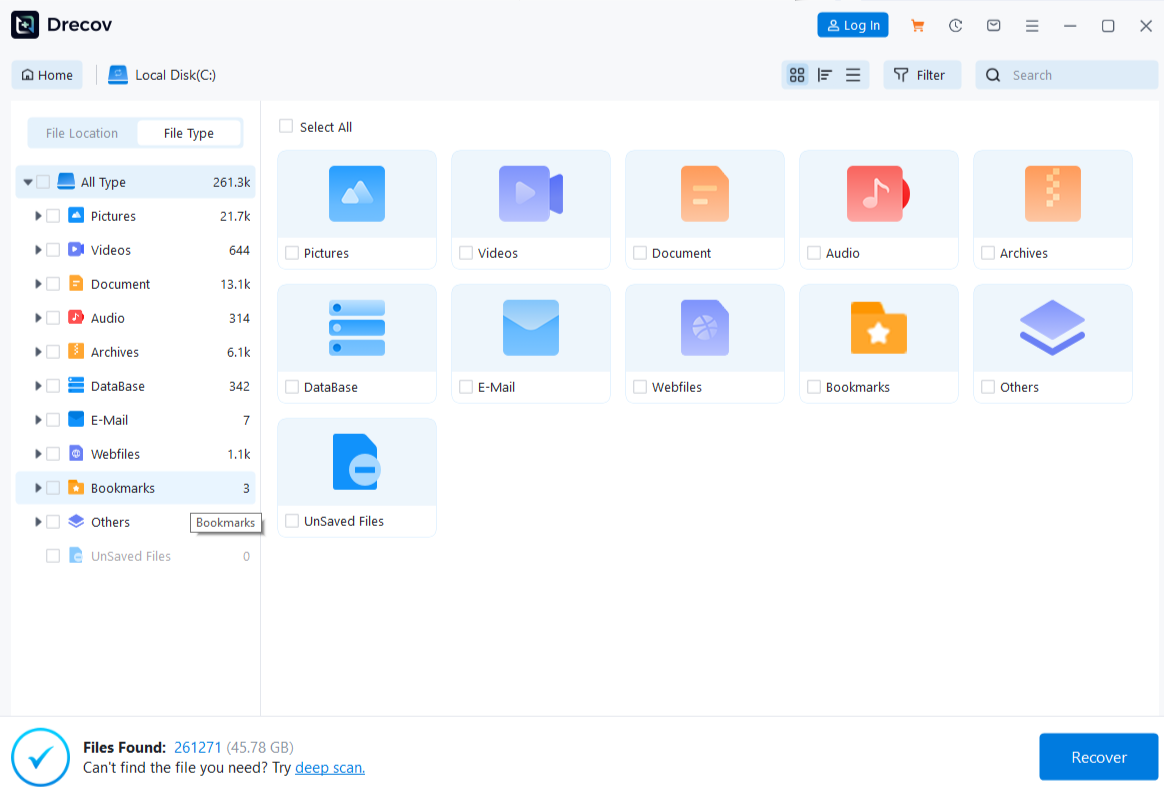
Step 3: Use Deep Scan only on a stable source
If Quick Scan misses needed files and detection remains reliable, continue with Deep Scan. Stop if the drive develops physical symptoms or severe read errors.
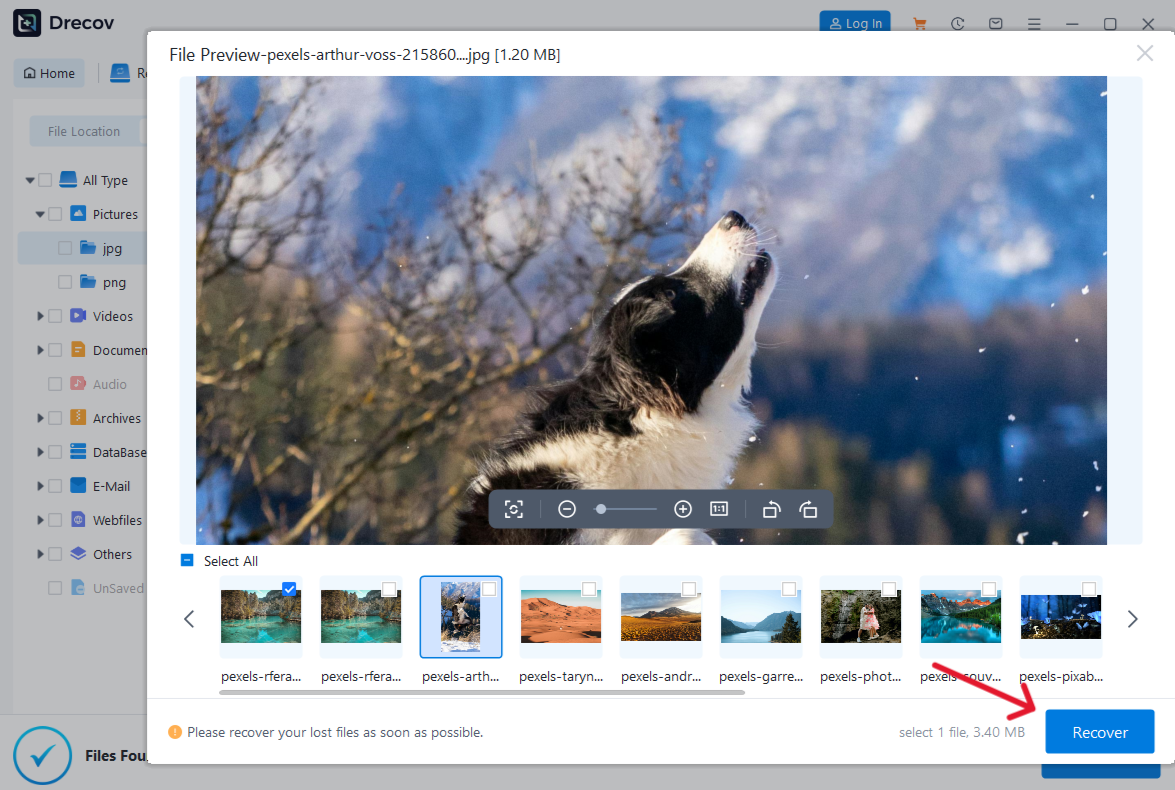
Step 4: Preview, recover elsewhere, and verify
Preview representative supported files, knowing that a sample does not certify every page or archive member. Recover to another healthy drive, never the source. Check Drecov Folder or Recovery Folder if output is not where expected. Open important files and compare contents before changing the source partition.
⚠ Warning: Install it on a drive different from the one where your data was lost to prevent overwriting.
Retry setup only after the cause is known
When the requirement has been corrected, start the BitLocker wizard again and choose a recovery-key destination you can actually use. Verify that the key exists outside the encrypted drive. Run the system check when offered and pay attention to its result. Do not interpret the start of encryption as proof that the computer will unlock after a firmware update or hardware change.
Restart normally, verify that the expected drive unlocks, and confirm the protection status. Keep the backup until encryption completes and several ordinary boots succeed. For a removable drive, test it on another compatible Windows device while retaining the recovery key. If setup fails again, compare the new message with the original; a different message is evidence, not necessarily progress.
Related reading includes the Drecov homepage, instructions for finding a BitLocker recovery key, the distinction when a BitLocker recovery key is rejected, and a guide to computer data recovery. A rejected key is a different task from a setup prerequisite failure.
FAQ
Can BitLocker work without a TPM?
Some configurations can use a USB startup key when firmware and policy support it. The exact requirement depends on the target drive and Windows setup.
Should I clear the TPM to make BitLocker start?
No. Clearing it can affect existing keys and sign-in features. Identify the actual error and preserve recovery information first.
Does a failed setup mean my files are encrypted?
Not necessarily. Check the current drive status instead of guessing. Encryption may not have started, may be in progress, or may be suspended.
Can Drecov unlock a BitLocker drive?
No. A valid recovery key or supported unlock method is needed to access encrypted data. Drecov can recover eligible files from accessible stable storage.
Is formatting a solution to a partition-layout warning?
Do not format a drive holding needed files. Document the layout and make a verified backup before any partition change.
Conclusion
When BitLocker could not be enabled, keep the exact message and trace its requirement: edition, policy, TPM, startup USB access, recovery-key escrow, or partition layout. Back up first, correct only the demonstrated blocker, and confirm that the key can unlock the drive after setup. If a separate disk change actually lost local files, Drecov can recover candidates from a stable accessible source to another healthy location before partition or encryption work resumes.
⚠ Warning: Install it on a drive different from the one where your data was lost to prevent overwriting.





