







Yodot MOV Repair is a specialist desktop utility for damaged MOV, MP4, and M4V video files. Its official instructions describe selecting a damaged video and, on Windows, a healthy recording from the same camera as a reference. That can suit a file whose container information is damaged while media data remains. It is not a universal answer for deleted clips, zero-byte files, failing storage, or footage that was never recorded.
What This Review Can Establish
This is a documentation-based editorial assessment, not a laboratory benchmark. No claim here represents a measured recovery rate, scan speed, repair score, or current price. Those numbers would require controlled files, disclosed hardware, repeatable tests, and a dated commercial check. Instead, the review compares the vendor’s documented workflow with the evidence a user can inspect before and after a repair.
The distinction matters because “video corruption” describes several different failures. A MOV file may have a damaged header or index. It may contain a valid video stream but an unsupported codec. The final part may be absent because a phone lost power before closing the recording. A transfer may have produced an incomplete copy. At the storage level, the original file may have been deleted or the card may be unstable. One program cannot solve all five cases in the same way.
| Observed condition | Likely task | Is Yodot a plausible fit? |
|---|---|---|
| Normal file size, but MOV will not open | Container or structural repair | Potentially, after testing a duplicate |
| Video opens but stops early | Check truncation and readable duration | Worth evaluating; missing payload cannot be invented |
| Only one player rejects the clip | Codec or player diagnosis | Test another decoder before buying repair software |
| File is missing after deletion or formatting | Recover the original file first | No; repair begins only after a file exists |
| Card disconnects or reports read errors | Stabilize or image the medium | Do not repeatedly read the failing source |
| File size is zero bytes | Find another copy or recover an earlier file | No media payload is present to repair |
How the Documented Yodot Workflow Operates
The vendor’s official Yodot MOV Repair page describes a Windows and Mac application for MOV, MP4, and M4V. The Windows process asks for the corrupt video and a healthy reference video recorded with the same camera or camcorder. After repair, the interface presents the result for preview and saving. Because vendor pages can change, confirm the current operating-system requirements, licensing terms, and save restrictions directly before installation.
Why the reference video matters
A healthy reference gives a repair engine an example of the way that recording device writes its container. The best reference usually comes from the same camera, with the same resolution, frame rate, codec, orientation, and recording mode. A random MOV downloaded from the internet may share the extension yet use a different internal structure. Record a short new clip only if the original device and card are stable. Save that reference to a healthy disk rather than adding data to a card that contains lost footage.
Reference-based repair does not mean that frames from the healthy clip are substituted into the damaged one. The reference supplies structural information. The damaged file must still contain its own readable audio and video payload. This boundary explains why a realistic preview is more valuable than a generic “repair completed” message.
Use a working copy, not the sole original
Copy the damaged file to a healthy local drive and preserve the original unchanged. Note its byte size, creation date, expected duration, camera model, and the event that preceded failure. If Windows cannot copy it cleanly, the card repeatedly disconnects, or an HDD clicks, stop. Repair software repeatedly reads a file; that is inappropriate when the underlying medium is physically unstable. A specialist may first create a sector-level image with controlled retry behavior.
A Fair Way to Evaluate the Demo and Preview
Do not judge a repaired video from its thumbnail or opening seconds. Preview near the beginning, middle, and end. Seek across scene changes. Listen for audio drift, gaps, or repeated blocks. Compare the displayed duration with the expected recording time. If the clip contains a spoken count, a clock, or a continuous camera movement, use it to detect discontinuities. For long footage, sample several points rather than watching only the first minute.
Also inspect the output outside the repair application. A preview may use the program’s own decoder, while your editor, archive system, or television uses another. When the demo does not allow an independent saved-file test, treat that as an evaluation limitation. Check the vendor’s current rules rather than assuming that an on-screen preview guarantees a portable result.
- Confirm that resolution and orientation match the source.
- Check total duration and seekability, not just playback start.
- Listen to audio through the entire sampled range.
- Look for frozen frames, green blocks, or time jumps.
- Keep the repaired output separate from both source and reference.
If a player already opens the original correctly, first investigate codec support or use a non-destructive remux on a copy. The guide to diagnosing a corrupted video file separates player, container, and storage problems before a paid repair decision.
Limits That Matter More Than a Feature List
A useful review states what the product cannot demonstrate. No repair utility can reconstruct video bytes that were never written. A zero-byte placeholder contains no footage. A clip cut off during recording may retain useful media, but its recoverable duration depends on what reached storage before the interruption. Overwritten sectors cannot be restored by rebuilding a MOV container.
Format names also need care. MOV and MP4 are containers, not single codecs. Two files with the same extension can store different video and audio streams. Confirm that the software supports the actual recording pattern you have, not merely the filename suffix. The MP4 container overview explains why metadata and payload failures require different responses.
Privacy is another decision point. Yodot is described as desktop software, so the documented workflow differs from uploading a confidential recording to a web service. Nevertheless, a buyer should verify the current privacy policy, telemetry settings, crash-report behavior, and license terms. Sensitive medical, legal, workplace, or family footage deserves that check before any tool handles it.
Finally, repair is not recovery. A repair program works on a file you possess. Recovery finds a deleted, formatted, or inaccessible file from storage. If the source MOV is absent, running a repair tool against a thumbnail, shortcut, or zero-byte placeholder cannot bring it back.
Recover a Missing MOV Before Attempting Repair
Drecov is Windows data-recovery software for logical loss from PCs, HDDs, SSDs, external drives, USB media, SD cards, and memory cards. It can locate photos, videos, documents, email data, audio, and archives through Quick Scan and Deep Scan, with filtering and preview. Lost Partition Recovery addresses a missing former volume. Its role here is to retrieve a missing MOV, MP4, or M4V to another healthy location so a separate repair test can begin. It does not repair camera hardware, stabilize a failing disk, recreate overwritten footage, or guarantee that every recovered video is intact.
⚠ Warning: Install it on a drive different from the one where your data was lost to prevent overwriting.
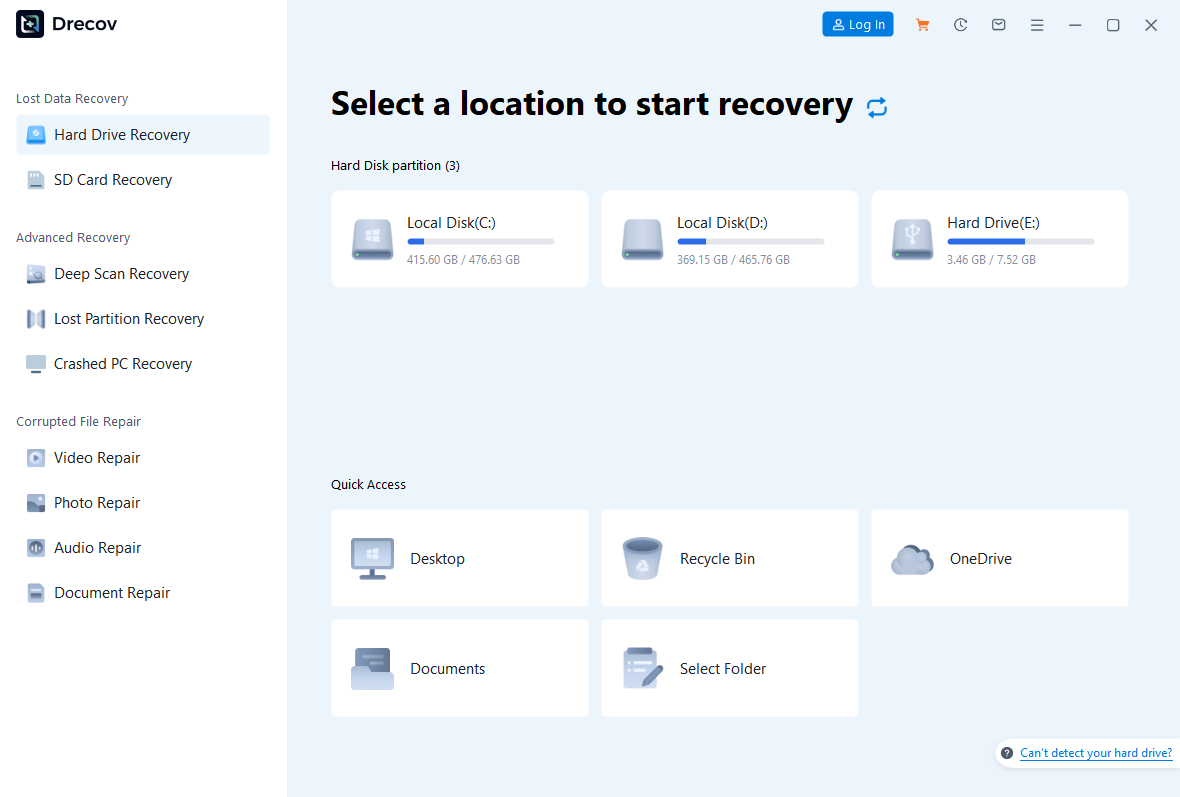
Step 1: Open Drecov and select the original recording location
Stop using the camera card or source partition. Prepare a healthy destination with enough free space. Do not install Drecov on the source. Open Drecov and choose the original card, external device, partition, or former folder. If the volume itself disappeared, use Lost Partition Recovery. End the attempt if the device drops offline, becomes extremely slow, or produces severe read errors.
Step 2: Run Quick Scan for the recent loss
Start Quick Scan and inspect the original DCIM, camera, export, or project path. Search by extension, filename, approximate date, and size. Keep several plausible candidates when cameras reuse names. A recovered filename alone does not prove that its content belongs to the missing recording.
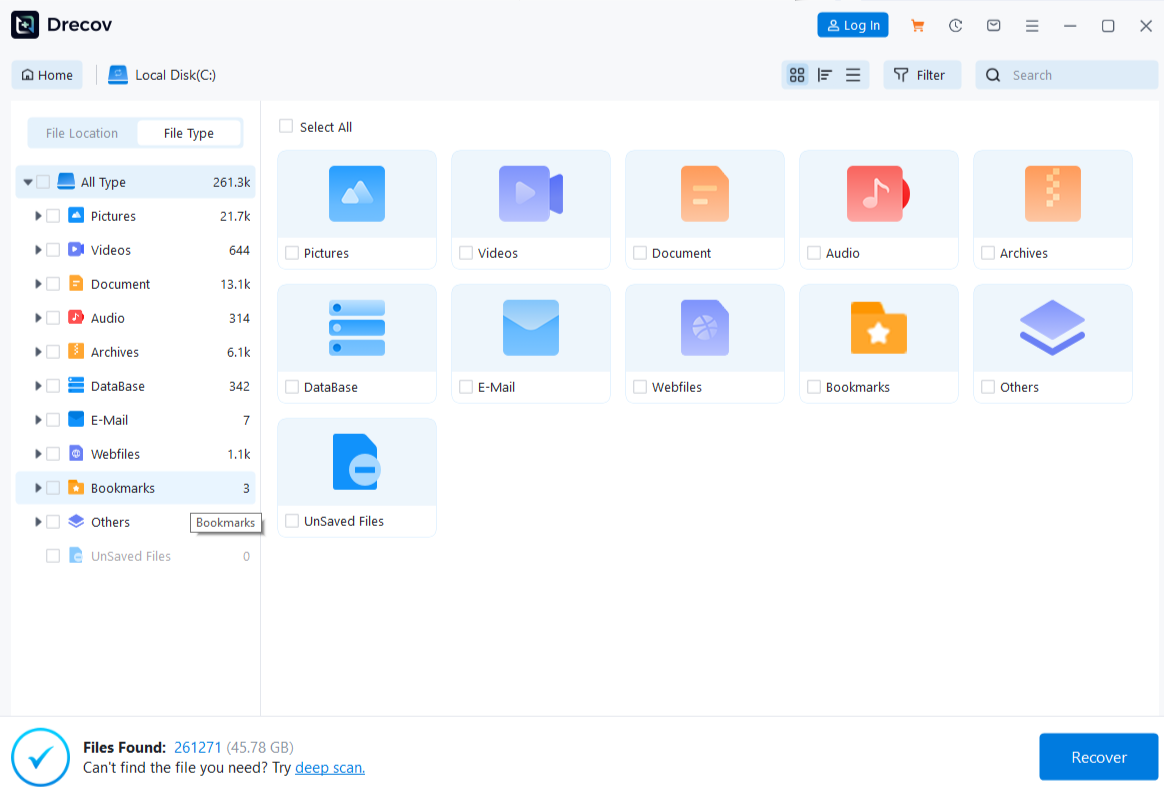
Step 3: Use Deep Scan only on stable media
If Quick Scan misses the video and the storage remains consistently readable, run Deep Scan. Expect file names or folders to be less complete after formatting or damaged metadata. Do not repeat scans merely to obtain a different answer from an unstable card.
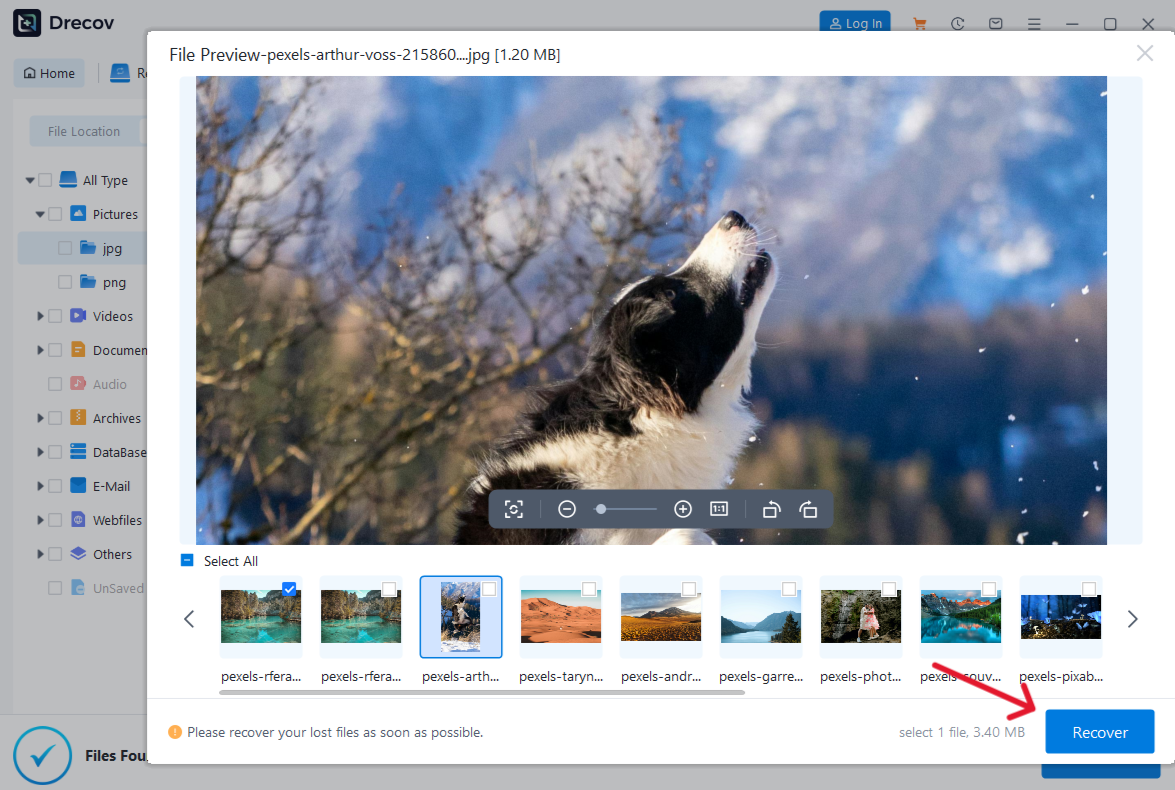
Step 4: Filter, preview, and recover elsewhere
Filter results by video type, location, time, and file size. Preview representative candidates when supported, remembering that a successful preview covers only the displayed portion. Recover selected files to the separate healthy drive, never to the source. If the expected directory is absent, check Drecov Folder or Recovery Folder.
Step 5: Verify the recovered video before repair
Open each output, compare its duration and size, and sample playback at multiple positions. Preserve one recovered copy untouched. Only then give a duplicate to Yodot or another repair method. The broader workflow for recovering deleted videos also covers backups and other non-repair sources.
⚠ Warning: Install it on a drive different from the one where your data was lost to prevent overwriting.
Who Should Consider Yodot MOV Repair?
Yodot is a plausible candidate when a nonzero MOV, MP4, or M4V exists, the storage is stable, ordinary players fail, and you can supply the documented reference where required. It is especially reasonable to evaluate when the failure followed an interrupted recording, transfer, or container-writing event. Use the preview as evidence, then decide whether the current commercial terms are acceptable.
Choose a different path when the problem is only one player’s codec support, when the file is absent, or when the medium is unstable. A free remux or player test may answer a compatibility question. Drecov may retrieve a deleted original. A professional service is safer for physical failure. For an alternative container-level first check, see how to test video repair with VLC on a duplicate.
Questions Before Using Yodot MOV Repair
Does Yodot MOV Repair need a healthy reference file?
The official Windows workflow says yes. Use a short recording from the same camera and settings. Verify the present Mac workflow on the vendor’s current page.
Can it repair a zero-byte MOV file?
No meaningful media payload exists in a zero-byte file. Look for a backup, another export, or a recoverable deleted original.
Should I run it directly on the memory card?
No. Copy a readable damaged file to healthy storage and work on a duplicate. Stop if the card is unstable or produces read errors.
Is a successful preview enough?
It is useful evidence, but inspect multiple time positions, audio synchronization, duration, and a saved output in the programs that must use it.
Can Drecov replace Yodot MOV Repair?
They solve different problems. Drecov retrieves a missing or inaccessible file from stable storage; Yodot attempts structural repair of a video file that already exists.
Conclusion
Yodot MOV Repair deserves consideration for an existing, nonzero MOV, MP4, or M4V whose container is damaged and whose storage is stable. Its reference-file workflow makes preparation important, while a careful preview supplies more evidence than promotional claims. Preserve the original, test the output across its duration, and verify current terms at the official source. When the recording itself was deleted or a partition disappeared, use Drecov first to recover candidates to another healthy drive. Repair only a duplicate after the recovered file has been opened and checked.
⚠ Warning: Install it on a drive different from the one where your data was lost to prevent overwriting.





