







A useful PNG fixer depends on what actually failed. A wrong extension may need identification, a strict decoder may reject one bad chunk, and a truncated file may lack image rows that no tool can recreate. Preserve the original, test a duplicate in more than one decoder, and record the exact error before editing bytes or converting the image. If the PNG was deleted or stored on unstable media, recovery comes before repair.
Read the Failure Pattern Before Choosing a Tool
Begin with the file’s size and history. A zero-byte PNG has no image payload. A tiny file may be a thumbnail, placeholder, or incomplete download. If its size looks plausible, ask whether the problem began after transfer, editing, synchronization, a crash, or storage failure. Compare it with an earlier copy without overwriting either file.
Open a duplicate in a web browser, the operating-system viewer, and a reputable image editor. One successful decoder suggests an application-specific problem rather than complete corruption. Exporting from the program that opens it can create a clean PNG, but only after you confirm dimensions, color, transparency, and visible content. Do not repeatedly save the only original.
| Symptom | Evidence to collect | Best first tool category |
|---|---|---|
| File has .png but no viewer recognizes it | Signature and real file type | File identifier or hex viewer |
| Browser opens it, editor refuses | Decoder error and chunk report | Validator, then lossless re-export |
| Image stops partway down | File size, IDAT sequence, IEND presence | Chunk validator; expect truncation limits |
| Background or edges look wrong | Alpha channel and color profile | Color-aware editor, not binary repair |
| CRC error names one ancillary chunk | Chunk type and whether pixels still decode | Copy-based chunk repair |
| PNG disappeared after deletion | Source location and storage stability | Data recovery before image repair |
Know What a Valid PNG Contains
The official W3C PNG specification defines a datastream with a PNG signature followed by chunks. A valid stream begins with IHDR and ends with IEND. Image data is carried in IDAT chunks. Each chunk has a length, type, data, and CRC field. The CRC can reveal that bytes in a particular chunk changed, but it is detection evidence rather than a backup copy of the original bytes.
Critical and ancillary chunks do not have equal importance. IHDR describes essential properties such as dimensions, bit depth, and color type. IDAT holds compressed image data. IEND marks the end. Ancillary chunks can carry a palette, transparency, color, text, time, and other information. A decoder may safely ignore an unknown ancillary chunk, yet damage to a critical chunk can prevent any useful rendering.
Check the signature before trusting the extension
Renaming a JPEG or WebP file to .png changes only its label. A file identifier or hex viewer can confirm whether the eight-byte PNG signature is present. If the content is really another format, restore the correct extension or open it with the matching decoder. Do not paste a PNG signature onto unrelated data; that merely creates a misleading header.
Use chunk and CRC reports as a map
PNG-aware validators can list chunks in order, report impossible lengths, and identify CRC mismatches. Save the report. If only a removable text or timestamp chunk is bad while all pixels decode, a specialized copy-based rewrite may produce a clean file. If IHDR contains impossible dimensions or IDAT is cut off, the job is harder. Never delete a chunk unless you understand whether it is required for color, transparency, animation, or decoding.
Choose Among Five PNG Fixer Approaches
1. A second standards-based decoder
This is the safest first comparison. Browsers, operating-system viewers, and editors use different libraries and tolerance rules. If one opens the image completely, make a duplicate and export a new PNG without resizing. Compare pixel dimensions and transparency. This approach is appropriate for a strict-reader disagreement, not a file that is physically incomplete.
2. A PNG validator or chunk inspector
A validator explains rather than magically repairs. It can separate a bad signature, chunk-order error, CRC mismatch, missing IEND, or truncated IDAT. That information prevents random conversion attempts. Command-line tools are suitable for technical users who can preserve originals and interpret output; graphical validators are easier when they clearly name the failed chunk.
3. A lossless editor or re-encoder
When the full image opens in at least one application, re-encoding can rebuild a consistent chunk sequence. Disable resizing and avoid a color-mode conversion unless desired. Check alpha transparency against both light and dark backgrounds. Compare embedded profile behavior, since a visually different result can be a color-management change rather than missing pixels.
4. A specialized binary repair tool
Use this only on a copy and only when the diagnostic identifies a narrow structural fault. A tool that recalculates a CRC does not restore altered data; it merely makes the checksum agree with the current bytes. Removing a damaged ancillary chunk may be valid, while manufacturing IHDR values or compressed rows without evidence can distort the image. Keep a repair log and retain every intermediate result separately.
5. Conversion from another intact source
If the PNG is an export, locate the original illustration, layered project, camera image, PDF, slide, or web asset. A fresh export often preserves more quality than repairing a damaged derivative. For a downloaded image, download again from the authoritative source and compare hashes or byte sizes. For synchronized files, inspect version history before accepting the newest broken copy.
Recognize Damage a PNG Fixer Cannot Reverse
Truncation creates a hard boundary. If the final IDAT data never reached disk, a decoder may display upper rows and lose the bottom. Some tools can salvage readable rows, but they cannot infer the exact missing pixels. A screenshot of the visible region is a last-resort derivative, not restoration of the original image.
Overwriting is equally final. Once another file replaces the sectors containing deleted PNG data, changing chunks cannot bring those bytes back. Severe storage errors also change the task. If a drive clicks, a card disconnects, or every copy attempt returns read errors, stop using image repair software against that medium. Controlled imaging or a professional lab protects the remaining readable sectors.
Encryption and permissions require different solutions. A password-protected archive containing a PNG is not a corrupt PNG. An “access denied” message may concern the folder or account. Resolve access without modifying the image. Likewise, malware damage should be handled on an isolated copy after the system is secured.
Recover the Intact PNG When the File Is Missing
On Windows, Drecov can retrieve logically lost files from a PC partition, HDD, SSD, external disk, USB device, SD card, or other memory card. It searches for photos, videos, documents, email data, audio, and archives. Quick Scan addresses recent logical deletion; Deep Scan searches more broadly on stable media. Filters, path information, and preview help locate candidates, while Lost Partition Recovery covers a missing former volume. Drecov retrieves files; it does not repair damaged pixels, failing hardware, encrypted content, or overwritten sectors.
⚠ Warning: Install it on a drive different from the one where your data was lost to prevent overwriting.
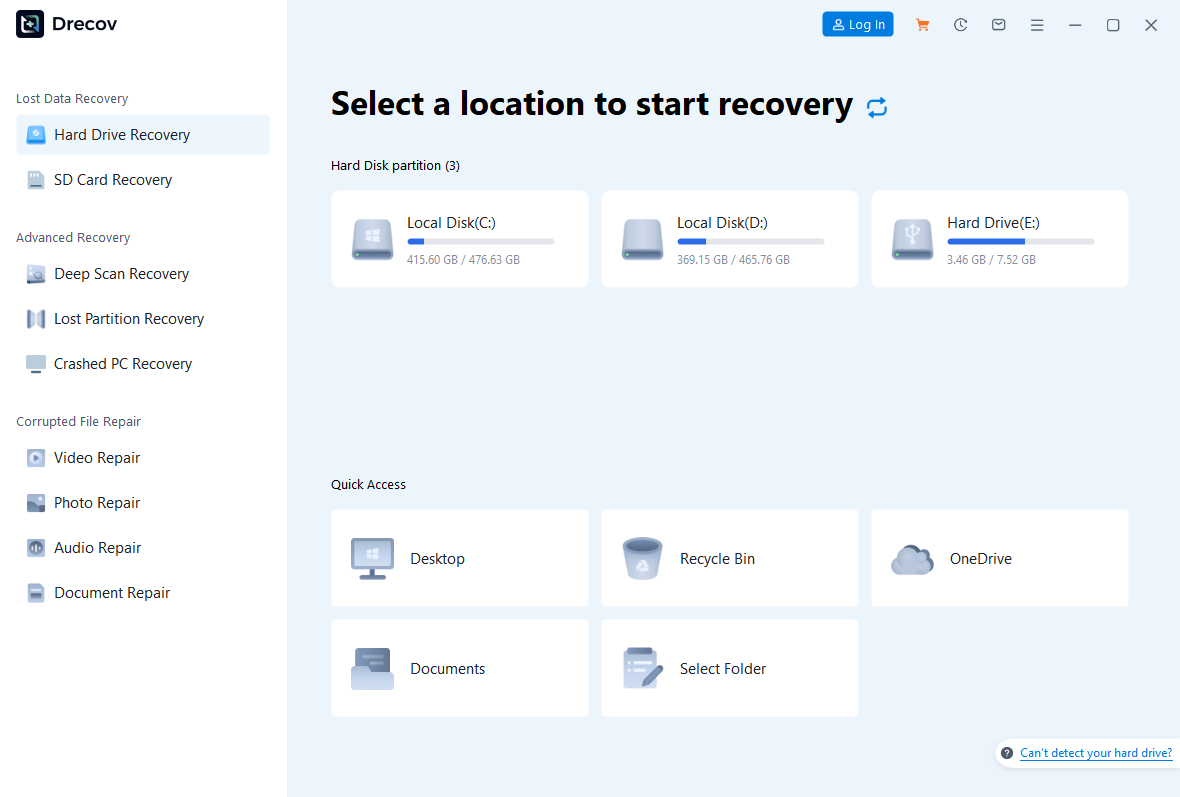
Step 1: Open Drecov and choose the original image location
Stop saving, downloading, or editing on the source. Prepare a healthy destination with adequate space, and do not install Drecov on the partition that held the PNG. Open Drecov and select the original drive, memory card, USB device, or folder location. If the partition vanished, select Lost Partition Recovery. Stop if the device becomes unstable or reports severe read errors.
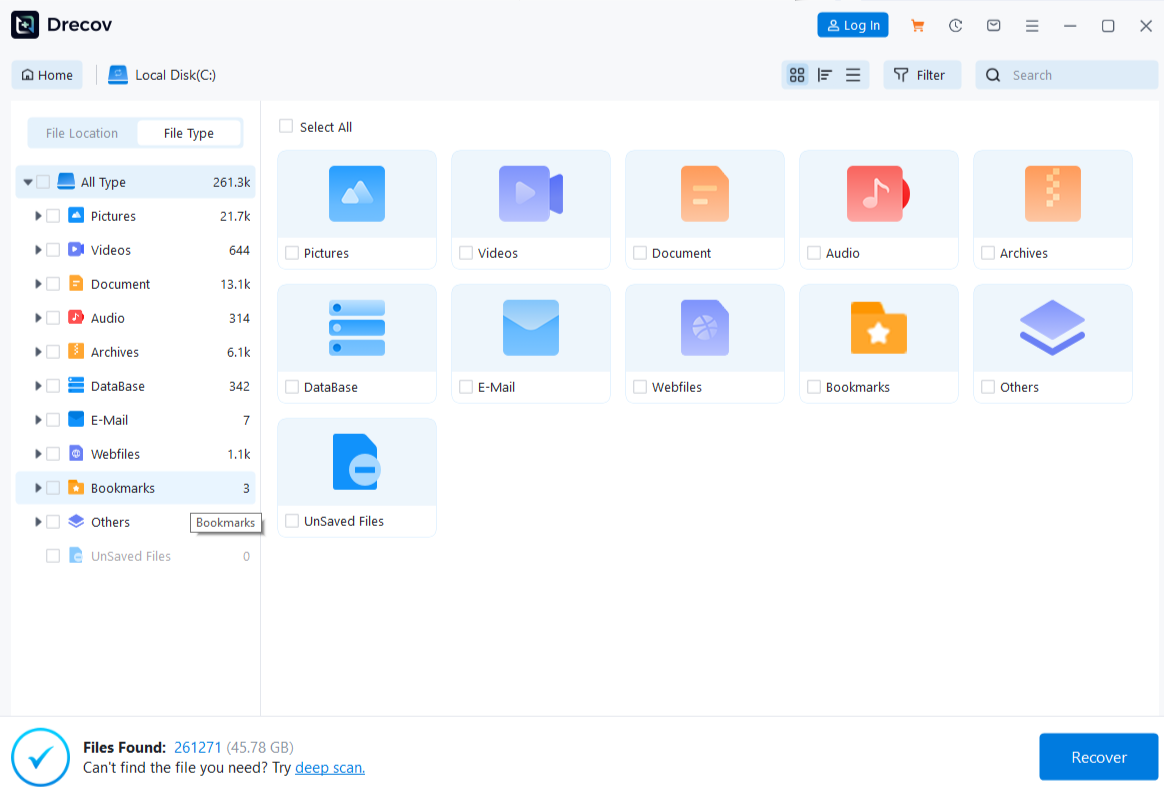
Step 2: Run Quick Scan, then Deep Scan only if stable
Start Quick Scan and inspect the former folder. Filter by PNG, approximate date, name, path, dimensions where available, and expected file size. If the candidate is absent and the source remains reliably readable, run Deep Scan. Avoid repeated scans of questionable storage.
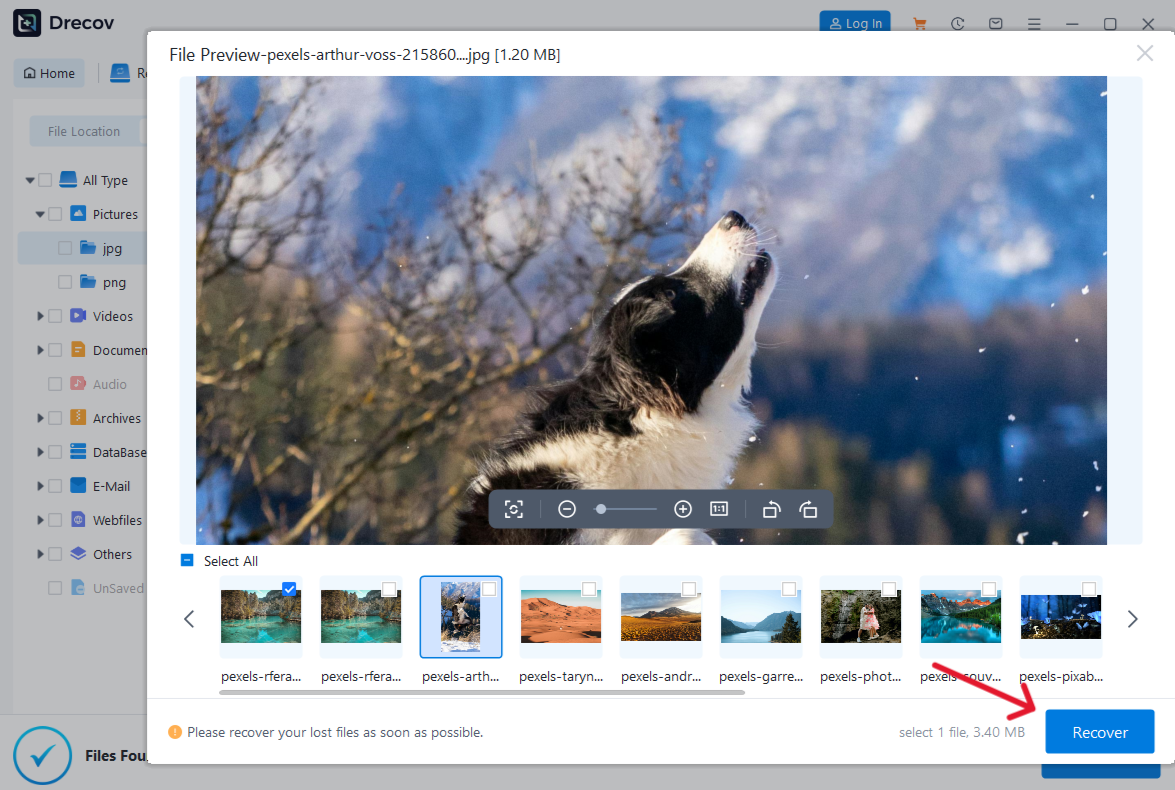
Step 3: Preview and recover to another drive
Preview representative PNG candidates, including transparency where the preview supports it. A thumbnail does not prove full-resolution integrity. Recover selected files to the prepared healthy destination, never to the source. Check Drecov Folder or Recovery Folder if the old hierarchy cannot be reconstructed. Open the recovered images in multiple viewers and keep one copy untouched before using any PNG fixer. The guide to recovering deleted photos explains backup and trash options as well.
⚠ Warning: Install it on a drive different from the one where your data was lost to prevent overwriting.
A Practical Verification Checklist
- Confirm the expected width and height rather than trusting a thumbnail.
- Zoom to 100 percent and inspect edges, gradients, text, and fine lines.
- Test transparency on light, dark, and colored backgrounds.
- Compare color in a managed editor and a browser.
- Open the file after closing the repair program.
- Keep the original, repaired copy, and fresh export separately named.
For broader image symptoms, see the decision path for fixing corrupted image files. If the extension itself is uncertain, the overview of image file formats helps distinguish PNG from JPEG, WebP, TIFF, and project formats without forcing conversion.
Questions About PNG Fixers
Can a CRC fixer restore the original pixels?
No. A CRC reports whether chunk bytes match the stored checksum. Recalculating it cannot reconstruct bytes that changed or disappeared.
Why does the PNG open in a browser but not my editor?
Decoders differ in strictness and supported chunks. Validate the file, then export from the successful decoder only after confirming full dimensions and transparency.
Can I repair a zero-byte PNG?
No image data exists inside a zero-byte placeholder. Find a backup, version history, original project, or recoverable deleted copy.
Should I convert the PNG to JPEG?
Only if transparency and lossless reproduction are unnecessary. JPEG conversion can remove alpha and introduce compression artifacts, so preserve a clean PNG whenever possible.
Does Drecov repair a corrupted PNG?
Drecov recovers a missing or inaccessible file from stable storage. Use a PNG-aware validator or editor for internal corruption after an intact candidate has been recovered.
Conclusion
The right PNG fixer follows the evidence. Confirm the true file type, compare decoders, inspect signature and chunks, and decide whether re-export, narrow structural repair, or a fresh source is appropriate. Never sacrifice the only original to experimentation. If the PNG was deleted or its partition disappeared, Drecov can recover candidates to another healthy drive before image repair begins. Verify dimensions, color, transparency, and full-resolution content before accepting any result.
⚠ Warning: Install it on a drive different from the one where your data was lost to prevent overwriting.





