







Understanding Cyclic Redundancy Check Errors
What Is a Cyclic Redundancy Check Error?
A cyclic redundancy check error is a warning generated when a system detects inconsistencies while reading or transferring data. The CRC process is designed to verify data integrity by comparing stored information against a calculated checksum. If the values do not match, the operating system assumes that the data may be damaged or corrupted.
Users commonly encounter this issue when opening files, copying data between drives, accessing external storage devices, or performing backup operations. The error may appear on internal hard drives, SSDs, USB flash drives, memory cards, CDs, DVDs, and external storage devices.
A CRC error does not always mean that the data is permanently lost. In many situations, the problem results from temporary read failures, damaged sectors, loose connections, or file system inconsistencies. However, repeated CRC errors may indicate a more serious hardware issue.
When the message appears, it is important to avoid unnecessary write operations. Continuing to use a failing drive can worsen the condition of damaged sectors and reduce recovery opportunities.
Understanding what triggers CRC validation failures helps users choose the most effective repair strategy. Early diagnosis often improves the chances of restoring access to files while minimizing additional damage to the storage device.
How CRC Verification Protects Data Integrity
CRC technology exists to ensure that information remains accurate during storage and transmission. Every time data is written to a storage device, a checksum can be generated based on the file contents. When the data is later accessed, the checksum is recalculated and compared against the original value.
If the two values match, the system assumes the file remains intact. If they differ, the system reports a data error cyclic redundancy check warning.
This process helps detect:
- File corruption
- Damaged sectors
- Transmission errors
- Storage failures
- Unexpected modifications
CRC validation is widely used because it is fast and effective at identifying integrity issues. Modern operating systems rely on similar verification methods to monitor storage reliability and prevent corrupted data from being used unknowingly.
While CRC can identify problems, it cannot repair them automatically. Once an inconsistency is detected, additional troubleshooting tools are required to locate the root cause and restore functionality.
As storage devices age, CRC-related warnings may become more frequent. Monitoring these alerts can provide valuable insight into overall drive health and help users avoid sudden data loss events.
Where Data Error Cyclic Redundancy Check Messages Commonly Appear
Users often encounter CRC errors in several common situations.
One of the most frequent scenarios involves external hard drives. When attempting to copy files from a failing drive, Windows may display a data error cyclic redundancy check message and stop the transfer process.
Other situations include:
- Opening damaged documents
- Accessing corrupted folders
- Reading scratched CDs or DVDs
- Recovering data from failing drives
- Connecting faulty USB devices
- Transferring large files
The error can also occur during system backups. Backup software may fail when it encounters unreadable sectors or corrupted files.
In enterprise environments, CRC warnings sometimes appear on RAID arrays or network storage systems experiencing hardware issues.
Recognizing when and where the error occurs can help narrow down possible causes. For example, a CRC error affecting only one file may indicate corruption, while errors affecting an entire drive may point to hardware or file system problems.
⚠️ Warning: If a drive repeatedly produces CRC errors across multiple folders and files, immediately back up accessible data before attempting repairs.
Common Causes Behind Cyclic Redundancy Check Errors
Bad Sectors and Drive Damage
Bad sectors represent one of the most common causes of CRC failures. A bad sector is a portion of storage media that can no longer reliably store or retrieve information.
Physical bad sectors often develop due to:
- Mechanical wear
- Manufacturing defects
- Power interruptions
- Overheating
- Physical impact
When a file occupies a damaged sector, the operating system may be unable to read the data correctly. The resulting mismatch triggers a cyclic redundancy check error.
Logical bad sectors can also occur when file system structures become corrupted. Unlike physical damage, logical sector problems may sometimes be repaired using software tools.
Hard drives are especially vulnerable because they contain moving mechanical components. SSDs can also experience storage failures, although the underlying causes differ.
Users noticing slow performance, unusual noises, or repeated CRC warnings should investigate storage health as soon as possible. Delayed action increases the likelihood of additional data loss.
Corrupted Files and File System Problems
File corruption is another frequent source of CRC failures.
Corruption may occur when:
- Systems shut down unexpectedly
- Software crashes during file operations
- Malware modifies stored data
- Storage devices disconnect improperly
- Power failures interrupt write operations
The file system itself may also become damaged. File systems maintain records describing where files are stored. If these structures become inconsistent, the operating system may struggle to locate and validate data correctly.
Corrupted file systems often produce additional symptoms such as:
- Missing folders
- Invalid file names
- Read/write failures
- Access denied errors
- Unexpected drive behavior
Repair utilities such as CHKDSK can sometimes resolve logical inconsistencies and restore access to affected files.
However, severe corruption may require specialized recovery procedures before repair attempts begin.
Connection Issues and Hardware Failures
Not all CRC errors originate from the storage media itself. In some cases, communication problems between devices generate read failures.
Potential connection-related causes include:
- Damaged USB cables
- Loose SATA connections
- Faulty USB ports
- Defective card readers
- Power delivery problems
A poor connection may interrupt data transmission, causing CRC validation to fail even though the underlying files remain intact.
Hardware controllers can also contribute to the problem. Malfunctioning drive electronics or motherboard components sometimes generate intermittent read errors.
Testing alternative cables, ports, and adapters often helps identify these issues quickly.
Before assuming that a drive has failed completely, users should verify all physical connections and eliminate external factors that may be interfering with communication.
⚠️ Warning: Never force a failing drive to perform repeated scans if unusual clicking sounds are present, as additional damage may occur.
How to Perform a Cyclic Redundancy Check Error Fix
Method 1: Reconnect and Inspect the Storage Device
Before using advanced repair tools, users should verify that the storage device is connected properly.
Test Environment
- Windows 11 Pro 24H2
- External USB hard drive
- USB 3.2 connection
- CRC error during file transfer
Steps to Check Physical Connections
- Safely disconnect the storage device.
- Inspect the cable for visible damage.
- Connect the device to a different USB port.
- Test another cable if available.
- Connect the drive to another computer.
- Attempt to access the affected files again.
This simple procedure often resolves CRC issues caused by unstable connections.
Many users immediately assume that storage media has failed when the actual problem involves a damaged cable or malfunctioning port.
Testing the drive on another system can also help determine whether the issue originates from the device or the computer itself.
If CRC errors disappear after changing ports or cables, no further repairs may be necessary.
Method 2: Run CHKDSK to Repair File System Errors
CHKDSK is one of Windows’ most useful built-in repair tools. It can detect logical file system problems and attempt to repair bad sectors.
Test Environment
- Windows 11 Pro
- NTFS external hard drive
- CRC errors during file access
Steps to Run CHKDSK
- Open Command Prompt as Administrator.
- Enter:
chkdsk X: /f /r - Replace X with the correct drive letter.
- Press Enter.
- Allow the scan to complete.
- Review the repair report.
- Restart the system if prompted.
The /f parameter repairs logical file system issues, while /r attempts to identify unreadable sectors and recover usable information.
Depending on drive size and condition, the process may require several hours.
Many users consider CHKDSK the first serious cyclic redundancy check error fix because it addresses both file system inconsistencies and sector-related issues.
⚠️ Warning: Interrupting CHKDSK while repairs are in progress may increase the risk of file system corruption.
Method 3: Use SFC and DISM to Repair System Files
Sometimes a cyclic redundancy check error is not caused by the storage device itself. Damaged Windows system files can interfere with file operations, drive access, and storage communication, resulting in CRC-related warnings.
System File Checker (SFC) and Deployment Image Servicing and Management (DISM) are built-in Windows utilities designed to repair operating system corruption.
Test Environment
- Windows 11 Pro 24H2
- Internal NVMe SSD
- CRC error during backup operations
- Administrative account access
Steps to Run SFC
- Open Command Prompt as Administrator.
- Enter:
sfc /scannow - Press Enter.
- Wait for the verification process to complete.
- Review the scan results.
If SFC reports unresolved issues, proceed with DISM.
Steps to Run DISM
- Open Command Prompt as Administrator.
- Run:
DISM /Online /Cleanup-Image /RestoreHealth - Allow the scan and repair process to finish.
- Restart the computer.
- Test the affected storage device again.
SFC checks protected system files and replaces corrupted versions. DISM repairs the Windows image used by SFC for file replacement.
These tools are particularly useful when CRC errors occur during system-level operations rather than direct file access.
Although they do not repair physical drive damage, they can eliminate operating system corruption that contributes to storage-related problems.
Method 4: Recover Important Files with PandaOffice Drecov Before Repairs
Before attempting aggressive repairs on a failing drive, recovering important data should often be the highest priority. If the drive condition continues to deteriorate, repair attempts may become less effective and valuable files may become inaccessible.
Test Environment
- Windows 11 Pro
- 2TB external hard drive
- Multiple CRC errors
- PandaOffice Drecov latest version
Steps to Recover Data
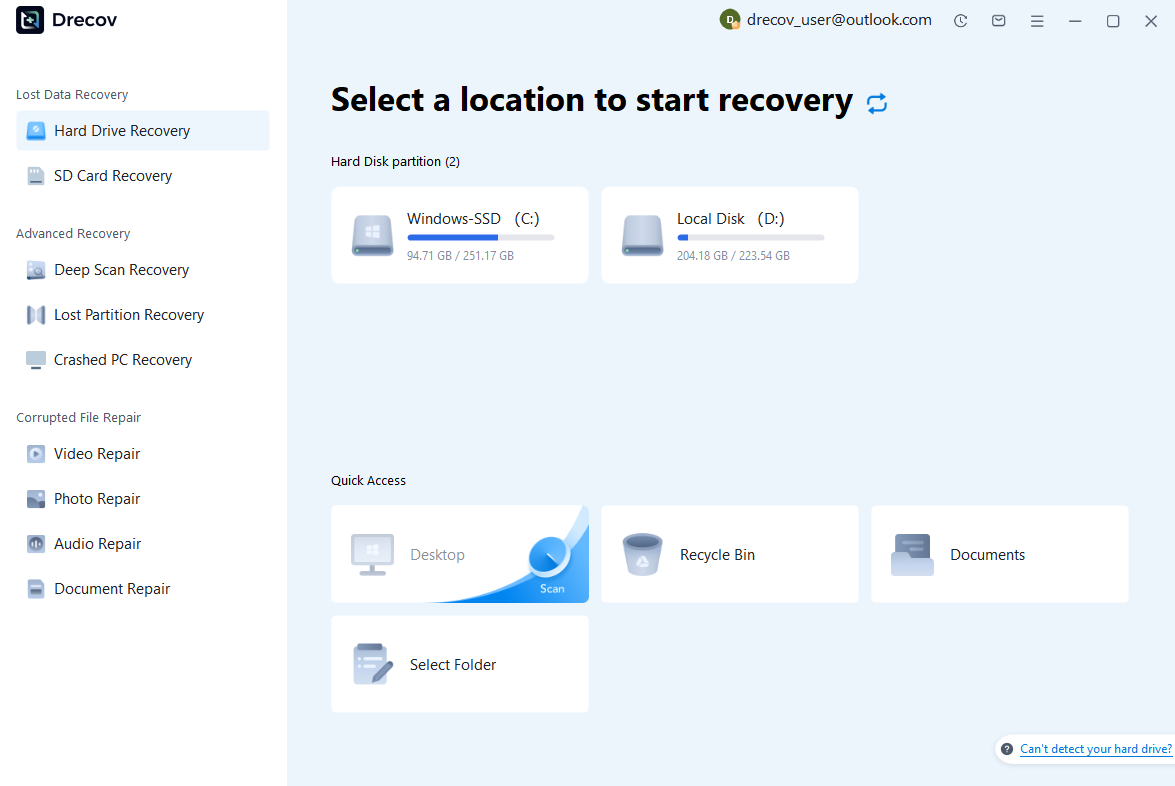
Step 1: Scan the Storage Device (SD Card / Hard Drive / USB)
Connect your device (SD card, HDD/SSD, or USB drive) to your computer and launch PandaOffice Drecov. Select the target device and start the scan. The software will perform a quick scan and deep scan to detect lost or deleted data.
Step 2: Locate and Preview Lost Files
After scanning, browse the detected files and use the preview feature to check recoverable data. You can preview documents (Word, Excel, PDF), photos, and videos to ensure file integrity before recovery.

Step 3: Recover and Save to a New Location
Select the files you want to restore and click recover. Save all recovered data to a different drive or location (not the original device) to avoid overwriting lost data.

Why Choose PandaOffice Drecov Recovery Software?
PandaOffice Drecov offers a fast, secure, and user-friendly solution for recovering lost files across multiple scenarios. Whether you need email recovery, ZIP File Recovery, format data recovery, or help to recover deleted drafts Outlook, the software provides reliable recovery performance for both personal and business users.
PandaOffice Drecov supports recovery from formatted hard drives, SSDs, USB drives, SD cards, and external storage devices. Its advanced scanning engine can locate deleted archives, damaged ZIP files, lost Outlook drafts, and accidentally removed documents with high accuracy. For users searching for how to find deleted messages in Teams, PandaOffice Drecov can also help recover exported chat files, attachments, and related local cache data when available.
Key advantages include:
- Deep scan technology for complex data loss situations
- Support for emails, archives, videos, photos, and office documents
- Recovery from accidental deletion, formatting, corruption, and system crashes
- Easy preview before restoring files
- Compatible with Windows and multiple storage devices
Unlike complicated enterprise recovery tools, PandaOffice Drecov keeps the recovery process simple. Users can scan, preview, and restore files in just a few steps without technical expertise.
Whether you are dealing with lost Outlook drafts, corrupted ZIP archives, formatted drives, or missing communication data, PandaOffice Drecov provides an efficient and practical recovery experience designed to minimize downtime and protect important files.
Disk imaging ensures that even partially corrupted drives can be preserved. This is often the safest approach before attempting any aggressive repair operations for fix bad sectors on hard drive situations.
When a drive experiences repeated data error cyclic redundancy check warnings, immediate recovery may prevent permanent file loss.
Recovery software often succeeds because it can access sectors directly and bypass certain file system problems that prevent normal operating system access.
Users should always save recovered files to a different drive to avoid overwriting potentially recoverable data.
This approach is particularly valuable when important documents, photos, videos, or business files are involved.
⚠️ Warning: Never install recovery software directly onto the failing drive, as new data writes may overwrite lost files.
Method 5: Format the Drive After Backing Up Data
If previous solutions fail and the drive remains accessible, formatting may help restore functionality by rebuilding the file system structure.
Formatting should only be considered after:
- Recovering important files
- Creating backups
- Verifying drive health
Test Environment
- Windows 11 Pro
- 500GB external HDD
- Persistent CRC errors
- Backup completed successfully
Steps to Format the Drive
- Open File Explorer.
- Right-click the affected drive.
- Select Format.
- Choose an appropriate file system.
- Enable Quick Format if desired.
- Confirm the operation.
- Wait for completion.
- Test the drive again.
Formatting removes file system inconsistencies and creates a fresh storage structure.
However, formatting does not repair severe physical damage. If CRC errors return after formatting, hardware failure may be present.
Users should continue monitoring the drive for additional warning signs, including slow performance, unusual noises, or repeated read failures.
For older drives with recurring CRC issues, replacement may be the safest long-term solution.
Preventing Future Data Error Cyclic Redundancy Check Issues
Monitor Drive Health Regularly
Many CRC-related problems develop gradually rather than appearing suddenly. Regular health monitoring can help users identify warning signs before major data loss occurs.
Modern drives often support SMART (Self-Monitoring, Analysis, and Reporting Technology) diagnostics. SMART attributes can provide insight into:
- Reallocated sectors
- Read error rates
- Temperature history
- Power-on hours
- Pending sector counts
Periodic health checks allow users to detect deteriorating storage conditions early.
Additional monitoring practices include:
- Reviewing system event logs
- Running occasional disk scans
- Watching for performance degradation
- Checking manufacturer diagnostic tools
A proactive maintenance strategy reduces the likelihood of unexpected CRC failures and improves long-term storage reliability.
Protect Storage Devices from Physical Damage
Physical damage remains one of the leading causes of CRC errors.
Hard drives contain delicate internal components that can be affected by:
- Drops
- Vibration
- Excessive heat
- Moisture
- Dust exposure
External drives are particularly vulnerable because they are frequently transported between locations.
To minimize risks:
- Store drives in protective cases.
- Avoid sudden impacts.
- Maintain proper ventilation.
- Keep liquids away from storage devices.
- Use surge protection when possible.
SSDs are generally more resistant to physical shock, but they still require proper handling and environmental protection.
Preventing physical damage helps preserve both data integrity and overall device lifespan.
Maintain Reliable Backup Practices
No repair method can guarantee successful recovery in every situation. For this reason, backups remain the most effective protection against data loss.
A strong backup strategy typically includes:
- Local backups
- External drive backups
- Cloud storage copies
- Versioned backups
- Automated scheduling
The widely recommended 3-2-1 backup approach involves:
- Three copies of important data
- Two different storage media types
- One offsite backup location
Regular backups significantly reduce the impact of CRC errors because users can restore data from a healthy copy rather than relying entirely on recovery tools.
Whether the problem involves corruption, hardware failure, or accidental deletion, backup availability simplifies the recovery process considerably.
⚠️ Warning: Backups should be tested periodically to ensure files remain accessible and intact.
Frequently Asked Questions About CRC Errors
Can a Cyclic Redundancy Check Error Be Fixed?
Yes, in many situations.
A successful cyclic redundancy check error fix depends on the underlying cause. File system corruption, connection issues, and certain logical errors can often be repaired using built-in utilities such as CHKDSK, SFC, and DISM.
However, severe physical damage may require data recovery efforts followed by drive replacement.
Does a CRC Error Mean the Drive Is Failing?
Not always.
A CRC error can result from:
- Corrupted files
- Damaged sectors
- Loose connections
- Faulty cables
- File system problems
Repeated CRC warnings across multiple files and folders may indicate worsening drive health, but additional diagnostics are necessary before confirming hardware failure.
Monitoring SMART information and running diagnostic tools can help determine the true condition of the drive.
Will Formatting Remove CRC Errors?
Formatting can resolve CRC errors caused by file system inconsistencies.
However, formatting cannot repair:
- Physical bad sectors
- Damaged controllers
- Mechanical failures
- Severe hardware defects
If the underlying problem is hardware-related, CRC errors may return even after formatting.
Users should always recover important files before formatting a problematic drive.
Can Lost Files Be Recovered After a CRC Error?
Often, yes.
Recovery success depends on factors such as:
- Extent of drive damage
- Amount of overwritten data
- File system condition
- Recovery timing
Many files affected by a data error cyclic redundancy check issue can still be recovered using specialized recovery software if action is taken quickly.
The sooner recovery begins, the greater the likelihood of successful restoration.
Final Thoughts on Resolving CRC Problems
Best Solutions for Different CRC Scenarios
CRC errors can arise from many different sources, making accurate diagnosis essential.
For example:
- Connection problems may only require cable replacement.
- File system corruption may respond well to CHKDSK.
- System file issues can often be repaired with SFC and DISM.
- Data loss situations may require recovery software.
- Severe hardware failures may necessitate drive replacement.
Choosing the appropriate solution depends on identifying the root cause rather than simply addressing the error message itself.
Users who respond quickly often achieve better recovery outcomes and avoid more extensive storage failures.
Key Takeaways for Long-Term Data Protection
A cyclic redundancy check error should never be ignored. Although some CRC warnings result from minor issues, others may indicate developing hardware problems that could eventually lead to significant data loss.
Important takeaways include:
- Stop using affected drives immediately when critical data is involved.
- Verify cables and connections first.
- Run CHKDSK to repair logical errors.
- Use SFC and DISM when Windows corruption is suspected.
- Recover important files before major repairs.
- Maintain regular backups.
- Monitor drive health proactively.
By combining preventive maintenance, proper troubleshooting techniques, and reliable backup strategies, users can minimize the impact of CRC-related issues and maintain better long-term storage reliability.






