







If you share your computer with family members, coworkers, or friends, keeping your activity private becomes important. One of the easiest ways to protect your privacy is learning how to delete recent files in Windows 10. Recent files are documents, images, videos, spreadsheets, and other items that Windows keeps track of for quick access. While this feature is convenient, it can also expose your personal or confidential files to anyone using your PC.
In this comprehensive guide, you will learn multiple methods to remove recent files in Windows 10, clear Quick Access history, disable recent items completely, and improve your privacy. Whether you want to delete a single file from the history or clear everything at once, this tutorial covers everything step by step. Furthermore, because managing files can sometimes lead to accidental deletions, we will explore advanced file management techniques to ensure your critical data remains secure throughout the cleanup process.
What Are Recent Files in Windows 10?
Recent files are shortcuts or references to files you recently opened on your computer. Windows 10 automatically records this activity to help users quickly reopen documents and folders. However, if you want to maintain your privacy and keep your workspace clean, learning how to delete recent files in Windows 10 is an essential skill for managing these automatic system tracks effectively.
You can usually find recent files in:
- File Explorer Quick Access
- Start Menu
- Recent Items folder
- Microsoft Office applications
- Taskbar jump lists
Although convenient, these records can clutter your system and compromise privacy. Understanding how these tracking systems operate allows you to manage your operating system more efficiently while keeping your digital footprint minimal.
Why Delete Recent Files in Windows 10?
There are several reasons users want to clear recent file history:
- Protect Personal Privacy: Anyone using your computer can see what files you recently accessed.
- Remove Clutter: Recent file lists can become overcrowded with unnecessary items.
- Improve Organization: Cleaning file history makes navigation easier and more efficient.
- Hide Sensitive Work Documents: Business users often remove recent files to prevent accidental exposure of confidential data.
- Troubleshooting File Explorer Issues: Sometimes corrupted recent item history can cause Quick Access problems, leading to slow loading times or interface crashes.
By executing regular cleanups, you can ensure your system remains responsive and your personal data remains private.
Method 1: How to Delete Recent Files in Windows 10 from Quick Access
Quick Access is the most common location where recent files appear in Windows 10. Every time you open a document or photo, Windows generates a shortcut here.
Steps to Clear Recent Files from Quick Access
- Step 1: Open File Explorer by clicking its taskbar icon or pressing the Windows Key + E hotkey.
- Step 2: Click on File in the upper-left corner of the window.
- Step 3: Select Change folder and search options from the dropdown menu to open the Folder Options dialog box.
- Step 4: Under the General tab, locate the Privacy section at the bottom.
- Step 5: Click the Clear button next to Clear File Explorer history.
- Step 6: Press OK to close the window.
This instantly removes all recent files and frequently used folders from Quick Access, restoring a clean state to your file management view.
Method 2: Remove Individual Recent Files
If you only want to remove specific files instead of clearing everything, follow these steps. This method is perfect if you want to retain your general history but need to hide specific sensitive documents.
Steps to Delete Specific Recent Files
- Step 1: Open File Explorer using the Windows Key + E shortcut.
- Step 2: Click Quick Access in the left-hand navigation pane.
- Step 3: Locate the specific file you want to remove from the Recent files list.
- Step 4: Right-click the file to open the context menu.
- Step 5: Select Remove from Quick access.
The file will disappear from the recent file history without deleting the actual file from your computer.
Method 3: Clear Recent Files Using the Recent Items Folder
Windows stores recent file shortcuts in a hidden system folder. If you want to know how to delete recent files in Windows 10 at the root level, clearing this folder ensures that the hidden cache is completely emptied.
Open the Recent Items Folder
- Step 1: Press Windows + R to open the Run dialog box.
- Step 2: Type
%AppData%\Microsoft\Windows\Recentinto the field. - Step 3: Press Enter or click OK.
You will see all recent file shortcuts stored by Windows.
Delete Recent Files
- Step 1: Press Ctrl + A to select all items inside the folder.
- Step 2: Right-click on any highlighted file shortcut.
- Step 3: Choose Delete from the menu, or press the Delete key on your keyboard.
This removes the background recent file history from Windows 10 completely.
Method 4: Disable Recent Files Completely in Windows 10
If you do not want Windows to track recent files at all, you can disable the feature permanently through the Settings app.
Disable Recent Files in Settings
- Step 1: Open the Settings menu by pressing Windows Key + I.
- Step 2: Click on the Personalization category.
- Step 3: Select Start from the left-hand sidebar menu.
- Step 4: Turn off the toggle switch for “Show recently opened items in Jump Lists on Start or the taskbar and in File Explorer Quick Access”.
- Step 5: Turn off “Show recently added apps” if you also want to hide newly installed programs.
This prevents Windows from recording recently opened files across all system areas moving forward.
Method 5: Clear File Explorer History
File Explorer also keeps a search and navigation history that can reveal your previous activities.
Steps to Clear File Explorer History
- Step 1: Open File Explorer.
- Step 2: Click File on the top menu bar.
- Step 4: Select Change folder and search options.
- Step 5: Under the General tab, find the Privacy section.
- Step 6: Click Clear, then hit Apply and OK.
This removes recent searches, frequently used folders, and structural recent files simultaneously.
Method 6: Delete Recent Files from Microsoft Office
Microsoft Office applications maintain their own recent document lists independently of the Windows system settings.
Clear Recent Files in Microsoft Word
- Step 1: Open Microsoft Word.
- Step 2: Click File and select Open.
- Step 3: Right-click a recent document you wish to hide.
- Step 4: Choose Remove from list.
Remove All Recent Documents
- Step 1: Go to File and click Options.
- Step 2: Select the Advanced tab.
- Step 3: Scroll down to the Display section.
- Step 4: Set the number for “Show this number of Recent Documents” to 0.
- Step 5: Click OK to apply changes.
You can repeat similar steps for Excel and PowerPoint to manage your productivity history.
Method 7: Clear Taskbar Jump Lists
Jump Lists display recently opened files when you right-click application icons pinned to the taskbar.
Steps to Clear Jump Lists
- Step 1: Open the Settings application (Windows Key + I).
- Step 2: Go to Personalization and choose Start.
- Step 3: Turn off “Show recently opened items in Jump Lists on Start or the taskbar”.
This clears and disables Jump Lists instantaneously.
Method 8: Use Disk Cleanup to Remove Temporary History
Disk Cleanup can help remove temporary files, system cache, and background installation logs that track user behavior. While this system tool is primarily designed for general maintenance, running it is also an excellent supplementary step when you are figuring out how to delete recent files in Windows 10 and thoroughly wiping your digital footprint from the OS drive.
Steps to Run Disk Cleanup
- Step 1: Search for Disk Cleanup in the Windows Search Bar.
- Step 2: Open the application and select your system drive (usually C:).
- Step 3: Check temporary file categories, thumbnails, and temporary internet files.
- Step 4: Click OK, then choose Delete Files to confirm the action.
While this does not specifically target recent shortcuts, it improves privacy and general system performance.
Method 9: Delete Recent Files Using Windows Registry
Advanced users can disable recent file tracking through the Windows Registry Editor.
Warning: Editing the registry incorrectly may affect system stability or cause system errors. Create a full system backup before proceeding.
- Step 1: Press Windows + R, type
regedit, and press Enter to open the Registry Editor. - Step 2: Navigate to the following path:
HKEY_CURRENT_USER\Software\Microsoft\Windows\CurrentVersion\Explorer - Step 3: Locate the value named ShowRecent. If it does not exist, right-click an empty space, choose New > DWORD (32-bit) Value, and name it ShowRecent.
- Step 4: Double-click ShowRecent and set its value data to 0.
- Step 5: Restart your computer to apply the registry configurations.
Method 10: Clear Recent Files with Group Policy Editor
Windows 10 Pro, Enterprise, and Education users can disable recent files completely through the Local Group Policy Editor.
- Step 1: Press Windows + R, type
gpedit.msc, and hit Enter. - Step 2: Navigate to:
User Configuration > Administrative Templates > Start Menu and Taskbar. - Step 3: Scroll down the right pane to find Do not keep history of recently opened documents.
- Step 4: Double-click the policy, select Enabled, and click Apply followed by OK.
- Step 5: Restart the computer to enforce the policy change across all local user accounts.
How to Automatically Clear Recent Files on Shutdown
Some users prefer automatic cleanup for better privacy, ensuring that no records remain at the end of a session.
Use Storage Sense
- Step 1: Open Settings and go to System.
- Step 2: Select Storage from the left column.
- Step 3: Enable Storage Sense and configure it to clean temporary files periodically.
While Storage Sense mainly handles temporary files, combining it with disabled recent tracking improves system privacy automatically.
What to Do If You Accidentally Delete Actual Files?
When cleaning up clutter or executing commands like Ctrl + A combined with Delete, users sometimes make mistakes. It is common to accidentally delete a real project file instead of its shortcut link. If this happens, your important documents, photos, or business presentations might suddenly vanish.
To ensure complete safety during your file cleanup process, you must know how to handle unintended data loss. You can find official guidance on general operating system maintenance by visiting the Microsoft Support Homepage. If you realize you have removed an actual source file, don’t panic. Below are the steps to recover your files effectively.
Check the Recycle Bin First
Before using advanced tools, check the default system trash location. If you did not use the Shift + Delete shortcut, your file is likely sitting in the Recycle Bin waiting to be restored.
Recovering Lost Files with PandaOffice Drecov Data Recovery Software
When standard recovery options fail, utilizing professional software like PandaOffice Drecov data recovery software is the most reliable way to retrieve permanently lost documents. This tool scans the deep architectures of your storage media to locate and reconstruct deleted files safely.
⚠ Warning: Install it on a drive different from the one where your data was lost to prevent overwriting.
- Step 1: Launch the application and select the specific drive partition or exact folder where your file was originally saved before accidental deletion occurred.

- Step 2: Click the Scan button to begin the data retrieval process. The program will first run a Quick Scan to locate recently deleted file pointers, followed automatically by a Deep Scan to read raw data sectors.

- Step 3: Browse through the found items using the file category filters or the search bar. You can preview individual text documents, pictures, or spreadsheets to verify their structural integrity.
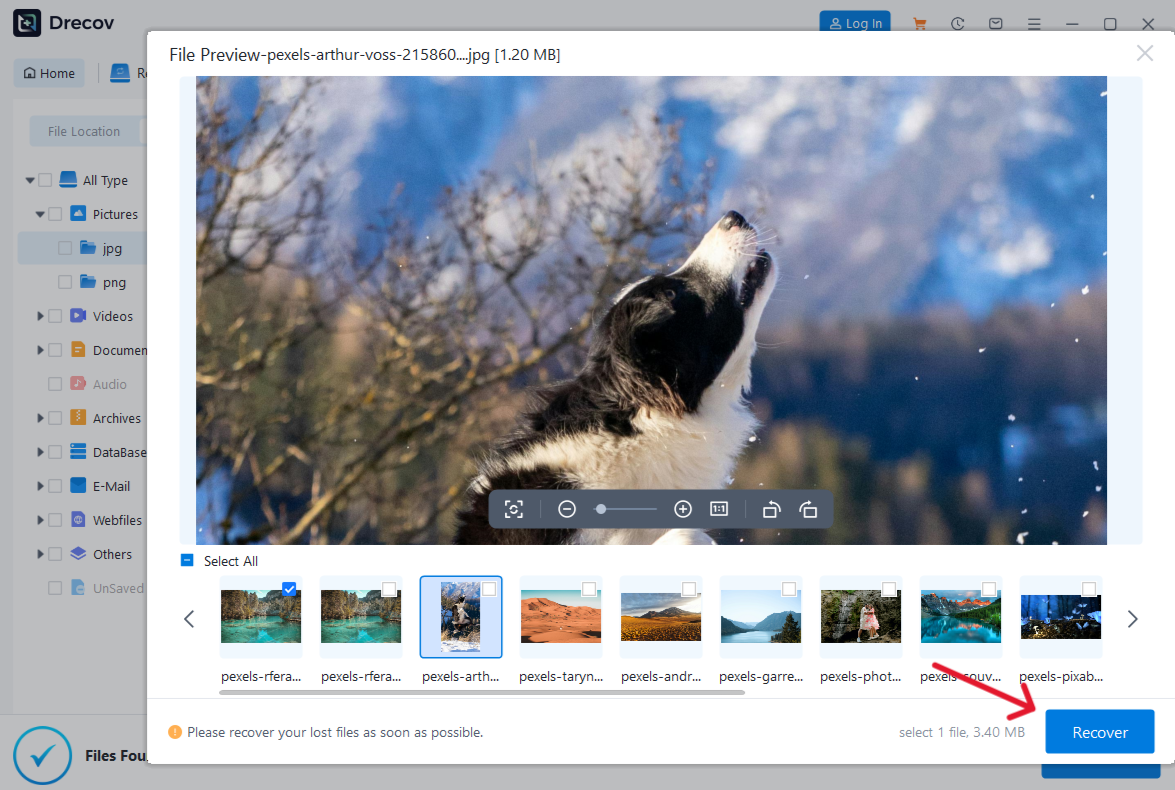
- Step 4: Check the boxes next to the target files you want to retrieve and click the Recover button.
Warning: Always save the recovered files to an external storage media or a completely different local drive partition. Saving them back to the original location can overwrite the underlying sectors and corrupt the files permanently.
For further specialized recovery problems, consult these dedicated guides:
- If you face cloud synchronization storage errors, learn how to handle them through the OneDrive Windows 10 Not Syncing Guide.
- If you work across multiple platforms and experience drive detection errors, check out the guide on How to Fix LaCie Hard Drive Not Showing Up on Mac.
- For quick primary recovery solutions regarding your desktop trash, read the instructions on How to Restore Deleted Files from Recycle Bin.
Benefits of Clearing Recent Files
Deleting recent files offers several distinct advantages for everyday computer users:
- Enhanced Privacy: Keeps sensitive information hidden from family members, classmates, or nosy coworkers who share the workstation.
- Cleaner Interface: Quick Access and the Start menu become easier to navigate when free from redundant history logs.
- Reduced Clutter: Prevents long, confusing file histories that complicate manual file searching.
- Better Performance: In rare cases, clearing history logs helps File Explorer run more smoothly, preventing interface freezes.
Common Problems When Deleting Recent Files
Some users experience issues while clearing recent file history due to underlying system configurations.
Recent Files Keep Reappearing
This usually happens because global tracking remains fully enabled within the account profile.
- Fix: Ensure you disable recent file tracking in Windows Settings as outlined in Method 4.
Quick Access Not Clearing Properly
Sometimes the local File Explorer cache becomes corrupted, preventing the clear command from executing.
- Fix: Open Task Manager, locate Windows Explorer, right-click it, and select Restart to force a cache refresh.
Office Recent Files Still Visible
Office applications store their own history separately from the Windows core shell environment.
- Fix: Clear the item history directly inside the settings panel of Word, Excel, or PowerPoint.
Tips to Maintain Privacy in Windows 10
Here are additional proactive ways to keep your computer activity private:
- Use Guest Accounts: Separate user accounts prevent others from seeing your custom shortcuts or system navigation paths.
- Enable Password Protection: Always secure your account with a strong password or Windows Hello PIN, and lock your screen (Windows Key + L) when stepping away.
- Regularly Clear Browser History: Recent files are not the only records stored on your PC; web cookies and caches also store private user details.
- Use Private Folders: Sensitive documents can be stored in encrypted folders using BitLocker or dedicated compression utilities with password protection.
How to Delete Recent Files in Windows 10 FAQs
Does deleting recent files remove the actual files?
No. Clearing recent files only removes shortcuts and history entries. Your actual files remain safe on the computer. However, if you delete a file inside its true parent folder instead of removing it from a recent list shortcut, the actual file will be lost.
Can I recover deleted recent file history?
Usually no. Once recent file history is cleared via the folder options privacy button, the temporary shortcut links are permanently removed from the system index.
Why does Windows 10 track recent files?
Windows tracks recent files for convenience and quick access, allowing users to return to their ongoing tasks without navigating deep folder directories.
Is Quick Access the same as recent files?
Not exactly. Quick Access includes both your recent files history list and your pinned or frequently used system folders.
Can I disable recent files without deleting history?
Yes. You can disable future tracking within the Windows Settings application while keeping existing historic entries visible until you manually clear them.
Conclusion
Learning how to delete recent files in Windows 10 is essential for protecting privacy and keeping your computer organized. Whether you simply want to remove a few documents from Quick Access or completely disable Windows activity tracking, there are multiple effective methods available.
By regularly clearing recent files, disabling Jump Lists, and managing File Explorer history, you can maintain a cleaner and more secure Windows environment. The process only takes a few minutes and can significantly improve your privacy, especially on shared computers. If an accident occurs during cleanup, solutions like PandaOffice Drecov data recovery software can protect your important data from permanent loss. Combining regular privacy clearings with proactive data safety habits ensures a worry-free computing experience.






