If you are asking what a PSB file is, think of it as a Photoshop working document for a very large project. It can retain layers and other editing information in a file that exceeds ordinary PSD limits. Open it in a compatible version of Photoshop before treating the extension as damage. If a PSB has gone missing, look for the original location, a saved copy, and Photoshop recovery information before scanning the disk. Do not save a new file over the missing original’s drive.
What makes PSB different from a normal image?
PSB stands for Photoshop Large Document Format. It is a working format, not just a picture for viewing. A layered design may contain text, masks, adjustment layers, smart objects, and other information that a flat JPEG cannot keep in editable form. Adobe lists PSB among Photoshop’s supported graphic formats and recommends it for documents that exceed the size or dimensions practical for PSD. The file may be large because of its canvas, resolution, layers, or embedded assets.
That explains why a PSB may appear to take a long time to open. Photoshop has to load the document structure, not merely display a compressed preview. Large file size alone is not proof of corruption. Check whether the storage drive has enough free space and whether the computer has the resources the project needs. If an app other than Photoshop refuses the file, confirm that the app actually supports PSB; many simple photo viewers do not.
A PSD and PSB serve similar editing purposes, but PSB is the choice for oversized documents. Adobe’s large-document instructions describe using File > Save As and choosing Large Document Format. They also note that some plug-ins may not work on very large documents. A flattened export such as JPEG, PNG, or TIFF can be useful for delivery, yet it may not preserve every editable part of the original.
Open it without sacrificing the original
Start with the file you actually received or saved. Check its extension and size in File Explorer. Do not rename a JPEG to .psb; changing letters at the end of the name does not convert the contents. In Photoshop, use File > Open and choose the PSB. If it opens, immediately save a second copy to a healthy destination before experimenting with layers, plug-ins, or exports.
If you need to share a view-only version, export a separate image or PDF from the open PSB. Keep the layered source as well. If you only have a flattened export, it cannot recreate all original layers automatically. For a smaller PSD project that will not open, the PSD opening guide covers that adjacent problem. A PSB should not be converted merely because another app cannot preview it.
If Photoshop warns that it cannot read the PSB, make a copy of the file first. Test the copy on a known-good disk and a compatible Photoshop installation. A file truncated by an interrupted save may have the expected name but incomplete data. An available preview or thumbnail can show part of the composition without proving every layer is intact. Do not overwrite the original with a repaired or re-saved attempt.
Which version should you keep?
Keep the editable PSB as the master if the project still needs changes. A JPEG or PNG is useful for viewing and sending, but it does not preserve the same layer structure. A TIFF can be useful in some print workflows, yet the exact export settings matter. Do not delete the PSB just because a smaller export looks correct on screen. Save at least one verified copy on another drive before archiving a large project.
For collaboration, ask the recipient which format their application accepts. A person who only needs to review a design may prefer a flattened preview, while another Photoshop editor needs the layered source. Include linked assets and fonts where the workflow requires them; the PSB file alone may not contain every external element. Record the file name and date of the version that was approved, especially when several large saves exist.
If you must reduce project size, work on a duplicate. Merging layers, flattening, or discarding hidden content can make later edits impossible. Test the smaller copy in Photoshop, compare important layers, and keep the original until the export has been accepted. This is a file-management decision, not a data recovery step.
When the PSB seems to have vanished
First decide whether the document was saved at all. In Photoshop, check recent files and the folder chosen during the last Save As. Search File Explorer for the project name and .psb extension on the drives you actually used. Look for an alternate version on a synced folder or external project disk. A recent item in Photoshop can point to a location that is no longer connected, so confirm the path rather than assuming deletion.
After a crash, reopen Photoshop and look for its recovery prompt before creating a new file with the same name. Photoshop recovery information is meant for interruption scenarios and is not a complete history of every edit. The Photoshop auto-save explanation describes that boundary. If the PSB was in a cloud folder, inspect that service’s version history or trash. If it was on a local Windows drive and you deleted it, check the Recycle Bin first.
Large PSB files may be copied slowly. If you unplugged an external drive during a transfer, compare source and destination sizes. Open the source if it is stable. Keep both versions until you know which one opens correctly. If the original drive clicks, disconnects, or stalls on simple reads, stop software scans and ask about imaging or professional recovery. A fragile device can worsen under repeated full-disk access.
If the local file was deleted, recover it safely
Drecov is Windows data recovery software that can search stable PC drives, SSDs, external disks, and USB devices for missing files. In this article its role is to retrieve a deleted or lost local PSB candidate from the original Windows storage, not to rebuild Photoshop layers or repair a damaged document. Quick Scan, Deep Scan, filtering, and preview help locate likely results before saving to a different healthy drive. Preview availability can vary by format and file condition; do not promise that every PSB will display inside the recovery tool. Drecov also supports Lost Partition Recovery when the former partition itself is missing, but it cannot fix failed hardware.
⚠ Warning: Install it on a drive different from the one where your data was lost to prevent overwriting.
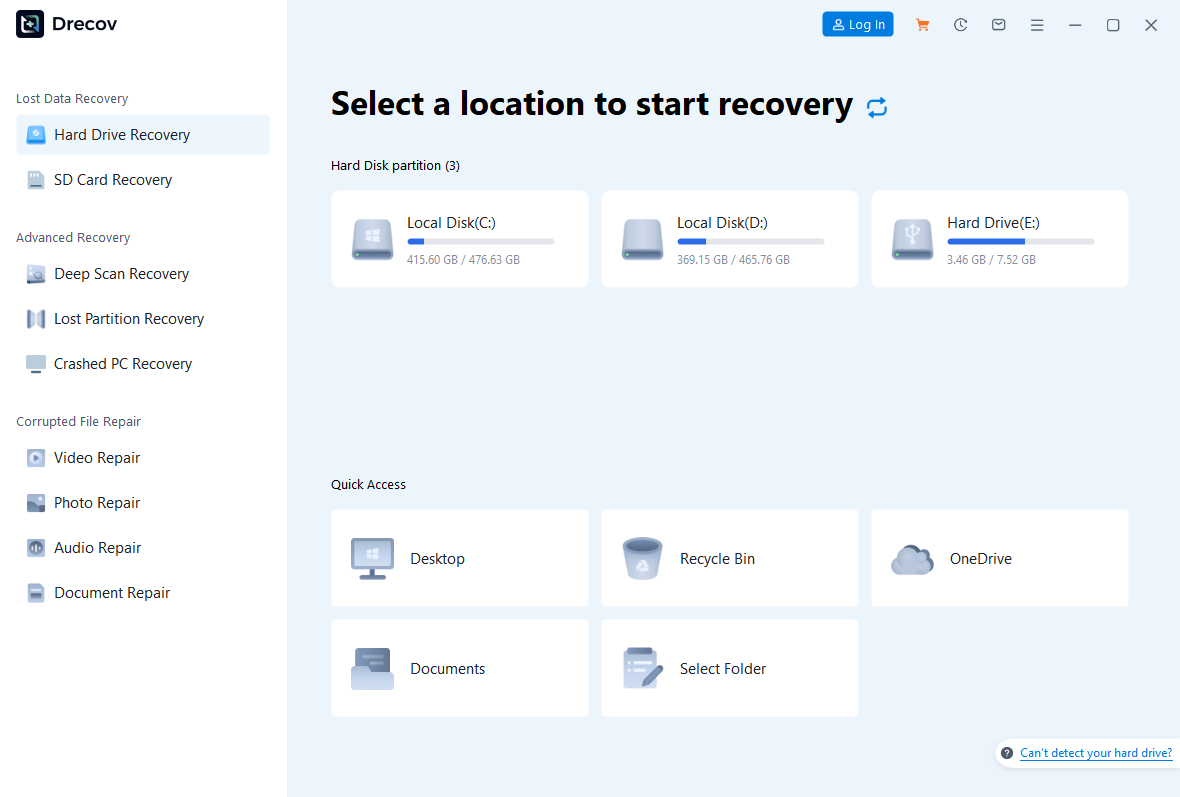
Step 1: Open Drecov and select the former PSB location
Stop saving new work to the drive where the PSB disappeared. Prepare a separate healthy destination large enough for the project. Install and open Drecov from a different drive or partition, then select the original source by capacity and location. If the PSB was only in a cloud account, use its own trash or version history instead of a local disk scan.
Step 2: Start Quick Scan
Run Quick Scan on that source. Search the former project folder and compare file names, dates, and sizes. Check for alternate versions and related PSD or exported files, but keep them separate. A similarly named export is not a replacement for the layered PSB.
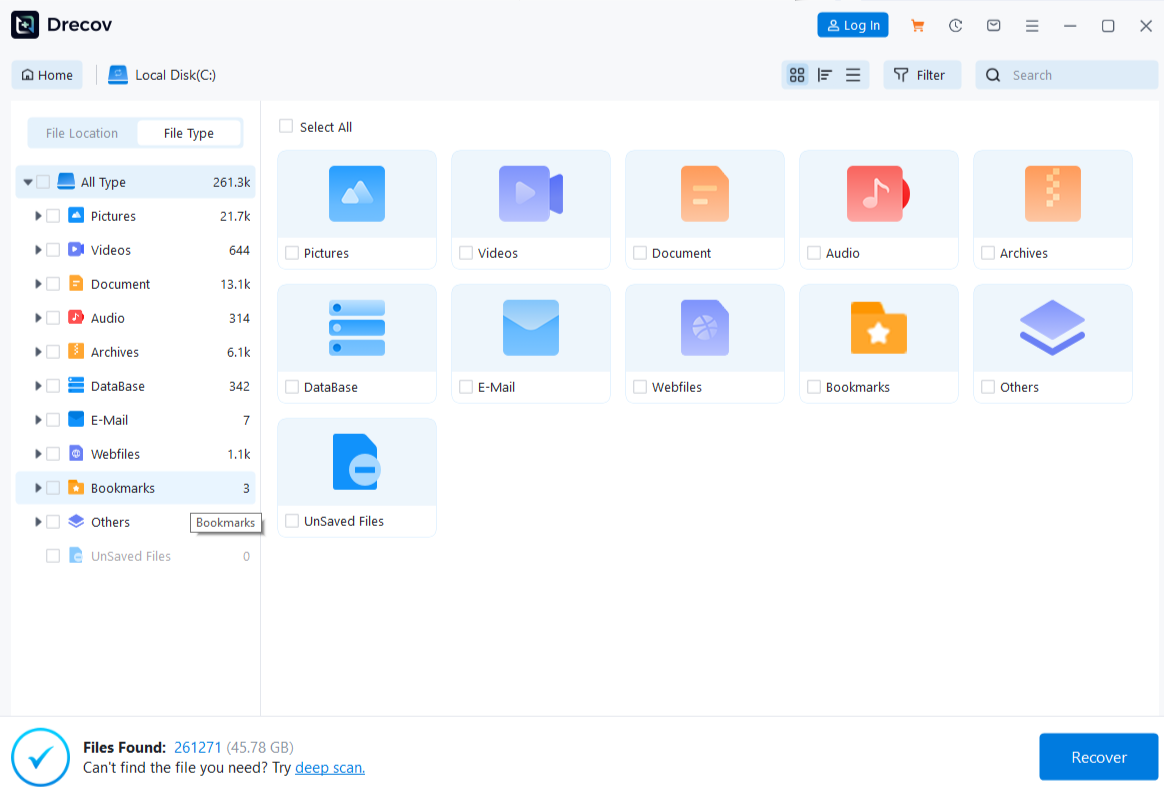
Step 3: Use Deep Scan if the source remains stable
If Quick Scan misses the project and the drive remains consistently readable, try Deep Scan. Stop when the device drops offline or reports serious read errors. A wider scan may find files without their original names, so use the expected file size and nearby project files as clues. Do not scan a failing disk again just because the first scan did not find a match.
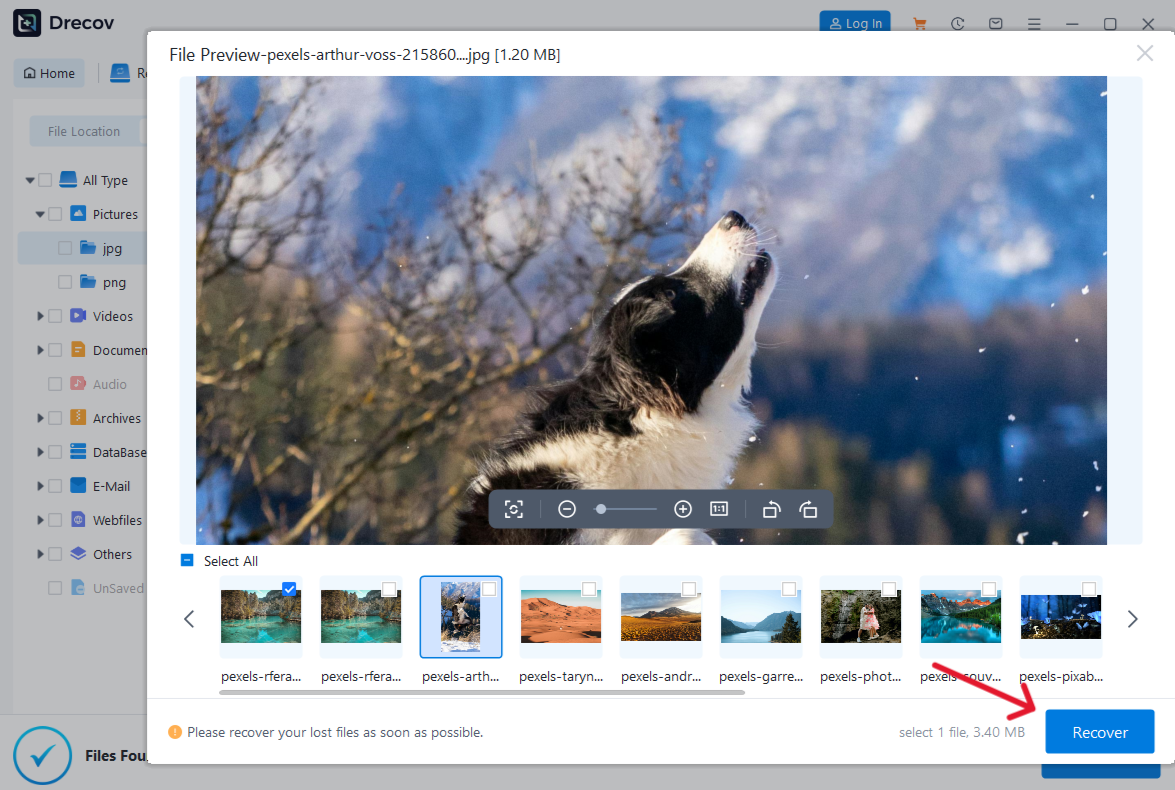
Step 4: Filter and examine candidates
Filter by former path, name, date, and file type when those details are available. Preview supported candidate files, such as exported images, to identify the right project set. A PSB preview, if available, cannot prove that every layer and linked asset survived. Treat each result as a candidate until you open the recovered copy in Photoshop.
Step 5: Recover elsewhere and inspect in Photoshop
Save promising versions to the separate healthy drive, never back onto the source. If they are not in the expected place, check the Drecov Folder or Recovery Folder. Open each candidate in Photoshop, inspect layers and important areas of the canvas, and compare with any earlier export. Keep the untouched source and at least one verified backup before attempting file repair or cleanup.
⚠ Warning: Install it on a drive different from the one where your data was lost to prevent overwriting.
For a deleted preview image rather than the layered project, photo recovery basics can help. It should not be confused with recovering the editable PSB. A flattened picture may preserve how the artwork looked while losing the structure needed for future edits.
Conclusion
A PSB is Photoshop’s large editable document format. Open it in compatible Photoshop, keep the layered original, and use separate exports for sharing. If the file is missing, check recent locations, crash recovery, and backups first. For a deleted local PSB on stable Windows-readable storage, Drecov can search the original drive and save candidates elsewhere; confirm the recovered project opens with its layers before treating it as restored.
⚠ Warning: Install it on a drive different from the one where your data was lost to prevent overwriting.