If CHKDSK reports “cannot open volume for direct access,” it has not gained the access it needs to inspect the selected volume. Another program may be using the drive, Windows may need to check it at startup, or the device may be failing. Do not keep repeating a repair command until you know which case you have. First, confirm that the correct drive is selected and that your important files are safe.
What CHKDSK was trying to access
A volume is the usable storage area Windows gives a drive letter, such as D: or E:. CHKDSK needs to read its file-system information. Repair options also need enough control of that volume to change it. When another process holds the volume open, Windows may refuse direct access. The same message can appear when a removable device disconnects, a security tool interferes, or storage hardware behaves inconsistently.
The wording alone does not prove that the file system is corrupt. It does not prove that the disk is healthy, either. The useful question is what happened just before the message: Were you checking the Windows system drive? Did the error begin after a USB drive vanished? Could you still open ordinary files before you ran the command? Your answer determines whether a scheduled check, a connection test, or data recovery deserves priority.
Microsoft’s CHKDSK command reference explains an important distinction: a read-only check reports status, while repair switches can write changes. The /x switch forces a dismount when necessary. That can interrupt applications using the volume, so it is not a harmless shortcut around every access error.
Start with three observations, not another repair command
Is the selected letter still the right device?
Open File Explorer and identify the drive by its label, capacity, and the files you expect to see. External drives may receive a different letter after reconnection. If you typed chkdsk E: from memory, E: could now represent a card reader, another USB device, or nothing at all. In Disk Management, match the size and file-system label before choosing any action. Close Disk Management without initializing or formatting a disk that holds needed data.
Can the drive read ordinary files without interruption?
Try opening one small, noncritical file and note whether the drive stays connected. A quick successful read makes a temporary lock more plausible, although it cannot certify drive health. If the drive clicks, repeatedly disconnects, reports the wrong capacity, or takes an unusually long time to list a folder, stop testing. Repeated scans can place more stress on unstable media. A professional recovery service or a controlled image made by a qualified technician is safer than another CHKDSK attempt.
Is this the Windows system volume or a removable drive?
Windows uses its own system volume constantly. A request to check C: may therefore offer to schedule work for the next restart. An external volume should normally become available after the applications using it are closed. Treat these as different situations. Scheduling a check on the system drive is not a reason to restart repeatedly if the PC also shows boot failures or storage errors.
If the drive is stable, find the temporary lock
Save open work before changing how a volume is accessed. Close File Explorer windows showing that drive, document editors with files on it, backup programs, disk utilities, and virtual-machine software. Pause any scan that you personally started and can identify. Then unplug and reconnect an external drive once, using a known-good port and cable where possible. Allow Windows to finish detecting it before opening the drive again.
For an external disk with readable files, retry a read-only CHKDSK check from an elevated Command Prompt using its verified letter. Run chkdsk E: only if E: is truly the target; replace that letter with the one you confirmed. This command asks for a status check, not a repair. If the same message returns, note whether another application opens the drive normally. That difference helps distinguish a lock affecting CHKDSK from general loss of access.
Some security products, encryption tools, or backup agents keep a volume in use. Do not disable protection blindly. If you know which application opened the drive, close it normally and test again. If the volume is encrypted, unlock it through the usual Windows or vendor interface and retain the recovery key. A locked BitLocker volume is not fixed by formatting it. If you cannot identify the owner of the lock, leave repair switches alone and protect your data first.
Windows may ask to schedule a check of its active system volume at the next restart. That is a different path from forcing an external disk to dismount. Before accepting, ensure that a usable backup exists, that the PC has reliable power, and that you can identify the Windows drive. If the machine has already been freezing or failing to boot, recover files before adding a repair run. The separate article on CHKDSK’s current-drive lock explains that system-volume scheduling in more detail.
Protect files when access is uncertain
If you can still browse the drive, copy the irreplaceable files to a different healthy disk before pursuing repair. Prioritize work documents, photos, current project files, and anything without a second copy. A backup is only useful after you open several copied files and confirm that they are complete. Do not choose another folder on the same troubled drive as the destination.
If folders have disappeared but the device remains steadily connected and Windows reports the expected capacity, a logical file-loss problem may be recoverable. Drecov is Windows data-recovery software that can scan a recognized hard drive, SSD, USB device, or memory card without using a file-system repair command. Its Quick Scan, Deep Scan, filters, and file preview help you identify candidate files before saving them to another healthy location. The hard-drive recovery page explains the drive-focused workflow. Drecov does not remove a process lock, fix a damaged controller, repair physical media, or guarantee recovery of overwritten files.
Do not install recovery software on the affected partition. Prepare a second drive with enough free space for the results. If this is the Windows C: drive and the PC will not boot reliably, do not assume you can safely install and scan from that same system. Use a suitable recovery environment or attach the stable source drive to another Windows PC without writing to it. An unstable drive that disconnects or makes unusual sounds is not a candidate for repeated software scans.
⚠ Warning: Install it on a drive different from the one where your data was lost to prevent overwriting.
Step 1: Open Drecov and select the original drive
After connecting a healthy destination, open Drecov on a working Windows installation. Select the source volume where files were last accessible, checking its capacity and label rather than relying only on its letter. If the missing files came from a USB device, choose that device; if they came from the internal data partition, select that original partition. Do not choose the empty destination drive as the scan source.
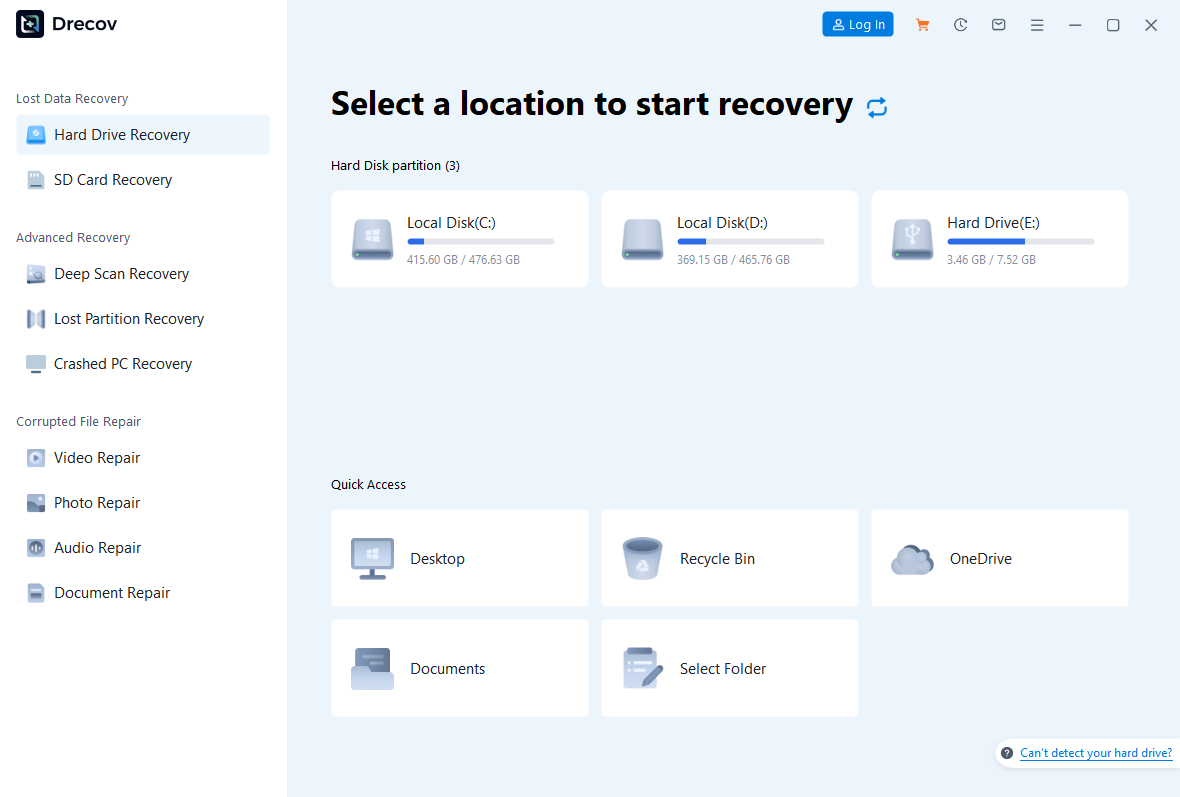
Step 2: Run Quick Scan and inspect likely folders
Start Quick Scan. Look for familiar folder names and a few distinctive filenames. A result list is not proof that every file can be opened, but it can show whether the missing material is visible without a longer scan. If the source drops offline or becomes unusually slow, stop instead of restarting the scan.
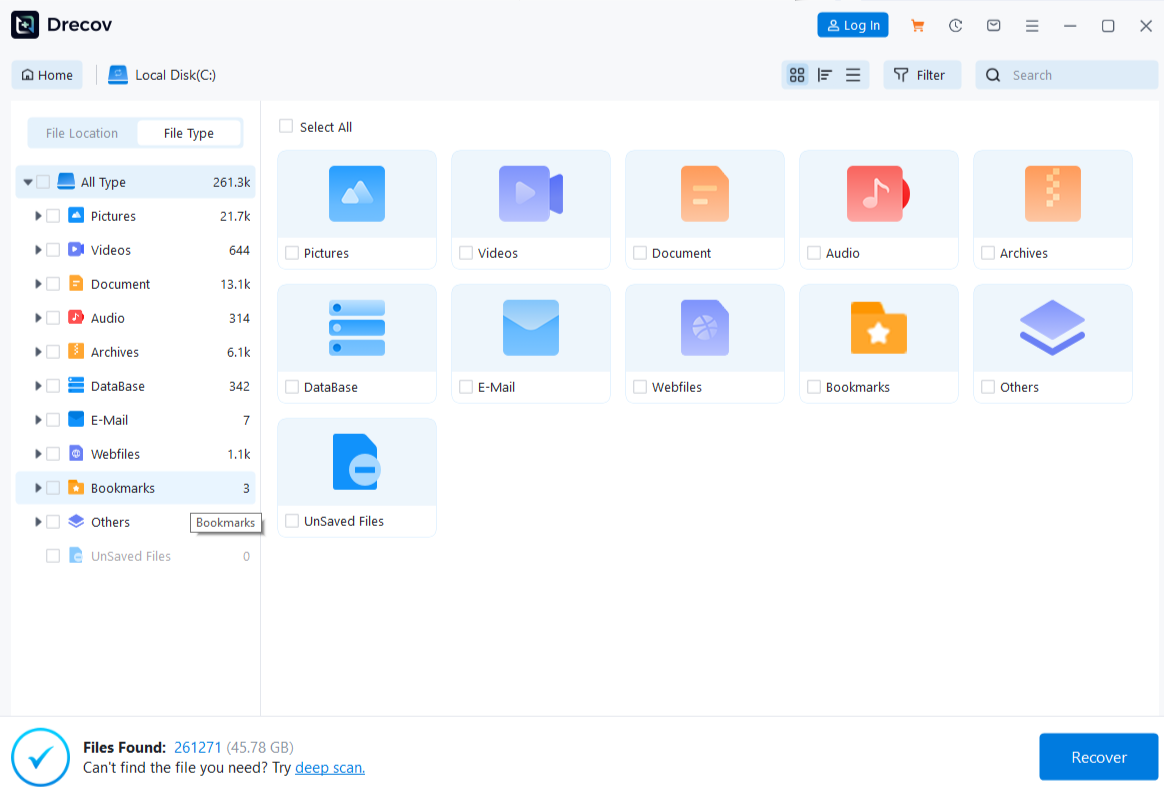
Step 3: Use Deep Scan only when the source stays stable
When Quick Scan misses essential files and the device continues to read normally, run Deep Scan. This may find additional candidates from the original storage area. It is not a substitute for hardware repair. If the drive repeatedly disconnects or its capacity changes, stop the software workflow and seek specialist help.
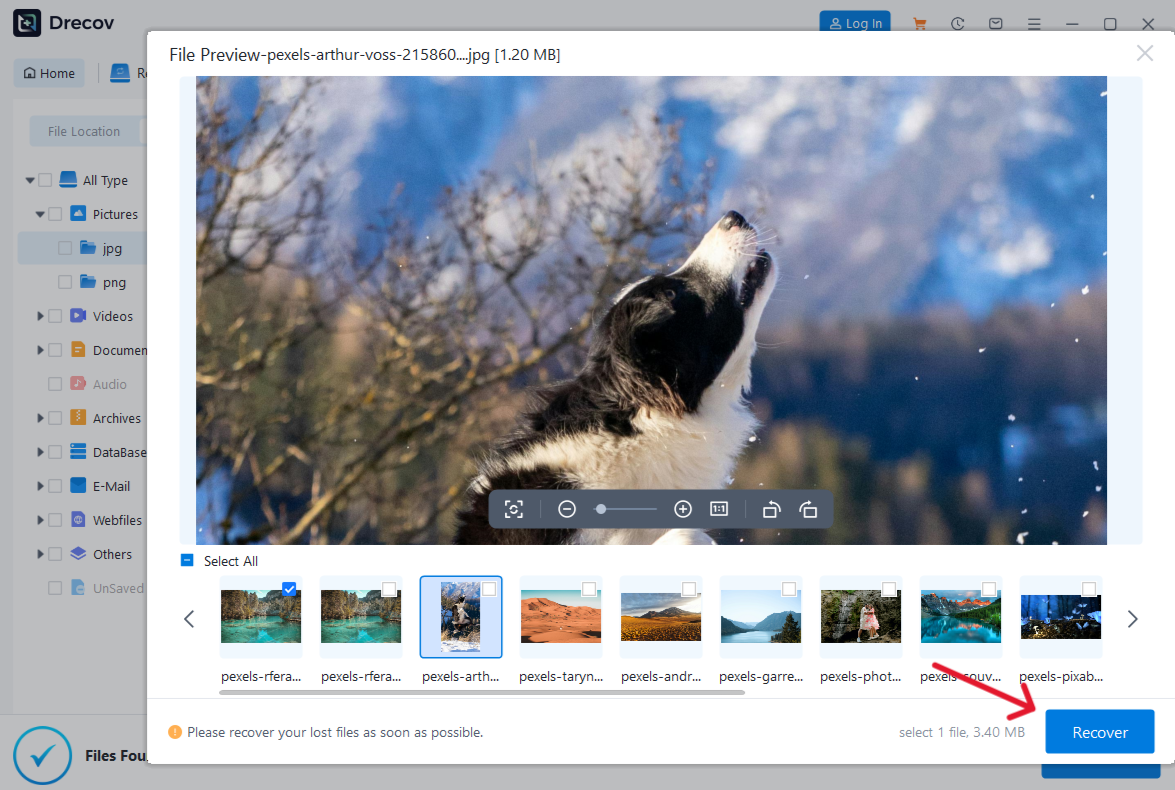
Step 4: Filter and preview the files you actually need
Use file type, filename, and original location to narrow the list. Preview representative documents or photos where preview is available, including one recent and one older example. A preview confirms that a particular sample can be displayed; it cannot guarantee every page, frame, or linked project asset. For large projects, retain the surrounding folder structure and related files rather than selecting only a single visible document.
Step 5: Recover elsewhere and verify the output
Save selected files to the separate healthy drive, never back to the source. If they do not appear in the folder you expected, check the Drecov Folder or Recovery Folder on that destination. Open several recovered files in their usual applications and compare filenames, size, dates, and contents with your expectations. Only after those checks should you consider a write-based disk repair or a reset of the original volume.
⚠ Warning: Install it on a drive different from the one where your data was lost to prevent overwriting.
Choose the next action from the result you observed
Readable volume; CHKDSK alone cannot access it: identify and close the application holding the volume. A read-only retry after a normal reconnect may be enough. The error itself does not justify a forced dismount. If you need to run a repair later, verify a backup first and understand that the repair may alter file-system records.
Stable volume; some files or folders are missing: preserve a copy of what remains, then consider file recovery before allowing CHKDSK to change metadata. Recovered files belong on a different drive. A scan result should be evaluated by opening actual output, not by counting listed filenames.
Volume vanishes, clicks, or shows the wrong size: stop trying commands. Cable and power faults are possible, but so is a failing drive. One known-good connection check can be useful; repeated reconnects, full-surface scans, and repair retries are not. Ask a recovery professional about imaging or lab work if the data has value.
Windows will not start: the drive may be involved in a broader boot problem. Do not convert the disk, reinstall Windows, or reset the PC merely because a CHKDSK message appears. Establish a safe way to access the source and protect the files first. If the machine later reports that CHKDSK cannot continue in read-only mode, the read-only mode error has a separate cause-and-action path.
Questions readers often have
Does this error mean my drive is broken?
No. A temporary lock can produce it on a healthy volume. However, disappearing connections, unusual noise, the wrong reported capacity, or repeated read failures raise a different concern. Assess those signs before deciding that it is only a Windows software issue.
Should I run CHKDSK with /f, /r, or /x next?
Not automatically. The first two can lead to repairs or extensive reads; the third may force the volume to dismount. Preserve important files and confirm that the source is stable first. Choose a switch only when you understand the target drive, the intended change, and the available backup.
Can I just format the volume?
Formatting may make the volume usable again, but it changes the source and does not retrieve your files. If the data matters, recover or verify a complete backup before formatting. A physically unstable device needs diagnosis rather than a quick format.
What if File Explorer opens the disk but CHKDSK does not?
That contrast suggests that access is being denied to the utility rather than to every file operation. Copy valuable files while they remain readable, close programs using the volume, and retry a read-only status check. Escalate if read failures or disconnections appear.
Can Drecov make CHKDSK access the volume?
No. Drecov is for recovering files from an appropriate stable source, not for unlocking CHKDSK or repairing hardware. Its role here is to protect missing or inaccessible files before a separate disk-repair decision.
Conclusion
This message describes a failed access attempt, not a diagnosis by itself. Check the selected drive, its stability, and any application using it. Copy readable files before repair; if files are missing from a stable recognized device, Drecov can scan the original location and save recoverable results to a different healthy drive. Verify those results before you allow CHKDSK or another tool to modify the source.
⚠ Warning: Install it on a drive different from the one where your data was lost to prevent overwriting.