







Introduction to Recuva Data Recovery on Linux Systems
Understanding Recuva data recovery and its role in file restoration
Recuva data recovery is widely known as a lightweight and beginner-friendly tool designed to restore deleted files from storage devices such as hard drives, USB flash drives, and memory cards. Although it is primarily developed for Windows environments, many users search for ways to apply it in Linux-based systems due to the growing popularity of Linux distributions for personal, academic, and professional use.
At its core, recuva data recovery software for pc works by scanning storage sectors and identifying traces of deleted files that have not yet been overwritten. When a file is deleted, the system does not immediately erase the content; instead, it marks the space as available. This allows recovery software recuva to locate and reconstruct files before they are permanently lost.
On Linux systems, however, things become more complex. Linux uses different file systems such as ext4, Btrfs, and XFS, while recuva data recovery software is mainly optimized for NTFS and FAT-based environments. This creates compatibility challenges, which is why users often explore alternative methods or workaround setups to make recovery possible.
Despite these limitations, the core concept of recovery remains the same: identifying recoverable fragments before they are overwritten. This is why even Linux users still consider recuva data recovery as a reference point when looking for simple recovery solutions.
Why Linux users search for Recuva recovery solutions
The increasing number of Linux users has led to more demand for accessible file recovery tools. Unlike Windows, Linux systems often rely on command-line operations, which can sometimes lead to accidental file deletion without an easy graphical recovery interface.
Many users search for recuva data recovery software for pc because they are familiar with its interface and simplicity. They expect similar ease of use in Linux environments, especially when dealing with lost documents, scripts, or media files.
Another reason is cross-platform storage usage. Many Linux users still interact with external drives formatted in NTFS or FAT32. In such cases, recovery software recuva becomes relevant because it can potentially scan those partitions when accessed through compatible methods such as Wine or dual boot systems.
However, Linux introduces unique challenges. Permissions, mount states, and file system differences can affect recovery success rates. Therefore, understanding both the capabilities and limitations of recuva data recovery software is essential before attempting recovery on Linux-based systems.
⚠️Warning: Important limitations before using Recuva in Linux environments
Before attempting any recovery process, users must understand that recuva free or paid versions are not natively designed for Linux systems. Installing or forcing execution without proper setup can lead to unstable performance or incomplete scanning results.
Additionally, recovery attempts on actively mounted drives may overwrite deleted data. This significantly reduces recovery success rates.
To maximize success:
- Avoid writing new data to affected drives
- Use read-only access whenever possible
- Do not install recovery tools on the same partition being recovered
These precautions are essential when working with recuva data recovery software for pc in non-native environments.
Why Data Loss Happens and Recovery Challenges in Linux Environments
Common causes of file loss in Linux systems
Data loss in Linux environments can occur for several reasons, many of which are related to system-level operations or user commands. Unlike graphical operating systems, Linux often requires manual file handling, which increases the risk of accidental deletion.
One of the most common causes is accidental execution of terminal commands such as rm -rf, which permanently deletes files without sending them to a recycle bin. Another common issue is partition formatting errors during system updates or disk management operations.
Storage device failures also contribute to data loss. External drives, SSDs, and SD cards may become corrupted due to improper ejection or sudden power loss.
In all these cases, recuva data recovery software is often considered as a potential solution, especially when the affected storage device uses compatible file systems like NTFS or FAT32.
However, Linux-native file systems such as ext4 require different handling approaches, making recovery more complex than standard recuva data recovery scenarios.
Limitations of Recuva data recovery software for PC in Linux environments
Although recuva data recovery software for pc is effective in Windows systems, it faces limitations in Linux environments due to file system incompatibility.
Recuva does not natively support ext4 or advanced Linux file structures. As a result, scanning Linux partitions directly may produce incomplete or inaccurate results.
Another limitation is permission handling. Linux file systems often restrict access to system-level directories, which can prevent recovery tools from performing full scans.
Even when using workarounds such as Wine or virtual machines, performance may not match native Windows execution. This can reduce the efficiency of recovery software recuva when used in cross-platform scenarios.
Therefore, users must carefully evaluate whether Recuva is suitable for their specific Linux recovery case.
⚠️Warning: Avoid overwriting deleted Linux data
One of the most critical mistakes during recovery is continuing to use the affected drive. Every new write operation increases the risk of permanently overwriting recoverable files.
Even background system processes can write temporary files that reduce recovery chances. For best results, the drive should be mounted in read-only mode whenever possible.
This precaution is especially important when attempting recuva data recovery in mixed Linux-Windows environments.
How to Use Recuva in Linux-Based Recovery Scenarios (Practical Methods)
Method 1: Using Recuva through dual boot Windows environment
Test environment: Dual boot system (Windows 11 + Ubuntu) + NTFS external drive
One of the most reliable ways to use recuva data recovery software for pc in a Linux-based system is through a dual boot configuration. This allows users to switch into a Windows environment where Recuva can run natively.
Steps:
- Restart system and boot into Windows partition
- Install recuva data recovery software on system drive
- Connect external drive or affected storage device
- Launch Recuva and select file type for recovery
- Perform quick scan or deep scan depending on data loss level
- Preview recoverable files
- Restore files to a separate safe drive
This method is effective because it avoids Linux compatibility issues entirely. It allows recovery software recuva to operate in its intended environment, improving recovery accuracy and speed.
Method 2: Running Recuva using Wine compatibility layer
Test environment: Ubuntu Linux + Wine + external NTFS drive
Another approach is using Wine, a compatibility layer that allows Windows applications to run on Linux systems.
Steps:
- Install Wine package on Linux system
- Download recuva dl installer file
- Run installer through Wine environment
- Launch Recuva inside virtual Windows layer
- Select target drive for scanning
- Use quick or deep scan mode
- Restore recovered files
This method provides flexibility for Linux users who do not want to install a full Windows system. However, performance may vary depending on system configuration.
While recuva free version can still be used in this setup, scan speed and stability may be lower than native execution.
Method 3: Using Recuva in virtual machine environment
Test environment: Linux host + Windows 10 virtual machine
A virtual machine provides another stable way to run recuva data recovery software for pc inside a Linux system.
Steps:
- Install VirtualBox or VMware on Linux
- Create Windows virtual machine
- Install Windows OS inside VM
- Install recuva data recovery software
- Mount external storage device to VM
- Run scan and recovery process
- Export recovered files to host system
This method isolates recovery operations and reduces risk to Linux host system.
It is especially useful for users who regularly switch between operating systems.
Method 4: Free Recuva recovery usage for basic file restoration
Test environment: Windows VM + external USB drive + small data loss scenario
The recuva free version is often sufficient for simple file recovery cases such as accidental deletion or recently removed documents.
Steps:
- Open Recuva in Windows or VM
- Select file type filter
- Run quick scan mode
- Identify recently deleted files
- Preview and confirm file integrity
- Restore to external storage
While limited compared to paid versions, recuva free remains useful for lightweight recovery tasks.
Advanced Linux File Recovery Techniques Beyond Recuva
Using Linux-native recovery tools alongside Recuva-based workflows
Test environment: Ubuntu 22.04 + corrupted external NTFS drive + recovery workstation
While recuva data recovery software is often the first tool users consider, Linux environments provide powerful native alternatives that can be combined with Recuva-based workflows for better results.
Tools such as TestDisk and PhotoRec are commonly used to recover lost partitions and raw files. These tools operate at a deeper level than typical file recovery software, scanning disk sectors directly rather than relying on file system metadata.
A hybrid approach is often more effective:
- Use Linux tools to detect partition structure
- Use recuva data recovery software for pc (via VM or Wine) for file-level recovery
- Compare recovered datasets for completeness
This layered strategy increases success rates, especially when dealing with damaged or partially corrupted drives.
Unlike recovery software recuva, Linux-native tools are better suited for ext4 or damaged partition tables, making them essential in advanced recovery scenarios.
Deep scan recovery strategy for Linux storage devices
Test environment: Linux Mint system + 1TB external HDD + partially overwritten partition
Deep scan recovery becomes necessary when quick recovery methods fail. This often happens when files are deleted long ago or when storage has been partially overwritten.
Deep scan works by analyzing raw sectors of the storage device rather than relying on directory structures. This allows recovery tools to reconstruct file fragments even when metadata is missing.
Steps typically include:
- Mount disk in read-only mode
- Perform sector-level scanning
- Identify file signatures manually or via tool
- Reconstruct fragmented files
- Validate recovered data integrity
Although recuva data recovery software offers deep scan mode, Linux-native tools may provide better results in non-Windows file systems.
File system repair before recovery attempts
Test environment: Debian Linux + corrupted ext4 partition + system rescue USB
Before attempting any recovery, repairing the file system can sometimes improve results. However, this must be done carefully to avoid overwriting recoverable data.
In Linux systems, tools like fsck are used to check and repair file system inconsistencies.
Steps:
- Boot from live USB environment
- Ensure disk is not mounted
- Run file system check tool (fsck)
- Identify and fix structural errors
- Attempt safe mounting in read-only mode
- Proceed with recovery process
Repairing file systems can make recuva data recovery software for pc more effective when used afterward in a compatible environment like Windows VM.
⚠️Warning: Do not force mount corrupted partitions
Forcing a damaged partition to mount in read-write mode can permanently overwrite recoverable data. Always use read-only mode during recovery attempts.
⚠️Warning: Avoid repeated scanning on failing drives
Repeated scans on unstable drives can cause mechanical or logical degradation, reducing overall recovery success rates.
PandaOffice Drecov in cross-platform recovery workflows
When Recuva-based recovery is not enough
Test environment: Linux system + severely corrupted NTFS external drive + partial recovery results
In complex recovery scenarios, especially when recuva data recovery software or Linux-native tools fail to fully reconstruct files, additional recovery layers may be required.
For example, when a drive contains fragmented or partially overwritten data, standard recovery tools may only retrieve incomplete files. This is where supplementary reconstruction tools can help improve results.
PandaOffice Drecov can be used as a secondary analysis layer in such workflows. It focuses on re-analyzing fragmented disk sectors and attempting to rebuild incomplete file structures, particularly for images, documents, and video files.
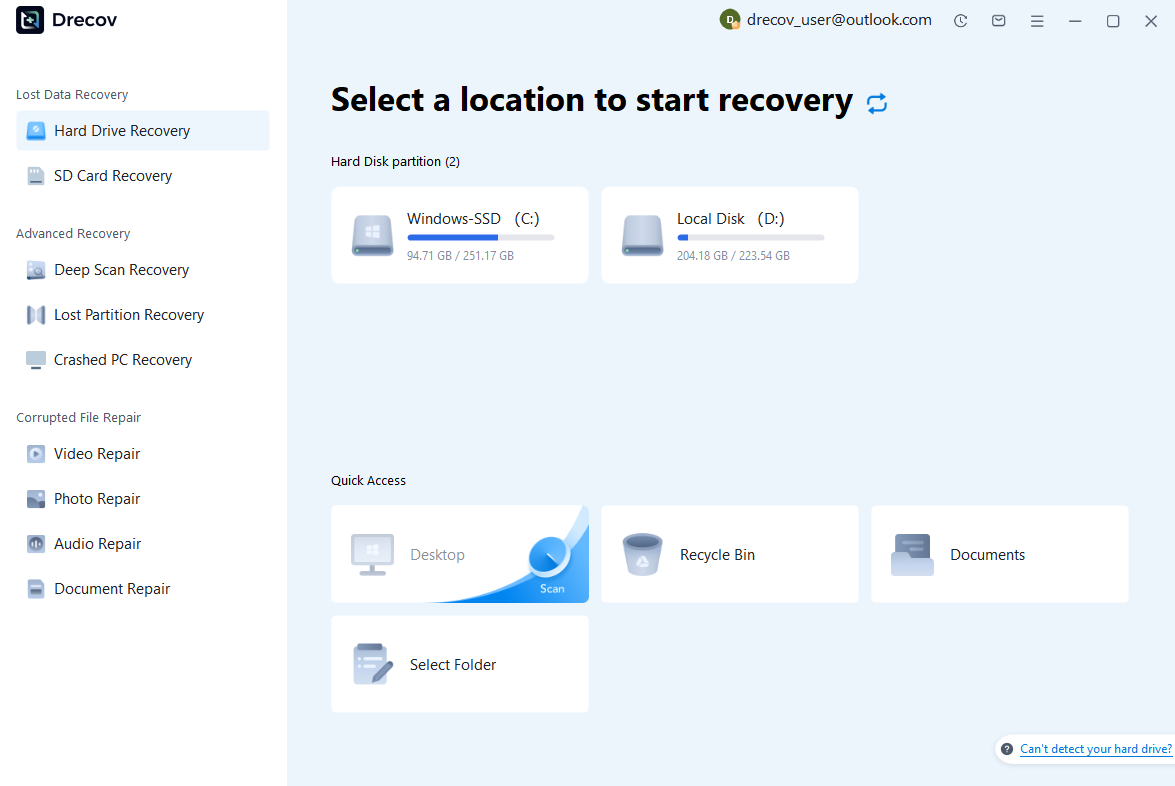
Step 1: Connect the Drive / USB)
Connect your device (SD card, HDD/SSD, or USB drive) to your computer and launch PandaOffice Drecov. Select the target device and start the scan. The software will perform a quick scan and deep scan to detect lost or deleted data.
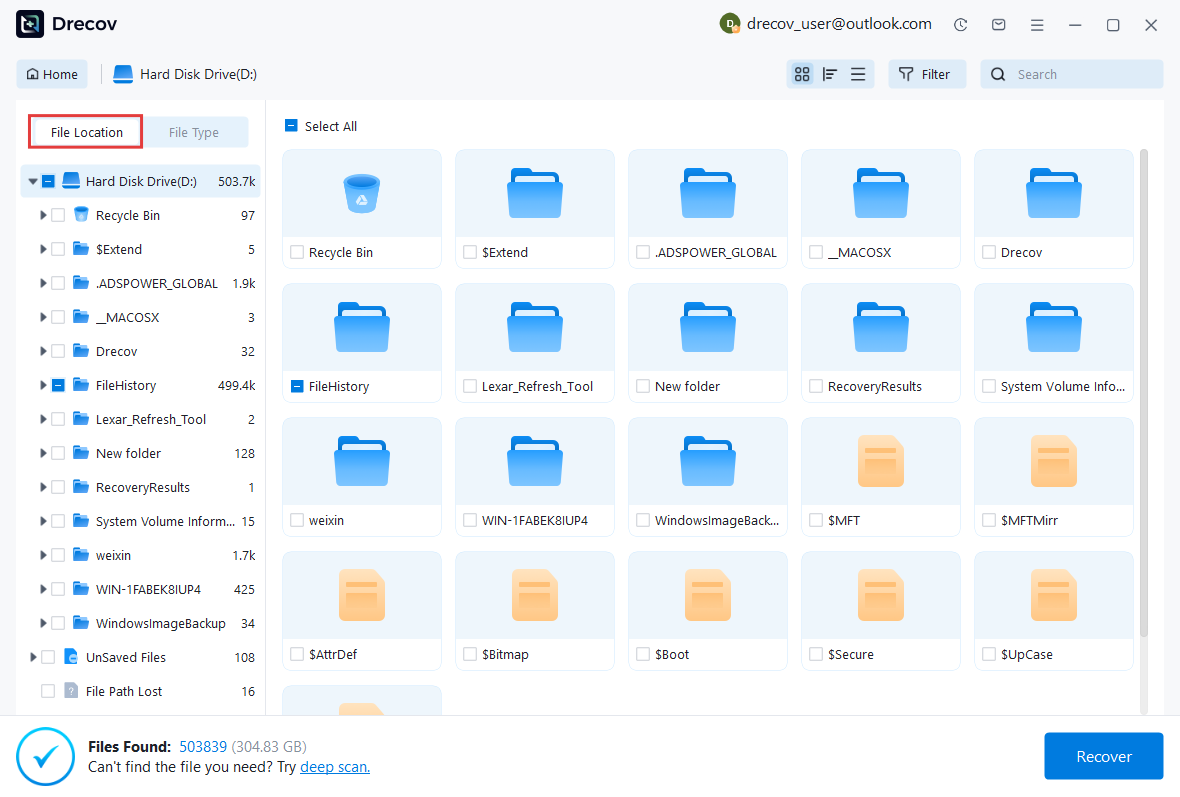
Step 2: Locate and Preview Lost Files
After scanning, browse the detected files and use the preview feature to check recoverable data. You can preview documents (Word, Excel, PDF), photos, and videos to ensure file integrity before recovery.
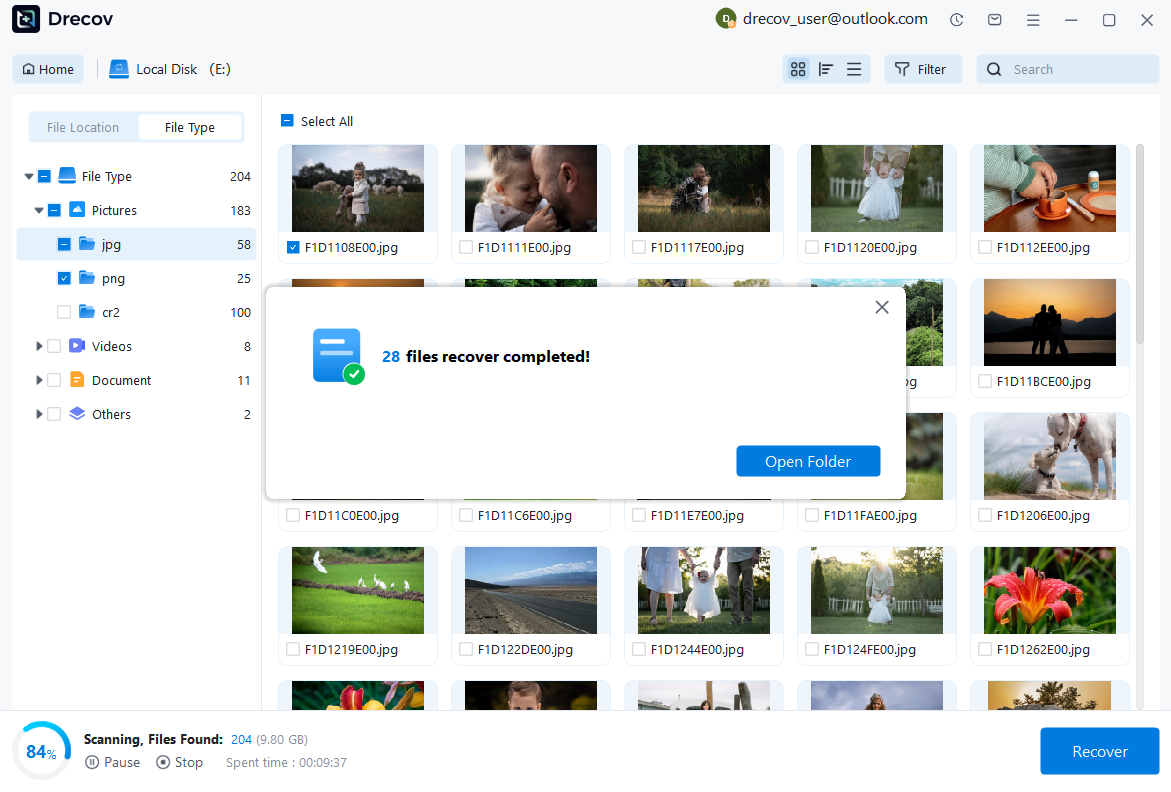
Step 3: Recover and Save to a New Location
Select the files you want to restore and click recover. Save all recovered data to a different drive or location (not the original device) to avoid overwriting lost data.
Why Choose PandaOffice Drecov Recovery Software?
PandaOffice Drecov offers a fast, secure, and user-friendly solution for recovering lost files across multiple scenarios. Whether you need email recovery, ZIP File Recovery, format data recovery, or help to recover deleted drafts Outlook, the software provides reliable recovery performance for both personal and business users.
PandaOffice Drecov supports recovery from formatted hard drives, SSDs, USB drives, SD cards, and external storage devices. Its advanced scanning engine can locate deleted archives, damaged ZIP files, lost Outlook drafts, and accidentally removed documents with high accuracy. For users searching for how to find deleted messages in Teams, PandaOffice Drecov can also help recover exported chat files, attachments, and related local cache data when available.
After recovery, test the file again. If the audio stream was damaged because of storage issues, a recovered version may play normally.
This method is particularly useful when only a few files exhibit audio problems while VLC works correctly with all other media.
This method can help users recover files from floppy disk storage after accidental deletion, formatting, or logical corruption.
In practice, it is typically used after initial recovery attempts from recovery software recuva or Linux-native tools have already been completed, serving as a final enhancement stage rather than a primary recovery solution.
FAQ: Recuva Data Recovery Linux Common Questions
Can Recuva run natively on Linux systems?
No. recuva data recovery software is designed for Windows and must be run through Wine, VM, or dual boot methods.
Is recuva free version enough for Linux recovery cases?
It can be useful for basic file recovery, especially when used in a Windows virtual machine, but it is limited for complex Linux file systems.
What does recuva dl mean?
It refers to downloading the installer package used to install Recuva software on a supported system.
Can Recuva recover ext4 partitions?
Not directly. ext4 is a Linux-native file system and is not fully supported by recuva data recovery software for pc.
Why are recovered files sometimes corrupted?
This usually happens due to:
- Overwritten sectors
- Fragmented storage
- Incomplete scan reconstruction
Conclusion: Best Practices for Recuva Linux Recovery
Key recovery strategy summary
Successful recovery in Linux environments requires combining multiple tools and approaches rather than relying on a single solution like recuva data recovery software.
Best practice workflow:
- Use Linux-native tools for partition-level recovery
- Use recuva data recovery software for pc via VM or Wine for file-level recovery
- Apply deep scan methods for corrupted or deleted data
- Validate recovered files before final restoration
Final takeaways for safe data recovery
The most important principle in any recovery process is to prevent further data overwriting.
- Stop using affected storage immediately
- Mount drives in read-only mode
- Avoid unnecessary scans on failing disks
- Choose recovery tools based on file system type
While recovery software recuva remains a useful entry-level solution, Linux environments often require a multi-tool strategy for optimal results.
Final Summary
Data recovery in Linux is a layered process involving system tools, compatibility solutions, and deep scanning techniques. The effectiveness of recuva data recovery software depends heavily on how it is deployed within a Linux workflow and whether it is combined with native recovery utilities.
When used correctly alongside Linux-native tools and safe recovery practices, it can still play a valuable role in restoring lost data across different storage environments.





