







A restored picture is not necessarily a restored Photoshop project. You may still need editable text, separate layers, or assets hidden behind the visible composite. If you are evaluating Photoshop Recovery Toolbox, the product’s official name is Recovery Toolbox for Photoshop. It works with an existing damaged PSD. It is not a replacement for finding a deleted document or work that was never saved.
The important decision comes before purchase: which parts of the project must remain usable? A flattened reference image might rescue an urgent presentation. It will not necessarily support tomorrow’s design revisions. This documentation-based review explains how to evaluate the repair workflow without assuming a preview proves complete recovery. No independent success-rate or speed testing was performed.
Define What a Successful PSD Result Must Contain
Write down the elements that make the document valuable before trying software. For a poster, editable text and print dimensions may be essential. A photo composite might depend on individual source layers and their visibility. An old proof may only need a readable final image. These are different acceptance criteria, even when every file has the same extension.
Separate display from editability
A thumbnail can look healthy while the larger document fails to open. A repaired composite can also resemble the original while important editing structure is missing. Treat appearance as one check, not the entire verdict. Keep an exported proof nearby if available, but remember that a proof cannot confirm hidden layers or editable text.
Also check the file’s size before paying for a repair attempt. A zero-byte PSD has no document payload to analyze. A much smaller copy may be an interrupted transfer rather than the full damaged project. Search the source computer or backup for a larger version. The separate corrupted-image diagnosis guide explains why missing data differs from a viewing problem.
What Photoshop Recovery Toolbox Documents—and What It Does Not
The official Recovery Toolbox for Photoshop page describes damaged PSD/8BPS input, layer or object preview, and output to a new PSD. Its documented workflow does not modify the damaged original. The demo permits inspection; saving repaired output requires the full version under the stated limitation. Confirm current terms before committing money.
Those capabilities do not establish that every layer feature will survive. Do not assume PSB support, perfect Smart Objects, or complete mask restoration from general marketing language. Inspect the actual document you need. A vendor’s recovery percentage also cannot predict the outcome for your particular file, especially when its damage mechanism is unknown.
Drecov serves a different Photoshop problem
PandaOffice Drecov is Windows data recovery software for missing or deleted files on supported local storage. It can search PCs, HDDs, SSDs, external drives, USB drives, and memory cards. Its supported categories include documents and photos, alongside video, audio, email, and archives. The useful Photoshop case is finding a saved original or earlier copy that disappeared.
Read-only recovery mode, Quick Scan, Deep Scan, and result filtering help you search without deliberately repairing the source filesystem. Supported previews provide an initial check before saving elsewhere. Lost Partition Recovery can help locate files when a partition is missing. None of these functions guarantees PSD layer reconstruction, specialized PSD preview support, or recovery of overwritten bytes.
Choose by what is absent. If you have the damaged document, evaluate a repair copy. If the document itself was deleted, search for it first. When a drive clicks or repeatedly disconnects, neither a PSD repair utility nor repeated file scanning addresses the hardware problem. Stop and seek appropriate imaging or professional recovery.
⚠ Warning: Install it on a drive different from the one where your data was lost to prevent overwriting.
Look for a Stronger Saved Copy Before Repairing
Preserve the damaged PSD under its original name on healthy storage. Then inspect backup drives, cloud version history, and other machines involved in the project. Download older versions to a separate folder instead of restoring over the damaged file. An earlier editable version may be more useful than a newer flattened repair.
Compare versions by content, not just timestamps
A synchronization timestamp can reflect copying rather than the last meaningful edit. Open candidate copies separately and inspect the latest design change you remember. Compare canvas dimensions and layer names as well. Keep each candidate until you understand which one contains the strongest combination of structure and recent work.
If the file was accidentally removed, check the Recycle Bin before installing anything. Our emptied Recycle Bin guidance covers the next branch when it is no longer available there. Cloud trash and local trash may contain different copies, so inspect the account that actually held the project.
Avoid cleanup while the source is unresolved
Do not free space by deleting project folders, caches, or unfamiliar Photoshop files during a recovery search. New exports can also overwrite recoverable storage. If a scratch-disk warning triggered the problem, follow scratch-disk cleanup precautions only after preserving needed work. Freeing space and rescuing a missing document are separate tasks.
Recover a Missing Local Project Without Replacing the Evidence
This procedure applies when a saved PSD or useful earlier local copy was deleted or became inaccessible. Stop saving and synchronizing to the affected device. Prepare a different healthy drive for output, and install Drecov away from the lost file’s partition. Check backups first. SSD TRIM may reduce what remains recoverable; scanning cannot reverse that process.
Step 1: Open Drecov and Select the PSD’s Former Location
Choose the Windows volume, external drive, or original project location that held the saved document. Do not select a cloud folder merely because its shortcut remains visible. For a missing partition, use the relevant Lost Partition Recovery option without creating a replacement volume. The target is the stored document, not unsaved Photoshop memory.

Step 2: Run Quick Scan and Review Project Names
Inspect Quick Scan results for the project folder and known filename variants. Designers often keep numbered revisions, so examine nearby versions rather than selecting one exact name immediately. A previous revision may retain more editable structure than the damaged final copy. Record which candidates deserve closer inspection.
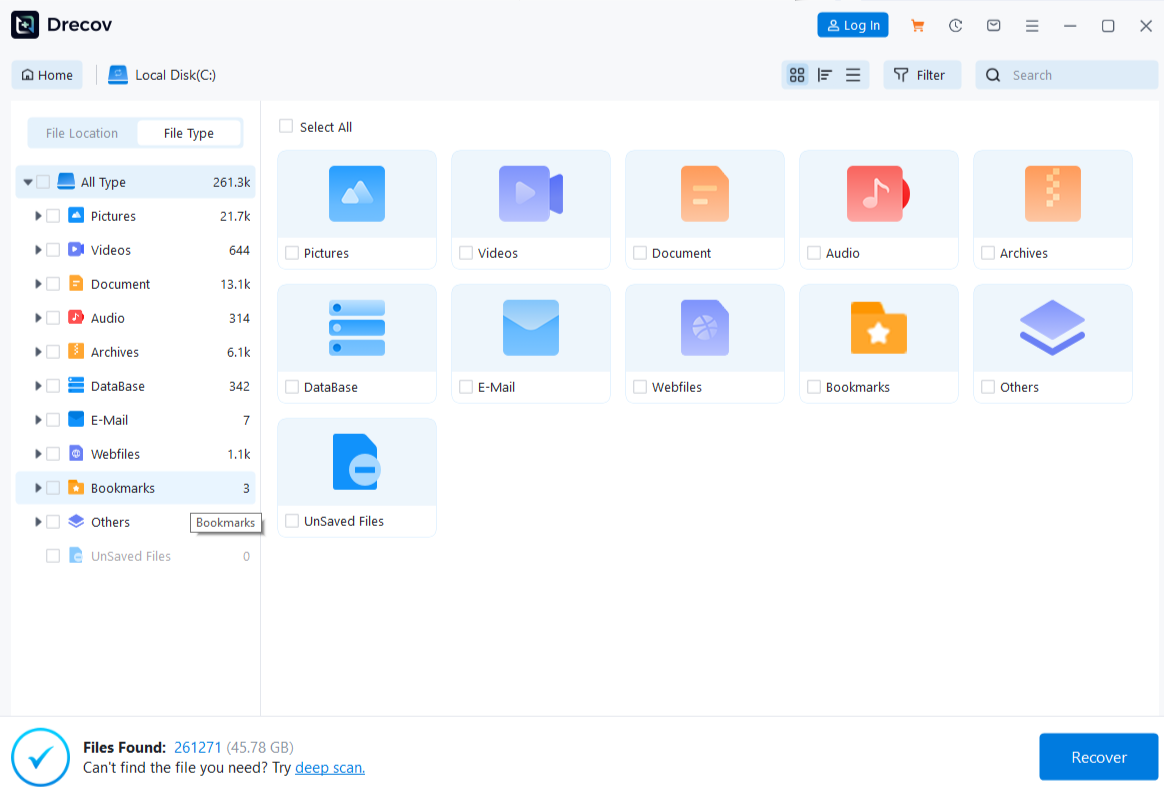
Step 3: Extend the Search With Deep Scan When Stable
If the needed file is absent, run Deep Scan only while storage remains reliable. Repeated disconnections, severe read errors, or abnormal noises are stop signs. Escalate to suitable imaging or a professional service instead of repeating scans. Do not initialize, format, or run modifying repairs to make the source look normal first.
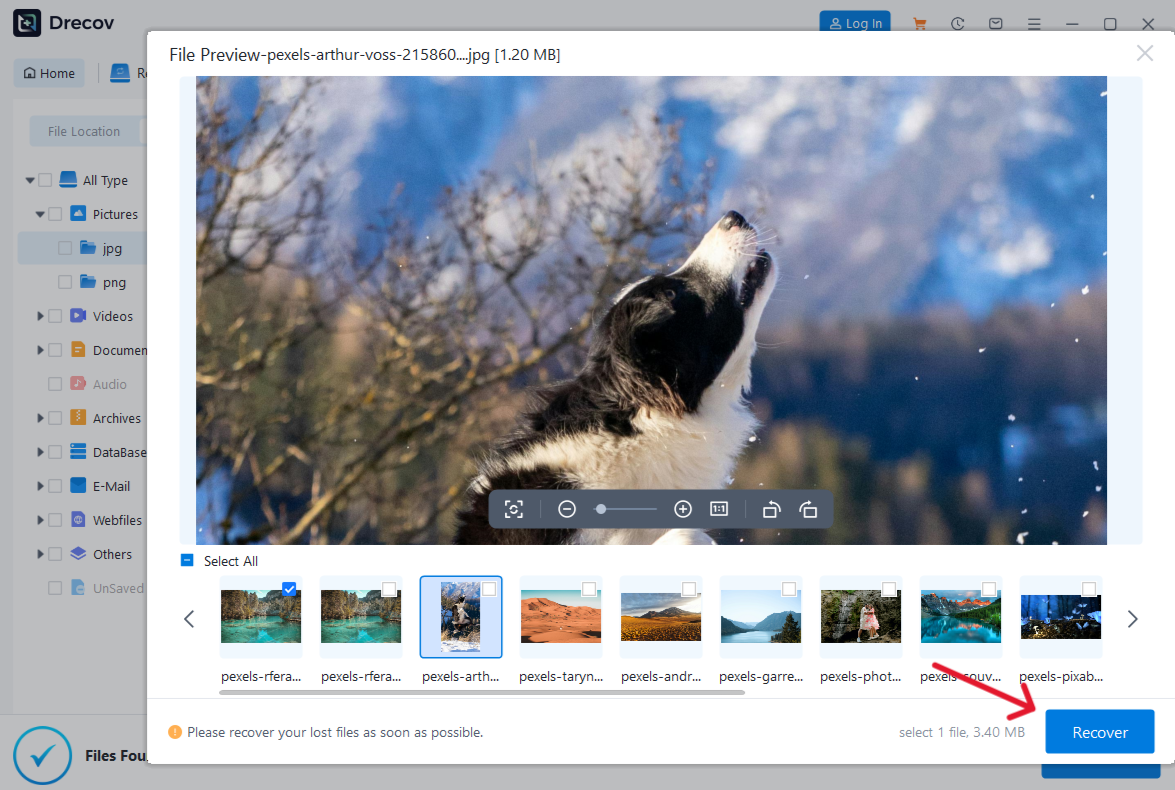
Step 4: Locate PSD Candidates and Use Available Previews
Filter or browse by available file type, path, and filename information. Compare plausible sizes rather than assuming every PSD-named result is complete. Use supported previews where available, but do not require a specialized layer preview from Drecov. The decisive editability checks happen after recovery in Photoshop, not from a generic thumbnail.
Step 5: Save Distinct Candidates to the Healthy Destination
Recover selected files to the other drive, never the original source. Keep versions in separate folders or give them distinct names. Do not replace the damaged PSD with an unverified candidate. This preserves the option to compare a recovered original against any later repair output.
⚠ Warning: Install it on a drive different from the one where your data was lost to prevent overwriting.
Step 6: Open and Verify Before Any Source Cleanup
Check the Drecov Folder or Recovery Folder if output is not where expected. Open each promising copy in Photoshop and inspect the project elements you listed earlier. Verify several candidates when results differ. Only after preserving a usable copy should you consider filesystem repair, formatting, or cleanup on the original device.
Use a Layer-Level Acceptance Check for Repaired Output
When repair remains necessary, feed the utility a copy of the damaged PSD. Review available layers or objects before purchasing output capability. Save any repaired result under a new name on healthy storage. The documented preservation of input is helpful, but keeping your own untouched copy remains prudent.
Run the following acceptance check against the project’s real purpose. Some failures may be acceptable for a reference image but unacceptable for editable client work. Record those limitations rather than describing the entire project as restored.
- Confirm canvas dimensions and compare the visible composition with a trusted proof.
- Toggle important layers individually to check whether their content survives.
- Inspect text that must remain editable, including its wording and placement.
- Check required masks, effects, and linked assets instead of assuming their presence.
- Save a separate test copy, close it, and reopen it in Photoshop.
If the repaired document only produces a flat picture, retain it as a salvage result. Continue looking for an older editable version when revisions matter. Avoid repeated saves over either candidate. A clean reopening is reassuring, but it still needs the visual and structural checks above to establish fitness for your project.
Questions About PSD Repair and Missing Projects
Will Photoshop Recovery Toolbox restore every layer?
No complete-layer guarantee follows from the documented preview and export workflow. Inspect the layers your project needs before relying on the result. Missing or overwritten document data can prevent a full reconstruction.
Can it recover work that was never saved?
The described workflow uses an existing damaged file. It does not establish recovery of unsaved application memory. Check Photoshop’s available recovery material separately, without assuming a PSD repair utility can create a missing original.
Should I buy it when the preview looks correct?
Check what the preview actually demonstrates. A convincing composite may not confirm editable text or required layers. Review the current saving terms and decide whether the demonstrated result meets your needs.
Does renaming a PSB file to PSD make it supported?
No. Changing an extension does not convert the document’s internal format. Verify explicit support for the actual file type before using a repair product. Keep the original extension and an untouched copy.
Can Drecov repair a damaged PSD header?
The verified Drecov workflow locates and recovers files; it does not establish PSD-header repair. Use it for a missing saved original or alternative copy. Evaluate any recovered candidate in Photoshop before deciding on further repair.
Conclusion
Evaluate Photoshop Recovery Toolbox against the editable project you need, not just a successful preview. Preserve the damaged PSD, inspect available layers, and verify separately saved output in Photoshop. When the saved original is missing, Drecov provides a different route: search stable local storage and recover candidates elsewhere. A usable older project may be the better result.
⚠ Warning: Install it on a drive different from the one where your data was lost to prevent overwriting.





