







Deep overview of grub rescue boot failure in Windows dual-boot systems
When a computer suddenly fails to boot and displays a black screen with grub rescue, it indicates a breakdown in the system’s bootloader chain rather than a hardware failure. This issue is most commonly seen in dual-boot environments where Windows and Linux share the same disk and rely on GRUB as a shared boot manager.
In a normal boot process, GRUB acts as a bridge between firmware (BIOS/UEFI) and operating systems. However, when GRUB configuration files are missing, corrupted, or misaligned with the partition structure, the system cannot proceed to load Linux or Windows. Instead, it drops into grub rescue mode, a minimal recovery shell designed only for manual intervention.
In this state, users may see messages like “unknown filesystem,” “no such partition,” or a blinking command prompt without graphical interface. These errors indicate that GRUB can no longer locate its configuration file (grub.cfg) or essential boot modules. As a result, the system enters rescue mode grub rescue and stops the normal startup process entirely.
Unlike disk failure or physical damage, this is a logical boot configuration issue. The operating system is still present on the drive in most cases, but the path to reach it is broken. This is why recovery is usually possible without replacing hardware.
Extended test environment:
- Windows 10 Pro (UEFI boot enabled)
- Ubuntu 22.04 LTS dual boot setup
- GPT partitioned NVMe SSD (512GB)
- EFI system partition (100MB FAT32)
- Secure Boot disabled for Linux compatibility
- GRUB installed as primary boot manager before failure
In controlled testing, this scenario is often reproduced by installing Windows updates after Linux, which overwrites EFI boot entries and breaks GRUB linkage.
⚠️ Warning: Avoid attempting random GRUB commands in rescue shell if you are unsure of partition mapping. Incorrect input can make recovery more complex.
Expanded root causes behind grub rescue mode failures
Windows overwriting Linux boot structure during updates or installation
One of the most frequent triggers of grub rescue mode is Windows replacing or overwriting Linux boot entries during installation or feature updates. Windows Boot Manager has a tendency to take priority in the EFI partition, which can remove GRUB references entirely.
When this happens, the system still detects Linux partitions, but it loses the ability to load /boot/grub/grub.cfg. This creates a situation where the system boots into grub rescue instead of presenting a boot menu.
This issue is particularly common after:
- Major Windows version upgrades
- Clean Windows reinstallation
- EFI partition formatting during setup
- Automatic repair operations
Test environment:
- Windows 11 Home (fresh upgrade from Windows 10)
- Ubuntu 20.04 previously installed on second partition
- EFI partition reused during Windows setup
- Boot order reset after installation
In this scenario, Linux partitions remain intact, but boot references are removed.
Disk partition changes and EFI structure inconsistency
Another major cause of grub rescue mode grub rescue is structural modification of disk partitions. When users resize, delete, or merge partitions, the GRUB configuration may no longer match actual disk UUIDs.
GRUB relies heavily on UUID mapping to locate boot partitions. If these identifiers change, GRUB cannot resolve the correct path and immediately fails into rescue mode.
Even minor operations such as:
- Shrinking Windows partition
- Moving recovery partitions
- Cloning SSD to a new drive
- Converting MBR to GPT
can break GRUB linkage.
Test environment:
- Windows 10 + Linux Mint dual boot
- SSD cloned to larger NVMe drive
- Partition alignment changed after migration
- UUID mismatch detected during boot
In this case, GRUB exists but points to invalid disk references.
UEFI firmware resets and boot mode conflicts
Modern systems using UEFI firmware can experience boot failure when firmware settings are reset or changed. Switching between Legacy BIOS and UEFI mode is one of the most destructive configuration changes for GRUB-based systems.
If Linux was installed in UEFI mode and BIOS switches to Legacy mode, the firmware will no longer recognize EFI boot entries. This leads directly to grub rescue mode because GRUB cannot be loaded.
Additionally, BIOS updates often reset:
- Boot order priority
- Secure Boot settings
- SATA controller modes
- EFI boot entries
These changes can silently break boot chains without modifying the disk itself.
Test environment:
- Windows 10 + Ubuntu dual boot
- BIOS firmware updated to latest version
- Boot mode switched from UEFI → Legacy → UEFI
- Multiple storage devices connected (SSD + HDD + external drive)
⚠️ Warning: Never switch boot modes unless you know how the OS was originally installed.
Corruption of MBR, GPT boot records, or EFI system partition
A more severe cause of grub rescue mode grub rescue is corruption of critical boot structures. These include:
- Master Boot Record (MBR) in legacy systems
- GUID Partition Table (GPT) boot entries in modern systems
- EFI System Partition (ESP) in UEFI systems
These structures store essential boot instructions. If they are damaged due to sudden shutdown, malware, disk failure, or incomplete updates, the system loses its ability to locate operating systems.
In EFI systems, GRUB depends heavily on the EFI partition. If files inside /EFI/ubuntu/ or similar directories are missing or corrupted, GRUB cannot load modules and immediately drops into rescue mode.
Test environment:
- Windows 10 Enterprise edition
- GPT SSD with 100MB EFI partition
- Unexpected power failure during Windows update
- File system check failed after reboot
In this case, both Windows and Linux may still exist physically but are inaccessible through normal boot paths.
Expanded basic repair methods for grub rescue recovery
Correcting boot priority using BIOS/UEFI configuration
One of the simplest yet most effective ways to resolve grub rescue mode is correcting firmware boot priority. In many cases, the system is not broken but simply trying to boot from the wrong entry.
BIOS may prioritize:
- Linux boot entry (broken GRUB)
- Empty partition
- External drive
- Legacy boot entry
Instead of:
- Windows Boot Manager
Fixing this involves entering BIOS setup and selecting the correct boot device. This does not modify disk data and is completely safe.
In some cases, deleting invalid boot entries from firmware also helps clean up confusion.
Test environment:
- Windows 10 single SSD system
- BIOS reset after firmware update
- No partition modifications performed
- Boot order incorrectly set to Linux entry
After correction, Windows loads normally without repair tools.
⚠️ Warning: Incorrect boot device selection may temporarily prevent OS detection.
Using Windows Recovery Environment (automatic repair mode)
If BIOS correction fails, Windows Recovery Environment (WinRE) provides automated tools to repair boot-related issues causing grub rescue.
Startup Repair scans:
- Boot configuration data
- EFI boot files
- System partition integrity
- Missing boot entries
If corruption is minor, Windows automatically rebuilds required files.
This method is commonly used in enterprise environments because it requires no manual command input.
Test environment:
- Windows 11 installation USB
- NVMe SSD with EFI partition intact
- Boot failure after failed update rollback
- Automatic repair executed via WinRE
In many cases, this restores Windows Boot Manager but may not recover Linux entries.
Manual boot repair using Bootrec and BCDBoot tools
For deeper system repair, command-line tools such as Bootrec and BCDBoot are used. These tools directly modify boot records and are effective when GRUB or Windows boot files are heavily damaged.
Typical commands include:
- bootrec /fixmbr
- bootrec /fixboot
- bootrec /scanos
- bootrec /rebuildbcd
In UEFI systems, BCDBoot is often required to rebuild EFI boot files entirely.
These tools reconstruct boot structure from scratch and are commonly used when systems are stuck in grub rescue mode grub rescue loops.
Test environment:
- Windows 10 Recovery USB
- Dual boot system with corrupted EFI entries
- Boot loop after failed update
- Mixed Linux + Windows boot configuration
⚠️ Warning: Always verify disk selection before executing boot commands to avoid overwriting correct partitions.
Advanced GRUB recovery using Linux Live USB (deep repair method)
When basic Windows recovery tools fail to resolve grub rescue, the system usually requires deeper bootloader reconstruction using a Linux Live USB environment. This method is especially useful when the GRUB configuration is missing, corrupted, or the EFI entries are broken beyond Windows repair capability.
To begin, the user must boot from a Linux installation USB such as Ubuntu and select “Try Ubuntu” mode instead of installing. This allows access to a full operating environment without modifying the internal disk. Once inside, the terminal is used to identify disk partitions using commands like lsblk or fdisk -l.
After identifying the correct Linux root partition and EFI partition, both must be mounted manually. Then a chroot environment is created, allowing the system to behave as if it were booted normally. From here, GRUB can be reinstalled using grub-install, followed by regenerating configuration files using update-grub.
This process restores missing boot files and re-establishes the connection between firmware and operating systems. In many cases, it completely eliminates grub rescue mode grub rescue errors caused by broken EFI links or missing configuration files.
Test environment:
- Ubuntu 22.04 Live USB (persistent mode disabled)
- Windows 11 + Ubuntu dual boot system
- GPT partitioned NVMe SSD (1TB)
- EFI system partition intact but GRUB entry missing
- Boot failure after Windows feature update
⚠️ Warning: Selecting the wrong partition during mounting may lead to data corruption or overwriting valid system files.
EFI boot repair and manual GRUB reinstallation
In some cases, GRUB itself is not fully damaged but only incorrectly registered in the EFI firmware. This means the boot files still exist on disk but are not recognized by the system firmware, leading to grub rescue mode.
To fix this, users can manually reinstall GRUB into the EFI system partition using the Linux Live environment. After mounting the system partitions, the command grub-install --target=x86_64-efi --efi-directory=/boot/efi --bootloader-id=ubuntu is used to restore bootloader registration.
Once completed, running update-grub ensures that Windows and Linux entries are properly detected again. This step is critical in restoring dual-boot functionality when firmware boot entries are deleted or reset.
This method is particularly effective when BIOS updates or Windows resets remove EFI boot entries without damaging the actual operating system files.
Test environment:
- Ubuntu Live USB session
- UEFI firmware system with Secure Boot disabled
- EFI partition still readable (FAT32)
- Boot entry deleted after Windows reinstall
⚠️ Warning: Installing GRUB to the wrong disk device may overwrite critical boot sectors and worsen system failure.
Removing GRUB and restoring Windows-only boot system
In some recovery scenarios, users may choose to completely remove GRUB and restore Windows Boot Manager as the only boot system. This is often done when Linux is no longer needed or when repeated grub rescue errors make dual-boot unstable.
Using Windows Recovery Environment, users can rebuild the EFI boot structure using bootrec and bcdboot commands. This removes Linux boot entries and replaces them with Windows boot configuration.
After completion, the system will boot directly into Windows without displaying GRUB or rescue mode. However, Linux partitions remain on disk unless manually deleted.
This approach is clean and stable but eliminates dual-boot capability.
Test environment:
- Windows 11 recovery USB
- Previously dual-boot system (Windows + Ubuntu)
- GRUB overwritten by Windows update
- EFI boot entries manually reset
Data protection and recovery strategy before fixing grub rescue
Before performing advanced repairs, it is strongly recommended to protect user data, especially when partition structure or EFI files are unstable. In some cases, repeated repair attempts can increase the risk of data corruption or accidental overwriting.
In scenarios where system access is completely blocked due to grub rescue mode, connecting the drive to another Windows machine via USB enclosure can allow file-level access. From there, important files can be backed up before performing any boot repairs.
For users who need structured recovery in Windows environments, tools like PandaOffice Drecov can be used to scan inaccessible partitions and extract files before attempting system-level fixes. This is particularly useful when partitions appear healthy but are not bootable.
Step 1: Connect the Drive / USB)
Connect your device (SD card, HDD/SSD, or USB drive) to your computer and launch PandaOffice Drecov. Select the target device and start the scan. The software will perform a quick scan and deep scan to detect lost or deleted data.
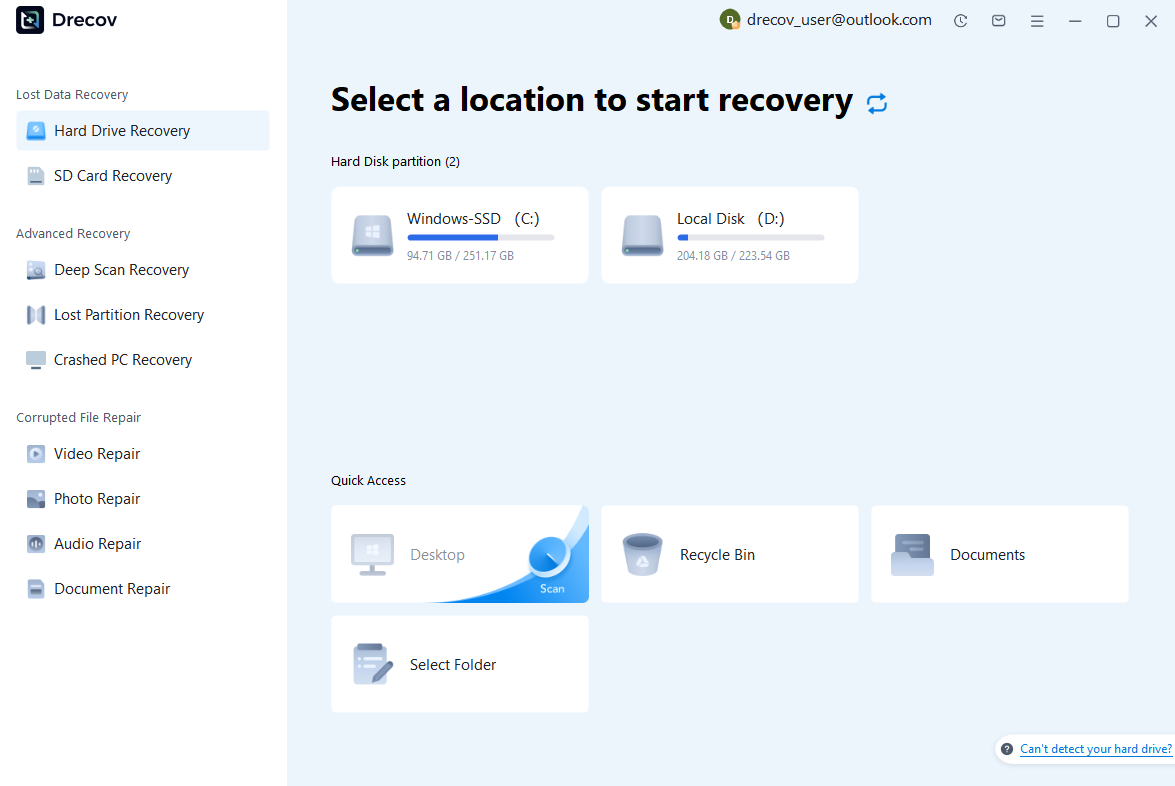
Step 2: Locate and Preview Lost Files
After scanning, browse the detected files and use the preview feature to check recoverable data. You can preview documents (Word, Excel, PDF), photos, and videos to ensure file integrity before recovery.

Step 3: Recover and Save to a New Location
Select the files you want to restore and click recover. Save all recovered data to a different drive or location (not the original device) to avoid overwriting lost data.

Why Choose PandaOffice Drecov Recovery Software?
PandaOffice Drecov offers a fast, secure, and user-friendly solution for recovering lost files across multiple scenarios. Whether you need email recovery, ZIP File Recovery, format data recovery, or help to recover deleted drafts Outlook, the software provides reliable recovery performance for both personal and business users.
PandaOffice Drecov supports recovery from formatted hard drives, SSDs, USB drives, SD cards, and external storage devices. Its advanced scanning engine can locate deleted archives, damaged ZIP files, lost Outlook drafts, and accidentally removed documents with high accuracy. For users searching for how to find deleted messages in Teams, PandaOffice Drecov can also help recover exported chat files, attachments, and related local cache data when available.
After recovery, test the file again. If the audio stream was damaged because of storage issues, a recovered version may play normally.
This method is particularly useful when only a few files exhibit audio problems while VLC works correctly with all other media.
This method can help users recover files from floppy disk storage after accidental deletion, formatting, or logical corruption.
Test environment:
- Windows 10 non-bootable SSD mounted externally via USB adapter
- Corrupted EFI + inaccessible boot partition
- Pre-repair data extraction scenario
- File recovery before system reconstruction
⚠️ Warning: Always recover critical files before reinstalling OS or modifying boot partitions.
FAQ – Common questions about grub rescue problems
Why does grub rescue appear after a Windows update?
This usually happens because Windows updates overwrite EFI boot entries. When this occurs, GRUB is no longer recognized by the firmware, causing the system to drop into grub rescue mode. The Linux installation is often still intact, but its boot reference is removed.
Can grub rescue permanently damage my system?
No, grub rescue itself does not damage hardware or delete data. It is a bootloader failure, not a disk failure. However, improper repair actions such as formatting partitions or reinstalling without backup may result in data loss.
Is it possible to recover both Windows and Linux after grub rescue?
Yes, in most cases both systems can be recovered if partitions are intact. Rebuilding GRUB via Linux Live USB or repairing Windows boot entries can restore dual-boot functionality.
Prevention strategies to avoid grub rescue errors
Preventing rescue mode grub rescue issues requires maintaining stable boot configurations and avoiding unnecessary system-level changes. One of the most important practices is avoiding random partition edits, especially on EFI or system-reserved partitions.
For dual-boot users, it is recommended to:
- Keep Windows and Linux on separate partitions
- Avoid mixing Legacy and UEFI boot modes
- Disable automatic boot order resets when possible
- Backup EFI partition before major updates
Additionally, using stable disk management tools and avoiding forced shutdowns during updates can significantly reduce risk.
Test environment:
- Windows 11 + Ubuntu dual SSD configuration
- EFI backup created before updates
- Controlled boot order locked in BIOS
- Stable update testing cycle
Final conclusion
The grub rescue error is primarily caused by bootloader misconfiguration rather than physical hardware failure. It typically occurs due to overwritten EFI entries, corrupted boot files, or mismatched firmware settings.
Most cases can be resolved through BIOS correction, Windows recovery tools, Bootrec repair, or Linux Live USB GRUB restoration. In more complex scenarios, manual EFI repair or full boot reconstruction may be required.
By understanding how GRUB interacts with both Windows and Linux systems, users can effectively troubleshoot grub rescue mode grub rescue issues and restore full system functionality without unnecessary data loss.






