







Understanding SSD Bad Sectors and Drive Health
What Is an SSD Bad Sector?
A sector is a small storage unit used to organize data on a drive. Traditional hard drives store information on magnetic platters, while solid-state drives use NAND flash memory cells. Although SSD technology differs significantly from HDD technology, storage errors can still occur.
An ssd bad sector generally refers to a storage area that can no longer reliably read or write data. In SSDs, the issue is often associated with damaged memory cells, firmware problems, or logical corruption rather than the classic physical sector damage seen on hard drives.
When sectors become unreliable, users may experience:
- Slow file access
- Application crashes
- File corruption
- System freezes
- Boot failures
- Missing data
Modern SSD controllers attempt to remap failing memory cells automatically. However, when errors continue to increase, the drive may be approaching the end of its usable lifespan.
Understanding how these storage errors occur can help users react quickly before important files are lost.
Can SSDs Develop Bad Sectors?
A common misconception is that SSDs never develop storage errors.
While SSDs do not contain moving parts, they can still experience failures due to:
- NAND wear
- Firmware corruption
- Electrical issues
- Manufacturing defects
- Excessive write cycles
As flash memory cells age, some cells may become unreliable. SSD controllers often compensate by relocating data to spare cells, but eventually the number of available replacements decreases.
As a result, bad sectors on ssd devices can appear even on relatively modern hardware.
Warning Signs of SSD Problems
Early detection can prevent major data loss.
Potential symptoms include:
- Frequent system crashes
- Unexpected blue screens
- Slow file transfers
- Files becoming inaccessible
- Read/write errors
- Applications refusing to launch
Users noticing these symptoms should immediately verify drive health and create backups.
⚠️ Warning: Continued use of a failing SSD may increase the risk of permanent data loss.
Why Bad Sectors Appear on SSDs
Physical and Logical Storage Errors
Storage errors generally fall into two categories: physical and logical.
Physical issues involve the flash memory itself, while logical problems affect how the operating system accesses stored data.
Logical errors may result from:
- Improper shutdowns
- File system corruption
- Malware activity
- Software conflicts
Physical problems may involve:
- Worn NAND cells
- Controller failures
- Manufacturing defects
Both types of issues can create behavior similar to an ssd with bad sectors.
Wear and Tear of NAND Flash Memory
Every SSD has a finite number of write cycles.
Over time:
- Cells gradually wear out.
- Error correction becomes more active.
- Spare blocks are consumed.
- Performance may decline.
Enterprise and consumer SSDs include wear-leveling technologies designed to distribute writes evenly across memory cells.
Even with these protections, aging storage devices may eventually develop reliability issues.
The likelihood increases when drives are subjected to:
- Constant heavy workloads
- Large database operations
- Continuous video recording
- Frequent rewriting of temporary files
Power Failures and File System Corruption
Unexpected power interruptions can affect SSD reliability.
Examples include:
- Sudden shutdowns
- Battery failures
- Power outages
- Forced reboots
Although SSDs generally recover better than mechanical drives, abrupt interruptions may still damage file systems or interrupt write operations.
This can create symptoms resembling bad sectors on ssd storage even when the flash memory itself remains healthy.
How to Check and Handle Bad Sectors on SSD
Method 1: Use CHKDSK to Scan the SSD
Windows includes CHKDSK, a built-in utility capable of identifying file system errors and storage inconsistencies.
Steps
- Open Command Prompt as Administrator.
- Enter the following command:
chkdsk C: /f /r
- Press Enter.
- Confirm scheduling if prompted.
- Restart the computer.
- Allow the scan to finish.
CHKDSK can identify logical errors and isolate problematic storage areas.
Test Environment
- Windows 11 Pro
- 1TB NVMe SSD
- NTFS File System
- Administrator Account
This method is often the first step when diagnosing an ssd bad sector issue.
Method 2: Check SSD Health with Windows Error Checking
Windows File Explorer includes a graphical disk-checking feature.
Steps
- Open File Explorer.
- Right-click the SSD.
- Select Properties.
- Open the Tools tab.
- Click Check under Error Checking.
- Follow the prompts.
- Review results.
This method is suitable for users who prefer graphical tools over command-line utilities.
Test Environment
- Windows 10 Pro
- SATA SSD
- NTFS Volume
- Local User Account
Although less detailed than dedicated diagnostics, Error Checking can identify common file system problems.
Method 3: Analyze SMART Data
Most SSDs support SMART (Self-Monitoring, Analysis, and Reporting Technology).
SMART statistics provide valuable insight into drive health.
Important indicators include:
- Reallocated sectors
- Wear leveling count
- Media errors
- Temperature
- Power-on hours
Steps
- Open PowerShell as Administrator.
- Run:
Get-PhysicalDisk
- Review reported health information.
- Use advanced monitoring tools if more detail is required.
Test Environment
- Windows 11 Pro
- PCIe Gen4 SSD
- SMART Supported Device
- PowerShell 7
SMART monitoring can often identify an ssd with bad sectors before severe symptoms appear.
⚠️ Warning: Increasing error counts may indicate that the SSD should be backed up immediately.
Method 4: Run Manufacturer Diagnostic Tools
Most SSD manufacturers provide official diagnostic software designed specifically for their storage products. These utilities can perform detailed health analysis beyond the basic tools included with Windows.
Manufacturer tools commonly provide:
- Health percentage ratings
- Firmware status information
- Temperature monitoring
- Error reporting
- Performance testing
- Drive optimization features
Steps
- Identify your SSD manufacturer.
- Download the official diagnostic utility.
- Install the software.
- Launch the application.
- Select the SSD to analyze.
- Run a full diagnostic scan.
- Review the generated health report.
The results can help determine whether the drive is healthy, developing problems, or approaching failure.
Test Environment
- Windows 11 Pro
- 2TB NVMe SSD
- Official Manufacturer Utility
- GPT Disk Layout
Diagnostic utilities often provide the most accurate assessment of whether an SSD is experiencing serious storage issues.
Method 5: Recover Important Files with PandaOffice Drecov Before Repairs
Before attempting major repairs or replacement procedures, users should secure important files if an ssd bad sector problem is suspected.
When storage errors increase, the risk of file corruption rises significantly. Recovering data before additional troubleshooting helps reduce the chance of permanent loss.
PandaOffice Drecov can scan SSDs for accessible and deleted files, allowing users to save valuable data before performing advanced maintenance procedures.
Steps
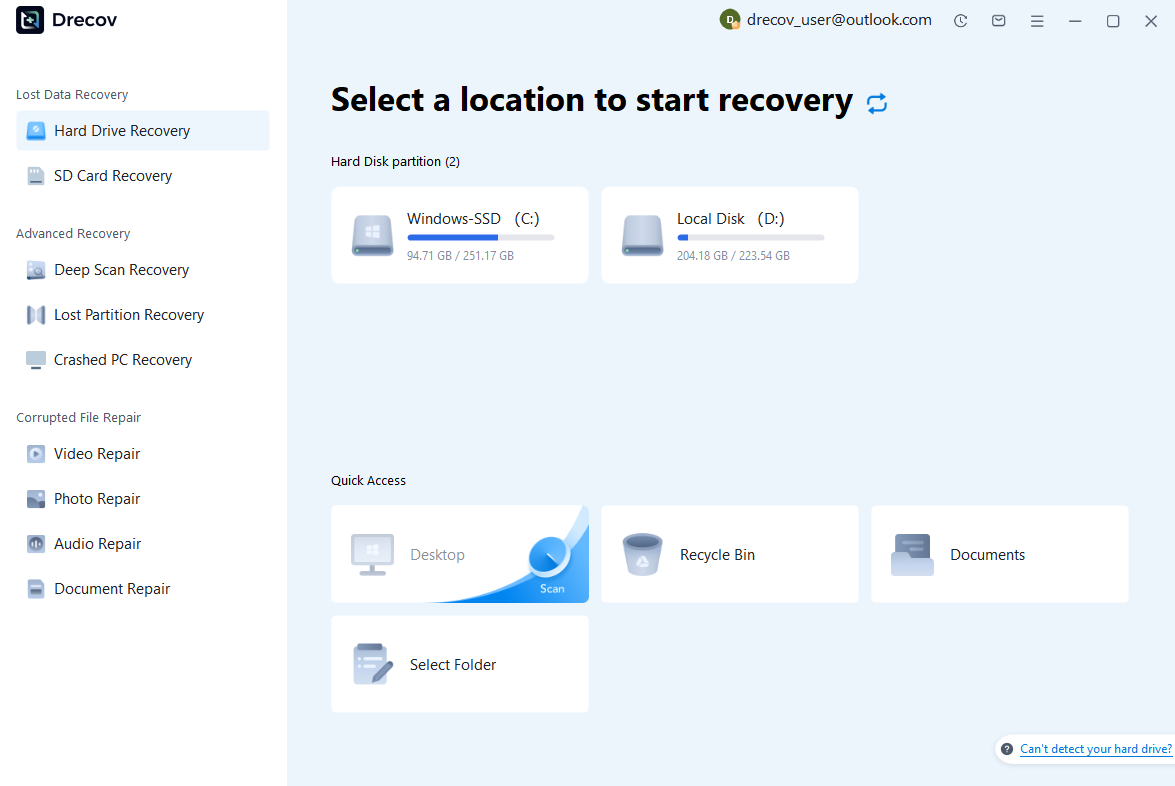
Step 1: Connect the Drive / USB)
Connect your device (SD card, HDD/SSD, or USB drive) to your computer and launch PandaOffice Drecov. Select the target device and start the scan. The software will perform a quick scan and deep scan to detect lost or deleted data.
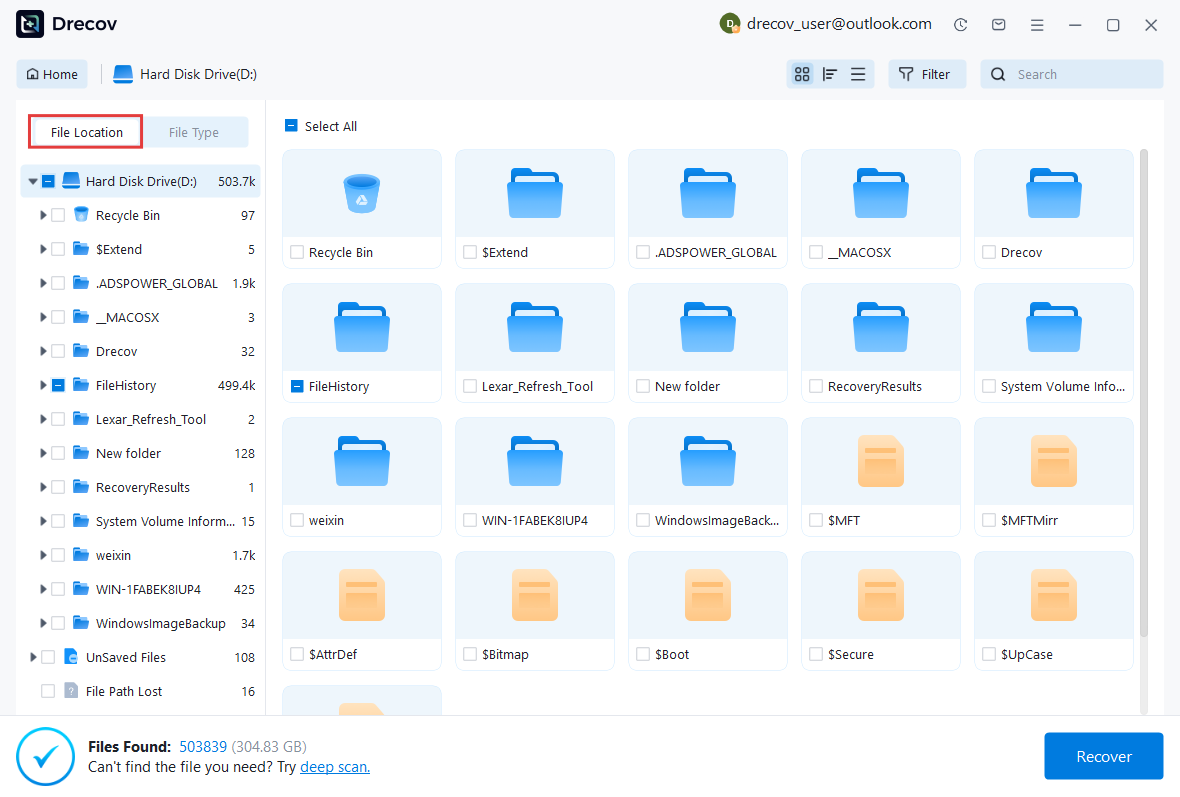
Step 2: Locate and Preview Lost Files
After scanning, browse the detected files and use the preview feature to check recoverable data. You can preview documents (Word, Excel, PDF), photos, and videos to ensure file integrity before recovery.
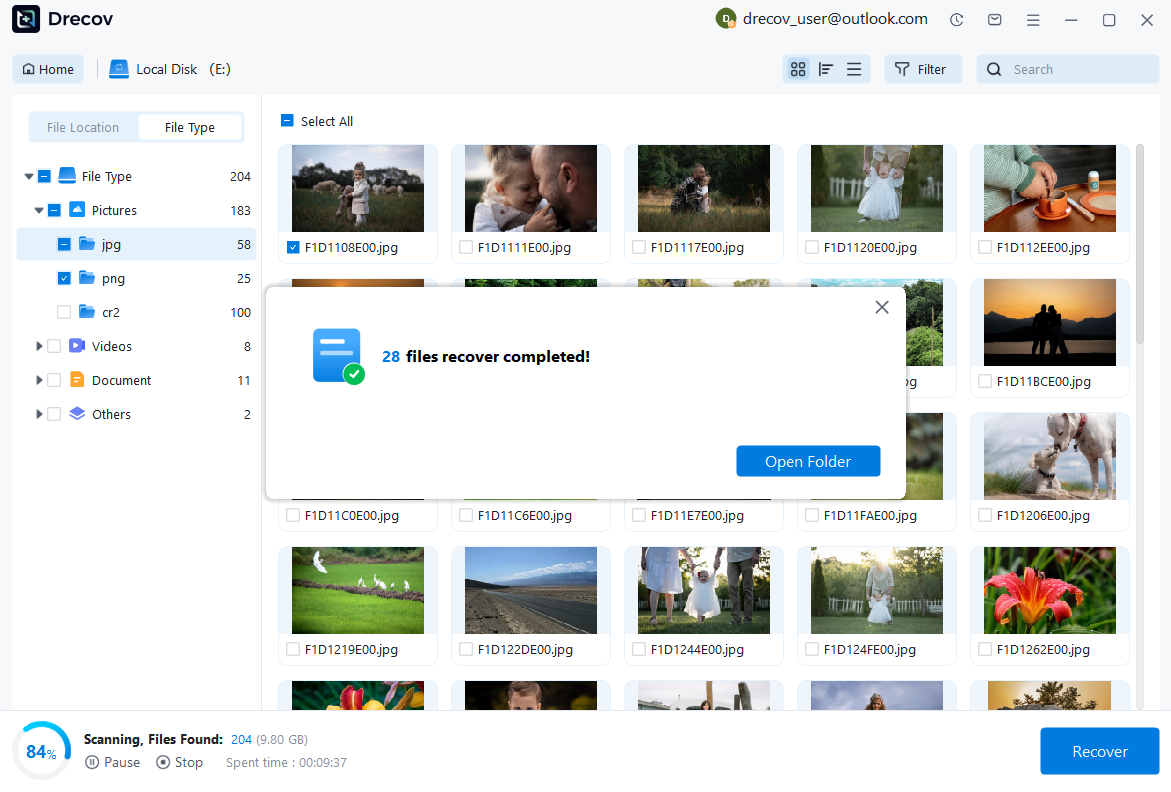
Step 3: Recover and Save to a New Location
Select the files you want to restore and click recover. Save all recovered data to a different drive or location (not the original device) to avoid overwriting lost data.
Why Choose PandaOffice Drecov Recovery Software?
PandaOffice Drecov offers a fast, secure, and user-friendly solution for recovering lost files across multiple scenarios. Whether you need email recovery, ZIP File Recovery, format data recovery, or help to recover deleted drafts Outlook, the software provides reliable recovery performance for both personal and business users.
PandaOffice Drecov supports recovery from formatted hard drives, SSDs, USB drives, SD cards, and external storage devices. Its advanced scanning engine can locate deleted archives, damaged ZIP files, lost Outlook drafts, and accidentally removed documents with high accuracy. For users searching for how to find deleted messages in Teams, PandaOffice Drecov can also help recover exported chat files, attachments, and related local cache data when available.
After recovery, test the file again. If the audio stream was damaged because of storage issues, a recovered version may play normally.
This method is particularly useful when only a few files exhibit audio problems while VLC works correctly with all other media.
This method can help users recover files from floppy disk storage after accidental deletion, formatting, or logical corruption.
Common recoverable file types include:
- Documents
- Photos
- Videos
- Databases
- Archives
- Project files
Test Environment
- Windows 11 Pro
- 1TB SSD
- NTFS File System
- Corrupted Storage Volume
Backing up important information should always be the first priority when dealing with storage reliability concerns.
⚠️ Warning: Do not save recovered files back to the affected SSD, as this may overwrite recoverable data.
Method 6: Update SSD Firmware
Firmware controls how the SSD communicates with the operating system and manages internal storage operations.
Outdated firmware may contribute to:
- Stability problems
- Performance degradation
- Compatibility issues
- Error reporting inaccuracies
Manufacturers periodically release firmware updates to address known problems and improve reliability.
Steps
- Open the manufacturer’s management utility.
- Check the current firmware version.
- Search for available updates.
- Review release notes.
- Install the update.
- Restart the computer.
- Verify successful installation.
Test Environment
- Windows 11 Home
- PCIe Gen4 SSD
- Manufacturer Firmware Utility
- UEFI System
Updating firmware may resolve issues that resemble bad sectors on ssd devices but are actually software-related.
Method 7: Replace an SSD with Bad Sectors
When storage errors continue to increase despite troubleshooting, replacement may be the safest option.
An ssd with bad sectors can continue functioning temporarily, but ongoing deterioration may eventually result in data loss or complete drive failure.
Signs replacement may be necessary include:
- Repeated SMART warnings
- Increasing error counts
- Frequent file corruption
- System instability
- Failed diagnostics
Steps
- Back up all important files.
- Purchase a replacement SSD.
- Clone the existing drive if possible.
- Install the new SSD.
- Verify successful migration.
- Securely erase or retire the old drive.
Test Environment
- Windows 11 Pro
- 1TB SATA SSD
- External Backup Drive
- Cloning Software
Replacing a failing SSD proactively is often more cost-effective than attempting emergency recovery after complete failure.
Best Practices to Prevent SSD Sector Problems
Monitor Drive Health Regularly
Routine monitoring helps identify developing problems before they become severe.
Recommended monitoring metrics include:
- Health percentage
- Wear level indicators
- Temperature readings
- Error counters
- Remaining lifespan estimates
Checking these metrics monthly allows users to track changes over time.
Many SSD management tools can automatically notify users when thresholds are exceeded.
Avoid Sudden Power Loss
Power interruptions remain a common cause of storage-related issues.
To reduce risk:
- Use a UPS for desktop computers.
- Avoid forced shutdowns.
- Allow updates to complete.
- Keep laptop batteries healthy.
Stable power delivery helps maintain file system integrity and prevents interrupted write operations.
Although SSDs are generally resilient, repeated power disruptions can still contribute to corruption-related issues.
Maintain Sufficient Free Space
Leaving adequate free space on an SSD improves performance and longevity.
Experts commonly recommend maintaining at least:
- 10% to 20% free capacity
Benefits include:
- Improved wear leveling
- Better garbage collection
- Enhanced performance
- Reduced write amplification
A nearly full SSD may experience slower operation and increased wear over time.
⚠️ Warning: Running an SSD continuously at maximum capacity may accelerate performance degradation.
Frequently Asked Questions
Can Bad Sectors on SSD Be Fixed?
The answer depends on the type of problem.
Logical errors can often be corrected through:
- CHKDSK scans
- File system repairs
- Firmware updates
Physical NAND deterioration, however, cannot truly be repaired. Modern SSD controllers may remap failing cells automatically, but damaged memory cells cannot be restored to their original condition.
When failures continue to increase, replacement is generally recommended.
Is an SSD with Bad Sectors Safe to Use?
An ssd with bad sectors may continue functioning for some time, especially if the errors are isolated and properly managed.
However, continued use carries risks such as:
- File corruption
- Unexpected crashes
- Data loss
- Reduced performance
Users should maintain current backups and monitor drive health closely.
How Many Bad Sectors Are Acceptable?
There is no universal threshold because SSD models differ significantly.
A small number of remapped cells may not indicate immediate danger. However, a steadily increasing error count often suggests the drive is deteriorating.
Users should pay close attention to:
- SMART warnings
- Diagnostic reports
- Manufacturer health scores
Rapid growth in error statistics typically warrants replacement planning.
Should I Replace an SSD Showing Errors?
Replacement is recommended when:
- Diagnostics repeatedly fail.
- SMART warnings persist.
- Errors increase over time.
- Critical files become corrupted.
- System stability declines.
The cost of replacing an SSD is usually far lower than the cost of recovering data after a catastrophic failure.
Do SSDs and HDDs Handle Bad Sectors Differently?
Yes.
Traditional hard drives experience physical sector damage on magnetic platters. SSDs use flash memory and rely on controllers to manage failing cells.
As a result:
- SSDs automatically remap damaged cells.
- Wear-leveling distributes write activity.
- Error management occurs internally.
Despite these differences, both technologies can ultimately experience storage failures that threaten data integrity.
Final Thoughts
Protecting Data from SSD Sector Failures
Although SSDs are faster and more durable than traditional hard drives, they are not immune to storage problems. An ssd bad sector issue can develop because of NAND wear, firmware problems, file system corruption, power interruptions, or manufacturing defects. Recognizing the warning signs early is essential for preventing serious data loss.
In this guide, we explored multiple ways to identify and manage bad sectors on ssd devices, including CHKDSK scans, Windows Error Checking, SMART monitoring, manufacturer diagnostics, firmware updates, and replacement planning. We also discussed the importance of recovering valuable files with PandaOffice Drecov before performing major repairs.
The best protection strategy includes:
- Regular health monitoring
- Routine backups
- Stable power management
- Timely firmware updates
- Maintaining sufficient free space
If you suspect your system contains an ssd with bad sectors, act quickly. Early intervention can protect important files, extend drive usability, and help you avoid unexpected storage failures. By combining preventive maintenance with proper diagnostic procedures, users can significantly reduce the risks associated with SSD reliability issues and keep their systems operating smoothly for years to come.






