







When BitLocker keeps asking for recovery key at every startup, enter the matching key once and back up important files before changing TPM, firmware, Secure Boot, or partitions. A valid key proves that you can unlock the encrypted volume; the repeated prompt means Windows no longer trusts the current boot measurements. Identify what changed, restore a known configuration, and suspend then resume protection only through an authorized Windows session.
bitlocker keeps asking for recovery key: safe diagnosis
BitLocker protects an operating-system drive by binding its key protectors to expected startup conditions. On many computers, the Trusted Platform Module releases the necessary secret when measured boot values match the state recorded earlier. If firmware settings, Secure Boot, boot components, or attached hardware change those measurements, BitLocker enters recovery rather than silently releasing the key.
The 48-digit recovery key unlocks the volume for that boot. It does not automatically accept the new measurements as the future baseline. Therefore, a successful unlock followed by another request is different from an incorrect or missing key. It is also different from a USB data drive that simply needs a password.
| What changed before the loop | Why it matters | What to verify first |
|---|---|---|
| BIOS or UEFI update | Firmware and measured-boot values may have changed | Confirm the update completed and settings match the supported configuration |
| Secure Boot enabled, disabled, or keys changed | The trusted startup chain differs | Record the present state; do not toggle it repeatedly |
| TPM cleared, disabled, replaced, or reset | The previous sealed protector relationship may be unavailable | Confirm TPM readiness after entering Windows |
| Boot order, boot manager, partition, or storage changed | Windows may be starting through a different path | Check the intended Windows Boot Manager and disk layout |
| Dock, expansion device, or external boot media attached | Hardware or boot selection can alter measurements | Shut down and compare one boot without nonessential devices |
Record the recovery-key ID, computer model, firmware version, Secure Boot state, and last known normal boot. Save this information away from the encrypted PC. A screenshot of the recovery page is useful, but do not publish or send the 48-digit key in an unsecured channel.
Unlock Once and Create a Verified Safety Copy
Use the recovery key whose identifier matches the screen. Microsoft explains where authorized owners may find it in the official BitLocker recovery-key guidance. The record might be held in a Microsoft account, work or school account, printed page, saved file, or organizational directory. A key for another computer cannot substitute.
After Windows opens, copy irreplaceable user folders to a healthy external drive or approved network destination. Open representative documents, photos, archives, and project files from the copy. Preserve a second backup when the data is important. Do not begin by clearing the TPM, deleting protectors, converting partitions, rebuilding BCD, or reinstalling Windows.
If the system drive clicks, vanishes from firmware, freezes during reads, or reports severe storage errors, stop repeated boot cycles. The recovery prompt may coexist with a physical problem. Unlocking encryption does not make unstable hardware safe. Controlled imaging or professional recovery may be necessary.
Read the Current BitLocker and TPM State
Sign in to an administrator account after the successful unlock. Open Manage BitLocker and confirm which drive is protected. An elevated terminal can show status with manage-bde -status C:. Read the conversion status, protection status, lock state, and encryption method. Do not paste commands from an unrelated machine without first confirming the drive letter.
Windows Security can report whether the security processor is ready. PowerShell cmdlets such as Get-Tpm may provide TPM presence and readiness on supported systems. Record the output rather than changing it immediately. A disabled TPM, pending restart, or firmware update in progress changes the safest branch.
Check the actual boot entry and device order
Open firmware settings only after the backup. Confirm that the expected Windows Boot Manager remains first for the internal system disk. Remove nonessential bootable USB devices for one controlled comparison. Do not switch randomly between UEFI and Legacy or CSM modes. Such changes can make Windows unbootable and alter BitLocker measurements again.
If Windows Boot Manager is absent, the problem belongs to the boot path rather than a simple protector refresh. Follow a recovery-first approach before BCD or EFI edits. The guide to a missing Windows Boot Manager covers that boundary.
Compare firmware and Secure Boot with the known baseline
Review the computer manufacturer’s record of the recent BIOS update. Confirm that it was intended for the exact model. Note whether Secure Boot, TPM, storage mode, virtualization, or boot order returned to defaults. Restore only settings that you know were previously correct and supported.
Do not clear the TPM as a trial. Clearing can remove keys used by Windows Hello and other services. Do not delete all BitLocker protectors while the only recovery information is uncertain. On a managed PC, stop and contact the organization because its policy may recreate or rotate protectors.
Reseal Protection After the Cause Is Stable
If the system now boots reliably, storage is healthy, the backup is verified, and the configuration is the one you intend to keep, suspend BitLocker protection through Manage BitLocker. Suspension temporarily allows a planned trusted-boot change without decrypting the whole drive. Restart once, sign in, and resume protection. This process lets BitLocker bind to the accepted configuration.
Use suspension before a manufacturer-directed firmware update when the vendor or administrator recommends it. Resume immediately after the update and successful boot. Do not leave protection suspended indefinitely. Confirm the status in Manage BitLocker or with manage-bde -status, then perform a controlled restart.
If the prompt returns, compare the measurements and boot state again rather than repeatedly suspending. A setting may be changing on every startup, the TPM may not retain state, or Windows may use another boot path. Firmware service or organizational support is then more appropriate than deleting protectors.
When decrypting and re-encrypting is justified
It helps diagnose bitlocker keeps asking for recovery key without changing the source data. Full decryption is not the first fix for a recovery loop. It writes the entire volume and can take substantial time. Consider it only after a verified backup, stable storage, and a clear administrative reason. Complete decryption before changing partition style or replacing boot-critical hardware when the supported migration plan requires it.
Changing GPT or MBR layout is not a routine BitLocker repair. It can alter the boot mechanism and partition metadata. The explanation of GPT and MBR boot requirements helps identify why such a conversion needs its own plan.
Recover Files Only After the Volume Is Authentically Unlocked
This check is especially useful for bitlocker keeps asking for recovery key. Drecov can help when a BitLocker-protected Windows volume has been successfully unlocked and files are then found to be deleted or logically inaccessible. It recovers data in Windows from PCs, HDDs, SSDs, external drives, USB devices, SD cards, and memory cards. Quick Scan looks for recent logical loss. Deep Scan searches a stable accessible source more broadly. Filters, paths, and preview help locate documents, photos, video, audio, email data, and archives. Lost Partition Recovery handles missing partition metadata after authorized access is available.
Drecov cannot discover a BitLocker password, calculate a recovery key, bypass encryption, repair the TPM, or stop the recovery prompt. It also cannot make a physically unstable drive safe. If you cannot unlock the volume with authorized credentials, file recovery software cannot read meaningful plaintext from it.
⚠ Warning: Install it on a drive different from the one where your data was lost to prevent overwriting.
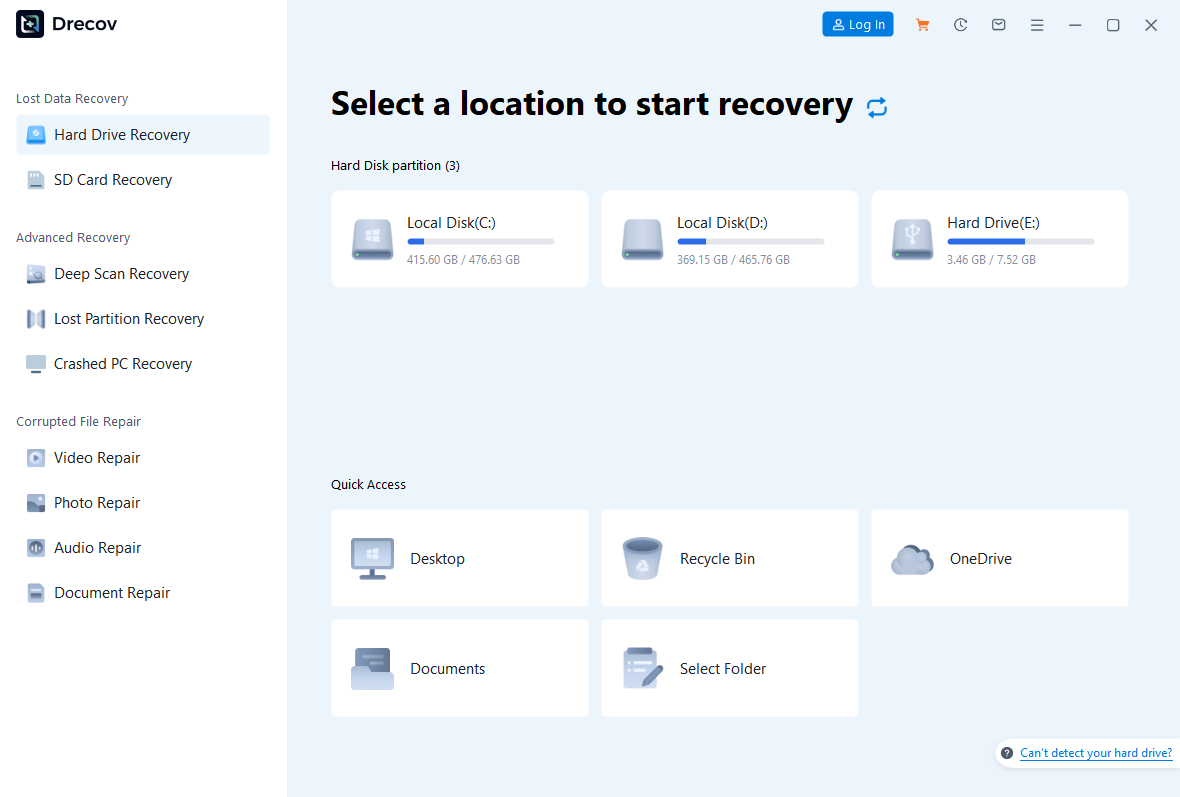
Step 1: Open Drecov and select the unlocked original location
Prepare another healthy device with enough free space. Do not install Drecov on the partition that lost data. After entering the correct BitLocker key and confirming stable detection, open Drecov and select the original Windows volume or lost location. If the partition no longer appears after unlocking, use Lost Partition Recovery. Stop if the drive disconnects or reports severe read errors.
Step 2: Run Quick Scan for recent loss
Start Quick Scan and inspect the former user folders. Search a few known filenames and compare their paths, dates, and sizes. Keep other disk-intensive work closed. Do not choose the encrypted recovery partition merely because it has a similar label.
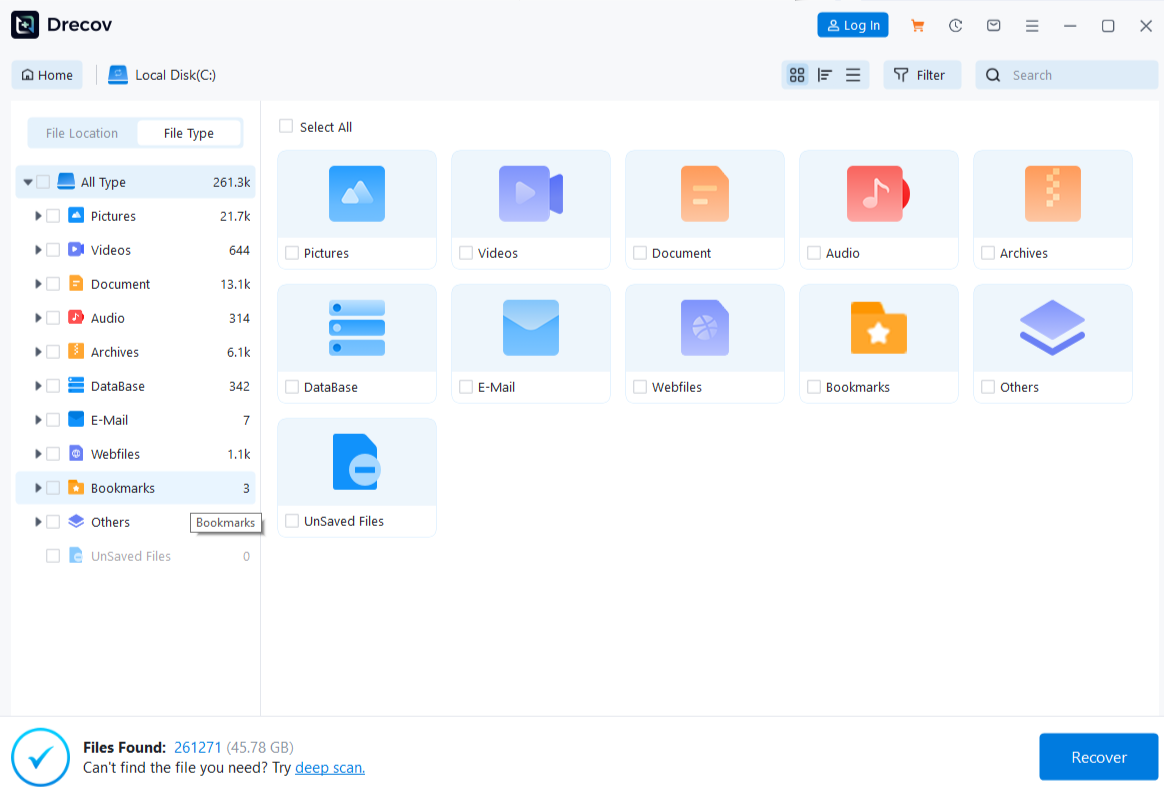
Step 3: Use Deep Scan only when storage remains stable
Continue with Deep Scan if Quick Scan misses important files and the source stays responsive. End the scan at the first new disconnect, severe slowdown, or read-error pattern. Repeated scans do not repair a failing SSD or hard drive.
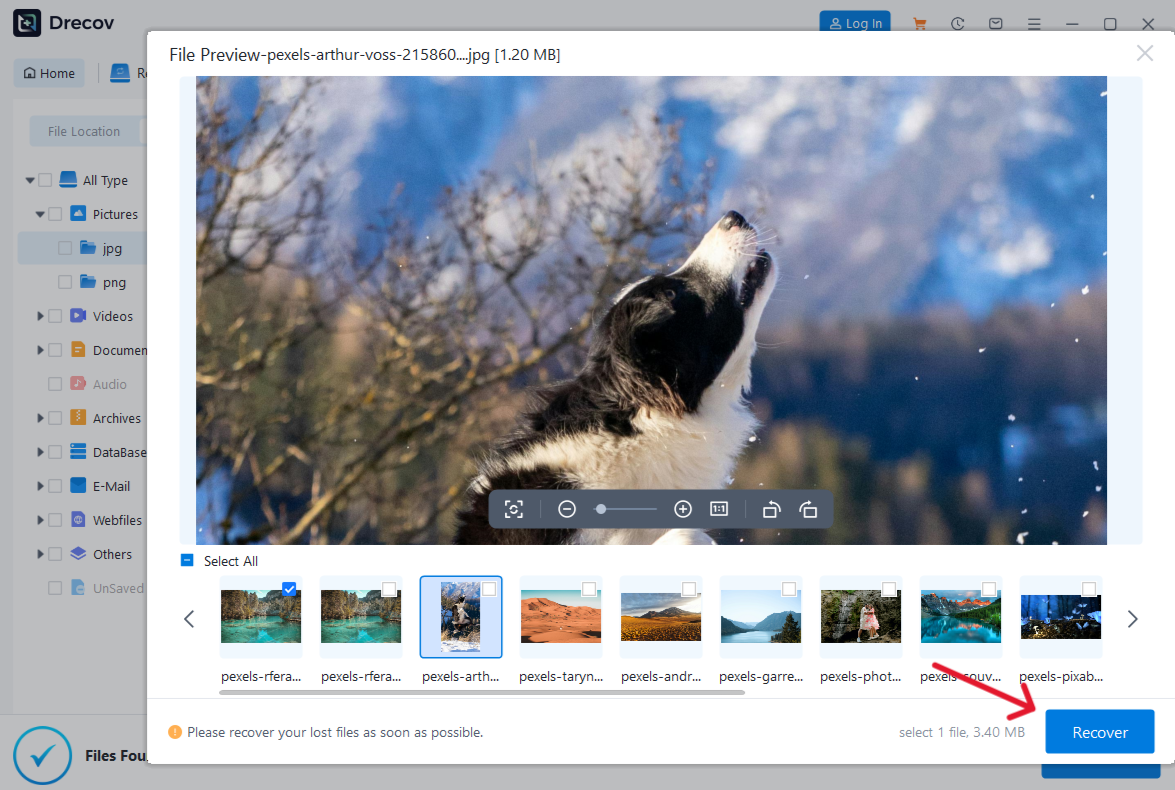
Step 4: Filter and preview representative candidates
Filter by file type, former path, name, date, or approximate size. Preview several supported files from each critical folder. A visible preview confirms only the displayed sample. It cannot guarantee every page, video frame, formula, archive member, or project dependency.
Step 5: Recover elsewhere and validate before boot repair
Save selected files to the prepared healthy device, never to the encrypted source. Check Drecov Folder or Recovery Folder if the expected structure is not reproduced. Open representative outputs and make a second copy. Only then resume partition, BCD, firmware, or Windows repair. If the system becomes unbootable, the inaccessible boot-device workflow explains a related recovery path.
⚠ Warning: Install it on a drive different from the one where your data was lost to prevent overwriting.
Verify That the Recovery Loop Is Actually Gone
Restart from a complete shutdown with the normal hardware configuration. Confirm that Windows reaches sign-in without the 48-digit key. Then restart once more with only the usual dock or approved peripherals. Check BitLocker protection status after each test.
Record the final firmware version, TPM readiness, Secure Boot state, active boot entry, and BitLocker protection status. Store the recovery key securely outside the PC. Do not delete older key records until you know which identifier is active and organizational retention rules permit removal.
If the prompt returns only with one dock, external device, or bootable USB attached, leave that component disconnected and update it through the supported vendor path. If it returns after every cold boot despite a stable configuration, seek firmware or TPM support. Repeated key entry is access, not a permanent repair.
Questions About a Repeating BitLocker Key Prompt
Why does BitLocker ask again when the key was correct?
The key unlocked one boot, but the TPM still sees startup measurements that differ from the trusted baseline. Firmware, Secure Boot, boot order, TPM state, or hardware may be involved.
Should I clear the TPM to stop the loop?
No, not as a trial. Clearing the TPM can remove other protected keys. Back up data, document the configuration, and use the supported administrative path.
Does suspending BitLocker decrypt the drive?
No. Suspension temporarily changes how protection is enforced during a planned boot change. Resume protection after the stable configuration and verify its status.
Can Drecov recover files without the BitLocker key?
No. The volume must first be unlocked with valid credentials. Drecov can then recover deleted or inaccessible files from stable, readable storage.
What if the system disk also disappears from BIOS?
Stop treating the event as only a BitLocker problem. Missing firmware detection suggests a connection or hardware issue. Avoid repeated boots and protect data through a qualified recovery path.
Conclusion
When BitLocker keeps asking for the recovery key, a valid key solves access for one boot but does not explain the changed trust state. Back up files, document TPM, firmware, Secure Boot and boot order, then restore one supported configuration. Suspend and resume protection only after the system is stable. If unlocked files are genuinely missing, Drecov can recover candidates to another healthy device, but it cannot bypass encryption or repair the TPM. Confirm the result with cold boots and an active BitLocker protection status.
⚠ Warning: Install it on a drive different from the one where your data was lost to prevent overwriting.





