







What is WebM file format? WebM is an open, web-focused media container commonly used for video and audio delivered in browsers. The .webm extension does not describe one fixed codec. Before converting or repairing a file, identify its streams and determine whether the problem is compatibility, incomplete transfer, corruption, or deletion.
what is webm file format: safe diagnosis
A WebM file can hold video, audio, timing, and metadata in a Matroska-derived container. WebM profiles are associated with codecs such as VP8, VP9, AV1, Vorbis, and Opus depending on the file and implementation. A player must understand both the container and the encoded streams.
The filename extension is only a label. Renaming WebM to MP4 does not transcode the streams or rebuild metadata. Use a trusted media-information tool to inspect codecs, duration, dimensions. Frame rate, and whether the parser reaches the end of the file.
Separate Browser Compatibility from File Damage
Test the file in a current browser and a reputable desktop player. If one opens it completely, update or reconfigure the failing application rather than repairing the file. Browser policy, MIME type, server headers, hardware acceleration. And codec support can affect online playback even when the local WebM is healthy.
If every decoder stops at the same timestamp, reports premature end of file. Or shows a much shorter duration than expected, the copy may be incomplete. Compare it with the upload source, cloud object, download size, or checksum. Preserve the longest intact copy.
Convert a Duplicate for Compatibility
Keep the original WebM and convert a duplicate only when the target application requires another container or codec. Choose settings based on the destination, not a promise of “higher quality.” Transcoding is lossy when it re-encodes media and cannot restore detail absent from the source.
For web publishing, test the actual page response as well as the file. A wrong Content-Type or broken URL can produce an HTML5 error unrelated to corruption. Local playback separates server delivery from media structure.
What is webm file format — Useful related reading includes recover deleted videos, repair corrupted video files, and understand MP4 files.
Recover Missing Local Data Before Repair Changes the Source
When the checks above establish genuine local loss, PandaOffice Drecov provides a read-only Windows recovery path. It supports PCs and common internal or removable storage, plus photos, video, documents, email data, audio, and archives. Quick Scan, Deep Scan, preview, and recovery to a selected healthy destination help retrieve deleted WebM originals, exports, and related project media. Lost Partition Recovery and Crashed PC Recovery cover their named logical-loss situations; neither is a physical repair service.
⚠ Warning: Install it on a drive different from the one where your data was lost to prevent overwriting.
Step 1: Open Drecov and Point It to the Last Known Location
Leave the source unchanged. Confirm that it stays readable; stop on clicks, repeated disconnects, capacity changes, or severe read errors. Connect a separate healthy output drive, keep the software off the source, open Drecov. And choose the stable drive, USB device, or memory card that held the original WebM file.

Step 2: Let Quick Scan Reconstruct the Recent View
Begin with Quick Scan. Browse the former directory and compare names, sizes. And dates while looking for deleted WebM originals, exports, and related project media. This focused pass is preferable to an immediate exhaustive scan after a recent loss.

Step 3: Escalate to Deep Scan Only on Reliable Media
Use Deep Scan when the first result set is incomplete and the device remains stable. Older candidates may be organized by type rather than their former folders. End the session if the source becomes unstable and move to an image or specialist workflow.
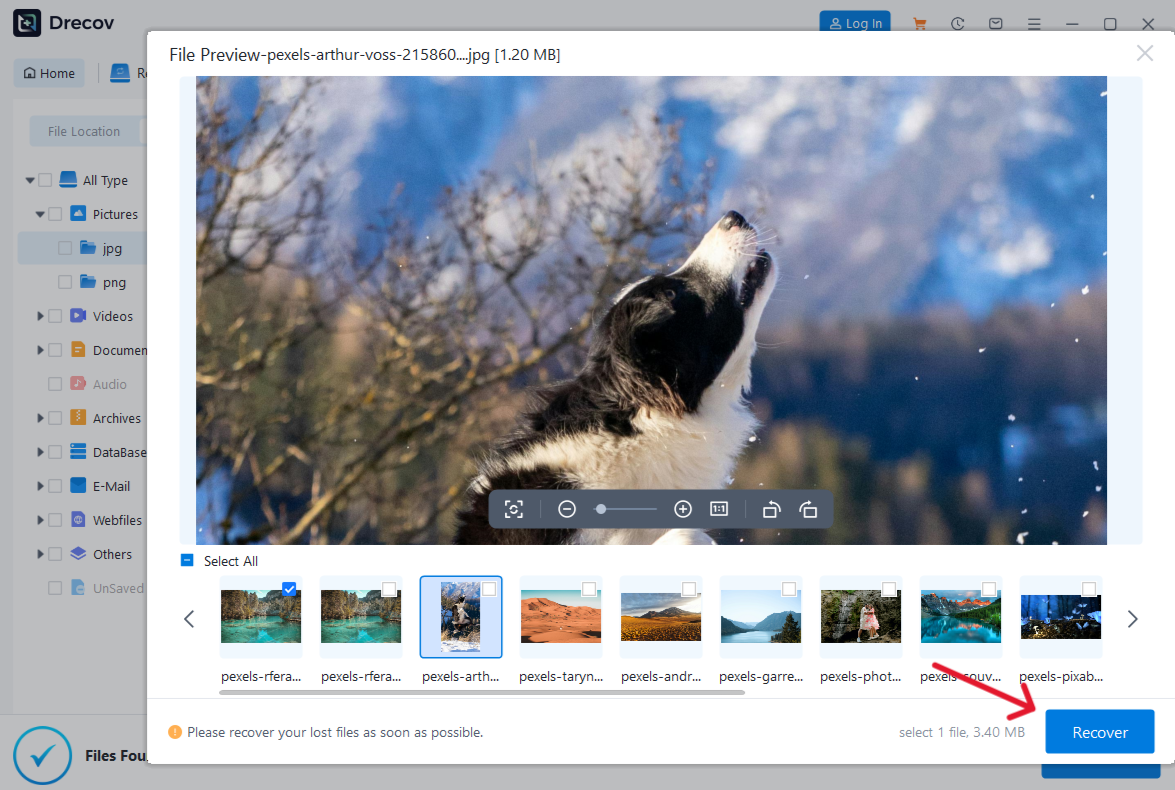
Step 4: Locate Evidence and Preview More Than One File
Apply WebM or video type, original folder, filename, size, creation date, and previewed content. Preview a small but representative set and keep differently dated candidates separate. A thumbnail or opening page alone cannot prove an entire file is intact.
Step 5: Send the Recovery Elsewhere, Then Test It
Choose the healthy destination rather than the stable drive, USB device, or memory card that held the original WebM file. If files seem absent afterward, inspect Drecov Folder and Recovery Folder. Finally, play the beginning, several seek points, and final seconds after recovery to another healthy device. Only verified copies justify proceeding with repairs that write to the original storage.
⚠ Warning: Install it on a drive different from the one where your data was lost to prevent overwriting.
Recover a Missing WebM Instead of Converting Nothing
If the file was deleted or a project folder vanished. Check browser downloads, editor autosaves, cloud trash, version history, and backups. Then stop writes to the original local storage. File recovery can locate surviving WebM data; it does not repair a server URL or recreate overwritten frames.
What is webm file format — For the relevant documented behavior, consult the official technical guidance. Use that source for current interface or command details, and keep the protected original available while testing.
Choose WebM for the delivery context, not the extension alone
WebM is an open media container commonly used for web delivery. A .webm file may carry VP8, VP9, or AV1 video and Opus or Vorbis audio. So compatibility depends on the codecs as well as the container. Inspect actual stream information when a browser, editor, or player rejects a file.
For websites, test the final encoded file in the target browsers and devices. Compare startup time, visual quality, audio sync, captions, transparency needs, and file size at the same viewing conditions. Provide an alternative format when the audience includes software that does not support the chosen WebM codec.
Conversion should begin from the best available source and produce a new output. Repeatedly transcoding an already compressed file compounds quality loss. After encoding, seek through the full duration and inspect the final seconds. If a WebM file vanished, recover the source before creating new files on the same storage.
WebM also supports workflows that ordinary MP4 delivery may not cover in the same way. Including browser-oriented VP9 or AV1 compression and, in some implementations, transparency. Support still varies by application and codec profile. Editors should keep an intermediate master instead of using a web delivery file as the only archive. Document the encoder, codec, dimensions, frame rate, and audio settings. Those details make later compatibility fixes reproducible without repeatedly transcoding an already compressed WebM file.
Questions Readers Commonly Ask
Is WebM the same as MP4?
No. They are different containers with different common codec combinations and compatibility profiles.
Does converting WebM improve quality?
No. Conversion may preserve practical playback compatibility, but re-encoding cannot add missing source detail.
Why does WebM play locally but not on a website?
Check the resource URL, server MIME type, cross-origin policy, and browser support before assuming file corruption.
Keep the diagnosis tied to observable evidence
A WebM file can hold video, audio, timing, and metadata in a Matroska-derived container. WebM profiles are associated with codecs such as VP8, VP9, AV1, Vorbis, and Opus depending on the file and implementation. A player must understand both the container and the encoded streams.
Why one successful test is not enough
The filename extension is only a label. Renaming WebM to MP4 does not transcode the streams or rebuild metadata. Use a trusted media-information tool to inspect codecs, duration, dimensions. Frame rate, and whether the parser reaches the end of the file.
Preserve the cleanest available version
Test the file in a current browser and a reputable desktop player. If one opens it completely, update or reconfigure the failing application rather than repairing the file. Browser policy, MIME type, server headers, hardware acceleration. And codec support can affect online playback even when the local WebM is healthy.
Use the result to choose the next action
If every decoder stops at the same timestamp, reports premature end of file. Or shows a much shorter duration than expected, the copy may be incomplete. Compare it with the upload source, cloud object, download size, or checksum. Preserve the longest intact copy.
Know when the source needs specialist handling
Keep the original WebM and convert a duplicate only when the target application requires another container or codec. Choose settings based on the destination, not a promise of “higher quality.” Transcoding is lossy when it re-encodes media and cannot restore detail absent from the source.
Compare the protected copy with the working result
For web publishing, test the actual page response as well as the file. A wrong Content-Type or broken URL can produce an HTML5 error unrelated to corruption. Local playback separates server delivery from media structure.
Document the point at which the symptom changed
If the file was deleted or a project folder vanished. Check browser downloads, editor autosaves, cloud trash, version history, and backups. Then stop writes to the original local storage. File recovery can locate surviving WebM data; it does not repair a server URL or recreate overwritten frames.
Conclusion
The WebM file format is a web-focused media container whose real compatibility depends on its video and audio codecs. Test the intended delivery environment and preserve the master source before conversion. Drecov is relevant only when WebM or source files were deleted from stable local storage.
⚠ Warning: Install it on a drive different from the one where your data was lost to prevent overwriting.





