







Understanding AOL Email Deletion and Recovery Options
What Happens When AOL Emails Are Deleted
Email remains one of the most important communication tools for personal and professional use. Losing access to important messages can be frustrating, especially when invoices, account notifications, attachments, or business correspondence disappear unexpectedly. Many users begin searching for solutions after discovering an AOL email deleted accidentally or noticing that older messages are no longer available.
When an email is deleted in AOL Mail, it is typically moved to the Trash folder instead of being permanently erased immediately. This temporary storage period provides users with an opportunity to restore messages before they are removed permanently. However, the length of time emails remain recoverable depends on AOL’s retention policies and the actions taken after deletion.
The good news is that deleted AOL email recovery is often possible if you act quickly. Whether the email was removed accidentally, disappeared due to synchronization issues, or was lost during account cleanup, several recovery methods may help restore access to important messages.
Understanding where deleted emails go and how AOL manages removed messages is the first step toward successful recovery.
How AOL Stores Deleted Messages
AOL Mail uses a folder-based system to organize emails. When messages are deleted, they are generally transferred to the Trash folder. During this stage, they remain accessible and can usually be restored with just a few clicks.
Deleted messages may exist in:
- Trash folder
- Archived folders
- Email client backups
- Downloaded local mail files
- Server-side recovery systems
Depending on how the email account is configured, messages may also exist on connected devices through applications such as Outlook or Thunderbird.
Some users mistakenly believe their emails are permanently gone immediately after deletion. In reality, AOL often maintains deleted items temporarily, giving users a chance to retrieve them.
Can Deleted AOL Emails Be Recovered Successfully?
The success rate of recovery depends largely on how much time has passed since deletion and whether additional actions have overwritten the data.
Recovery is generally more successful when:
- Emails were deleted recently.
- Trash has not been emptied.
- Account activity remains minimal.
- Local email backups exist.
- Email clients downloaded copies of messages.
Users searching for recover deleted AOL email solutions should begin with the simplest recovery methods before moving to more advanced options.
⚠️ Warning: Avoid deleting additional emails or emptying folders while attempting recovery, as this may reduce the likelihood of successful restoration.
Common Reasons AOL Emails Disappear
Accidental Deletion of Important Messages
Human error remains one of the most common causes of email loss. A single misplaced click can move dozens of messages into the Trash folder.
Common scenarios include:
- Bulk inbox cleanup
- Mobile app mistakes
- Accidental keyboard shortcuts
- Incorrect filter settings
Many users searching for recover deleted AOL emails simply need to restore messages from Trash before they are permanently removed.
When dealing with large inboxes, deleted messages may not be noticed immediately. This delay can make recovery more challenging if AOL’s retention period expires.
When AOL Deleted All My Emails Unexpectedly
Some users report situations where it appears that AOL deleted all my emails without warning. While alarming, the issue is often related to account settings, synchronization conflicts, or inactivity policies rather than intentional deletion.
Possible causes include:
- Account inactivity
- POP/IMAP synchronization issues
- Third-party email client settings
- Accidental mass deletion
- Unauthorized account access
In many cases, messages remain available in alternate folders or synchronized devices even when they appear missing from the inbox.
Reviewing account activity and connected applications can help identify the source of the problem.
Email Retention Policies and Automatic Cleanup
Email providers periodically remove content based on retention rules. Messages stored in Trash are often deleted automatically after a predefined period.
As a result, users attempting recover deleted AOL mail weeks or months after deletion may face greater challenges than those acting immediately.
To reduce risk:
- Archive important emails.
- Create backups regularly.
- Export critical messages.
- Save attachments separately.
Understanding retention policies helps users make informed decisions about long-term email storage.
Account Access Issues and Missing AOL Old Email Data
Many users become concerned when an AOL old email account suddenly appears empty. In some situations, the problem stems from logging into the wrong account or using outdated credentials.
Additional causes include:
- Forgotten account aliases
- Synchronization conflicts
- Browser cache problems
- Incorrect account recovery attempts
Before assuming emails have been deleted permanently, verify that the correct AOL account is being accessed.
Users seeking access to AOL mail old messages should also check archive folders and connected email applications.
Synchronization Problems Across Devices
Modern email accounts often connect to multiple devices simultaneously. Synchronization errors can create confusion about whether emails actually exist.
Examples include:
- Mobile devices showing outdated data
- Desktop clients failing to sync
- Duplicate folder structures
- Offline email caches
When messages appear missing, checking AOL Mail directly through a web browser can help determine whether the issue is local or server-based.
How to Recover Deleted AOL Emails Step by Step
Method 1. Recover Downloaded AOL Email Files with PandaOffice Drecov
Test Environment
- Windows 11 Pro
- AOL Mail Account Previously Accessed
- Outlook or Thunderbird Installed
- Local Storage Available
Sometimes deleted AOL emails exist in downloaded email databases, exported mail archives, or locally stored attachments. If these files are accidentally deleted from a computer, they may still be recoverable.
PandaOffice Drecov is a data recovery solution designed to recover deleted documents, email archives, PST files, MBOX files, attachments, and other lost data from storage devices.
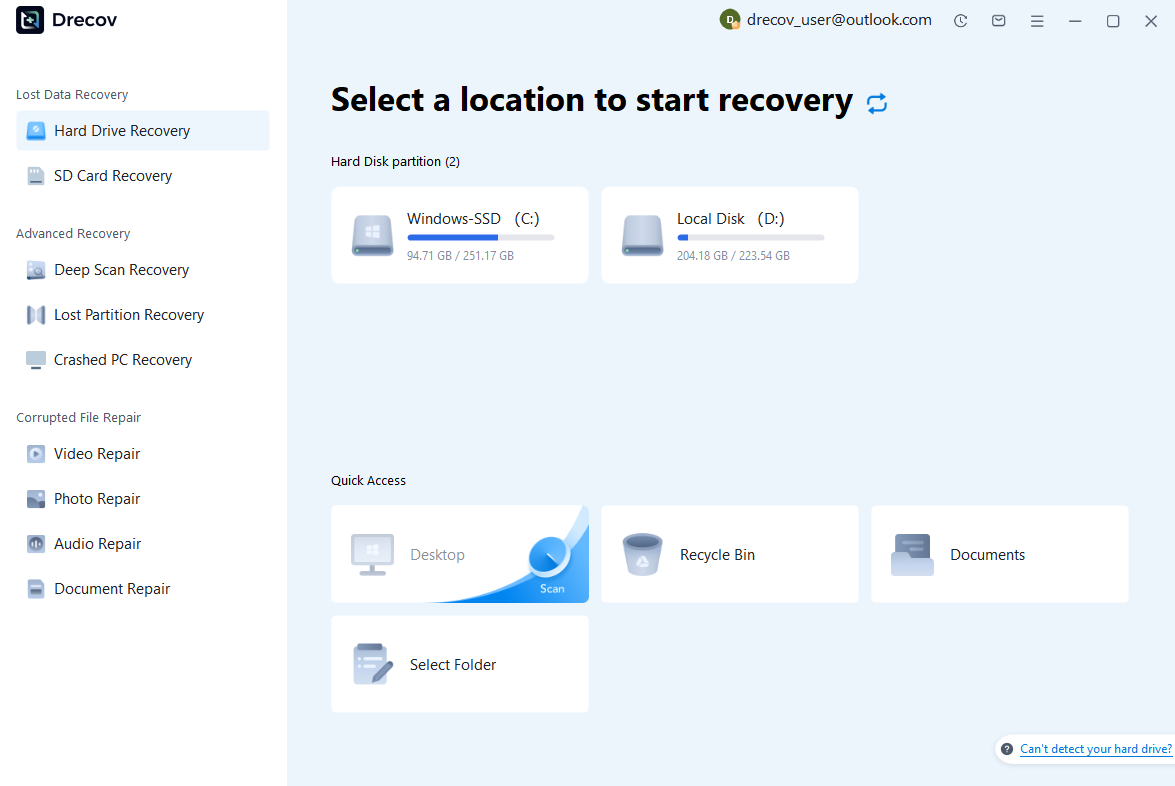
Step 1: Scan the Storage Device (SD Card / Hard Drive / USB)
Connect your device (SD card, HDD/SSD, or USB drive) to your computer and launch PandaOffice Drecov. Select the target device and start the scan. The software will perform a quick scan and deep scan to detect lost or deleted data.
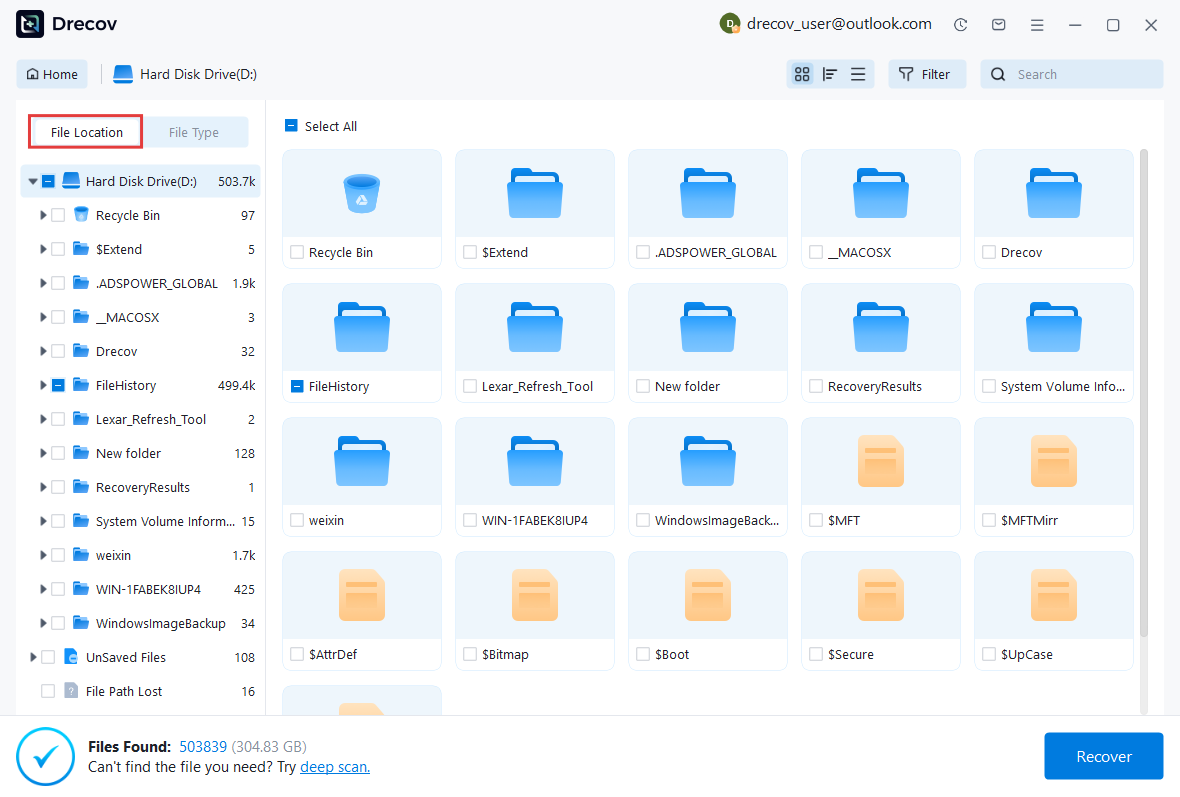
Step 2: Locate and Preview Lost Files
After scanning, browse the detected files and use the preview feature to check recoverable data. You can preview documents (Word, Excel, PDF), photos, and videos to ensure file integrity before recovery.
Step 3: Recover and Save to a New Location
Select the files you want to restore and click recover. Save all recovered data to a different drive or location (not the original device) to avoid overwriting lost data.

Why Choose PandaOffice Drecov Recovery Software?
PandaOffice Drecov offers a fast, secure, and user-friendly solution for recovering lost files across multiple scenarios. Whether you need email recovery, ZIP File Recovery, format data recovery, or help to recover deleted drafts Outlook, the software provides reliable recovery performance for both personal and business users.
PandaOffice Drecov supports recovery from formatted hard drives, SSDs, USB drives, SD cards, and external storage devices. Its advanced scanning engine can locate deleted archives, damaged ZIP files, lost Outlook drafts, and accidentally removed documents with high accuracy. For users searching for how to find deleted messages in Teams, PandaOffice Drecov can also help recover exported chat files, attachments, and related local cache data when available.
Key advantages include:
- Deep scan technology for complex data loss situations
- Support for emails, archives, videos, photos, and office documents
- Recovery from accidental deletion, formatting, corruption, and system crashes
- Easy preview before restoring files
- Compatible with Windows and multiple storage devices
Unlike complicated enterprise recovery tools, PandaOffice Drecov keeps the recovery process simple. Users can scan, preview, and restore files in just a few steps without technical expertise.
Whether you are dealing with lost Outlook drafts, corrupted ZIP archives, formatted drives, or missing communication data, PandaOffice Drecov provides an efficient and practical recovery experience designed to minimize downtime and protect important files.
Disk imaging ensures that even partially corrupted drives can be preserved. This is often the safest approach before attempting any aggressive repair operations for fix bad sectors on hard drive situations.
⚠️ Warning: Save recovered files to a different drive to avoid overwriting recoverable data.
Method 2. Restore Messages from the AOL Trash Folder
Test Environment
- AOL Mail Web Access
- Active Internet Connection
- Deleted Email Within Retention Period
The Trash folder is often the fastest recovery option.
Step 1. Sign in to AOL Mail.
Step 2. Open the Trash folder.
Step 3. Locate the deleted message.
Step 4. Select the email.
Step 5. Move it back to the Inbox or another folder.
For many users asking how to recover deleted emails on AOL, this method resolves the problem immediately.
The sooner you check the Trash folder, the better your chances of recovery.
Method 3. Use the AOL Mail Restore Feature
Test Environment
- Active AOL Account
- Deleted Email Removed Recently
- Browser Access Available
AOL provides an AOL mail restore feature that may help recover recently deleted messages.
Step 1. Log in to AOL Mail.
Step 2. Navigate to the Help or Recovery section.
Step 3. Access the email restoration request form.
Step 4. Specify the approximate deletion date.
Step 5. Submit the recovery request.
This option attempts to restore mailbox contents to a previous state before the deletion occurred.
Many users seeking AOL mail recover deleted email solutions rely on this feature when messages are no longer available in Trash.
Method 4. Submit an AOL Email Recovery Request
Test Environment
- AOL Mail Account
- Account Ownership Verified
- Recent Deletion Event
If automated restoration tools are unsuccessful, users can contact AOL support and submit a recovery request.
Step 1. Visit AOL support resources.
Step 2. Verify account ownership.
Step 3. Explain the deletion circumstances.
Step 4. Provide relevant account information.
Step 5. Follow recovery instructions provided by AOL.
This method may assist users who need how to recover deleted emails from AOL mail after standard recovery methods have failed.
Method 5. Check Archived or Saved Mail Folders
Test Environment
- AOL Mail Web Version
- Active AOL Account
- Browser Updated to Latest Version
- Internet Connection Available
Not every missing email has been deleted. In many cases, messages are accidentally moved to Archive, Saved Mail, or custom folders and simply become difficult to locate.
To search for misplaced messages:
Step 1. Sign in to your AOL Mail account.
Step 2. Review the Archive, Saved Mail, Spam, and custom folders.
Step 3. Use the AOL search bar to locate specific senders, subjects, or keywords.
Step 4. Check sorting and filter settings.
Step 5. Move recovered emails back to the Inbox if necessary.
This method is often overlooked by users searching for how to recover deleted AOL mail because they assume the messages have been permanently erased. In reality, folder rules, filters, or accidental moves may simply relocate emails to another location.
If you’re trying to find an AOL old email, searching archived folders may be especially useful. Many long-term users store older correspondence in dedicated folders to keep their inbox organized.
Taking a few minutes to inspect all mailbox folders can save significant time before moving to more advanced recovery techniques.
Method 6. Recover Emails Through Email Client Backups
Test Environment
- AOL Account Connected to Outlook or Thunderbird
- Email Synchronization Previously Enabled
- Local Backup Available
Many users access AOL Mail through desktop email clients. These applications often create local copies of emails, which can serve as valuable backups when messages disappear from the server.
To check for recoverable emails:
Step 1. Open your email client.
Step 2. Review local folders and archived mail.
Step 3. Search for missing messages using keywords or sender information.
Step 4. Export recovered emails if necessary.
Step 5. Re-import messages into AOL Mail or save them locally.
This method can be extremely effective when AOL email deleted messages have already been removed from the server but remain stored in a synchronized desktop application.
Users who regularly synchronize their email clients often have multiple copies of important messages, improving recovery opportunities.
⚠️ Warning: Before making changes to backup files, create a copy of the original email database to prevent accidental corruption.
Method 7. Restore AOL Mail from Local PST or MBOX Files
Test Environment
- Windows PC or Mac
- Outlook PST Backup or Thunderbird MBOX Archive
- Administrative Access
Many email applications save mailbox data in formats such as PST, OST, or MBOX. If these files were created before the emails disappeared, they may contain recoverable copies of messages.
To restore emails:
Step 1. Locate your backup PST or MBOX file.
Step 2. Open it using the appropriate email client.
Step 3. Browse mailbox folders.
Step 4. Identify the missing emails.
Step 5. Export or forward recovered messages back to your AOL account.
This technique is particularly helpful for users seeking recover deleted AOL email solutions after server-based recovery options have expired.
Businesses and long-term AOL users frequently maintain local archives containing years of correspondence. These archives may provide access to messages that are no longer available through AOL’s servers.
If you regularly archive email data, reviewing historical backups should be one of the first recovery steps you perform.
How to Protect AOL Emails from Future Data Loss
Enable Automatic Backup of Important Messages
The most effective way to avoid future recovery challenges is to maintain reliable backups. While AOL provides cloud-based email storage, additional copies offer greater protection against accidental deletion, account issues, or synchronization problems.
Recommended backup strategies include:
- Exporting critical emails regularly.
- Saving important attachments locally.
- Using email client archive features.
- Creating periodic mailbox backups.
Automatic backup systems reduce reliance on recovery tools and provide faster access to important information when problems occur.
Users who frequently search for how to recover AOL mail often discover that maintaining current backups eliminates the need for complex recovery procedures altogether.
Regular backups also simplify migrations between devices and email platforms.
Export AOL Emails Regularly
Manual exports provide an additional layer of protection for valuable communications.
Consider exporting:
- Financial records
- Contracts
- Business correspondence
- Tax-related emails
- Important personal communications
By creating offline copies, users reduce the risk associated with accidental deletion or account access issues.
This practice is especially beneficial for individuals maintaining large collections of AOL mail old messages that may have long-term value.
Establishing a monthly or quarterly export schedule helps ensure important emails remain accessible regardless of future account changes.
Organize and Archive Valuable Communications
Good mailbox organization reduces the likelihood of accidental deletion.
Helpful organizational practices include:
- Creating dedicated folders.
- Archiving completed projects.
- Labeling important correspondence.
- Separating personal and business emails.
Organized email systems make it easier to locate messages and identify missing content before retention policies remove recoverable copies.
Users attempting deleted AOL email recovery often discover that poor mailbox organization contributed to the loss in the first place.
Investing a small amount of time in folder management can prevent significant frustration later.
Maintain Access to AOL Mail Old Messages
Older emails may contain valuable records, account information, or personal memories. Unfortunately, some users lose access to older content due to inactivity, forgotten passwords, or account management issues.
To preserve access:
- Update recovery information regularly.
- Maintain active account usage.
- Store copies of important emails.
- Review account security settings.
Taking these precautions helps ensure continued access to AOL old email content while minimizing the risk of unexpected data loss.
Frequently Asked Questions About AOL Email Recovery
How to Recover Deleted AOL Emails After 7 Days?
The ability to recover deleted emails after seven days depends on AOL’s retention policies and available recovery options.
Start by:
- Checking the Trash folder.
- Using the AOL mail restore feature.
- Reviewing backup email clients.
- Searching archived folders.
If standard recovery methods fail, contact AOL support as soon as possible.
The sooner recovery efforts begin, the higher the likelihood of success.
How to Recover Deleted Emails on AOL Mail if Trash Is Empty?
When Trash no longer contains the messages, alternative options include:
- AOL restoration requests
- Local backups
- Outlook PST archives
- Thunderbird MBOX files
- Downloaded email exports
Users asking how to recover deleted AOL emails after Trash has been emptied should focus on identifying any available backup sources.
Recovery becomes more difficult over time, making prompt action essential.
Can AOL Mail Recover Deleted Email Permanently Removed from Trash?
Sometimes. The success of recovery depends on:
- How recently deletion occurred
- AOL server retention policies
- Availability of backups
- Account recovery options
The AOL mail restore feature may help restore mailbox contents to an earlier state, although recovery is not guaranteed in every situation.
Users seeking recover deleted AOL mail solutions should submit recovery requests as quickly as possible after discovering the loss.
Why Did AOL Deleted All My Emails Without Warning?
Reports that AOL deleted all my emails often result from factors such as:
- Account inactivity
- Synchronization issues
- Unauthorized account access
- Mail filtering rules
- Folder misconfiguration
Before assuming permanent loss, inspect all folders, verify account settings, and review connected devices.
Many supposedly deleted emails are ultimately found in alternative locations.
How to Recover Deleted Mail on AOL Using Backups?
If backups exist, recovery is usually straightforward.
Common backup sources include:
- Outlook PST files
- Thunderbird MBOX archives
- Exported email databases
- Local email copies
Users researching how to recover deleted mail on AOL often find that backups provide the fastest and most reliable recovery method.
Maintaining multiple backup copies significantly improves long-term email protection.
Final Thoughts on AOL Mail Recovery
Best Recovery Methods for Deleted AOL Emails
Recovering lost emails is often possible when the correct steps are taken quickly. Depending on the situation, effective solutions may include:
- Checking the Trash folder
- Searching archived mail
- Using AOL recovery options
- Restoring local backups
- Recovering downloaded email files
The most appropriate method depends on how the emails were lost and whether backup copies remain available.
Users attempting recover deleted AOL emails should start with the simplest solutions before moving to advanced recovery techniques.
When the AOL Mail Restore Feature Can Help
The AOL mail restore feature is particularly valuable when messages have recently disappeared and are no longer available in Trash.
It can help restore mailbox content from an earlier state, offering users another opportunity to retrieve important correspondence.
Because restoration options may have time limitations, acting quickly improves recovery chances.
Whenever important emails disappear unexpectedly, checking available AOL recovery resources should be one of the first troubleshooting steps.
Key Tips for Preventing Future Email Loss
Email recovery is useful, but prevention remains the best strategy.
To reduce future risks:
- Maintain regular backups.
- Archive valuable communications.
- Review account security settings.
- Export important emails periodically.
- Monitor mailbox organization.
By combining proactive backup practices with effective recovery knowledge, users can protect both recent messages and valuable historical correspondence for years to come.





