







Does System Restore delete files? Windows designs it to roll back system files, registry settings, drivers, and installed programs—not ordinary personal documents, photos, or videos. That is not a backup guarantee. A failing drive, interrupted restore, redirected folder, application database, or confusion with Reset this PC can still leave data unavailable. Verify important files elsewhere before starting the rollback.
The Short Answer Depends on What You Call a File
“Files” can mean personal content, Windows components, application executables, drivers, restore-point data, or application databases. System Restore treats those groups differently. It returns protected system state to an earlier snapshot so Windows can recover from a bad driver, update, program installation, or configuration change.
| Item | What System Restore normally does | What you should verify |
|---|---|---|
| Documents, photos, videos, and music | Leaves ordinary personal files unchanged | Confirm current backups and redirected folder locations |
| Windows system files and registry | Rolls them back to the restore-point state | Expect settings and component state to change |
| Apps installed after the restore point | May remove their installation and registration | Keep installers, licenses, and app-specific exports |
| Apps removed after the restore point | May have system registration restored | Do not assume current user data returns with the app |
| Drivers and some updates | May revert them | Prepare network or storage drivers if needed |
| Email stores, game saves, and catalogs | Outcome depends on where the app stores them | Back up local-only databases and profiles separately |
Personal folders are outside the main rollback target
Files in Documents, Pictures, Videos, Music, and Desktop are generally not deleted because you choose an earlier restore point. System Restore is not designed to rewind those files to yesterday’s versions either. If you overwrite a document today, restoring a system point from last week is not a reliable way to retrieve the older document.
Applications are part of system state
A program installed after the selected restore point may disappear from the installed-app list. Its executable, services, drivers, file associations, and registry entries can be rolled back. Data stored in a separate personal folder may remain, while data kept inside the program’s installation or system-managed folders may not behave as expected.
System Restore is not Reset this PC
Reset this PC reinstalls Windows and offers choices about personal files. A clean installation and many factory-recovery procedures are broader still. Do not treat screenshots for those tools as System Restore instructions. Confirm the heading and options on the screen before approving any operation.
Why Personal Data Can Still Seem to Disappear
A missing file after rollback does not prove that System Restore deleted it. The restore may change the program, profile, drive mapping, index, or folder redirection used to display that file. Investigate location and access before running another restore.
The app that knew the path was rolled back
A photo catalog, email client, project manager, or game launcher may lose a recent database entry or configuration. The underlying media or save may still exist. Search the known storage folders and open a copied file directly. Reinstalling the app does not automatically reconnect every local database.
A synchronized or redirected folder changed state
OneDrive, organizational folder redirection, network drives, and removable storage add another layer. A restored sign-in component or client version may stop displaying a folder that still exists online. Check the provider through a browser and confirm the account before moving or deleting local placeholders.
The disk problem existed before the restore
System Restore cannot make unstable storage healthy. A disk that clicks, disconnects, reports the wrong size, or produces severe read errors may lose access before, during, or after rollback. Stop repeated boots and scans. Protect data through controlled imaging or professional recovery rather than blaming the most recent visible operation.
The user selected a different recovery operation
Windows Recovery Environment contains Startup Repair, Uninstall Updates, System Restore, Reset this PC, and command-line tools. Their effects differ. Review the actual recovery history and any confirmation screen. If Reset or reinstall was used, assess its chosen options instead of applying System Restore assumptions.
Prepare a Before-and-After Inventory
Microsoft explains System Restore within its official Windows recovery guidance. Even when the feature should leave personal files alone, a current backup makes the rollback verifiable and protects against unrelated hardware failure.
Copy irreplaceable files to a separate device
Back up active documents, photos, videos, local email archives, browser exports, project folders, game saves, encryption keys, and application profiles. Use another healthy physical device or a verified cloud destination. Do not store the only backup on a second partition of the same questionable disk.
Export application-specific data
Applications may keep data outside familiar personal folders. Export bookmarks, mail archives, address books, password-vault emergency material, editor presets, and license details through supported methods. Record the versions of programs and plug-ins required to open specialist files.
Use “Scan for affected programs”
Select the intended restore point and choose Scan for affected programs before proceeding. Save or photograph the report. It identifies programs and drivers likely to be removed or restored. The report is not an inventory of personal files, so keep the data checklist separately.
Verify the backup instead of trusting a copy dialog
Open representative documents and media from the backup destination. Compare recent modification dates and folder counts. Confirm that encrypted material opens with the available credentials. A completed progress bar does not prove that locked, cloud-only, or open files were copied correctly.
Run the Restore and Review Its Result Carefully
Connect the computer to stable power. Close applications and disconnect nonessential storage so the wrong device does not complicate troubleshooting. Choose the restore point that precedes the known system change, not simply the oldest point.
Let the process finish
Do not force power off because one stage appears slow. If the restore reports failure, record the exact message. Repeatedly selecting older points adds changes without explaining the first failure. The site’s failed restore point checklist helps separate a rollback failure from a data-loss event.
Compare the after-state with the inventory
Check personal folders first. Then review affected applications, drivers, network access, file associations, and synchronized services. Search for a known recent document and open it. If an app is gone but its data remains, reinstall the supported version and reconnect the data only after preserving a copy.
Do not overwrite evidence while searching
If a file is missing, avoid reinstalling many applications, downloading large updates, or creating new content on the same partition. Those writes can replace deleted data. Check backup, cloud trash, version history, Recycle Bin, and known alternate paths before using recovery software.
Use Drecov When a Personal File Is Truly Missing
Drecov is not a System Restore tool and does not undo registry rollback. It is relevant when a personal file was deleted or became logically inaccessible on stable Windows storage and no complete backup exists. Confirm the original location and loss window first. The site’s recently deleted file checks cover Recycle Bin and backup sources.
⚠ Warning: Install it on a drive different from the one where your data was lost to prevent overwriting.
PandaOffice Drecov can investigate a missing personal file on storage attached to Windows. That includes internal partitions, removable disks, USB flash storage, and memory cards. A read-only recovery workflow separates retrieval from rollback repair. Quick Scan starts with readily available records. When the source remains dependable, Deep Scan looks further. Type, previous directory, name, date, and supported preview evidence help compare candidate documents and media.
Lost Partition Recovery can search when a partition disappears. Drecov cannot reverse a restore point, reinstall applications, repair physical hardware, or guarantee overwritten or TRIM-cleared data. Stop direct scanning when a drive disconnects, clicks, stalls badly, or reports serious read errors.
Recover a Missing File After System Restore
Step 1: Open Drecov and choose the file’s original location
Provide a separate, healthy destination and keep the software installation away from the affected partition. Start Drecov, then select the user’s former folder or reliable storage device. If Windows no longer presents the partition, enter Lost Partition Recovery without initializing or formatting the source.

Step 2: Run Quick Scan and search the recorded path
Start Quick Scan. Use the former folder, filename, file type, date, and expected size. Search around the restore time and the last known edit. Include application-specific profiles only when the inventory shows that the missing content lived there.

Step 3: Use Deep Scan only on a stable source
Run Deep Scan if Quick Scan misses the required file and the device remains consistently readable. Stop for new I/O errors, disconnections, or severe delays. A deeper logical search does not make failing hardware safe.
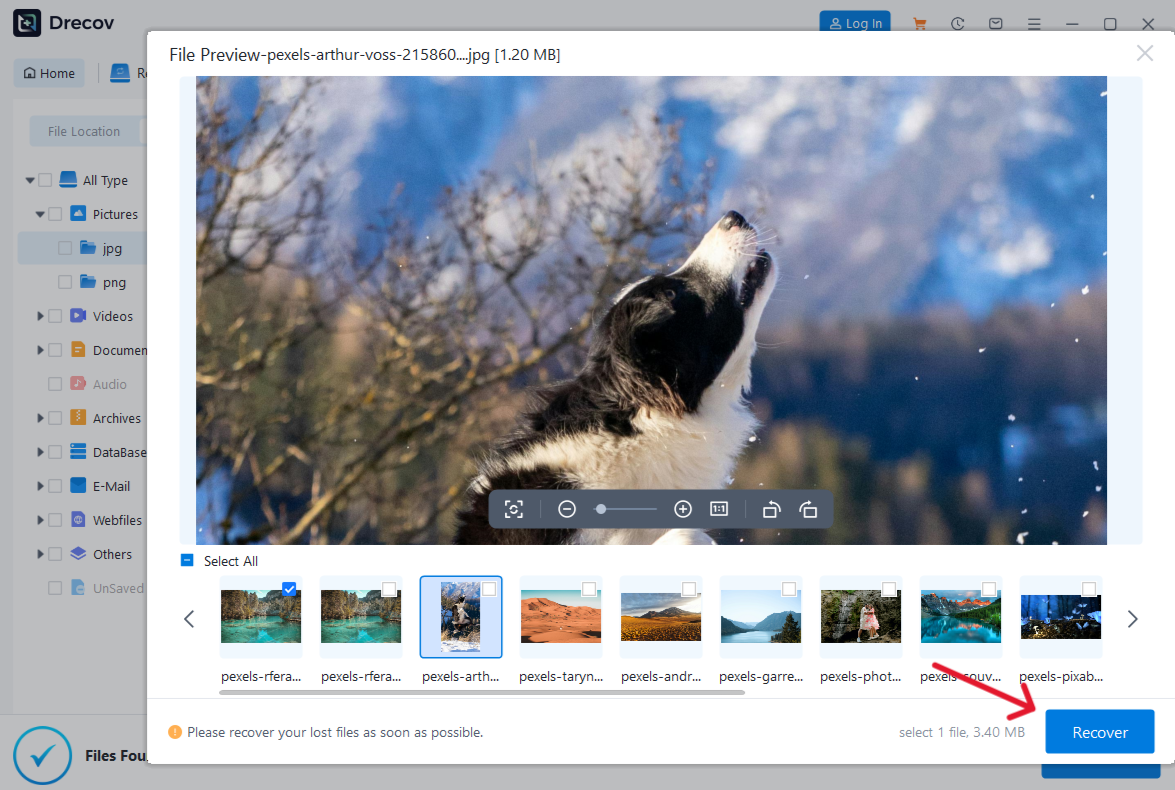
Step 4: Preview and recover candidates to the other disk
Filter by the recorded evidence and preview representative supported files. Preview can show that one displayed candidate is readable, but it cannot guarantee every page, frame, archive member, or project dependency. Recover selected candidates to the healthy destination, never to the source.
Step 5: Locate and verify the recovered data
Check Drecov Folder or Recovery Folder if the output is not where expected. Open samples from each important group. Compare dates, document contents, image resolution, video duration, and application context. Only after verification should you install removed applications, run disk repair, reset Windows, or reuse the source partition.
When an older document version is the real goal, an application or cloud version history may be more precise. For example, the site’s Word previous-version method avoids treating system rollback as document versioning.
Conclusion
Does System Restore delete files? It normally leaves ordinary personal files alone while rolling back Windows system state, drivers, registry settings, and installed programs. That distinction does not replace a backup. Inventory personal and application-specific data, verify a separate copy, and review affected programs before rollback. If a personal file is genuinely missing afterward from stable Windows storage, Drecov can search its original location and recover candidates to another healthy disk. Verify the output before installing software or making further system changes.
⚠ Warning: Install it on a drive different from the one where your data was lost to prevent overwriting.






