







To learn how to open PSD format file, decide whether you only need to view the image or must edit layers, masks, text, smart objects, and color information. Adobe Photoshop offers the broadest native support. Other applications and online viewers may display or edit a subset, but they can rasterize text, change blending, omit effects, or alter color. Duplicate the PSD before converting or saving it in another program.
How to Open PSD Format File and Keep Its Structure
Photoshop documents can hold layers, groups, masks, adjustment layers, editable type, paths, channels, smart objects, linked assets, guides, metadata, and color profiles. A viewer may produce a convincing composite while ignoring the editable structure underneath.
File size and complexity affect compatibility. Large dimensions, many layers, 16-bit or 32-bit channels, unusual color modes, and embedded or linked objects may exceed what a lightweight viewer handles. A failed preview does not by itself prove that the PSD is corrupt.
Adobe documents supported formats and their capabilities in its official Photoshop format reference. Check current application documentation before trusting a converter with production work.
Choose an Opening Method by What You Need to Keep
Use Adobe Photoshop when the document must remain fully editable or depends on advanced Photoshop features. Open the application first and use File > Open. This produces a clearer compatibility or file-reading message than relying only on the Windows file association.
For viewing, a reputable image application may render the composite preview without exposing every layer. That is suitable for approving appearance, not for confirming editability. Export a copy to PNG, TIFF, or JPEG only after deciding whether transparency, bit depth, compression, metadata, and layers matter.
For limited editing, check the alternative application’s own PSD support. Test on a duplicate and save to a new filename. Reopen both the exported file and the new PSD, then compare text, masks, blend modes, smart objects, artboards, and color.
Online viewers require uploading the document. Avoid them for client work, unreleased designs, personal documents, credentials, or regulated material unless the service’s ownership, retention, deletion, and privacy terms are acceptable. Local viewing is the safer default for sensitive files.
Diagnose a PSD That Will Not Open
Start with the exact error and a known-good PSD in the same application. If the known-good file opens, focus on the suspect file. If no PSD opens, update or repair the application, verify available disk space and scratch space, and test without third-party plug-ins.
Check the extension and file signature source. Renaming a JPEG to .psd does not convert it. Likewise, a partially downloaded file may carry the correct extension while lacking the complete structure. Compare size with the sender’s source and obtain a new copy when possible.
Copy the suspect file to a healthy local test folder before opening it from a network share, email cache, removable device, or synchronization placeholder. Preserve the original untouched. If the local copy opens, investigate the source connection, permissions, sync state, or removable media.
A zero-byte file contains no recoverable PSD structure. A file that opens as a flattened composite may have compatibility data even when some layers are damaged. Save any successful export under a new name; never overwrite the only source during diagnosis.
Conversion Is a Tradeoff, Not a Repair Button
| Goal | Possible output | Main loss to check |
|---|---|---|
| Web preview | PNG or JPEG | Layers, editability, bit depth, metadata |
| Transparent asset | PNG | Layer structure and some color information |
| Print exchange | TIFF or PDF | Feature compatibility, fonts, effects |
| Continue layered editing | PSD or compatible layered format | Smart objects, masks, type, blend modes |
| Archive the source | Original PSD plus assets | Linked files and application dependencies |
Do not use conversion merely to silence an open error. First preserve the source and determine whether the file is incomplete, mislabeled, inaccessible, or truly damaged. Converters cannot recreate bytes that were never downloaded or have been overwritten.
Related Drecov resources cover Windows data recovery, protecting an original image before repair, clearing Photoshop scratch space safely, and finding deleted Windows files.
Use Drecov When the PSD Source Was Deleted or Lost
PandaOffice Drecov is Windows data recovery software for PCs, HDDs, SSDs, external drives, USB drives, SD cards, and memory cards. It offers read-only recovery mode, Quick Scan, Deep Scan, filters, preview, and recovery to another healthy location. Lost Partition Recovery helps when the partition containing the artwork is missing. Supported categories include photos, video, documents, audio, email data, and archives.
Drecov fits this article only when the PSD or its packaged assets were deleted, became inaccessible, or vanished with a partition on stable, correctly recognized storage. It cannot add Photoshop compatibility to another editor, relink unavailable cloud assets automatically, repair failing hardware, or guarantee recovery of overwritten or TRIM-removed data.
Stop using a source that clicks, drops offline, freezes the PC, changes capacity, or reports serious read errors. Repeated preview and scan attempts create extra stress. Use controlled imaging or a professional service for unstable media.
⚠ Warning: Install it on a drive different from the one where your data was lost to prevent overwriting.
Recover the Missing PSD and Its Companion Assets
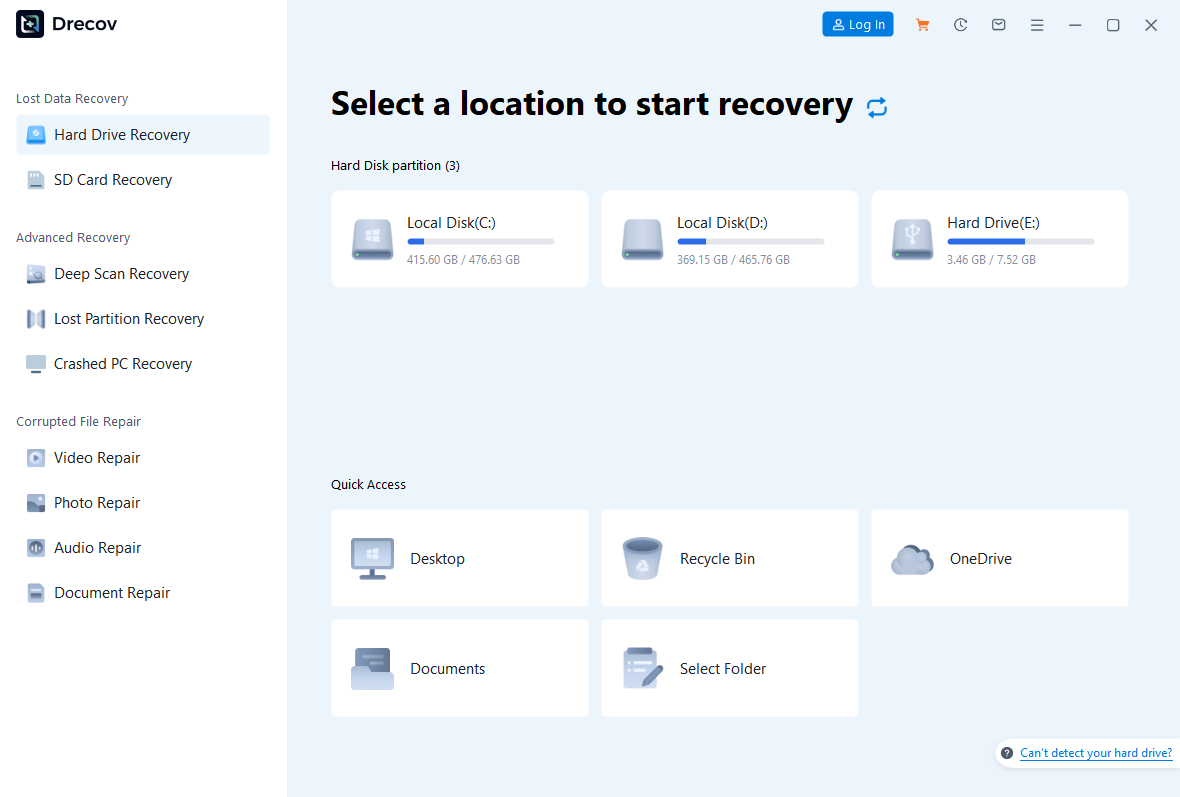
Step 1: Open Drecov and select the original artwork location
Prepare a healthy external destination and do not install Drecov on the source partition. Open Drecov and select the drive or project folder where the PSD was stored. If the whole partition is gone, use Lost Partition Recovery rather than initializing or formatting it.
Step 2: Run Quick Scan for the recent deletion
Start Quick Scan. Filter by PSD and related asset types, former path, filename, date, and size. Close Photoshop and synchronization tools that may write caches or replacement files to the source.
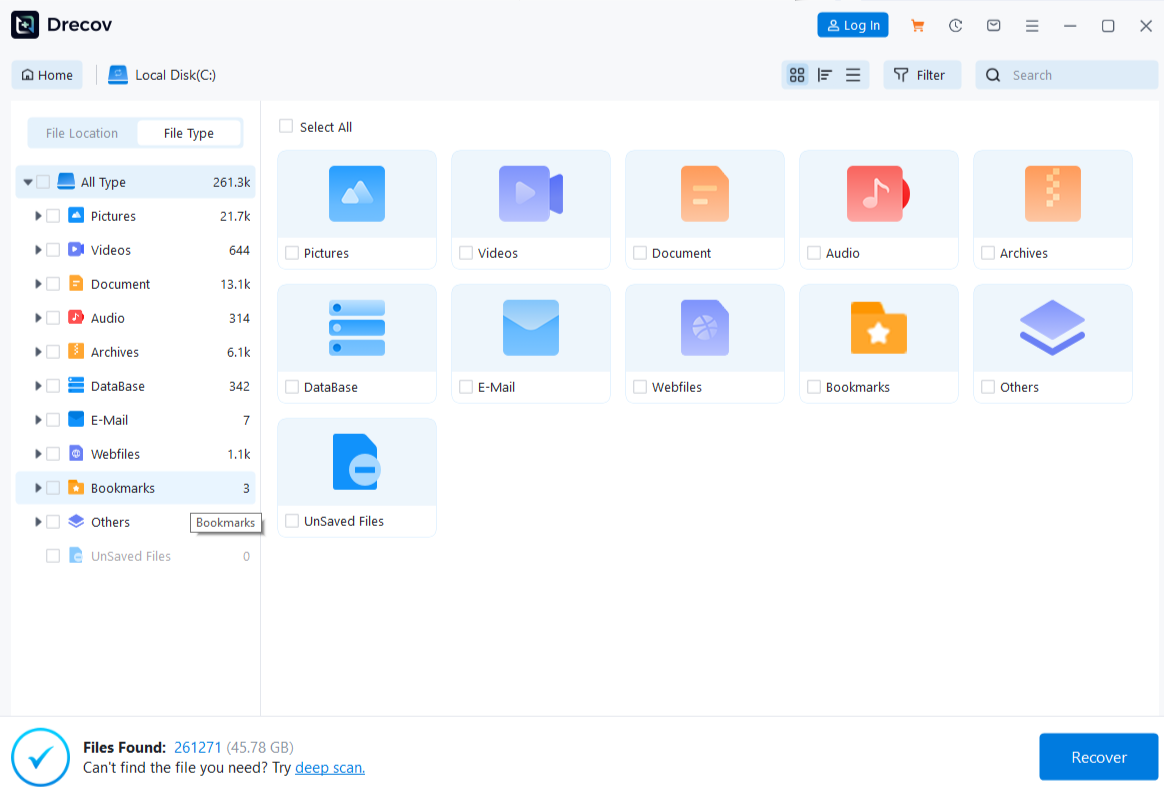
Step 3: Use Deep Scan only while storage remains stable
If the expected project is absent and detection remains consistent, run Deep Scan. Stop if the device disconnects, stalls, becomes noisy, or changes capacity.
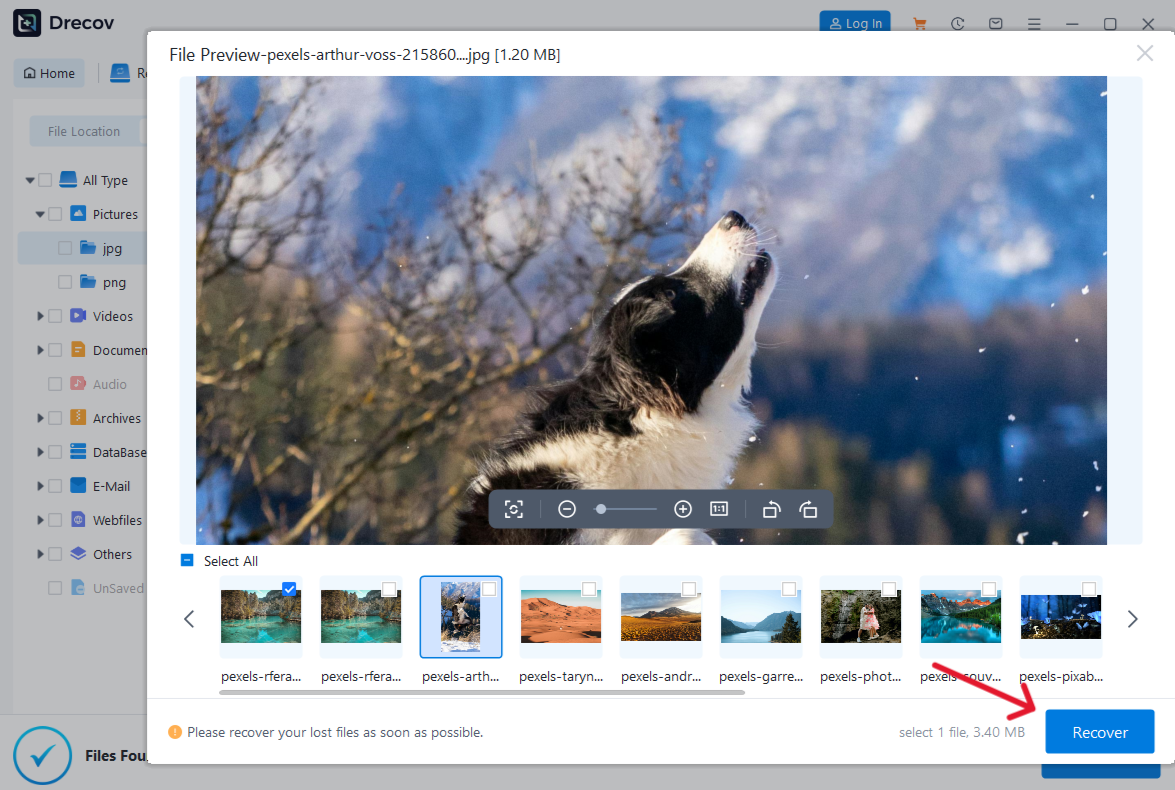
Step 4: Preview candidates and recover the project elsewhere
Preview supported results where available, but do not assume a visible composite proves that every layer and object is intact. Recover several likely PSD generations and companion assets to the separate healthy destination.
Step 5: Check output folders and inspect duplicates
If the output is not under the chosen path, inspect Drecov Folder or Recovery Folder. Preserve the raw recovery, open a duplicate in Photoshop, review layers and assets, and only then attempt document repair, conversion, scratch-disk cleanup, or source-drive changes.
Validate More Than the First Visible Image
Inspect the layer panel, hidden layers, masks, channels, paths, smart objects, editable text, artboards, and linked content. Zoom into detailed areas and toggle important layers. Check document dimensions, resolution, bit depth, color mode, and profile.
Save a test copy under a new name on healthy storage, close Photoshop, and reopen it. Export a reference PNG and compare it with the expected appearance. If the project goes to print or another editor, perform a round-trip test in that workflow.
Package or archive required linked assets and fonts according to licensing rules. Keep the untouched recovered source, the validated working copy, and a rendered reference. This gives future editors evidence even if an application changes its PSD interpretation.
Protect Color and Linked Content Across Applications
Color differences are not always file damage. Compare the document’s embedded profile, Photoshop color settings, monitor profile, proof setup, and the destination application’s color management. A browser viewer may ignore or simplify information that Photoshop honors. Keep an exported reference and record the expected color space before converting.
Smart objects can be embedded or linked. An embedded object travels inside the PSD, while a linked object may depend on another local or network file. If the design opens with missing links, collect the companion assets rather than repeatedly resaving the incomplete document. Relink copies in a test project and keep the original path map.
Fonts create another deceptive result. Missing typefaces can trigger substitution that changes line breaks and layout even though the PSD itself is intact. Record font names, licensing constraints, and rasterized reference images. Do not flatten the only editable source simply to make one computer display it consistently.
Before handing the file to another person, package the PSD, permitted linked assets, a rendered reference, and a note about Photoshop version, color profile, and required fonts. Have the recipient reopen the document and compare a critical sample. Compatibility is demonstrated by that round trip, not by a successful upload.
For a file received from someone else, ask how it was created and whether Maximize PSD and PSB File Compatibility was enabled. A compatible composite may let another application display the design even when it cannot interpret every feature. Request a rendered reference and, when needed, an agreed exchange format alongside the PSD. That combination makes visual discrepancies easier to identify and prevents a recipient from treating a limited import as the authoritative editable source.
Conclusion
Knowing how to open a PSD format file starts with the goal: viewing a composite is easier than preserving every editable feature. Use a capable application, duplicate the source, and treat conversion as a deliberate tradeoff. If the PSD or its local assets were genuinely deleted, Drecov can scan stable Windows storage and recover candidates to another device. Validate layers, color, links, and a reopened test copy before resuming production.
⚠ Warning: Install it on a drive different from the one where your data was lost to prevent overwriting.





