
A PC stuck in BIOS is usually not frozen in the ordinary sense. The firmware may be returning to its setup screen because it cannot find a usable Windows boot path. Before resetting settings or reinstalling Windows, check three facts: whether the storage device is detected, whether Windows Boot Manager is listed, and whether the correct entry is first in the boot order. These observations separate a simple boot-selection problem from a missing partition, damaged boot files, or an unstable drive.
Is the computer frozen, or does it keep returning to setup?
First identify the exact behavior. A machine that never responds to keyboard input inside BIOS has a different problem from one that accepts changes, restarts, and opens BIOS again. Test the arrow keys and open one harmless information page. If the interface is responsive, note the firmware date, storage model, boot mode, and boot entries without changing them. Take a phone photo if necessary.
Disconnect nonessential USB storage, memory cards, and external docks, then restart once. Firmware may choose a newly attached device before the internal Windows disk. If Windows starts after the removable device is disconnected, restore the intended internal entry to the top of the boot order. The successful test is a normal Windows start followed by another restart with no automatic return to setup.
If the setup screen itself freezes, turns off, or shows corrupted graphics, do not treat this as a Windows boot repair. Load testing, memory diagnosis, power checks, or professional hardware service may be required. A motherboard-logo freeze is also outside this article’s main path because the machine may not have reached an interactive firmware screen.
What does the firmware know about the Windows drive?
Open the Storage, Information, NVMe, SATA, or System Information page. Names vary by manufacturer, so use labels that report installed storage rather than changing controller settings. Compare the listed model and capacity with the internal drive you expect. Do not switch AHCI, RAID, Intel RST, or VMD modes as an experiment. Windows installed under one controller mode may stop booting under another, and changing the mode can complicate access to encrypted data.
| Firmware observation | What it narrows down | Next safe check |
|---|---|---|
| Drive model and expected capacity are present | The firmware can communicate with the device | Inspect Windows Boot Manager and boot mode |
| Drive is present, but Windows Boot Manager is absent | The EFI entry or system partition may be unavailable | Protect data, then use Windows recovery media to inspect startup |
| Drive appears intermittently or with a wrong capacity | Connection, power, controller, firmware, or media instability is plausible | Stop repeated boots and prioritize imaging or professional recovery |
| No internal drive is listed | The firmware has no source from which to boot Windows | Power down and check one known-good connection or seek hardware service |
| Windows Boot Manager exists but another device is first | The boot order is wrong | Select Windows Boot Manager once and verify a complete boot |
If the drive is absent, a Windows command cannot make it reappear. On a desktop, power down and disconnect AC power before checking one SATA power and data connection. On a laptop, follow the manufacturer’s service instructions rather than opening it blindly. Repeatedly power-cycling a clicking or disappearing hard drive can worsen physical damage. For symptoms that explicitly say no disk exists, use the more focused no-boot-disk detection guide.
Can Windows Boot Manager start when selected directly?
Open the Boot page and look for Windows Boot Manager associated with the expected drive. On a modern UEFI installation, that entry is normally more useful than selecting the raw drive model. Move Windows Boot Manager above network, optical, and removable devices, or use the one-time boot menu to select it without permanently changing other settings.
If Windows starts, sign in and restart once to confirm the order persists. A setting that reverts after every shutdown may indicate a firmware update issue, depleted CMOS battery on some systems, or a management policy. Record the exact change before pursuing the manufacturer-specific cause.
If the entry is missing, do not create random legacy entries or toggle UEFI to Legacy/CSM. A Windows installation created for UEFI normally relies on an EFI System Partition and a matching firmware entry. Switching modes can hide the valid path rather than repair it. The article on a missing Windows Boot Manager explains that narrower repair path after files are safe.
What should you preserve before startup repair or reinstallation?
If the drive is detected consistently but Windows cannot start, decide how important the files are before modifying boot partitions. Startup Repair and boot-record commands target system startup, but a mistaken partition selection, a clean installation, or an unstable disk can put personal data at risk. Check existing cloud, external-drive, and system-image backups from another device. Preserve any BitLocker recovery key linked to the Microsoft or organizational account.
You also need a workable access route. Because Windows on this PC does not start, ordinary desktop recovery software cannot simply run against its system volume. One option is to remove or connect the stable source drive to another compatible Windows computer as a secondary device. Another is to use a properly supported Windows recovery arrangement that gives the recovery software access to the original disk. If the drive is encrypted, it must be unlocked with the correct key. If it disconnects, clicks, stalls reads, or changes capacity, stop; software scanning is not the safe next step.
Microsoft’s Windows recovery options describe Startup Repair, installation media, System Restore, Reset, and reinstall choices. Those tools address Windows availability, not recovery of unbacked-up personal files. Treat any option that removes apps, resets Windows, deletes partitions, or performs a clean installation as a later action.
How does Drecov fit a BIOS-loop case?
Drecov is Windows data recovery software, not a firmware or bootloader repair tool. Its useful role begins when the original system drive is stable, detectable, and accessible from a functioning Windows environment. It can scan the former Windows partition for documents, photos, videos, archives, and other user files. If the expected partition has disappeared, Lost Partition Recovery can search the physical disk for the lost volume. Drecov cannot restore a drive that firmware never detects, repair electronics, unlock BitLocker without its key, or guarantee data that has been overwritten.
⚠ Warning: Install it on a drive different from the one where your data was lost to prevent overwriting.
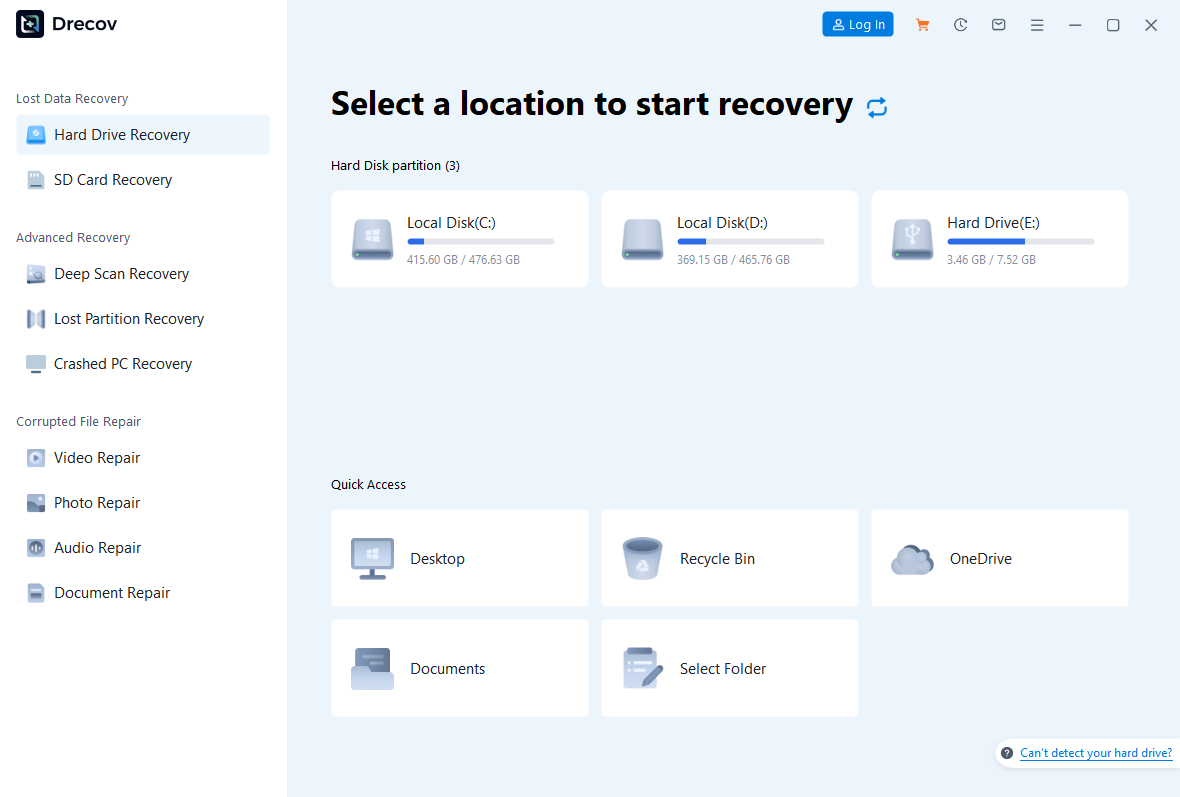
Step 1: Open Drecov and choose the original Windows source
Prepare another healthy drive with enough free space for the recovered files. Do not install Drecov on the affected Windows partition, and never use that partition as the recovery destination. From the working Windows environment, open Drecov and select the original system volume by its capacity and disk position. If that volume no longer exists in the partition list, select the physical disk through Lost Partition Recovery. Cancel if detection becomes unstable.
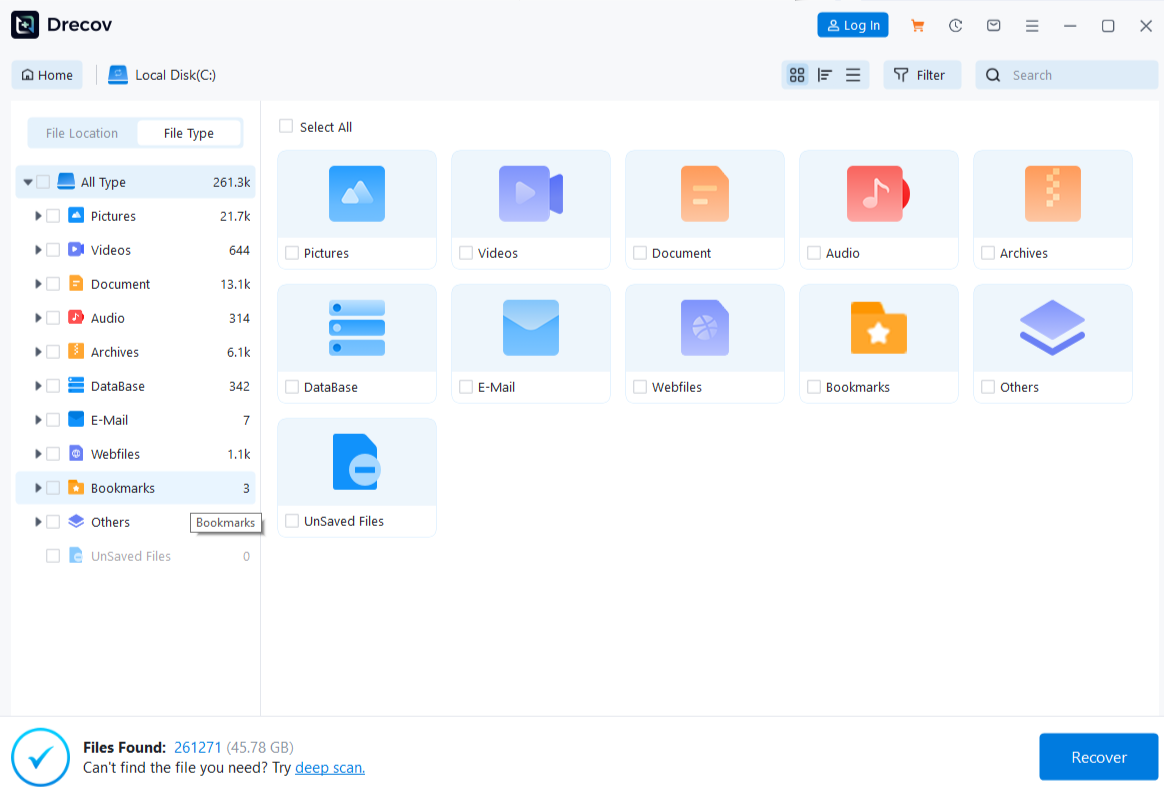
Step 2: Use Quick Scan to look for the user profile
Run Quick Scan first. Look for the former Users folder and the account that held Desktop, Documents, Pictures, Videos, Downloads, browser profiles, and application projects. Recovering a boot file is not the objective here; the priority is irreplaceable user content. If the expected profile or recent files are not present and the disk remains responsive, continue with Deep Scan.
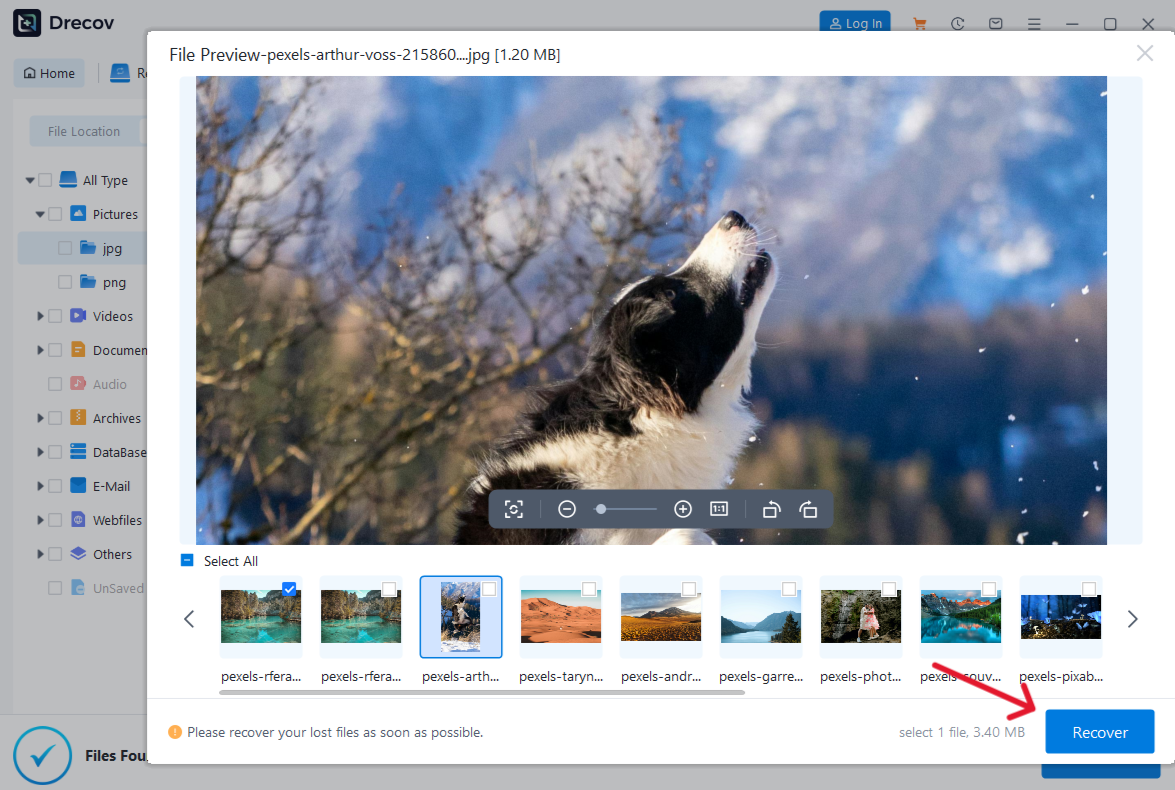
Step 3: Filter and preview the files that matter
Filter by former path, filename, date, or file type. Preview several supported documents, photos, and videos from different folders. A preview confirms that the displayed sample can be decoded; it does not certify every workbook sheet, video frame, archive member, or linked project asset. Preserve complete project folders when their applications depend on sidecar files.
Step 4: Recover elsewhere and verify before changing boot data
Save selected files to the separate healthy drive. If the output is not in the folder you expected, inspect the destination’s Drecov Folder or Recovery Folder. Open representative files, compare sizes, extract important archives, and play recovered media at several points. Keep the verified copy disconnected while you attempt startup repair, rebuild an EFI entry, reset Windows, or reinstall.
⚠ Warning: Install it on a drive different from the one where your data was lost to prevent overwriting.
Which Windows repair matches the evidence?
Once important files are verified, choose the least invasive repair that addresses the observed break. Do not cycle through unrelated commands merely because they are common in boot tutorials.
Make it the first permanent boot entry, save the firmware configuration, and restart. If it remains selected and Windows loads twice in succession, the boot order was the problem. Reconnect external devices one at a time so you can identify the item that displaced the entry.
The drive is present but Windows Boot Manager is missing
Boot official Windows installation or recovery media in the same UEFI mode as the installed system. Choose Repair your computer, then Troubleshoot > Advanced options. Startup Repair is the appropriate first automated attempt because it evaluates common startup faults without requiring you to guess partition letters. If it fails, record its message and log path. The page about Startup Repair not repairing a PC covers the evidence to collect before manual BCD work.
System Restore may help when a recent driver, update, or registry change broke startup and a suitable restore point exists. It does not restore personal files and will not fix a drive missing from firmware. Uninstall Updates is similarly narrow: use it only when the timing and recovery interface point to a recent update.
Create official installation media on another computer and use its repair entry rather than proceeding directly to Install. Confirm that the media was booted in UEFI mode and that the original system disk is still detected. If the built-in recovery entry itself is missing, follow the separate checks for when Windows cannot find the recovery environment.
The drive is unstable or absent
Do not run Startup Repair, CHKDSK, bootrec, or repeated scans against a device that disconnects or produces read errors. Repair tools assume reliable storage and may write metadata. Hardware stabilization, a controlled image, or professional recovery comes first. Replacing the drive and reinstalling Windows restores a usable computer, but it does not recover files from the failed source.
How do you prove the BIOS loop is resolved?
A single successful boot is encouraging but incomplete. Shut Windows down normally, remove installation or recovery media, and start the machine from power-off. Restart once more from Windows. In Task Manager or System Information, confirm the expected system disk is present. Check Disk Management without initializing or changing anything and ensure the Windows and EFI-related volumes have plausible sizes and status.
Open several user files and review the system log for recurring disk or controller errors. If BitLocker protection was suspended for a legitimate repair, resume it only after the boot configuration is stable and the recovery key is stored safely. Reconnect optional USB devices one at a time. The loop is resolved when the intended Windows Boot Manager remains first, the drive stays detected, and repeated cold and warm starts reach Windows without manual intervention.
PC stuck in bios FAQs
Should I load BIOS defaults?
Not as the first move. Defaults can change controller mode, Secure Boot, virtualization, fan, and boot settings. Record the existing configuration and identify the missing boot-path element first. Use defaults only when an OEM procedure or known configuration problem supports that choice.
Can a dead CMOS battery cause the loop?
On some systems, a weak battery can cause time or settings to reset after power is removed. Reverting boot order is possible, but a missing storage device or damaged EFI entry remains more common evidence to investigate. A clock that repeatedly loses time strengthens the battery hypothesis.
Why is the SSD visible but not bootable?
Firmware detection proves communication with the device, not that a valid UEFI entry and readable EFI System Partition exist. The Windows partition may also be encrypted or damaged. Check Windows Boot Manager and use recovery media after protecting files.
Will reinstalling Windows fix the problem?
A clean installation can create a new boot structure on stable hardware, but it can remove partitions and overwrite recoverable data. It also cannot fix an intermittently detected drive. Reinstall only after important files are backed up or recovered and the device has passed stability checks.
Can Drecov make the PC boot again?
No. Drecov retrieves files from a stable, accessible storage source; it does not edit firmware settings or rebuild the Windows bootloader. Its value here is protecting personal data before startup repair, reset, partition work, or reinstallation.
A PC that keeps returning to BIOS is exposing a break between firmware, the storage device, and the Windows boot entry. Read those three points in order. Correct a simple boot selection when the evidence supports it, preserve files before changing partitions or Windows, and stop software work when the drive itself is unstable.
⚠ Warning: Install it on a drive different from the one where your data was lost to prevent overwriting.