







The useful answer to how to read dat file depends on context that the phrase alone does not reveal. For the DAT origin check, change only one relevant variable at a time. Record the outcome, then return to the DAT origin check evidence before choosing a broader repair. Within the DAT origin check, protect the current state before testing. If access worsens, stop and reassess the DAT origin check boundary instead of stacking another fix.
DAT Describes a Container, Not Its Meaning
The .dat extension means data and can contain text, settings, databases, media, email, game resources, or proprietary binary records. If the DAT origin check points to unstable hardware or declining access, stop direct experiments. Escalation is safer than forcing another DAT origin check scan or write. Before extending the DAT origin check, preserve readable work and rollback information. Do not let the DAT origin check become an unplanned reset, cleanup, or overwrite.
Two DAT files from different applications may share nothing beyond the extension. For the DAT origin check, change only one relevant variable at a time. Record the outcome, then return to the DAT origin check evidence before choosing a broader repair. If access worsens, stop stacking fixes. Keep the DAT origin check narrow enough to interpret. Logs, paths, capacities, and account identity make the DAT origin check result stronger than a visual change alone.
Identify the Program and Folder That Created It
Folder context, neighboring files, timestamp, size, and source application provide the strongest first clues. Keep the DAT origin check narrow enough to interpret. Logs, paths, capacities, and account identity make the DAT origin check result stronger than a visual change alone. For the DAT origin check, change only one relevant variable at a time. Record the outcome, then return to the DAT origin check evidence before choosing a broader repair.
If the DAT origin check points to unstable hardware or declining access, stop direct experiments. Escalation is safer than forcing another DAT origin check scan or write. For the DAT origin check, change only one relevant variable at a time. Record the outcome, then return to the DAT origin check evidence before choosing a broader repair. For the DAT origin check, change only one relevant variable at a time. Record the outcome, then return to the DAT origin check evidence before choosing a broader repair. Interface wording and product limits can change.
| Evidence | Next decision |
|---|---|
| Folder context, neighboring files, timestamp, size, and source application provide the strongest first clues | Check directly |
| Inspect a duplicate because editors that save automatically can alter bytes, line endings, or encoding | Compare with a control |
| Notepad or a hex viewer may reveal headers, URLs, field names, or magic bytes without proving the full format | Protect the current state |
Inspect a Copy as Text Without Altering the Original
Notepad or a hex viewer may reveal headers, URLs, field names, or magic bytes without proving the full format. The DAT origin check should end with a repeatable observation, not a quieter warning. Verify the same DAT origin check condition after an ordinary restart or reconnection. Before extending the DAT origin check, preserve readable work and rollback information. Do not let the DAT origin check become an unplanned reset, cleanup, or overwrite.
Unreadable characters can mean binary, compression, encryption, or the wrong character encoding. The DAT origin check should end with a repeatable observation, not a quieter warning. Verify the same DAT origin check condition after an ordinary restart or reconnection. During the DAT origin check, compare this observation with the last working state. Keep that DAT origin check baseline until the next test gives the same result twice.
For the adjacent issue, use SWF file explanation only when its symptoms match this result.
Recognize Media, Mail, Game, and Binary DAT Files
Some VCD video files use DAT, but renaming every DAT to MPG is not a general solution. Confirm the DAT origin check outcome with a second representative case. Retain the protected source until the DAT origin check result survives normal use. Before extending the DAT origin check, preserve readable work and rollback information. Do not let the DAT origin check become an unplanned reset, cleanup, or overwrite.
Winmail.dat commonly contains Outlook TNEF-formatted message material. This observation gives you a practical boundary. For how to read dat file, note the device, account, file, or screen involved and the last time the task worked normally. That small baseline keeps later tests comparable.
Avoid Blind Renaming and Online Uploads
Game DAT files may depend on an executable, index, version, or companion archive. Use the DAT origin check to separate cause from coincidence. A useful DAT origin check result should explain both the failure and the known-good comparison. A controlled DAT origin check compares like with like. Repeat the original task under the same DAT origin check conditions before replacing hardware or reinstalling software. Several simultaneous changes can hide the cause.
A controlled DAT origin check compares like with like. Repeat the original task under the same DAT origin check conditions before replacing hardware or reinstalling software. The DAT origin check should end with a repeatable observation, not a quieter warning. Verify the same DAT origin check condition after an ordinary restart or reconnection. Within the DAT origin check, protect the current state before testing. If access worsens, stop and reassess the DAT origin check boundary instead of stacking another fix. For the DAT origin check, change only one relevant variable at a time. Record the outcome, then return to the DAT origin check evidence before choosing a broader repair.
For the adjacent issue, use M3U file explanation only when its symptoms match this result.
Handle a Missing or Damaged DAT File Separately
Changing the extension does not convert the internal format. Within the DAT origin check, protect the current state before testing. If access worsens, stop and reassess the DAT origin check boundary instead of stacking another fix. The DAT origin check should end with a repeatable observation, not a quieter warning. Verify the same DAT origin check condition after an ordinary restart or reconnection. Confirm the DAT origin check outcome with a second representative case. Retain the protected source until the DAT origin check result survives normal use.
Use the DAT origin check to separate cause from coincidence. A useful DAT origin check result should explain both the failure and the known-good comparison. Keep the DAT origin check narrow enough to interpret. Logs, paths, capacities, and account identity make the DAT origin check result stronger than a visual change alone. Within the DAT origin check, protect the current state before testing. If access worsens, stop and reassess the DAT origin check boundary instead of stacking another fix. A durable result should survive normal use.
Recover Missing Local Files Before the Risky Change
PandaOffice Drecov is Windows data recovery software for stable, recognized PCs, hard drives, SSDs, external drives, USB drives, SD cards, and memory cards. It works in read-only recovery mode and can search for photos, videos, documents, email data, audio, and archives. In this case it is appropriate only when important local files are genuinely missing or inaccessible on a stable Windows-recognized source. It cannot repair physical damage, a controller, a boot configuration, cloud retention, or fully overwritten data.
⚠ Warning: Install it on a drive different from the one where your data was lost to prevent overwriting.
Step 1: Open Drecov and choose the original loss location
Do not install Drecov on the volume that held the missing files. Prepare another healthy destination, open Drecov, and select the original partition or device. If it clicks, disappears, changes capacity, or produces severe read errors, stop direct scanning and use an image or professional recovery service.

Step 2: Start Quick Scan and review the likely paths
Run Quick Scan first. Browse former folders and filter by filename, path, type, date, or size where those details are available. Keep the source unchanged while you decide whether the expected items are present.
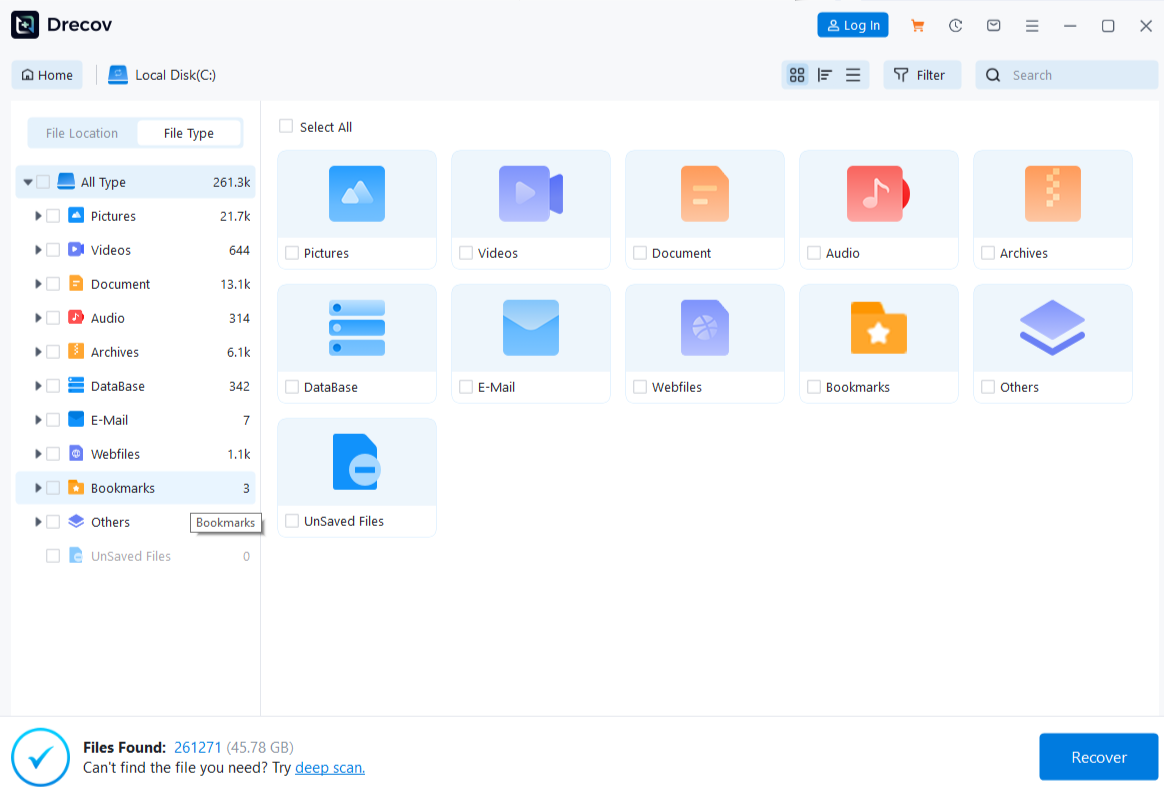
Step 3: Use Deep Scan only on stable media
If Quick Scan does not locate the target files and the source remains stable, run Deep Scan. More scanning cannot restore sectors that have been overwritten, and repeated scans are unsafe on failing hardware.
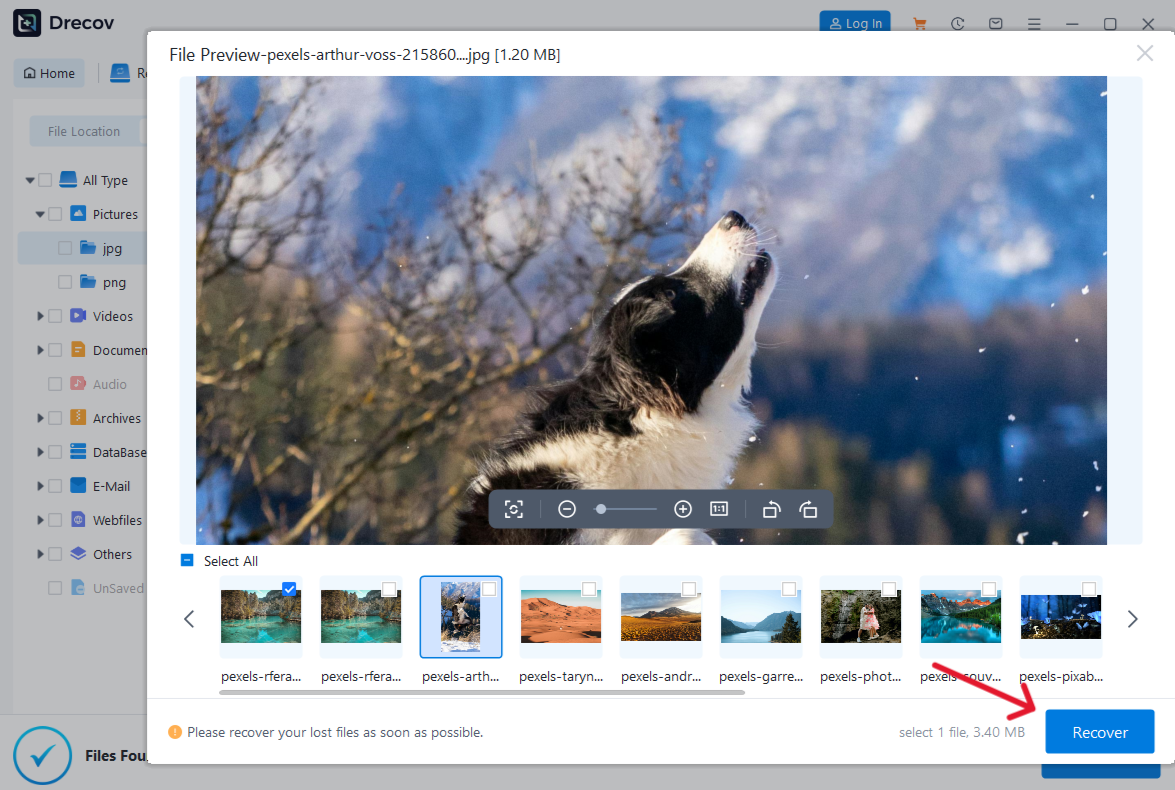
Step 4: Filter and preview representative files
Narrow the results, then preview several supported examples. A readable preview is helpful evidence, but it does not guarantee that every page, frame, linked asset, archive member, or database record is intact.
Step 5: Recover to another healthy device
Select the needed files and recover them to the prepared destination, never back to the source. If the output is not where expected, check the Drecov Folder or Recovery Folder.
Step 6: Open and verify before repair
Open a representative sample, compare size and dates, and test the files in their normal application. Only after verification should you convert, format, repartition, reinstall, clear local originals, or perform another source-modifying repair.
⚠ Warning: Install it on a drive different from the one where your data was lost to prevent overwriting.
Related background is available in recovering text from a file. For current platform behavior, consult Microsoft Windows file-naming documentation.
How to Determine the Origin and Purpose of a .DAT File Before Escalating
Generic .dat files can contain anything from application settings and database indexes to video streams. Before attempting aggressive file conversions, app reinstalls, or hardware fixes, systematically analyze the file’s origin and behavior.
1. Analyze File Metadata & Avoid Universal Renaming
- Examine contextual clues: The folder context, neighboring files, creation timestamps, file sizes, and parent applications offer the strongest initial clues about what created the DAT file.
- Don’t blindly rename to .MPG: While old VCD (Video CD) files used
.datformatting, simply renaming every DAT file to.mpgis not a universal fix and often causes file corruption in non-video datasets.
2. Isolate Variables & Establish a Diagnostic Baseline
To accurately determine a DAT file’s true origin without compounding errors:
- Avoid simultaneous changes: Changing several settings at once hides the true cause. Modify only one variable at a time and compare your current test state against a known-good working baseline.
- Stop fix-stacking: If file access or system performance worsens during testing, pause immediately. Reassess your diagnostic boundary instead of layering additional unverified workarounds.
- Verify repeatability: Re-run the same test under identical conditions until you achieve the same result twice before drawing conclusions.
3. Rely on System Logs Over Visual Hints Alone
- Gather hard diagnostic evidence: Use system application logs, file directory paths, volume capacities, and user account credentials—these provide far stronger evidence than simple file icon or UI changes.
- Halt direct tests on failing storage: If testing reveals underlying drive instability or declining disk access, stop direct file scans and write operations immediately. Escalating to specialized data recovery or hardware service is much safer than forcing repeated scans on a failing drive.
4. Protect Original Data & Confirm Stability
- Confirm long-term stability: A successful origin check ends with a consistently repeatable observation, not a quiet error suppression. Verify that the file behaves as expected after a standard system restart or reconnection.
- Protect system state before testing: Save readable work and create rollback checkpoints beforehand to ensure diagnostic tests never trigger an unplanned file wipe, cleanup, or overwrite.
How to read dat file FAQs
What should I check first?
The .dat extension means data and can contain text, settings, databases, media, email, game resources, or proprietary binary records. The DAT origin check should end with a repeatable observation, not a quieter warning. Verify the same DAT origin check condition after an ordinary restart or reconnection.
Which result changes the next step?
Within the DAT origin check, protect the current state before testing. If access worsens, stop and reassess the DAT origin check boundary instead of stacking another fix. Before extending the DAT origin check, preserve readable work and rollback information. Do not let the DAT origin check become an unplanned reset, cleanup, or overwrite.
What should I avoid?
Game DAT files may depend on an executable, index, version, or companion archive. A controlled DAT origin check compares like with like. Repeat the original task under the same DAT origin check conditions before replacing hardware or reinstalling software.
When is Drecov relevant?
Changing the extension does not convert the internal format. If the DAT origin check points to unstable hardware or declining access, stop direct experiments. Escalation is safer than forcing another DAT origin check scan or write.
How do I verify the outcome?
Within the DAT origin check, protect the current state before testing. If access worsens, stop and reassess the DAT origin check boundary instead of stacking another fix. During the DAT origin check, compare this observation with the last working state. Keep that DAT origin check baseline until the next test gives the same result twice.
Conclusion
Keep the DAT origin check narrow enough to interpret. Logs, paths, capacities, and account identity make the DAT origin check result stronger than a visual change alone. If the DAT origin check points to unstable hardware or declining access, stop direct experiments. Escalation is safer than forcing another DAT origin check scan or write. Before extending the DAT origin check, preserve readable work and rollback information. Do not let the DAT origin check become an unplanned reset, cleanup, or overwrite. A durable result should survive normal use. Use the DAT origin check to separate cause from coincidence. A useful DAT origin check result should explain both the failure and the known-good comparison.
⚠ Warning: Install it on a drive different from the one where your data was lost to prevent overwriting.





