
If your D drive disappeared in Windows 11, Drecov can help only after the disk state is understood; do not initialize, format, or recreate it just because File Explorer no longer shows it. The missing letter can have several causes: Windows may have removed the drive letter, the partition may be offline, the disk may have lost its partition information, or the hardware may no longer be stable. Open Disk Management first and identify which state you actually have. If the D drive contains irreplaceable files, protect or recover those files before any operation that writes to the disk.
What does Windows still detect?
The letter D is only a label assigned to a volume. Its absence does not prove that the files are gone. Press Windows + X, select Disk Management, and wait for the lower pane to populate. Match disks by capacity, connection type, and neighboring partitions rather than by letter alone. A 1 TB secondary SSD, for example, may appear as Disk 1 even though its former D volume has no letter.
| What Disk Management shows | Likely meaning | Safest next action |
|---|---|---|
| A healthy NTFS or exFAT volume without a letter | The volume exists, but its mount letter is missing or conflicting | Assign an unused letter after confirming the volume size and contents |
| The expected volume marked Offline | Windows has detected the disk but is not mounting it | Check the reported reason; bring it online only if the hardware is stable |
| RAW instead of NTFS or exFAT | The file system cannot be interpreted reliably | Recover needed files before CHKDSK or formatting |
| Unallocated space where D used to be | Partition metadata may be missing or damaged | Do not create a new volume; scan for the lost partition or files first |
| The whole physical disk is absent | A cable, enclosure, controller, power, firmware, or disk fault is possible | Power down and check one known-good connection; stop if the disk is unstable |
Also check whether D now belongs to a DVD drive, card reader, or mapped network share. A letter conflict can make the original volume mount under another letter. If an external disk is involved, compare its status with the symptoms in this external-drive detection checklist before assuming the partition itself has failed.
When is assigning the letter back the correct fix?
Assigning a drive letter is appropriate only when Disk Management shows the correct healthy volume at the expected capacity. Right-click that volume, choose Change Drive Letter and Paths, select Add or Change, and choose an unused letter. D is convenient, but another free letter is safer if D is already occupied. Confirm the change, reopen File Explorer, and test a few folders.
A successful result is more than seeing an icon. Open files from different folders, confirm that their sizes look plausible, and copy one noncritical file to a healthy disk. If Windows immediately removes the letter again, asks to format the volume, or reports an I/O error, stop. Those results point beyond a simple mount-letter problem.
Do not reassign letters on EFI, Recovery, Microsoft Reserved, or other small system partitions. They are normally hidden. Changing the Windows system volume from C is also unsafe because installed programs and boot references expect that path. Microsoft documents the interface in its official Disk Management guidance.
⚠ Warning: Install it on a drive different from the one where your data was lost to prevent overwriting.
What if the disk is present but the D volume is RAW or unallocated?
A RAW label means Windows sees a partition boundary but cannot mount the file system. Unallocated space means Windows is not recognizing the expected partition boundary at all. Neither state is repaired by assigning a letter. Formatting would create a new file system and write new metadata; creating a new simple volume would also write partition information. Both can make later recovery harder.
If the disk holds important data, avoid CHKDSK at this stage. CHKDSK is a consistency repair utility for a recognizable file system, not a general undelete tool. On damaged metadata it may discard entries while trying to make the volume consistent. The safer order is to recover or image the data, verify the recovered copies, and only then decide whether to rebuild or format the affected volume. If the entire partition has vanished, the distinction between file recovery and lost-partition recovery matters because the source evidence and risks differ.
Before concluding that the layout is damaged, use Action > Rescan Disks in Disk Management once. If the disk then appears with its expected capacity and remains stable, record its status and proceed according to the table above. If it repeatedly vanishes, reports zero capacity, or changes size between checks, stop using repair commands. That behavior is consistent with a connection, controller, firmware, or media problem rather than a missing letter.
When should you stop software troubleshooting?
Software scanning assumes that the device can read data consistently. Stop powering or scanning the disk if it clicks, disappears repeatedly, reports wildly changing capacity, stalls the computer whenever connected, or becomes unusually hot. Repeated retries can worsen a failing mechanism or exhaust a marginal flash device. For valuable data, a professional lab or a controlled sector-by-sector image is more appropriate than repeated consumer scans.
For an internal SATA drive, shut the computer down before reseating power or data cables. For an external drive, try one known-good cable and a direct port rather than cycling through many adapters. Do not open a sealed hard drive. If the disk becomes stable after a connection change, copy essential data first; a temporary return does not prove the hardware is healthy.
An SSD can fail without clicks, so silence is not proof of safety. Watch for intermittent detection, freezes during reads, and new controller errors. If BitLocker was enabled, preserve the recovery key before changing hardware or boot settings. Encryption does not cause the letter to disappear, but losing the key can turn a recoverable volume into an inaccessible one after a configuration change.
How can Drecov recover files before a risky repair?
Drecov is Windows data recovery software for logical-loss situations in which the original disk remains stable and detectable. In this case, its role is to retrieve files from the former D volume before formatting, partition creation, or other write-heavy repairs. Quick Scan can look for recently lost entries, deep scan can search more broadly when the first pass is insufficient. PandaOffice Drecov does not repair a failing drive, rebuild hardware, guarantee overwritten files, or substitute for a clean-room service.
⚠ Warning: Install it on a drive different from the one where your data was lost to prevent overwriting.
Step 1: Select the original D-drive location
Connect a separate healthy disk with enough free space for the recovered data. Do not install Drecov on the missing D volume or choose that volume as the destination. Open Drecov and identify the original source by its physical disk, former partition, capacity, and position. If the partition is absent, use Lost Partition Recovery on the physical disk that previously contained D. If the source keeps disconnecting, cancel the scan and move to imaging or professional recovery.
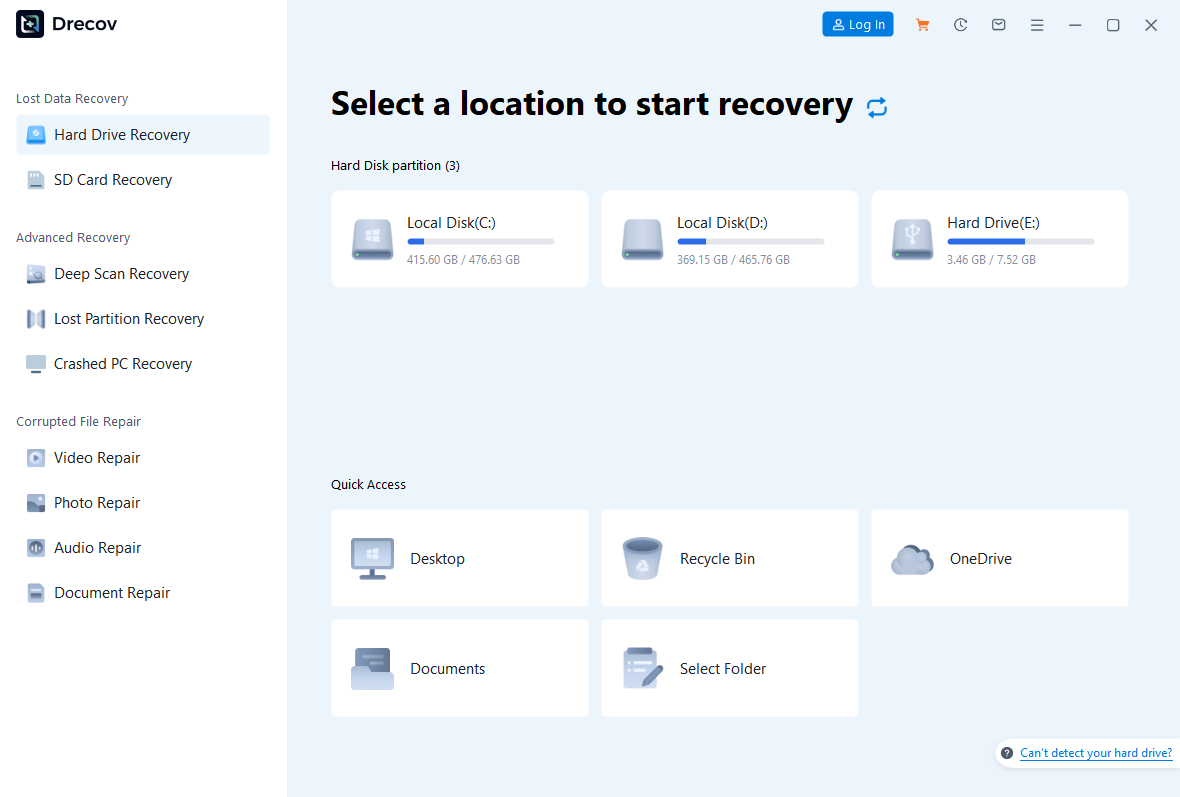
Step 2: Run Quick Scan before a deeper search
Start Quick Scan on the selected source. Look first for the former folder structure and the file types that matter most, such as work documents, photos, project archives, or application data. If the needed folders do not appear and the disk remains responsive, continue with Deep Scan. A scan that freezes alongside disconnects or new device noises is a stop signal, not a reason to repeat the same scan.
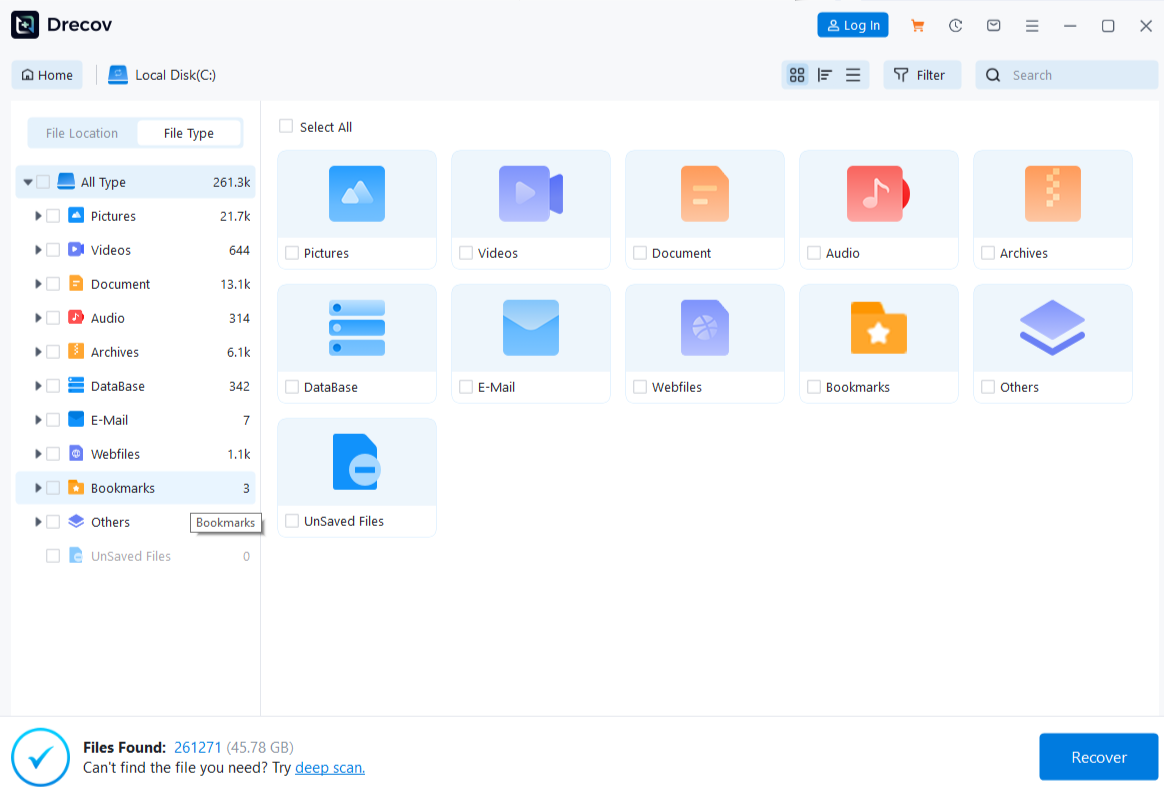
Step 3: Locate and preview useful results
Filter by former path, filename, file type, or other available attributes. Check several representative files rather than relying on a single preview. A readable preview is useful evidence that a file can be decoded, but it does not prove that every page, frame, linked asset, or archive member is intact. Give priority to irreplaceable material before large replaceable downloads.
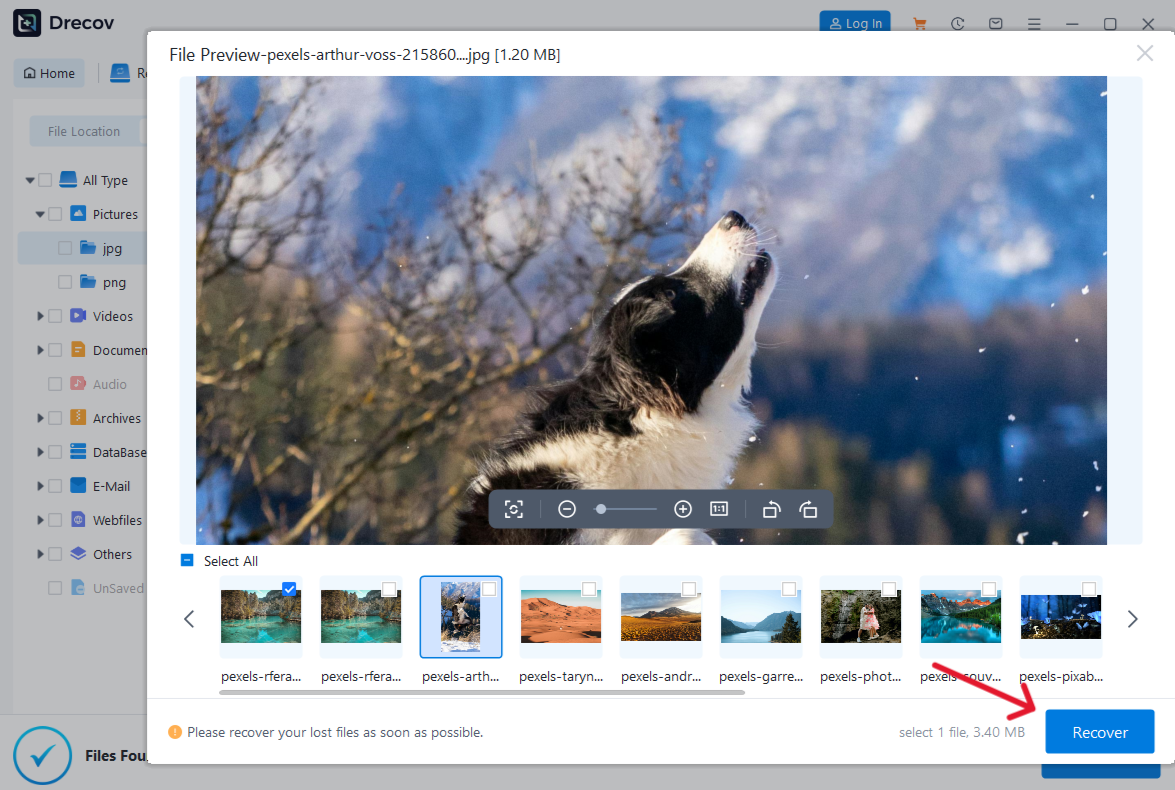
Step 4: Recover to another healthy device
Select the required files and save them to the separate healthy disk. Never restore them to the source being recovered, because new writes can overwrite other recoverable data. If the output is not where expected, check the chosen destination and its Drecov Folder or Recovery Folder. Open a sample from every important file group, compare sizes, and test archives or media through to the end where practical.
⚠ Warning: Install it on a drive different from the one where your data was lost to prevent overwriting.
Only after those copies pass verification should you create a new volume, format a RAW partition, run repair utilities, or replace the disk. For a broader view of partition and volume utilities, see this disk-management software comparison. The tools listed there manage storage; they do not remove the need to protect files first.
How do you choose the repair after the files are safe?
Use the observed disk state to choose one repair, not a chain of guesses. A healthy letterless volume needs a letter. An offline but stable disk needs the reason for its offline state resolved. A RAW volume may be reformatted after recovery and hardware checks. Unallocated space may justify partition reconstruction by an experienced user, or a fresh partition if no old layout needs to be preserved. A physically unstable disk should be replaced rather than trusted after a temporary recovery.
If a healthy volume only lost its letter
Keep the new letter if programs and shortcuts work. If the volume must return to D, first move or reassign the device currently using D, then change the target volume. Check shortcuts, backup jobs, game libraries, and applications that store absolute paths. Their failure after a letter change does not necessarily indicate file loss; they may still point to the old path.
The file system was RAW
After every required file is verified elsewhere, check the disk’s health and replace questionable hardware. A healthy disk can be repartitioned or formatted with the file system required by its workload. Formatting is a fresh start, not proof that the underlying cause has gone. Restore copies only after the new volume passes sustained read and write tests.
How can you verify that the problem is actually resolved?
Restart Windows once and confirm that the volume mounts consistently. Open files from several folders, not only the root. Copy a test folder to the D drive, eject or shut down safely where appropriate, then read that folder again after the next start. Review Event Viewer for recurring disk, NTFS, storport, or controller errors. A drive that reappears but continues to log read failures is not a dependable storage target.
Check health information with the disk manufacturer’s tool or an appropriate SMART reader, but do not treat a single “good” label as a guarantee. SMART does not describe every USB bridge problem or sudden electronic failure. Keep the verified recovered files on the separate healthy disk until the repaired or replacement volume has operated normally and a current backup exists.
Finally, decide what evidence should trigger replacement. Repeated dropouts, reallocated sectors, uncorrectable errors, severe slowdown, and recurring RAW states are stronger reasons to retire a drive than a one-time letter conflict. If the problem was only a conflict, record the new layout so a future card reader or network mapping does not take D again.
Questions people ask after a D drive goes missing
Can a Windows update remove the D drive?
If the D drive disappeared in Windows 11 immediately after an update, the timing is useful evidence but not a diagnosis. An update can coincide with a changed driver, mount assignment, or storage configuration. Disk Management and firmware detection show whether the issue is a letter, partition, connection, or device problem. Diagnose that state before rolling back Windows.
Will System Restore bring the D drive back?
System Restore mainly affects Windows system files, drivers, settings, and the registry. It is not a backup of personal files and does not rebuild a missing data partition. It may help only when a recent system configuration change caused the mount problem.
Why does the D drive appear in Disk Management but not File Explorer?
The volume may lack a letter, be offline, use an unsupported or damaged file system, or be a normally hidden system partition. Its size, file-system label, status, and position determine the next step. Do not expose a small system partition merely to make every listed volume visible.
Does formatting fix a missing D drive?
Formatting can make a stable volume usable again after files are protected, but it destroys the old file-system structure and is not a first diagnostic step. It also cannot repair unstable hardware. Recover and verify important data before formatting.
Can Drecov scan a D drive that is not shown in File Explorer?
It can address logical-loss cases when Windows can still detect the stable source disk or lost partition. It cannot scan a drive that repeatedly disconnects or is absent from hardware detection. In those cases, stabilize or professionally image the device first.
When a D drive disappears in Windows 11, the decisive fact is not the missing letter but what Windows still detects underneath it. Diagnose that state first, stop if the hardware is unstable, recover important files from a stable source with Drecov when necessary, and make only the repair that matches the evidence.
⚠ Warning: Install it on a drive different from the one where your data was lost to prevent overwriting.