
If your computer shut off and wont turn back on, first decide whether it truly has no power. No lights, fan movement, charging indicator, or sound points to an electrical or hardware path. Lights and fans with a black screen indicate power is present, while a logo or error means startup has progressed further. This distinction prevents Windows repairs from being applied to a power failure and keeps an intact storage drive from being needlessly formatted or reset.
What happens in the first ten seconds after you press Power?
Disconnect nonessential USB devices, memory cards, external drives, printers, and docks. Leave the normal display attached to a desktop. Press the power button once and watch closely. Note the power LED, charging or adapter LED, fans, keyboard lights, beeps, blink codes, screen backlight, and any logo. Do not keep pressing the button every few seconds; repeated attempts add no evidence and may stress a failing power component.
| Observation | Startup stage reached | Where to investigate |
|---|---|---|
| No light, fan, beep, or adapter response | No confirmed power | Outlet, cable, charger, battery, power supply, power button, mainboard |
| Lights or fans appear, but screen remains black | Power present; display or POST uncertain | Brightness, external display, blink codes, memory, graphics, POST |
| Manufacturer logo appears, then stops | POST began or completed | Firmware diagnostics, storage detection, boot selection |
| Windows logo or recovery screen appears | Boot reached Windows components | Windows Recovery Environment and startup evidence |
| Machine starts after cooling, then dies again | Intermittent power or thermal fault | Cooling, adapter/PSU, battery, board; back up promptly |
A blank display is not the same as no power. If fans run or Caps Lock responds, raise brightness and test the manufacturer’s supported external-display method. For a Lenovo-specific presentation, use the Lenovo black-screen diagnosis. If Windows or a boot error appears, skip electrical resets and follow the message.
How do you test a genuine no-power condition?
Check the source without opening the computer
Test the wall outlet with a simple known-working device. Bypass a questionable power strip. Inspect the computer’s cable or the laptop charger for damage, heat, looseness, or a dark status LED. Use only a compatible known-good adapter with the correct voltage, connector, and adequate wattage; a connector that fits is not proof of electrical compatibility.
For a desktop, confirm the rear power-supply switch is in the normal on position and the cable is fully seated. Do not open a power-supply enclosure: capacitors can retain dangerous voltage. A burning smell, visible damage, liquid exposure, sparks, or a swollen laptop battery is a stop condition. Disconnect power and arrange qualified service.
Perform one model-appropriate residual-power reset
With the computer off, disconnect AC power and all peripherals. Remove an externally removable battery only if the manufacturer’s instructions permit it. Hold the power button for the duration specified for that model, then reconnect only normal power and try once. Dell’s current desktop procedure, for example, specifies a 30-to-35-second hold in its official no-power instructions. Do not generalize that exact timing to every brand; consult the model’s service guidance.
A successful reset produces normal lights, POST, and a stable start. If it powers on, enter no repair commands yet. Copy important files while the machine is stable, then investigate the original shutdown. If there is still no response, repeating the drain many times is unlikely to help.
What if power returns but Windows does not?
Once a logo appears, the problem is no longer “no power.” Enter built-in diagnostics if the manufacturer provides them and record any code. Check whether firmware detects the internal drive with the correct model and capacity. Do not change SATA, RAID, AHCI, VMD, UEFI, or Legacy settings simply to make a drive appear. Those changes can hide the existing Windows boot path.
If firmware cannot detect the drive consistently, stop boot repairs. A loose connection, controller problem, or failing drive may be involved. If it detects the drive but reports no operating system, follow the no-boot-disk checks. A desktop that reaches a logo but never loads Windows belongs to the broader desktop boot-stage workflow.
Should you troubleshoot the sudden shutdown now?
Only after the machine stays powered. Review what happened immediately before it died: heavy rendering or gaming, a storm, adapter movement, battery depletion, a new component, blocked vents, or no obvious load. Preserve important files before stress testing. Tests that maximize CPU, GPU, memory, or storage load can reproduce the failure but also trigger another abrupt power loss.
Check vents for external blockage while the computer is off. Do not blow debris deeper into a laptop or spin fans at extreme speed with compressed air. Review temperature and power data with the manufacturer’s tools after startup. If shutdowns recur, use the dedicated random-shutdown investigation rather than treating the first successful boot as a cure.
When can you recover files if the PC itself will not run?
Drecov is Windows data recovery software; it does not restore electrical power, cool an overheating component, repair a motherboard, or make an undetected drive readable. Its role begins only when the source storage is stable and accessible to a functioning Windows environment. If the original computer remains dead, that may require a qualified technician to remove the drive or connect it safely as a secondary device. Soldered storage, RAID configurations, hardware encryption, and modern laptops with difficult disassembly need model-specific handling.
Before scanning, determine whether the drive is encrypted. Preserve the BitLocker recovery key or other required credentials. If the drive clicks, disappears, changes capacity, stalls the working computer, or becomes abnormally hot, disconnect it. Repeated software scans are inappropriate; a controlled image or professional recovery is safer.
⚠ Warning: Install it on a drive different from the one where your data was lost to prevent overwriting.
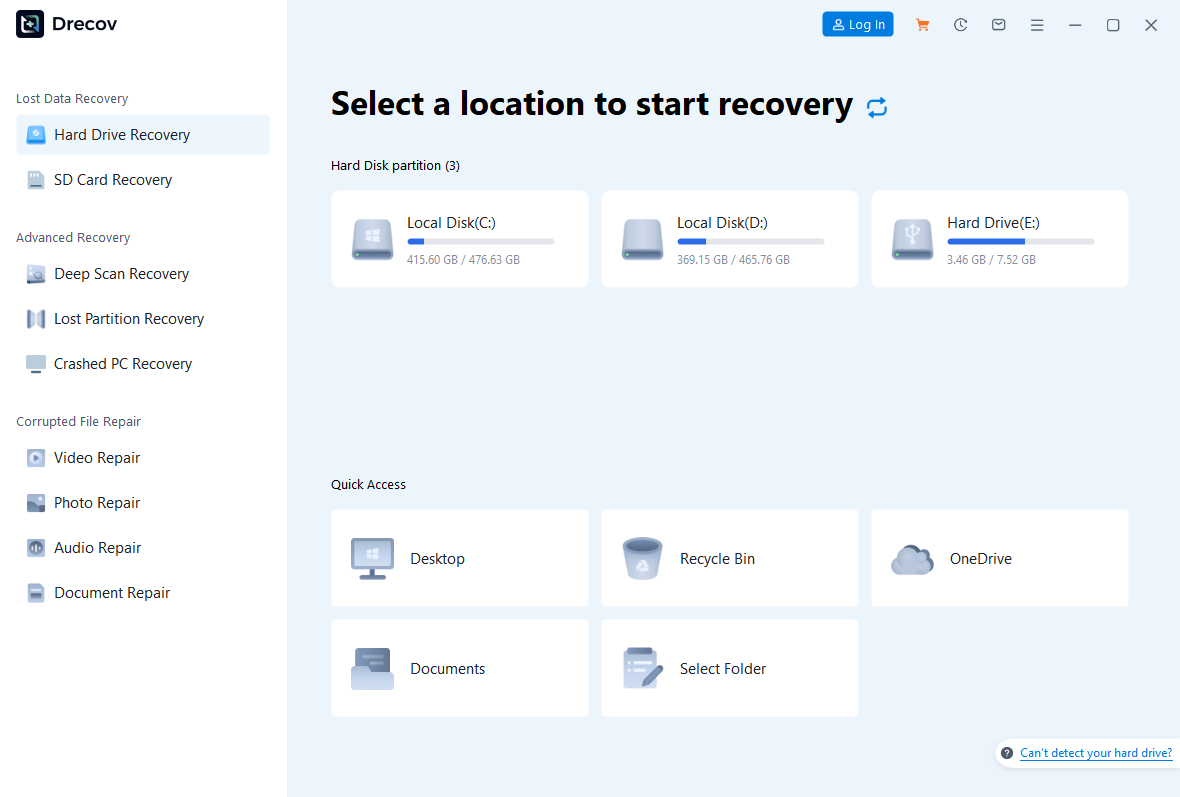
Step 1: Open Drecov and select the original data location
Connect another healthy drive large enough for recovered output. Do not install Drecov on the affected source and do not use that source as the destination. From a functioning Windows system, open Drecov and select the former system partition or user-data partition by physical disk, capacity, and layout. If a previously present partition has vanished but the physical disk is stable, use Lost Partition Recovery rather than creating a replacement partition.
Step 2: Run Quick Scan for the former user folders
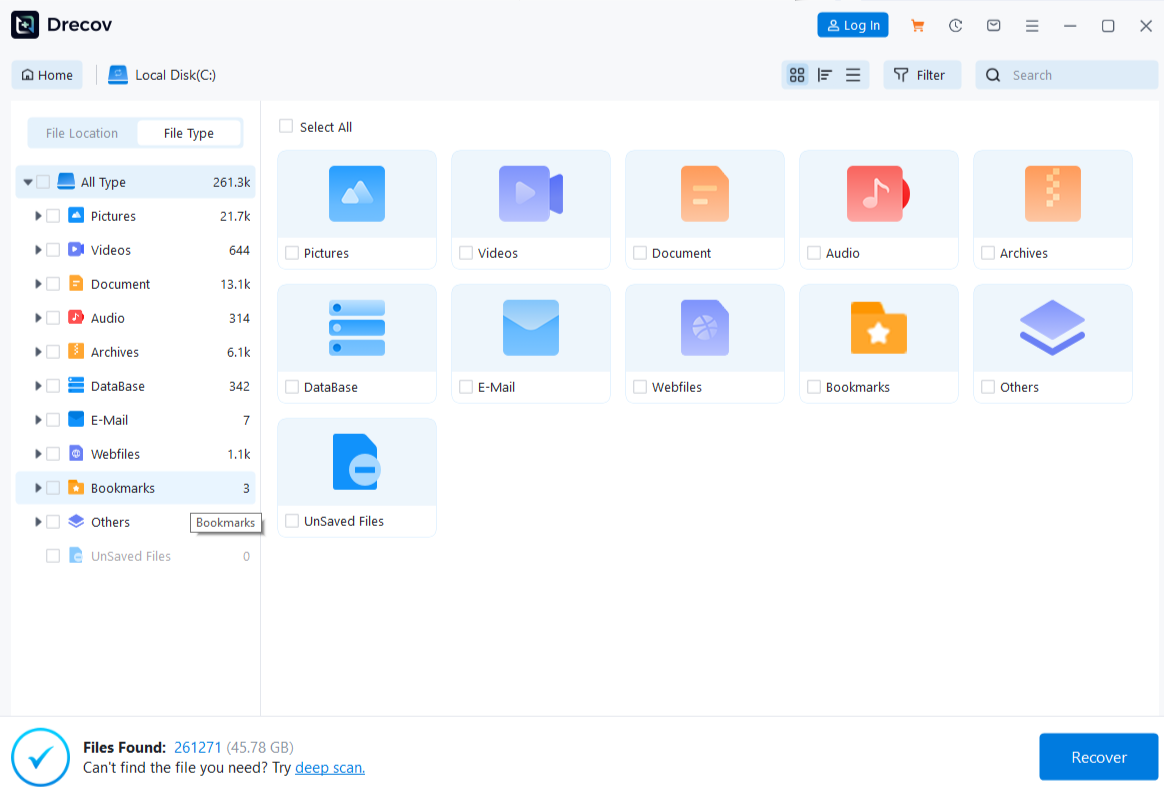
Start Quick Scan. Look for the former Windows user profile, including Desktop, Documents, Pictures, Videos, Downloads, browser profiles, and application project folders. If required material is absent and the disk remains consistently responsive, continue with Deep Scan. Stop if the device begins dropping offline or producing new read errors.
Step 3: Locate and preview priority files
Filter by path, filename, date, or file type. Preview several supported items from every important group. One readable preview is not proof that an entire archive, long video, workbook, database, or linked project is complete. Recover complete project directories when the application depends on related assets.

Step 4: Save to the healthy target and verify
Recover the files to the separate healthy drive. If output is not in the folder you expected, check the destination’s Drecov Folder or Recovery Folder. Open samples, compare sizes, extract important archives, and play media at several points. Keep the verified copy separate before replacing hardware, resetting Windows, changing partitions, or reinstalling.
⚠ Warning: Install it on a drive different from the one where your data was lost to prevent overwriting.
Which repair belongs to each startup stage?
For confirmed no power, remain in the electrical and hardware branch. A compatible known-good adapter, manufacturer power-supply self-test, documented battery isolation, or professional diagnosis can narrow the fault. Windows recovery media has no role until the computer completes POST.
For power with no display, test brightness, the supported external-display path, and diagnostic light or beep codes. Do not erase the system because the panel is dark. For a logo with no boot, inspect firmware storage detection and the boot entry. If Windows Recovery Environment loads, Startup Repair or System Restore may be appropriate after data is protected. Reset and clean installation are last-resort software actions because they can remove applications or data.
If the computer shut down during a firmware update, do not repeatedly interrupt or reapply power without the manufacturer’s recovery procedure. Some systems have a specific BIOS recovery method; using instructions for another model can leave the board unbootable. Record the exact model and indicator pattern before contacting support.
How do you verify a returned computer is safe to use?
After power returns, perform at least one cold start and one Windows restart. Confirm that the charger or power-supply indicators remain normal and that the machine does not shut off when lightly loaded. Open Event Viewer and distinguish an unexpected-shutdown record from the underlying cause; Kernel-Power records confirm an improper stop but do not identify which component failed.
Back up current work before any load test. Run the manufacturer’s built-in diagnostics and use the reported code, not a generic interpretation from another brand. Check drive health and copy a large noncritical test folder only if storage is stable. If the machine powers off again, stop the stress test and arrange service. Repeated hard shutdowns can corrupt open files even when the drive itself is healthy.
Questions after a computer dies without warning
Could an empty battery be the whole problem?
Yes, especially if the adapter, cable, outlet, or charging port was not supplying power. Allow the manufacturer’s recommended charging period and observe the charge indicator. A battery that is swollen, unusually hot, or physically damaged must not be charged or used.
Why do fans spin for a second and then stop?
The system receives some power but may be failing a protection or POST check. Disconnect peripherals and use the manufacturer’s diagnostic-light documentation. Do not repeatedly cycle it or replace random components without a model-specific test.
Can a failed SSD stop the PC from powering on?
A storage fault usually causes no-boot rather than complete no-power, although a shorted device can sometimes affect startup. Lights, fans, POST codes, and firmware detection establish which stage is failing. A drive absent from firmware cannot be repaired by Windows software.
With AC disconnected and the computer already off, a documented residual-power drain does not write to storage. Holding Power to force off a running computer can lose unsaved work and corrupt open data, so it should not become a routine shutdown method.
Should I reset Windows when power comes back?
No, not unless evidence shows a Windows problem. Reset cannot repair an adapter, battery, power supply, thermal fault, or motherboard. Back up or recover files first, then choose a repair that matches the stage where startup fails.
When a computer shuts off and stays off, the useful question is how far the next start gets. Establish power, display, POST, storage detection, and Windows boot in that order. Protect data as soon as stable access exists, and do not let a temporary restart hide a recurring electrical or thermal failure.
⚠ Warning: Install it on a drive different from the one where your data was lost to prevent overwriting.