







We have all experienced that sudden moment of panic. You have spent hours drafting a crucial report, and suddenly, Microsoft Word crashes, or your computer restarts unexpectedly. Consequently, you are left staring at a blank screen, wondering how to handle an unsaved document recovery word crisis. Fortunately, losing your progress does not mean you have to start from scratch. Microsoft Word has built-in safety nets, but native features sometimes fall short if a file is severely corrupted or permanently deleted. In such cases, professional data recovery tools become essential.
This comprehensive guide will walk you through the most effective methods for unsaved document recovery word, ranging from quick built-in Microsoft fixes to advanced data retrieval solutions. If you need a reliable, stress-free remedy right away, we highly recommend utilizing PandaOffice Drecov data recovery software. This powerful tool specializes in scanning deep within your system architecture to piece together lost data fragments, ensuring your hard work is never truly gone.
Understanding the Basics of Unsaved Document Recovery in Word
When you work on a document, Microsoft Word constantly writes temporary data to your hard drive. This architecture exists specifically to protect your files against sudden power failures or software crashes. However, executing an unsaved word document recovery successfully depends heavily on how quickly you act after the data loss occurs.
Common Issues and Challenges
- Overwritten Cache Files: Windows frequently reallocates disk space. If you continue using your computer, the system might overwrite the temporary files containing your lost document.
- Sudden System Crashes: Severe operating system crashes can corrupt the temporary files that Word relies on for AutoRecover functions.
- Accidental Closure: Clicking “Don’t Save” by mistake bypasses the standard prompt, which deletes the temporary working cache.
Why Choose PandaOffice Drecov Data Recovery Software?
When native Windows remedies fail, specialized software is your best line of defense. PandaOffice Drecov data recovery software is engineered with advanced deep-scanning algorithms that bypass operating system limitations. It scans the raw sectors of your storage drive to locate deleted temporary files (.tmp), AutoRecover files (.asd), and fragmented Word documents.
⚠ Warning: Install it on a drive different from the one where your data was lost to prevent overwriting.
Whether your file disappeared due to an unexpected power outage, a formatted drive, or malware corruption, this utility provides a streamlined approach to data retrieval. It supports multiple file systems (NTFS, FAT32, exFAT) and ensures complete data integrity throughout the scanning process.
Before diving into advanced recovery, you might also find these resources helpful if you are dealing with other common data loss scenarios:
- If you accidentally cleared your desktop shortcuts while looking for files, learn where is Recycle Bin in Windows 10.
- If you lost important browser shortcuts during a system crash, check out this guide on the Firefox bookmarks location.
Step-by-Step Solutions for Word Unsaved Document Recovery
Below are the most effective strategies to perform a word unsaved document recovery, organized by technical complexity.
Method 1: Utilizing Word’s Native AutoRecover Feature
Microsoft Word features a built-in safety mechanism known as AutoRecover. By default, it saves a copy of your progress every 10 minutes.
- Step 1: Open a fresh, blank Microsoft Word document.
- Step 2: Look at the left-hand sidebar. If the software closed unexpectedly, a Document Recovery pane should automatically appear.
- Step 3: Click on the available files listed in the pane to review their timestamps.
- Step 4: Once you locate the correct version, click Save As and store it securely on your drive.
Method 2: Recovering via PandaOffice Drecov
If Word’s built-in options show nothing, the temporary files may have been deleted or unlinked from the system directory. This is where PandaOffice Drecov data recovery software provides an efficient solution for unsaved document recovery.
⚠ Warning: Install it on a drive different from the one where your data was lost to prevent overwriting.
- Step 1: Launch the application and select the specific drive or folder where your Word files are typically managed.

- Step 2: Click the Scan button. The software will run a quick scan followed automatically by a deep scan to find hidden
.asdand.tmpfiles.
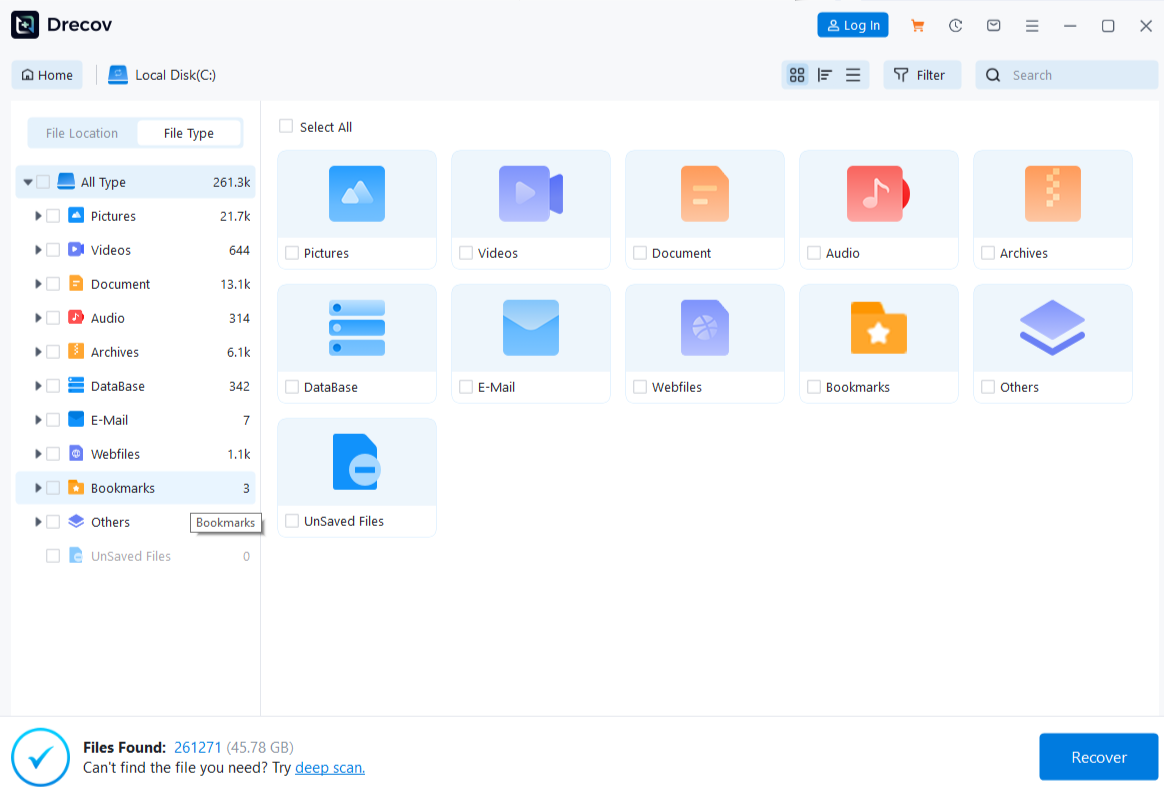
- Step 3: Use the filter sidebar to search for
.docx,.doc, or.asdextensions. Preview the discovered files to confirm their contents.

- Step 4: Select your lost file, click Recover, and save it to a secure external drive or a different local partition.
Method 3: Digging Into the AppData AutoRecover Directory
Sometimes, Windows fails to trigger the automatic recovery pane. However, the temporary .asd files might still sit silently in your hidden system folders.
- Step 1: Press the hotkey combination Windows Key + R to launch the Run dialog box.
- Step 2: Type
%appdata%\Microsoft\Word\into the text box and press Enter.Note: Alternatively, you can navigate manually toC:\Users\[YourUsername]\AppData\Roaming\Microsoft\Word\. - Step 3: Look for files ending with the
.asdextension. - Step 4: Copy the file, open Word, go to File > Open > Browse, change the file type dropdown menu to All Files (.), select the
.asdfile, and open it.
Alternative and Complementary Methods
If you are still searching for solutions, alternative manual avenues can help you execute an unsaved document recovery.
1. Searching for Temporary Files (.tmp)
Windows often drops temporary versions of your working files directly into the system temp directory.
- Open the Run dialog (Win + R), type
%temp%, and press Enter. - Sort the folder contents by Date modified to find files created around the time of the crash.
- Look for files starting with a tilde (
~) or a wave pattern. Change their extension to.docxto see if Word can parse them.
2. Checking the Windows Recycle Bin
If you accidentally deleted a previously saved draft while trying to clean up your workspace, check your trash folder immediately. For step-by-step assistance with this process, see this 5-minute fix to get recently deleted photos and files back.
Pros and Cons of Recovery Methods
| Recovery Method | Pros | Cons |
| Microsoft AutoRecover | Completely free; instant; built directly into Word. | Only works if Word was open during the crash; files disappear if you click “Don’t Save”. |
| Manual AppData Search | Accesses hidden system files; requires no third-party downloads. | Highly dependent on exact path accuracy; can be confusing for non-technical users. |
| PandaOffice Drecov | High success rate; recovers deeply buried, deleted, or corrupted fragments; highly automated. | Requires installation; scanning large drives can take a few minutes. |
Tips & Best Practices for Preventing Data Loss
The most successful data recovery strategy is a proactive defense. Implement these settings to minimize future disruption:
- Shorten AutoRecover Intervals: By default, Word saves data every 10 minutes. You should reduce this to 1 or 2 minutes. Go to File > Options > Save, and change the time limit under “Save AutoRecover information every X minutes.”
- Enable Cloud AutoSave: Connect your Microsoft Word application to OneDrive or SharePoint. This configuration uploads your changes in real-time as you type, creating an automated cloud backup log.
- Avoid Overwriting Data: The moment you realize a document is missing, stop writing new data to that drive. Avoid downloading heavy applications or transferring large media assets until your file is recovered.
- Use Proper Shutdown Procedures: Avoid holding down the physical power button to shut down your machine. Abrupt power loss prevents Word from closing its temporary logs cleanly, which often corrupts the document cache.
Frequently Asked Questions
Where does Word store unsaved documents?
Microsoft Word saves unmanaged files in a dedicated cache directory. For detailed insights on how Microsoft handles storage paths, you can refer to the official Microsoft Support Documentation. Generally, you can locate these drafts by navigating to:
C:\Users\[Username]\AppData\Local\Microsoft\Office\UnsavedFiles
Can I retrieve a document if I clicked “Don’t Save”?
Yes. When you click “Don’t Save”, Word usually purges the local AutoRecover file. However, the data block remains on your hard drive until it is overwritten by new system activity. Deploying PandaOffice Drecov data recovery software immediately after the incident provides an excellent chance of extracting those raw file remnants before they vanish permanently.
What is the shortcut key to recover an unsaved Word document?
There is no singular, direct hotkey to restore an unsaved file. However, you can use Ctrl + O to open the File menu, then click the Recover Unsaved Documents option located at the bottom of the Recent files list.
Why is my AutoRecover folder empty?
This occurs if the AutoRecover feature was disabled in your Word preferences, or if the temporary cache files were purged by a Windows disk cleanup utility. If you find yourself in this situation, a deep sector scan using dedicated recovery software is required.
Conclusion
Experiencing unexpected data loss is stressful, but a missing file is rarely gone forever. By leveraging Microsoft Word’s built-in AutoRecover systems or digging directly into your Windows AppData folders, you can resolve most basic file disruptions quickly.
Furthermore, when manual troubleshooting falls short, dedicated tools like PandaOffice Drecov data recovery software ensure that you have access to a reliable backup plan. It takes the guesswork out of data preservation by scanning deep system directories automatically.






