







To learn how to open AppData, press Windows+R, enter `%APPDATA%`, and press Enter. That command opens the current user’s Roaming folder, not the AppData root. To open the root, enter `%USERPROFILE%\AppData`; for Local, enter `%LOCALAPPDATA%`. AppData is hidden because applications manage much of its content. Viewing it is safe, but moving, renaming, or deleting unknown folders can reset programs, remove profiles, or erase local saves. Confirm the Windows account and application before changing anything.
How to Open AppData and Choose the Correct Branch
Roaming commonly stores settings and profile data that may follow a domain user in managed environments. Local stores machine-specific caches, databases, downloads, and application state that normally stays on one computer. LocalLow is used by applications running with lower integrity or specific compatibility needs.
These are conventions, not guarantees. An application may store important data in more than one branch, under ProgramData, Documents, Saved Games, its installation directory, or a custom path. Use the application’s documentation and current settings before assuming one folder is authoritative.
The current user’s paths differ from another profile’s paths. If a program was used under an old Windows account, opening `%APPDATA%` under the new account will lead to a different Roaming directory. Browse `C:\Users` carefully and preserve access controls rather than taking ownership of every profile.
Open AppData Four Safe Ways
Use the Run dialog for the active account
Windows+R and `%APPDATA%` opens Roaming. `%LOCALAPPDATA%` opens Local. `%USERPROFILE%\AppData` opens the root. Environment variables avoid hard-coding a username and are usually the fastest route.
Use File Explorer’s address bar
Paste the same variable or a verified full path into the address bar. Do not type it into the search box. The address bar navigates directly; search can return caches and similarly named folders from unrelated locations.
In File Explorer, enable Hidden items and browse the current user profile. Turning visibility on does not change the folder’s content. Do not remove the Hidden attribute from broad system folders merely to make navigation easier.
Open a known subfolder from an application
Some programs provide an Open Data Folder, Logs, Profiles, or Saves command. Prefer that command when available because it reveals the active path for that build and account.
Identify the Folder Before Copying or Cleaning
Close the application before backing up a database, browser profile, email store, or game save. Active programs may leave a changing or locked set of files. Copy the complete relevant folder to another healthy device and record the source path.
Check folder and file timestamps around the last successful use. Compare application account names, profile identifiers, game IDs, database sizes, and log entries. A recently modified cache is not necessarily the user’s irreplaceable data.
Cleanup utilities can remove caches safely in one application and erase offline content in another. Use the application’s own cache controls first. Never delete an entire AppData branch to fix one misbehaving program.
Helpful Drecov references include Windows data recovery, showing hidden Windows files, clearing temporary files deliberately, and finding deleted files. Microsoft defines the underlying folders in its Known Folder reference.
A Missing AppData Folder Is Not Always Deleted
| Observation | Likely explanation | Safe check |
|---|---|---|
| AppData is invisible under the user folder | Hidden items are off | Use the direct environment-variable path |
| Roaming opens but expected program data is absent | Wrong account or different storage branch | Check Local, LocalLow, and the app’s active path |
| A program created a new empty profile | Profile reset or path change | Close it and preserve both old and new folders |
| Folder exists but files are zero bytes | Incomplete writes or sync trouble | Check versions and backups |
| Old Windows profile was removed | Local deletion is plausible | Stop writes before recovery |
Search the exact application name, publisher name, profile ID, and known file extensions. Avoid broad searches that create thumbnails or indexes on the affected drive when recent deletion is suspected.
Check File History, Previous Versions, OneDrive where the folder was deliberately redirected, application exports, and manual backups. Most AppData is not automatically protected by ordinary cloud folder backup, so verify rather than assume.
Use Drecov When Application Data Was Truly Deleted
PandaOffice Drecov is Windows data recovery software for PCs and stable storage including HDDs, SSDs, external drives, USB drives, SD cards, and memory cards. It provides read-only recovery mode, Quick Scan, Deep Scan, filtering, preview, recovery to another healthy destination, and Lost Partition Recovery. It supports common documents, photos, video, audio, email data, and archives.
Drecov belongs only in the deleted or inaccessible local-data branch. It does not reveal a folder that is merely hidden, reset an application profile, decrypt protected databases, fix permissions, or reconstruct overwritten app state. SSD TRIM can sharply reduce recovery prospects. If the source drive clicks, drops offline, freezes the PC, changes capacity, or returns severe read errors, stop direct scans. Use imaging or professional recovery rather than treating physical instability as a hidden-folder problem.
⚠ Warning: Install it on a drive different from the one where your data was lost to prevent overwriting.
Drecov Steps for Deleted AppData Content
Step 1: Open Drecov and select the original Windows profile location
Prepare a healthy external destination. Do not install Drecov on the affected partition. Open Drecov and select the drive or user profile that held the missing AppData folder. Use Lost Partition Recovery only if the containing partition disappeared.

Step 2: Run Quick Scan and inspect the former branch
Start Quick Scan. Browse the former Roaming, Local, or LocalLow path and filter by application name, extension, date, and size. Keep the application closed to avoid creating replacement data.

Step 3: Use Deep Scan only on a stable source
If Quick Scan does not find the required files and storage remains consistently readable, run Deep Scan. Stop when read behavior worsens. Do not run CHKDSK before needed recovery.
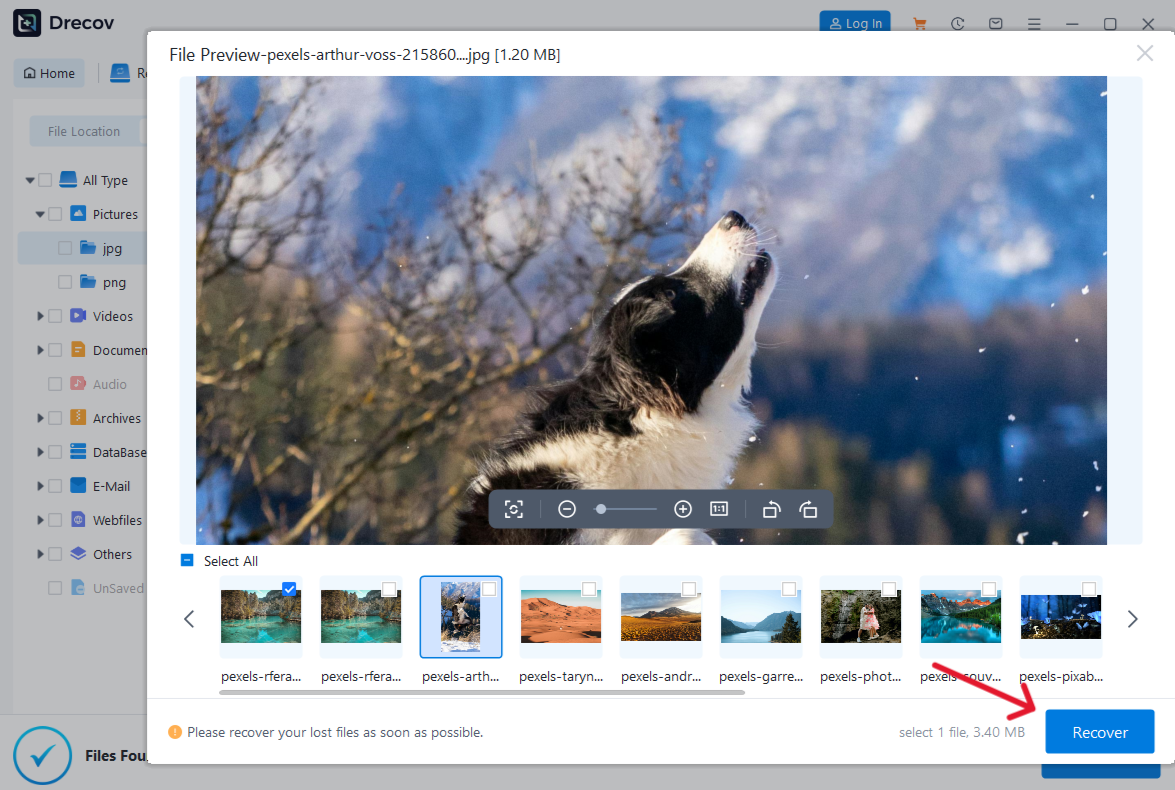
Step 4: Preview and recover the whole useful set elsewhere
Preview supported candidates and preserve companion files and folder context. Recover to the healthy destination, never back to the source profile. Keep multiple plausible generations.
Step 5: Check output folders and validate with a copy
If output is not where expected, inspect Drecov Folder or Recovery Folder. Back up the raw result, then test a duplicate with the application. Confirm account, content, dates, and save behavior before replacing any live AppData folder.
Restore Application Data Without Overwriting Evidence
Let the application create a clean test profile when necessary, then close it. Compare its folder structure with the recovered copy. Replace only documented data, and retain both folders until the application opens and saves normally.
Databases, mail stores, browser profiles, and game saves may need application-specific repair or import. Do not copy a damaged database over the only working profile. Use read-only inspection or an application-supported import when possible.
After successful validation, create an ordinary backup of the important AppData subset. Document the path and application version. This prevents the next troubleshooting session from depending on hidden-folder discovery or disk recovery.
Use Permissions Without Taking Ownership of Everything
Access denied under another Windows profile is a security boundary, not an instruction to reset permissions across the entire Users tree. First sign in with the correct authorized account or ask an administrator to copy the specific application folder. Broad ownership changes can break inherited permissions, expose private data, and make later application behavior difficult to diagnose.
When migrating a profile, copy data rather than moving the only source. Keep the original directory intact until the application starts, displays the expected account or project, and saves a new change. Some folders contain machine-specific paths, tokens, or caches that should not be transferred wholesale. Application documentation should decide which subfolders are portable.
Folder size also needs interpretation. A large Local directory may be a replaceable cache, an offline mailbox, downloaded creative assets, or a database with unique local work. Inspect names, extensions, application settings, and backup documentation before cleanup. Disk-usage tools reveal size, but they do not classify business value.
If Windows was reinstalled and an old profile remains under Windows.old, preserve it before cleanup deadlines or Storage Sense removes it. Check Documents, Desktop, Downloads, Saved Games, and application-specific AppData branches. Copy required data to another healthy device and validate it in a duplicate profile before deleting the former installation.
Command-line users can print the relevant variables without guessing a username, but scripts should still validate the resolved path before copying or deleting. Quoting matters when profile names contain spaces. Administrative consoles may run under a different account and therefore resolve AppData elsewhere. Display the path, compare it with File Explorer, and test a read-only listing first. Never place a cleanup command around an unresolved variable, wildcard, or parent user directory. The cost of one careful path check is far lower than rebuilding a damaged profile.
Conclusion
Knowing how to open AppData solves a navigation problem, not every application failure. Use the correct account and branch, close the program before copying, and preserve unfamiliar folders. When local application data was genuinely deleted from stable storage, Drecov can recover candidates to another device. Validate them in a duplicate profile before changing the live folder.
⚠ Warning: Install it on a drive different from the one where your data was lost to prevent overwriting.





