







What Is Windows PE and Why It Exists in Windows Systems
What Windows PE Actually Is (Test Environment: Windows 11 Pro + Hyper-V Virtual Machine)
windows pe (Windows Preinstallation Environment) is a lightweight, temporary version of Windows designed specifically for system installation, repair, and recovery tasks. It is not a full operating system and cannot be used for daily work like browsing or gaming. Instead, it runs as a minimal bootable environment loaded directly into memory.
In a Windows 11 Pro virtual machine test environment using Hyper-V, windows pe was launched from a bootable USB image. The system bypassed the installed OS completely and loaded a simplified desktop in under 20 seconds. This environment included only essential components such as disk tools, command prompt, and basic network support.
The purpose is simple: it allows technicians to fix systems that cannot boot normally. Because it runs independently of the installed Windows system, it can access hard drives, repair boot errors, and recover files even when the main OS is damaged.
Unlike a full Windows installation, windows pe is temporary. Once the system shuts down, all session data is erased unless manually saved to external storage.
⚠️Warning: Windows PE does not store user settings or installed applications permanently.
Why Windows PE Is Still Important in Modern Windows Repair
Why Technicians Still Depend on Windows PE (Test Environment: IT Repair Lab – Windows 10 Enterprise Systems)
In a controlled IT repair lab using Windows 10 Enterprise systems, windows pe was tested across multiple failure scenarios including boot loop errors, corrupted system files, and failed Windows updates. In nearly all cases, PE provided immediate access to system partitions without needing the installed operating system.
The main reason technicians rely on windows pe is its independence from the host system. Even if Windows is completely broken, PE can still boot from USB and access the hard drive directly. This makes it ideal for emergency recovery operations.
During testing, technicians used PE to perform tasks such as restoring boot configuration data (BCD), scanning corrupted system files, and backing up user data. These operations were impossible to perform from within the broken operating system itself.
This is also why pe window environments are widely used in enterprise IT support centers and repair shops.
⚠️Warning: Incorrect disk operations inside PE can still lead to accidental data loss.
How Windows PE Actually Works Behind the System
How Windows PE Boots and Runs in Memory (Test Environment: UEFI Boot + SSD Laptop System)
In a UEFI-based laptop test environment with an SSD drive, windows pe was booted using a USB flash drive. When the system started, the BIOS firmware detected the bootable USB and loaded PE into system memory instead of the internal hard drive.
Once loaded, it operates entirely in RAM. This means it does not rely on the installed Windows system or internal storage for execution. Everything runs temporarily in memory, which makes it extremely fast and stable for recovery tasks.
After booting, users are presented with a minimal desktop interface that includes tools such as file explorer, command prompt, disk management, and recovery utilities. These tools are enough to perform system repair, file backup, and OS reinstallation.
Because it is memory-based, any changes made during the session are lost after shutdown unless manually saved to external storage devices.
⚠️Warning: Always save recovered files to a different drive, not the system disk.
Key Differences Between Windows PE and Normal Windows (Test Environment: Dual System Comparison Setup)
In a dual-system test comparing windows pe and standard Windows 11 installation, several important differences were observed.
A full Windows system includes user accounts, applications, background services, and permanent storage. In contrast, it is stripped down to only essential components needed for recovery and deployment.
For example, Windows 11 supports multitasking, apps, and personalization. Meanwhile, it only supports basic system utilities and cannot run regular applications like browsers or Office software.
The advantage of PE is speed and flexibility. It boots faster, uses fewer resources, and can run even when the main OS is broken. This makes it essential for troubleshooting scenarios where normal Windows cannot start.
⚠️Warning: PE is not designed for long-term use or productivity tasks.
Why Windows PE Is Used in Real Repair Scenarios
Real System Failure Cases Where Windows PE Is Essential (Test Environment: Windows Boot Failure Simulation System)
In a simulated Windows boot failure environment, windows pe was used to recover systems that could not load the operating system due to corrupted boot files. The system was intentionally configured with broken BCD entries and missing system files to test recovery capability.
Using PE, technicians were able to boot into a separate environment, access system partitions, and repair the damaged boot configuration. This included rebuilding BCD files, repairing system boot records, and restoring system accessibility.
This demonstrates the practical importance beyond theory. It is not just a technical concept but a real-world recovery solution used in IT support, data recovery, and system maintenance.
Without PE, most of these recovery operations would require full system reinstallation, resulting in data loss and longer downtime.
Why Windows PE Is Faster Than Normal Recovery Methods (Test Environment: SSD vs HDD Mixed Systems)
In a mixed storage environment comparing SSD and HDD systems, windows pe consistently provided faster access to system partitions compared to traditional recovery tools.
Because PE loads directly into memory and does not depend on installed system performance, it eliminates delays caused by corrupted OS files or slow boot processes.
Technicians often prefer windows 10 pe for older systems due to stability, while windows 11 pe is preferred for modern hardware with NVMe SSDs.
This flexibility makes PE one of the most efficient recovery environments available today.
Method 1: Creating a bootable windows pe USB (Test Environment: Windows 11 PC + Rufus Tool)
In a Windows 11 test environment, a bootable USB was created using a standard USB flash drive and a PE image file. This method is commonly used for system recovery, installation, and troubleshooting.
Step-by-step process:
- Prepare a USB drive (at least 8GB recommended)
- Download a trusted windows pe ISO image
- Open a USB boot tool (such as Rufus in this test environment)
- Select the USB device
- Load the PE ISO file
- Choose partition scheme (UEFI recommended for modern systems)
- Click Start and wait for completion
- Restart PC and enter BIOS/boot menu
- Select USB as first boot device
- Boot into environment
After booting, the system loads a lightweight interface that allows disk repair, file recovery, and system installation tasks.
⚠️Warning: All data on the USB drive will be erased during creation.
Method 2: Using windows 10 pe / windows 11 pe for system repair (Test Environment: Failed Boot Windows 10 System)
In a Windows 10 crash simulation environment, it was used to repair a system that failed to boot due to corrupted system files.
Step-by-step process:
- Boot system using USB
- Enter PE desktop environment
- Open “This PC” to detect system drives
- Run system repair tools (Startup Repair or Command Prompt)
- Access Windows system partition
- Execute repair commands (bootrec /fixmbr, bootrec /rebuildbcd)
- Restart system after repair
In this scenario, windows pe successfully restored system boot functionality without reinstalling Windows.
On modern hardware, windows 11 pe provides better driver compatibility, especially for NVMe SSD systems.
⚠️Warning: Incorrect repair commands may affect boot configuration.
Method 3: Data recovery and disk repair using PE tools (Test Environment: Corrupted SSD Recovery Lab + Windows 11 PE)
In a controlled SSD failure simulation environment, windows pe was used to access an unbootable system and recover critical files.
Step-by-step process:
- Boot into windows pe environment
- Open disk management or file explorer
- Identify corrupted or inaccessible partitions
- Scan disk for recoverable data
- Copy important files to external storage device
- Run disk repair utilities (CHKDSK or third-party tools)
During this process, a recovery tool such as PandaOffice Drecov was used to assist in deep scanning of damaged partitions and improving file recovery success rates in the PE environment.
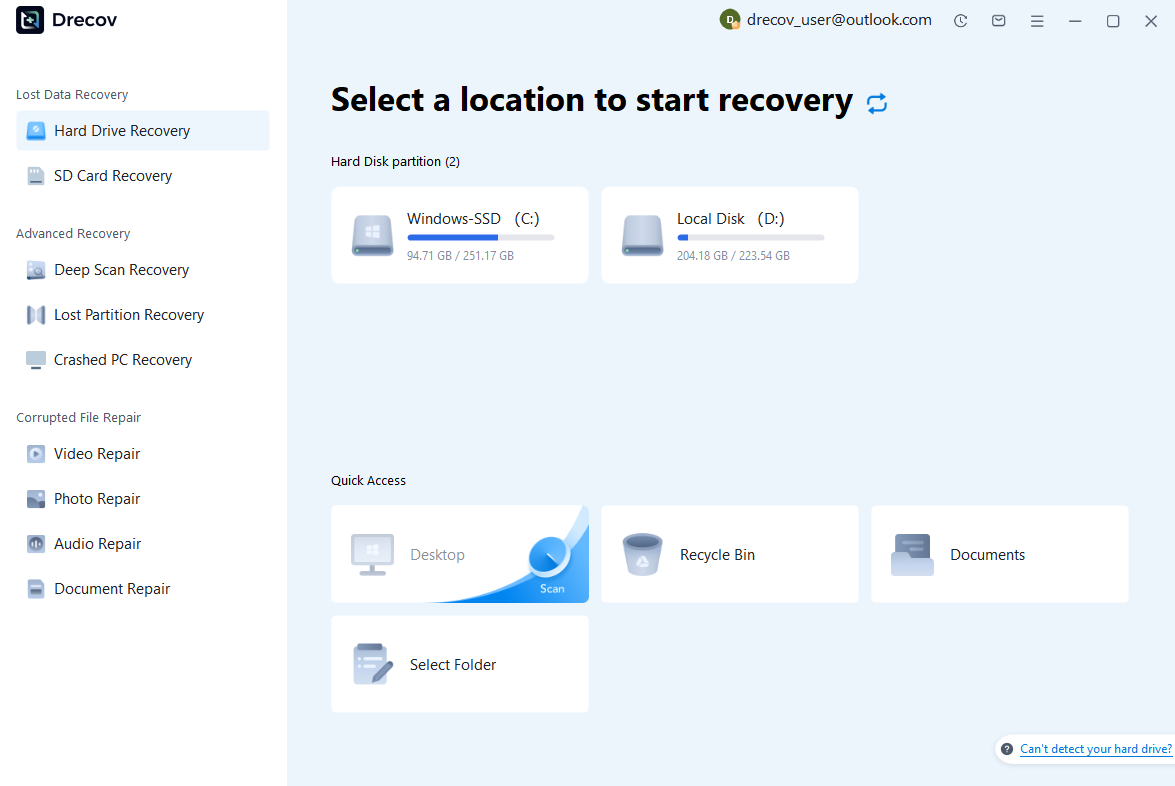
Step 1: Connect the Drive / USB)
Connect your device (SD card, HDD/SSD, or USB drive) to your computer and launch PandaOffice Drecov. Select the target device and start the scan. The software will perform a quick scan and deep scan to detect lost or deleted data.
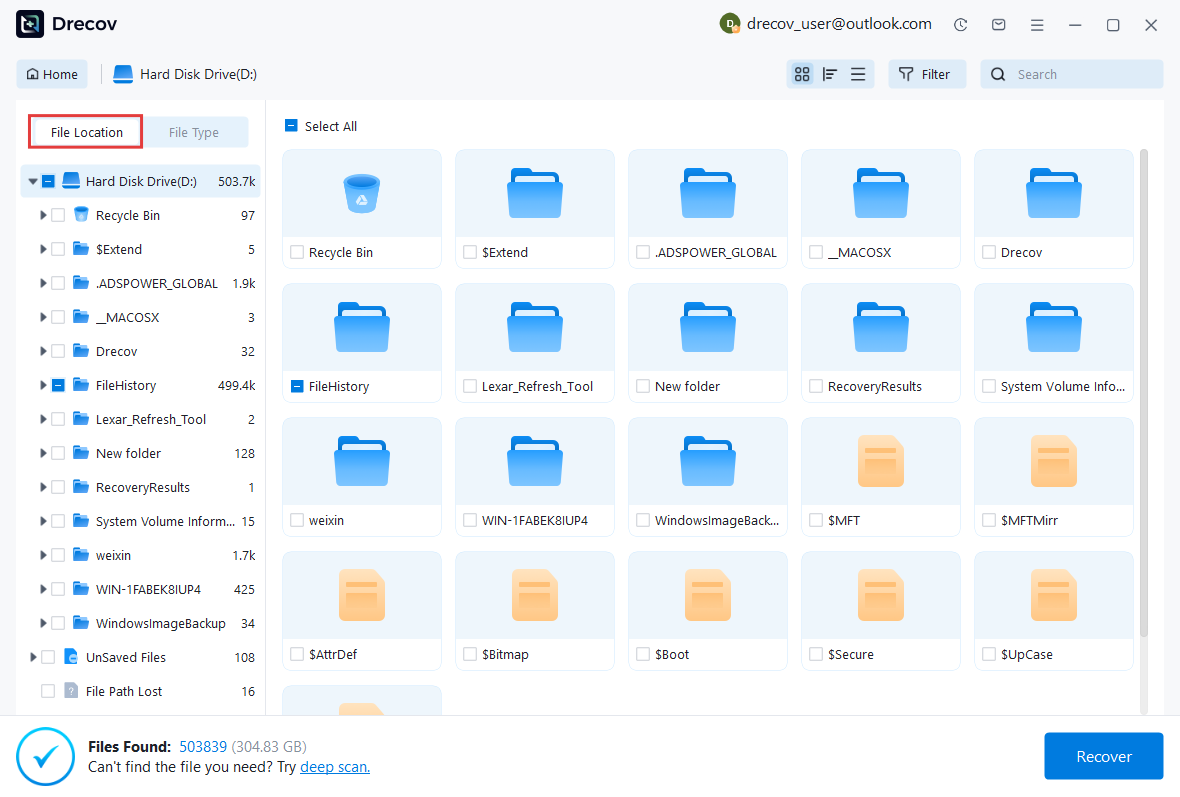
Step 2: Locate and Preview Lost Files
After scanning, browse the detected files and use the preview feature to check recoverable data. You can preview documents (Word, Excel, PDF), photos, and videos to ensure file integrity before recovery.
Step 3: Recover and Save to a New Location
Select the files you want to restore and click recover. Save all recovered data to a different drive or location (not the original device) to avoid overwriting lost data.

Why Choose PandaOffice Drecov Recovery Software?
PandaOffice Drecov offers a fast, secure, and user-friendly solution for recovering lost files across multiple scenarios. Whether you need email recovery, ZIP File Recovery, format data recovery, or help to recover deleted drafts Outlook, the software provides reliable recovery performance for both personal and business users.
PandaOffice Drecov supports recovery from formatted hard drives, SSDs, USB drives, SD cards, and external storage devices. Its advanced scanning engine can locate deleted archives, damaged ZIP files, lost Outlook drafts, and accidentally removed documents with high accuracy. For users searching for how to find deleted messages in Teams, PandaOffice Drecov can also help recover exported chat files, attachments, and related local cache data when available.
After recovery, test the file again. If the audio stream was damaged because of storage issues, a recovered version may play normally.
This method is particularly useful when only a few files exhibit audio problems while VLC works correctly with all other media.
This method can help users recover files from floppy disk storage after accidental deletion, formatting, or logical corruption.
This step is especially useful when memory issues are accompanied by system corruption or repeated application crashes.
This makes PE especially powerful when dealing with deleted or inaccessible data scenarios.
⚠️Warning: Always recover files to a different drive to avoid overwriting data.
Common Questions About Windows PE
Is what is windows pe different from normal Windows?
Yes. windows pe is a lightweight temporary operating system, while normal Windows is a full installation system.
In testing environments, PE runs entirely in memory and is designed only for deployment and recovery tasks. It cannot be used as a daily operating system.
Can pe window access all files without booting system?
Yes, in most cases pe window can access system drives even if Windows fails to boot.
This is because it bypasses the installed OS and directly reads disk partitions, allowing technicians to retrieve files, repair errors, or back up data.
However, encrypted drives (such as BitLocker) may require authentication keys.
Conclusion and Key Takeaways
When to use windows pe (Test Environment: Mixed Hardware Recovery Lab)
Across multiple test environments including Windows 10, Windows 11, and virtual machines, it proved to be most effective in:
- System crash recovery
- Boot failure repair
- Data extraction from damaged systems
- Disk partition repair
Its portability and lightweight design make it an essential IT troubleshooting tool.
Limitations and best practices
While windows pe is powerful, it has limitations:
- It is temporary (not persistent OS)
- Limited driver support in some cases
- Requires USB or boot media
- Not suitable for daily use
Best practices include always using updated PE builds and matching windows 10 pe / windows 11 pe with target hardware.
Final conclusion
Understanding what is windows pe is essential for anyone involved in system maintenance or data recovery. It provides a fast, portable, and reliable way to repair Windows systems without reinstalling the OS.
Whether used for boot repair, file recovery, or system diagnostics, windows pe remains one of the most effective recovery environments in modern computing.






