
If you are asking “why is my Excel so slow,” first find out whether the delay belongs to one workbook or to Excel itself. Open a new blank workbook, then compare it with the slow file. Note whether the wait happens when opening, typing, recalculating, filtering, or saving. Those actions use different parts of the application. Before deleting rows, changing formulas, or disabling features, save a separate copy of the affected workbook. A quick fix that makes the file smaller is not useful if it also removes a sheet, breaks a link, or changes a result you rely on.
One slow workbook or a slow Excel session?
Start with a short comparison you can repeat. Close other workbooks, open Excel to a blank file, and type in a few cells. If that feels normal, open a small file you trust. Finally, open the slow workbook and perform the action that usually stalls. Write down where the delay starts. A workbook-specific problem leads toward formulas, formatting, external links, and file size. If even the blank workbook lags, look at Excel add-ins, other running applications, available storage, and the health of the computer before dismantling a complex spreadsheet.
Location matters too. A file that opens quickly after being copied to a healthy local folder but slowly from a shared drive or synchronized folder may be waiting on the connection, authentication, or synchronization. Work on a copy, not the sole shared original. Confirm that colleagues are not editing it at the same time and that the local copy has the same content. If the program becomes completely frozen with “Not Responding,” use the separate guide for Excel not responding. This article is for a workbook that still responds, albeit slowly.
Keep a simple baseline: file size, where it is stored, how long the specific action feels, and whether other files behave normally. You do not need laboratory timing. The point is to avoid changing five settings at once. A difference after one reversible test is evidence; a difference after many simultaneous edits is harder to explain or undo.
When typing triggers a pause, inspect calculation
Excel recalculates formulas when their inputs change. A workbook with many dependent formulas can pause after a small edit, even if opening it was quick. Check the status bar for a calculation message. Compare a sheet that contains mostly values with one containing numerous lookups, dynamic arrays, conditional logic, or formulas referencing other workbooks. Large full-column references in certain array expressions and volatile functions can make the calculation work much larger than the visible data suggests.
On a copy of the workbook, review Formulas > Calculation Options. Do not switch to Manual merely to make a delay disappear and forget about it: values can then remain stale until recalculated. If you use Manual temporarily to isolate a calculation bottleneck, record the original setting and run a full calculation before judging results. Formula changes should be made one range at a time, with outputs compared to the untouched copy. A faster file with incorrect totals is not an improvement.
Microsoft’s Excel performance guidance points to calculation and workbook design as major areas to inspect. The safe takeaway for a non-specialist is not “remove formulas.” It is to find the sheet or action that triggers recalculation, then reduce unnecessary repeated work without changing the meaning of the result. For example, a formula copied far below the last real record may be doing work for empty rows. Check the actual data range and test a smaller range in your duplicate file before saving a new working version.
A large file can have a surprisingly large used area
Sometimes an apparently short worksheet has formatting or old data extending far beyond the last visible entry. Press Ctrl+End on a sheet to see Excel’s last used cell. If it jumps many thousands of rows or columns past your real data, the saved used range may be bloated. This can increase file size and slow opening or saving. Do not immediately delete everything after your visible table. Hidden cells, formulas, named ranges, charts, or imported data might still depend on those areas.
Inspect the far region in a duplicate workbook. If it truly contains only unwanted formatting or leftover content, remove the excess rows and columns in the copy, save it under a new name, close it, and reopen it. Compare the file size and the action that was slow. Check that totals, charts, filters, and named ranges still work. If anything changes unexpectedly, return to the untouched original. Clearing cells is not always the same as removing an expanded used area, so the close-and-reopen check matters.
Conditional formatting and objects can also grow across a whole sheet after repeated copying. Open Home > Conditional Formatting > Manage Rules in the duplicate and inspect the ranges to which rules apply. Remove only rules you can identify as unnecessary. If scrolling or selecting cells is the slow action, a huge formatted area may be more relevant than a formula calculation. Again, compare the same operation before and after one change rather than relying on file size alone.
Test links, add-ins, and the save location separately
Does the wait appear only while the workbook opens or updates? Look for external data connections and references to other files. A source that has moved or a network share that is offline can delay an update. Do not break links blindly: a workbook may depend on them for current values. In a copy, identify the source and decide whether the connection is still needed. Ask the workbook owner when the data model is unfamiliar. A missing source is not the same thing as a corrupt workbook.
When all workbooks feel slow, test Excel in Safe Mode on Windows by closing the application and using the appropriate Windows launch method for your installed version. Safe Mode loads Excel without some add-ins and customizations. If performance improves, reopen Excel normally and review File > Options > Add-ins. Disable one suspect add-in at a time and repeat your original action. Restore it if there is no difference. Do not remove a work-required add-in just because it appears on the list; it may provide functions that the workbook uses.
Saving can be slow for reasons that editing is not. A synchronized folder may be uploading a large file, or a network location may be unavailable. Save the duplicate to a healthy local folder and compare. If local saving works, address the connection or synchronization separately. If Excel reports a save error, preserve the still-open copy and use the dedicated guidance on why an Excel file will not save. Do not close the only unsaved session merely to see whether restarting helps.
Make one change, then verify the workbook still means the same thing
Performance testing has two outcomes: speed and correctness. After each change, repeat the action that was slow. Then compare a small set of values, totals, charts, and filters with the untouched original. If the file contains macros or linked data, test those too before replacing the shared copy. Give the new file a distinct name so that you can return to the old one. A reduced file size is useful only when the workbook still produces the expected answers.
When several people use the file, choose a short test window and tell them which copy is under review. A temporary local copy may be fast because it is no longer sharing updates, but that does not automatically make it the correct version to distribute. The owner should confirm the intended data source and calculation mode. For a personal workbook, a simple note listing the changed sheet, range, and setting can prevent confusion later.
Do not use disk cleanup, CHKDSK, or a format operation as a first response to a slow Excel workbook. Those actions target different layers and can change storage structures. If the entire PC is slow, the disk disconnects, or other files become unreadable, stop workbook tuning and investigate the storage condition. Software recovery is not a repair for a physically failing drive.
If the original workbook is now missing
A slow workbook is not itself a data-loss event. Drecov is not an Excel performance tool, and scanning the disk will not make formulas calculate faster. A separate problem arises if the original local workbook was deleted, moved unexpectedly, or lost while testing copies. First check Recycle Bin, the folder you saved to, cloud version history, and Excel’s AutoRecover locations. Our Excel AutoRecover location guide covers that built-in route. If the file was saved over or removed and no intact copy exists, stop writing new data to its original partition.
Drecov can search a stable Windows-accessible drive for a missing local Excel file. Quick Scan, Deep Scan when needed, filters, and preview help narrow results to a plausible workbook. Its role is file recovery, not worksheet repair or speed optimization. A physically unstable drive should not be subjected to repeated scans; imaging or professional recovery is safer. Prepare another healthy destination and install the software somewhere other than the partition that held the missing workbook.
⚠ Warning: Install it on a drive different from the one where your data was lost to prevent overwriting.
Recover the lost file without changing the source
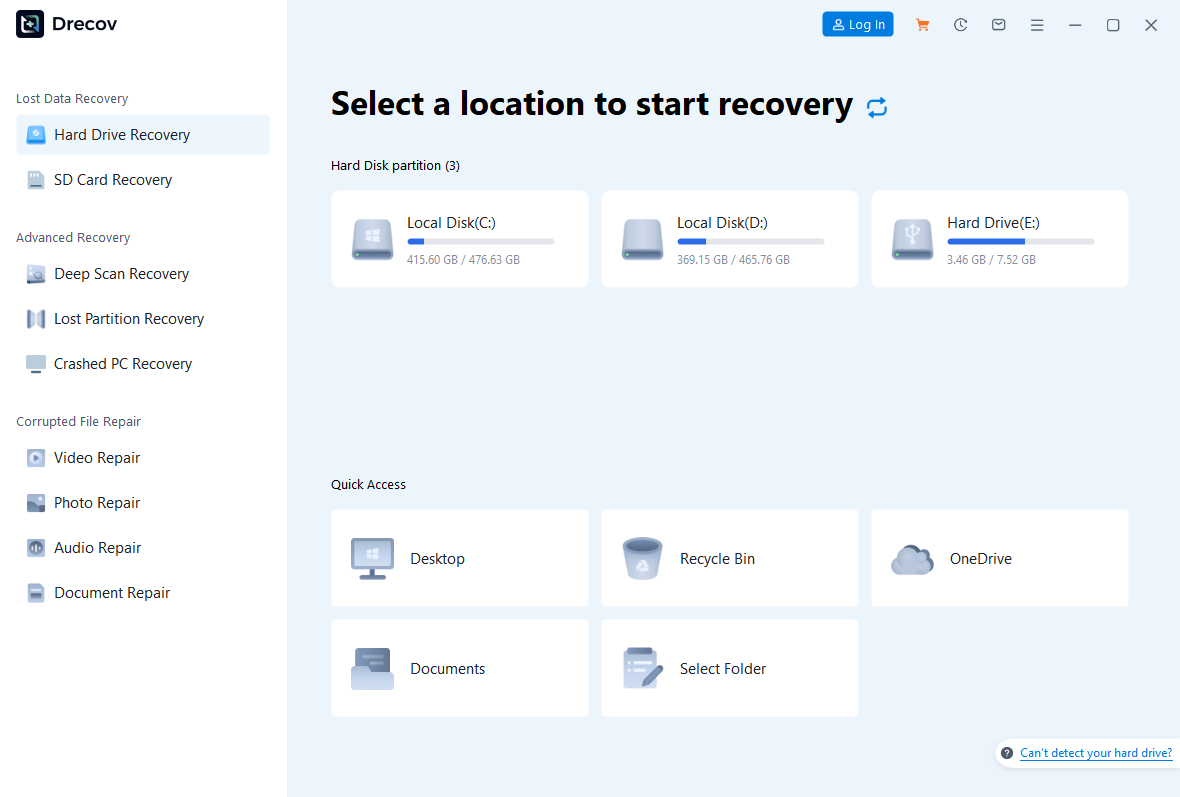
Step 1: Open Drecov and choose the workbook’s original location
Launch Drecov and select the local drive or folder’s partition where the workbook last existed. If it was in Documents, Downloads, or a project directory, use that location rather than a cloud folder that never stored a local copy. A different computer may assign the source another drive letter; identify it by capacity and folder structure.
Step 2: Run Quick Scan, then consider Deep Scan
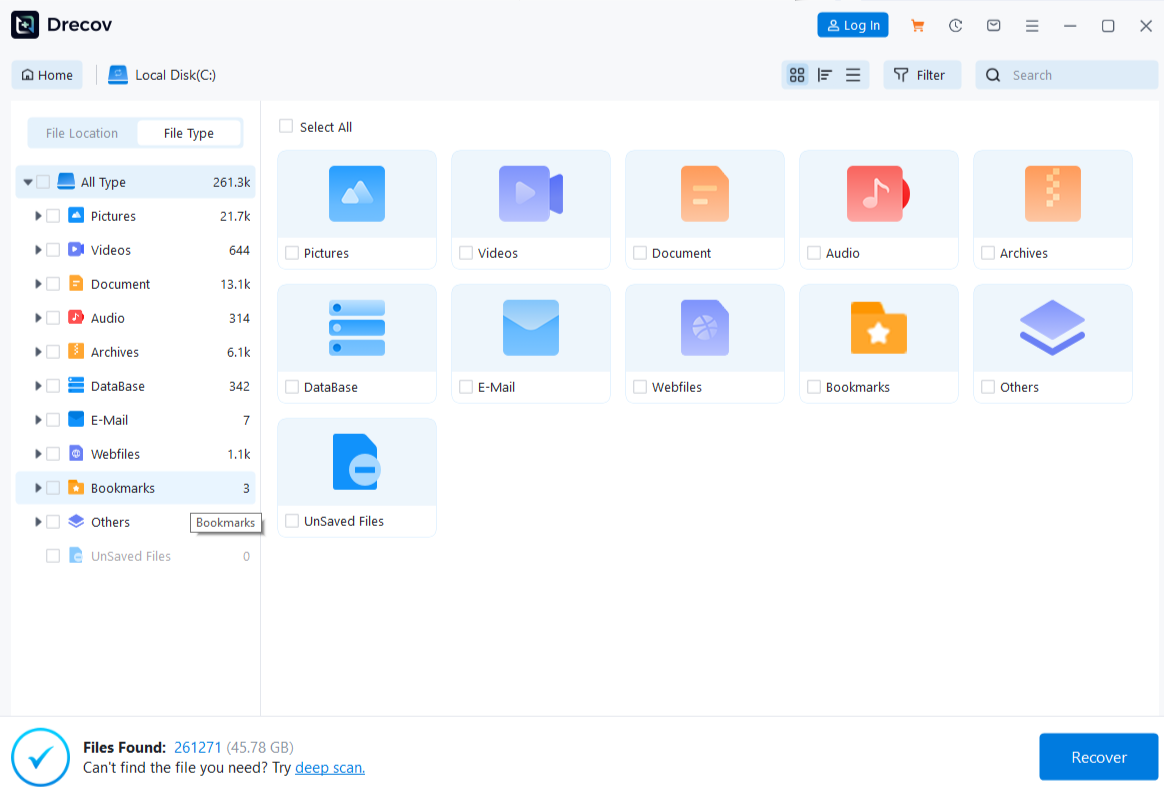
Begin with Quick Scan and look for the filename and nearby workbook copies. If the target is absent and the drive remains stable, run Deep Scan on the same source. Stop if the device clicks, disconnects, or reports worsening read errors.
Step 3: Filter and preview possible workbooks
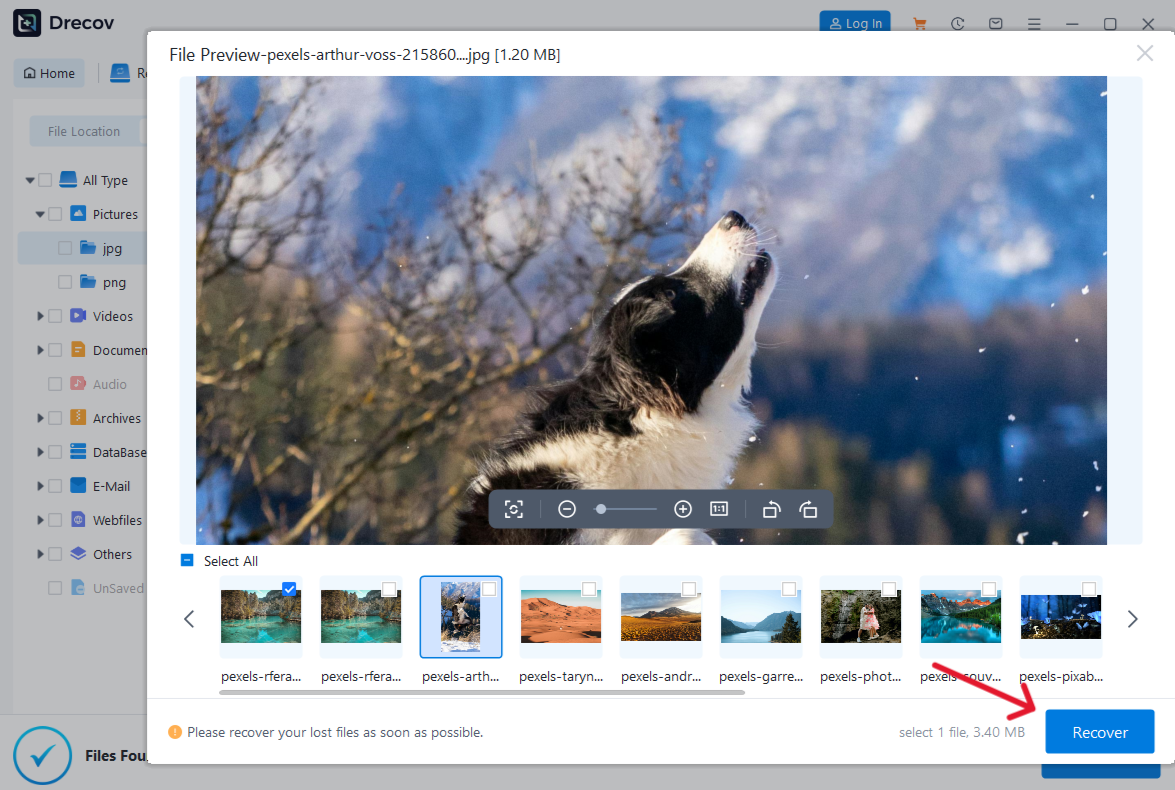
Filter for spreadsheet files and search the former path or name. Preview a representative candidate when supported. A preview may show content, but it cannot prove that every formula, external link, macro, or worksheet will function. Keep more than one plausible version if dates and sizes differ.
Step 4: Recover elsewhere and open the result in Excel
Save selected candidates to the healthy destination, never back to the source partition. If a result is not in the chosen output folder, inspect Drecov Folder or Recovery Folder. Open each recovered workbook in Excel and compare sheets, recent entries, formulas, and file dates with what you expected. Do not replace the working shared copy until the recovered candidate is verified. Recovery of a file does not guarantee that every internal workbook element survived an earlier overwrite or corruption.
⚠ Warning: Install it on a drive different from the one where your data was lost to prevent overwriting.
Conclusion
When Excel is slow but still responds, identify the action that waits and compare one workbook with a blank file before changing settings. Test formulas, used range, links, add-ins, and storage location on a duplicate, then verify both speed and results. Keep the original until the improved version proves reliable. Drecov belongs only to the separate case where a local workbook has actually gone missing: on a stable source, it can locate likely files, preview candidates, and recover them to another healthy drive. It does not accelerate Excel or repair a formula-heavy workbook.
⚠ Warning: Install it on a drive different from the one where your data was lost to prevent overwriting.