
A PC stuck on the startup screen is not one problem with one fix. The logo may belong to the computer maker, Windows, or a recovery tool, and each points to a different stage. Start by noting the last image that appears and whether the spinning dots move. Then try one controlled restart with nonessential external devices unplugged. If the same screen returns, avoid repeated force-offs or an immediate reset. Protect unique files before any repair that changes the system, particularly if the storage device has been slow, noisy, or unreliable.
Which startup screen is actually frozen?
Look at the screen without pressing anything for a moment. A manufacturer logo shown before any Windows dots suggests the computer has not completed firmware checks or has not handed control to Windows. A Windows logo with moving dots means the process has progressed further. A blue page with recovery choices is not a frozen startup logo at all; Windows has moved to its recovery environment. Write down the exact message or photograph it. Small differences here matter more than the broad description “won’t boot.”
Check for signs of progress rather than assuming the machine is frozen after an arbitrary minute count. During a major update, the display may pause while the drive remains active. An update label or changing percentage is a reason to let the current operation finish, especially on a laptop connected to power. There is no reliable universal wait time. By contrast, a screen that returns unchanged after a normal restart, with no update indication or disk activity, deserves troubleshooting. Do not keep holding the power button in a loop; interrupting an update repeatedly can make the next boot harder.
Can you open the firmware setup or boot menu? The key varies by manufacturer, so use the on-screen hint or the device manual rather than guessing commands. If the machine freezes even before that menu, this article’s Windows repair route is not yet applicable. Our separate page on a PC stuck at the motherboard screen focuses on the earlier POST stage. Here, the main question is why a PC that begins startup cannot complete it.
Remove only the simplest obstacles first
Shut the computer down once, using the normal control if available. Disconnect nonessential USB storage, memory cards, docks, and recently added accessories. Keep the power adapter, keyboard, and display connection needed to operate the PC. Then start it once and observe the same point as before. If the system now reaches sign-in, reconnect devices one at a time after making a backup. A removable drive placed first in the boot order can make the PC appear to stall even though the Windows disk is still healthy.
For a desktop with several internal drives, note any recent hardware or firmware change. Do not casually unplug internal cables while the machine is powered. If you know how to enter firmware setup, check whether the intended system drive is listed with a plausible model and capacity. This check is observational; it does not require changing SATA modes, Secure Boot, or the boot order. An absent drive, implausible capacity, clicking sound, or repeated disappearance is a stop signal for software repair. Repeated scans can stress an unstable device. Ask a qualified service about imaging or professional recovery instead.
If the drive is detected and the freeze follows the Windows logo, record whether the loading dots stop, whether the screen later changes to Automatic Repair, and whether you recently installed a driver or update. These observations help choose a targeted option. A driver changed immediately before the failure points toward Safe Mode or rollback; a missing boot manager has a separate answer. The guide to Windows Boot Manager missing applies only when that explicit error appears, not to every stalled logo.
Make a file plan before changing Windows
Before opening repair menus, check whether important local files are already backed up. Use another device to inspect cloud folders, an external backup, or a recent system image. Open representative documents and photos from that copy. A backup named “complete” is not enough if it predates yesterday’s project work. If all needed files are available, keep the backup disconnected while testing fixes. If unique files remain only on the affected PC, decide how to secure them before reset, reinstall, or partition work.
A stable system disk may be accessed from another functioning Windows computer if the hardware design and encryption settings permit it. Turn off the affected machine first and follow the manufacturer’s service instructions. Some devices have soldered storage, complex disassembly, or BitLocker protection, so moving the disk may not be practical. If a second computer asks to initialize or format the disk, cancel the prompt. That message does not mean the files are disposable. Do not install recovery software on the partition where files are missing.
Drecov is Windows data-recovery software for a stable, recognizable source. In this startup-screen situation, its purpose is to retrieve local files before a high-impact repair, not to make a PC boot. It can search a hard drive, SSD, external drive, USB device, or memory card using Quick Scan and, if necessary, Deep Scan. Filtering and preview help you identify useful documents, photos, and other supported files before saving them elsewhere. Lost Partition Recovery can help locate files on a lost partition, but it does not repair firmware, rebuild a boot sector, or fix a physically failing drive.
⚠ Warning: Install it on a drive different from the one where your data was lost to prevent overwriting.
Recover local files from the original system disk
Prepare another healthy drive with enough free space for the output. Install and run Drecov in the functioning Windows environment, not on the affected source partition. Confirm which connected drive came from the stalled PC by model, capacity, and its user-folder structure. Its letter may change when attached elsewhere. If the drive disconnects, clicks, or accumulates serious read errors, stop direct scans and seek imaging or specialist advice.
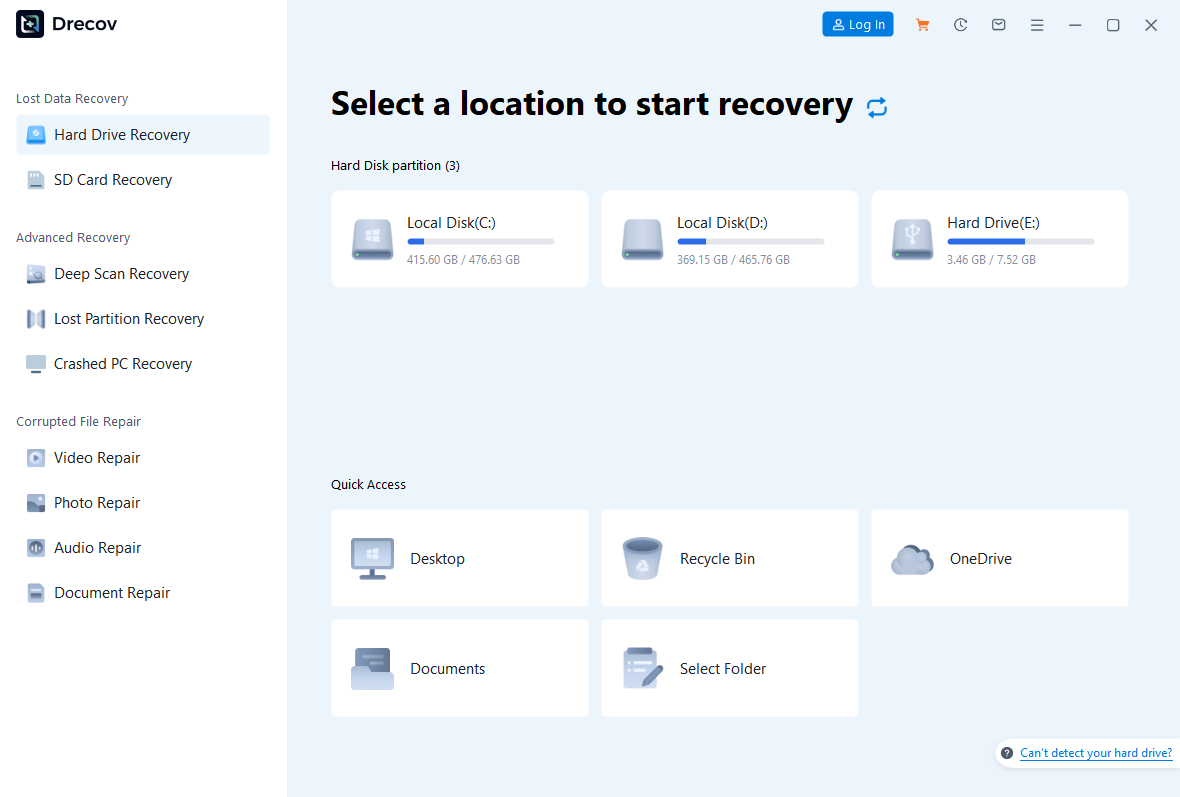
Step 1: Open Drecov and select the original file location
Launch Drecov and choose the old Windows partition or the relevant physical drive. Search the source that held the affected account’s Desktop, Documents, Pictures, and project folders. If the original partition is missing while the device remains stable and correctly identified, the Lost Partition Recovery mode may be relevant. Do not select your empty destination drive by mistake.
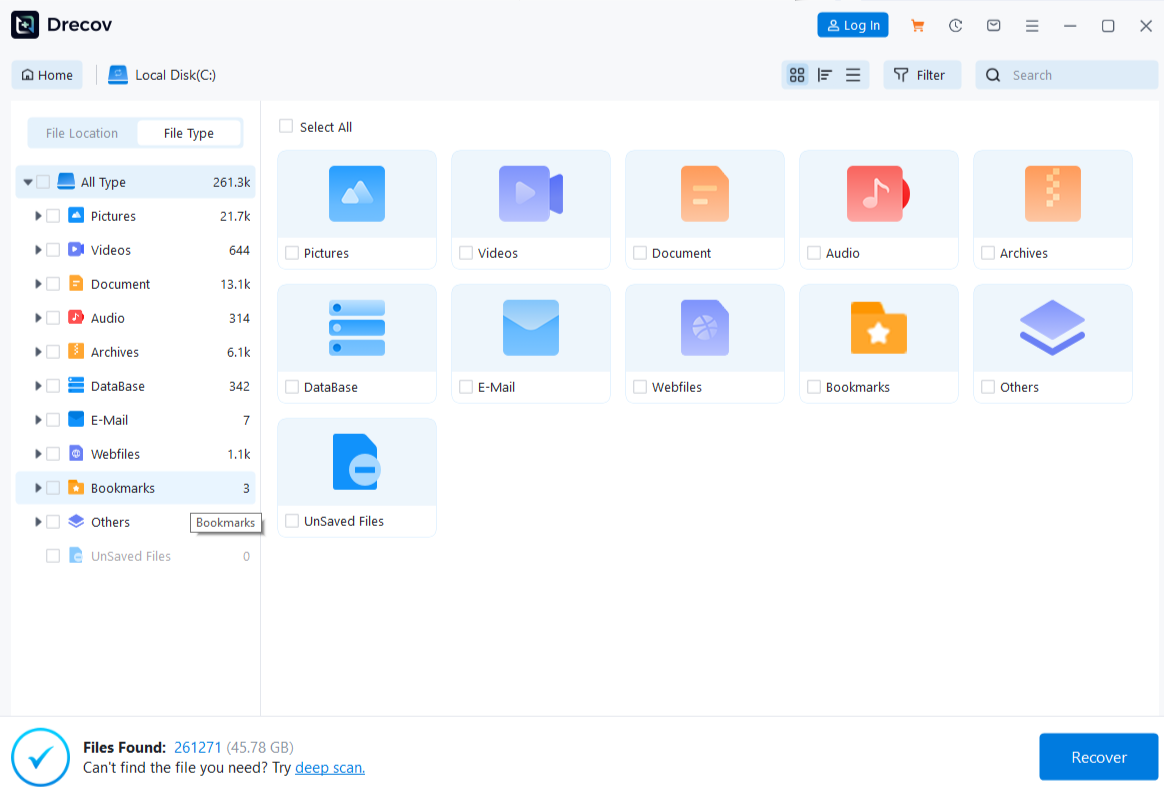
Step 2: Start Quick Scan and inspect what it finds
Run Quick Scan first. Browse the former user profile and look for a few important filenames. If the files are absent, note whether the source remains steadily connected. A successful scan of the wrong partition is not useful; recheck the source before escalating.
Step 3: Use Deep Scan only on stable media
Deep Scan can search more broadly when Quick Scan misses the target, provided the device is stable. Stop if a new clicking sound, repeated disconnect, wrong capacity, or severe read errors appear. Software cannot repair physical damage. The right next action may be an image or a recovery service, not another pass.
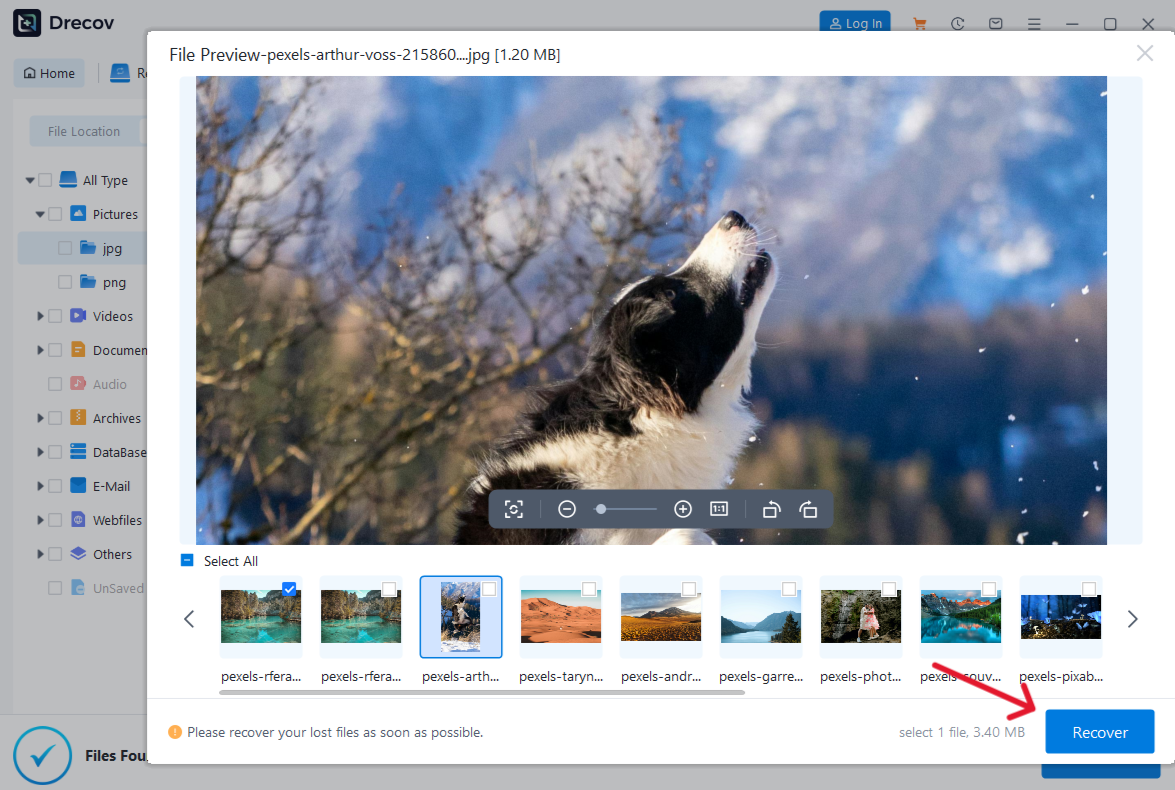
Step 4: Filter, locate, and preview the files you need
Use file type, name, and path filters to narrow the results. Preview representative supported files, particularly your newest documents and irreplaceable photos. A preview shows whether that sample is recognizable; it does not prove that every page or frame will be intact. Keep a short list of the most important files so you can verify them first.
Step 5: Save to another drive and verify the result
Recover selected files to the healthy destination, never back onto the original disk. If an expected output is not where you chose to save it, inspect the Drecov Folder or Recovery Folder for that result. Open several recovered files and compare their content, names, and dates with your records. Only after those checks should you consider a repair that writes to the original Windows installation. Keep the source untouched if recovery is incomplete or the drive’s condition worsens.
⚠ Warning: Install it on a drive different from the one where your data was lost to prevent overwriting.
Use Windows recovery options only after identifying the stage
If Windows reaches Automatic Repair, open Advanced options and note exactly which menu choices are available. Startup Repair is intended for certain startup issues. It may be reasonable on a stable disk after your files are protected, but it cannot address every driver, update, or hardware problem. Microsoft explains its purpose in the Startup Repair documentation. If it reports that it could not repair the PC, capture the message and use our focused article on Startup Repair failure rather than repeating the same attempt indefinitely.
A freeze that began just after a Windows update may call for Uninstall Updates in Advanced options. Choose the relevant recent quality update if the menu offers it. Read the confirmation before proceeding, and check the outcome once. A restore point from before a driver or software change is another possible route. System Restore changes system settings and can remove recently installed programs; it is not a substitute for copying personal files. If Windows reaches Safe Mode, remove or roll back the specific driver that preceded the problem rather than uninstalling unrelated devices.
These options depend on the PC actually reaching Windows Recovery Environment. If you cannot open it, do not jump straight to repartitioning or a clean installation. A Windows recovery USB created on another computer can provide a route to the repair menu, but using such media still requires selecting the correct disk and understanding which action writes to it. Reset this PC and reinstall belong after file protection. Even a keep-files reset can remove apps and settings, and a mistaken partition choice during setup can erase data.
Prove the fix survives another start
When Windows finally opens, sign in to the expected account. Check the actual Desktop and Documents folders, not just the wallpaper. A temporary or different profile can make the desktop look empty even though the original files remain elsewhere. Open a few documents and photos. Check the drive’s reported capacity and free space. If a recent update or driver was involved, examine its status before installing the same change again.
Make a current backup while the PC is accessible. Then shut down normally and start it again with only essential peripherals connected. A second clean startup matters because a one-time success may hide a recurring disk or driver fault. Reconnect one removed USB device at a time if that was part of the initial test. If the system freezes again at the same stage, retain your notes rather than stacking more repair commands. If Drecov retrieved files, leave them on the separate destination until the original PC has shown stable behavior.
Common questions about a stalled startup logo
Should I wait longer when the dots still move?
Moving dots or a changing update status show that work may still be in progress. Keep a laptop powered. There is no universal cutoff that proves failure. Repeated identical screens across normal restarts, especially without progress indicators, justify further diagnosis.
Is this the same as being stuck on the motherboard screen?
No. A freeze before firmware hands control to Windows may involve POST, device detection, or firmware configuration. A Windows logo with loading dots means startup has reached a later stage. Different evidence leads to different fixes.
Will resetting the PC preserve all my files?
Do not assume so from the option’s label. A reset changes the installation, may remove apps and settings, and is risky when the disk itself is unstable. Verify a usable backup of your own files before choosing it.
Can Drecov remove the frozen startup screen?
No. It retrieves files from stable, accessible storage when a suitable Windows environment is available. Use it to protect data before a repair, not as a firmware or boot repair utility.
Conclusion
A PC stuck on the startup screen needs a stage-specific response. Identify whether the machine stops before Windows, at the Windows logo, or in recovery; try one controlled restart with nonessential devices removed; and stop if the drive shows physical instability. Protect important files before reset or reinstall. On a stable source accessible from working Windows, Drecov can search the original location, preview likely files, and recover them to another healthy drive. Verify the recovered files and the PC’s next normal startup before considering the incident resolved.
⚠ Warning: Install it on a drive different from the one where your data was lost to prevent overwriting.