







Understanding MP4 File Recovery and Why It Matters
What Makes MP4 Files Important in Daily Life
MP4 is one of the most widely used video formats across computers, smartphones, cameras, drones, action cameras, and media players. People rely on MP4 files to store family videos, travel recordings, educational content, business presentations, security footage, and social media content.
Because MP4 files often contain valuable memories or important work materials, losing them can be frustrating. Unlike documents that may be recreated, a deleted video recording may be impossible to reproduce. Fortunately, modern recovery technologies make it possible to retrieve many lost MP4 videos under the right circumstances.
Whether videos disappear because of accidental deletion, formatting, file system corruption, or storage device failure, recovery may still be achievable if appropriate action is taken quickly.
Can Deleted MP4 Videos Be Recovered?
In many situations, yes.
When an MP4 file is deleted, the operating system usually removes the file reference rather than immediately erasing the video data itself. Until new data overwrites the storage space, recovery tools can often scan the drive and reconstruct the lost video.
Recovery success depends on several factors:
- Time elapsed since deletion
- Amount of new data written to the device
- Condition of the storage media
- Type of file system
- Recovery method used
⚠️Warning: Stop using the storage device immediately after discovering data loss. Continuing to save files may overwrite recoverable video data permanently.
Common Causes of MP4 Video Loss
Accidental Deletion and Human Error
Human mistakes remain one of the leading causes of video loss. Users may unintentionally remove files while organizing folders, clearing storage space, or deleting duplicate content.
Examples include:
- Pressing Shift + Delete on Windows
- Emptying the Recycle Bin
- Deleting videos from memory cards
- Removing files during file transfers
- Incorrect folder cleanup
Many users do not realize the importance of a video until after it has been removed.
Formatting of Storage Devices
Formatting is another common reason videos disappear.
Storage devices frequently affected include:
- SD cards
- MicroSD cards
- External hard drives
- USB flash drives
- SSDs
- Camera memory cards
Quick formatting often removes file indexes while leaving much of the original data intact. This creates opportunities for recovery using specialized tools.
File System Corruption
Unexpected system shutdowns, power interruptions, malware attacks, and unsafe device removal can damage file systems.
When corruption occurs, users may encounter:
- Missing video files
- RAW partitions
- Inaccessible drives
- Error messages requesting formatting
Although videos may seem lost, the actual data can remain present on the storage device.
Hardware and Software Failures
Physical or logical failures can also affect video storage.
Examples include:
- Bad sectors
- SSD controller failures
- Memory card errors
- Camera firmware issues
- Operating system crashes
The more severe the hardware damage, the more challenging the recovery process becomes.
Preparing for Successful MP4 Video Recovery
Stop Writing New Data Immediately
The first and most important step is preserving existing data.
When a file is deleted, its storage location becomes available for reuse. Any new downloads, installations, recordings, or file transfers may overwrite the lost video.
Recommended actions:
- Disconnect external storage devices
- Stop recording new videos
- Avoid software installations on the affected drive
- Create a backup image if possible
These precautions significantly improve recovery chances.
Identify the Type of Storage Device
Recovery procedures vary depending on the device involved.
Common storage media include:
| Device Type | Typical Recovery Difficulty |
|---|---|
| Hard Disk Drive (HDD) | Moderate |
| SSD | Higher due to TRIM |
| SD Card | Moderate |
| MicroSD Card | Moderate |
| USB Flash Drive | Moderate |
| Camera Storage | Moderate |
Knowing the device type helps determine the most suitable recovery strategy.
Check Available Backup Sources
Before using recovery software, investigate potential backups.
Possible locations include:
- Cloud storage services
- External backup drives
- NAS systems
- Camera backups
- Smartphone galleries
- Video editing project folders
Recovering from a backup is generally faster and safer than scanning a damaged storage device.
How Video Recovery Software Retrieves Lost MP4 Files
Deep Scan Technology Explained
Modern video recovery software performs storage analysis at multiple levels.
A deep scan examines:
- Deleted file records
- File allocation tables
- Raw storage sectors
- Fragmented video structures
- Hidden metadata
This approach allows software to locate videos even when directory information has been removed.
Signature-Based Video Recovery
Many recovery applications rely on file signatures.
Each MP4 file contains identifiable headers and structural information. Recovery tools search storage sectors for these patterns and reconstruct the video accordingly.
Benefits include:
- Recovery after formatting
- Recovery from corrupted partitions
- Recovery from RAW drives
- Support for damaged file systems
Signature scanning is especially useful when standard file records are no longer available.
Preview Functions Before Recovery
Advanced video file recovery software often provides preview capabilities.
Users can:
- Verify video integrity
- Confirm file relevance
- Filter scan results
- Recover only necessary files
This reduces recovery time and storage requirements.
⚠️Warning: Save recovered videos to a different drive. Writing recovered files back to the original device may overwrite additional recoverable data.
Method 1: Recover MP4 Videos Using PandaOffice Drecov
Test Environment
This recovery procedure was tested under the following conditions:
| Component | Configuration |
|---|---|
| Operating System | Windows 11 Pro |
| Storage Device | 128GB SD Card |
| Video Format | MP4 |
| Data Loss Scenario | Accidental Deletion |
| Scan Type | Deep Scan |
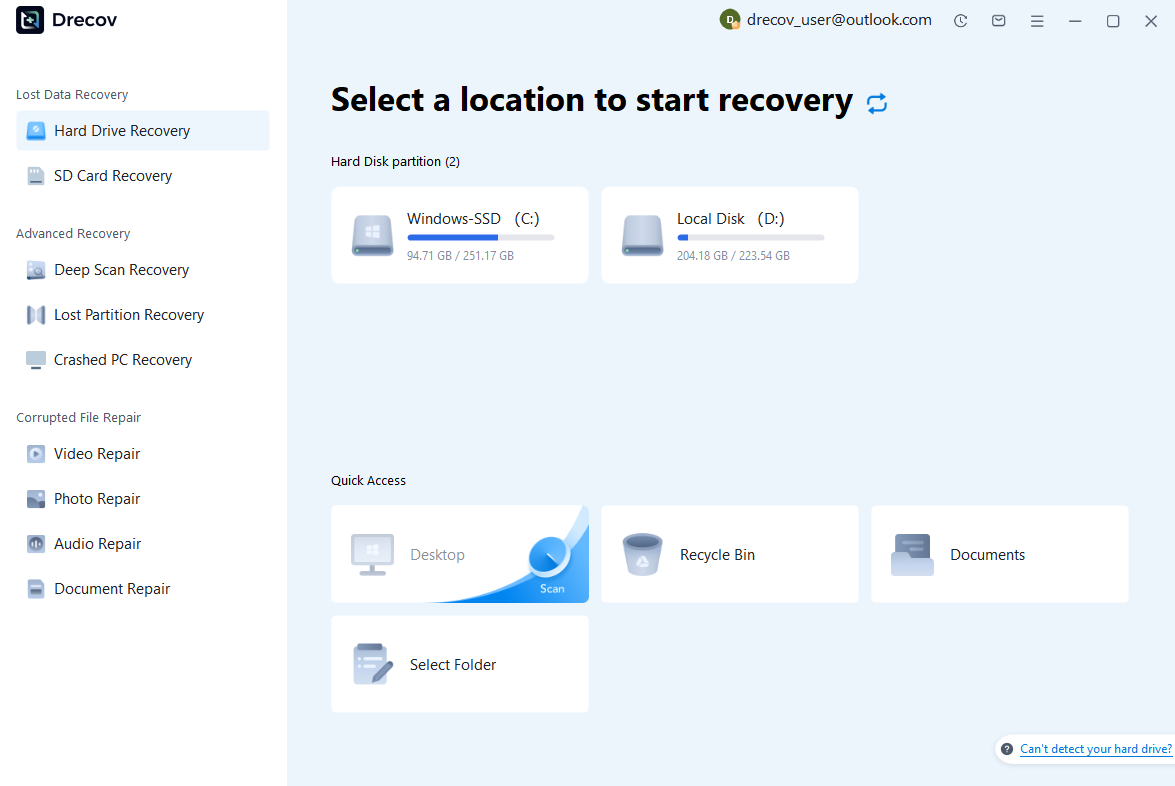
Step 1: Scan the Storage Device (SD Card / Hard Drive / USB)
Connect your device (SD card, HDD/SSD, or USB drive) to your computer and launch PandaOffice Drecov. Select the target device and start the scan. The software will perform a quick scan and deep scan to detect lost or deleted data.
Step 2: Locate and Preview Lost Files
After scanning, browse the detected files and use the preview feature to check recoverable data. You can preview documents (Word, Excel, PDF), photos, and videos to ensure file integrity before recovery.

Step 3: Recover and Save to a New Location
Select the files you want to restore and click recover. Save all recovered data to a different drive or location (not the original device) to avoid overwriting lost data.

Why Choose PandaOffice Drecov Recovery Software?
PandaOffice Drecov offers a fast, secure, and user-friendly solution for recovering lost files across multiple scenarios. Whether you need email recovery, ZIP File Recovery, format data recovery, or help to recover deleted drafts Outlook, the software provides reliable recovery performance for both personal and business users.
PandaOffice Drecov supports recovery from formatted hard drives, SSDs, USB drives, SD cards, and external storage devices. Its advanced scanning engine can locate deleted archives, damaged ZIP files, lost Outlook drafts, and accidentally removed documents with high accuracy. For users searching for how to find deleted messages in Teams, PandaOffice Drecov can also help recover exported chat files, attachments, and related local cache data when available.
Key advantages include:
- Deep scan technology for complex data loss situations
- Support for emails, archives, videos, photos, and office documents
- Recovery from accidental deletion, formatting, corruption, and system crashes
- Easy preview before restoring files
- Compatible with Windows and multiple storage devices
Unlike complicated enterprise recovery tools, PandaOffice Drecov keeps the recovery process simple. Users can scan, preview, and restore files in just a few steps without technical expertise.
Whether you are dealing with lost Outlook drafts, corrupted ZIP archives, formatted drives, or missing communication data, PandaOffice Drecov provides an efficient and practical recovery experience designed to minimize downtime and protect important files.
Disk imaging ensures that even partially corrupted drives can be preserved. This is often the safest approach before attempting any aggressive repair operations for fix bad sectors on hard drive situations.
Method 2: Restore MP4 Videos from the Recycle Bin
Test Environment
| Component | Configuration |
|---|---|
| Operating System | Windows 10 |
| Storage Device | Local HDD |
| Video Type | MP4 |
| Data Loss Scenario | Standard Deletion |
When This Method Works
Files deleted through standard Windows operations are often moved to the Recycle Bin.
Recovery is possible when:
- The bin has not been emptied
- Files were not permanently deleted
- Storage quotas have not been exceeded
This method is the simplest recovery option available.
Steps to Restore Deleted MP4 Files
1: Open the Recycle Bin from the desktop.
2: Search for the missing MP4 file.
Use sorting and search functions if many files are present.
3: Select the desired video.
Multiple videos can be restored simultaneously.
4: Right-click the selection.
Choose Restore.
5: Verify restoration.
Windows returns the file to its original location automatically.
This method requires no additional software and preserves original file attributes.
Method 3: Recover MP4 Videos from Backup History
Test Environment
| Component | Configuration |
|---|---|
| Operating System | Windows 11 |
| Backup Feature | File History |
| File Type | MP4 |
| Data Loss Scenario | Accidental Deletion |
When Backup Recovery Is Appropriate
If File History or another backup solution was enabled before data loss occurred, restoring videos may be quick and reliable.
Backup recovery offers several advantages:
- Original quality preservation
- Fast restoration
- Minimal risk
- No disk scanning required
Organizations and professional creators frequently rely on backup-based recovery because it avoids uncertainty.
Steps to Restore Videos Through File History
1: Open Control Panel.
2: Navigate to File History.
3: Select “Restore Personal Files.”
4: Browse available backup versions.
Locate the folder that previously contained the MP4 video.
5: Choose the desired version.
Review timestamps carefully.
6: Click Restore.
Windows copies the selected file back to its original location.
Backup-based recovery remains one of the safest methods whenever a valid backup exists.
Method 4: Recover MP4 Files from Cloud Storage Services
Test Environment
| Component | Configuration |
|---|---|
| Operating System | Windows 11 |
| Cloud Platform | OneDrive |
| File Type | MP4 |
| Data Loss Scenario | Accidental Deletion |
Why Cloud Recovery Can Be Effective
Many users automatically sync videos to cloud storage platforms. Even if a local copy is deleted, cloud services often retain deleted files for a specific period before permanent removal.
Common platforms that may contain recoverable videos include:
- OneDrive
- Google Drive
- Dropbox
- iCloud
- NAS cloud systems
Cloud storage can sometimes provide multiple versions of the same file, making recovery easier.
Steps to Recover Videos from Cloud Storage
1: Log in to your cloud account.
2: Open the Deleted Files or Trash section.
3: Search for the missing MP4 file.
4: Select the video you want to restore.
5: Click the Restore option.
6: Wait for synchronization to complete.
After restoration, verify that the recovered video plays correctly.
⚠️ Warning: Many cloud providers permanently delete files after a retention period. Check cloud backups as soon as possible after discovering data loss.
Method 5: Recover MP4 Videos After Formatting a Drive
Test Environment
| Component | Configuration |
|---|---|
| Operating System | Windows 10 |
| Storage Device | 256GB USB Drive |
| File Type | MP4 |
| Data Loss Scenario | Quick Format |
Can Formatted Videos Be Recovered?
A quick format generally removes file system records while leaving underlying video data intact. Because of this, many formatted drives still contain recoverable MP4 files.
Recovery success depends on:
- Whether a quick or full format was performed
- Amount of new data written afterward
- Storage device condition
- Fragmentation level of the original video
The sooner recovery begins, the better the chances of retrieving complete videos.
Recovery Procedure After Formatting
1: Disconnect the formatted device immediately.
2: Avoid copying any new files onto the drive.
3: Connect the device to a stable computer.
4: Use a recovery solution capable of deep sector scanning.
5: Scan the entire storage device.
6: Preview discovered MP4 files.
7: Save recovered videos to another drive.
Many users are surprised to discover that videos remain recoverable even after accidental formatting.
Method 6: Recover Videos from RAW Drives
Test Environment
| Component | Configuration |
|---|---|
| Operating System | Windows 11 |
| Drive Status | RAW Partition |
| File Type | MP4 |
| Data Loss Scenario | File System Corruption |
Understanding RAW Storage Devices
A RAW drive is a storage device whose file system can no longer be recognized by the operating system.
Common symptoms include:
- “You need to format the disk before using it”
- Drive appears inaccessible
- Missing folders and files
- File system reported as RAW
Although Windows may not recognize the partition structure, the actual video data may still exist.
Recovery Process for RAW Drives
1: Do not format the drive.
Formatting may complicate recovery efforts.
2: Connect the drive to a reliable system.
3: Run a deep scan of the entire device.
4: Locate recoverable MP4 files.
5: Preview available videos.
6: Recover files to another storage location.
After successful recovery, users can safely reformat the affected drive if needed.
⚠️ Warning: Never perform repair operations directly on a RAW drive before recovering important files.
Fixing Corrupted MP4 Files After Recovery
Why Recovered Videos Sometimes Fail to Play
Recovering a file does not always guarantee immediate playback.
Certain videos may remain corrupted because:
- Parts of the file were overwritten
- Storage sectors were damaged
- Video headers became corrupted
- Transfer interruptions occurred
- Recording devices shut down unexpectedly
Fortunately, some corruption issues can be repaired.
Repairing Video Headers
MP4 files rely on header information that tells media players how to interpret video and audio streams.
If header information is damaged:
- Videos may not open
- Playback may freeze
- Audio may disappear
- Duration may display incorrectly
Repair utilities can often rebuild missing metadata and restore normal playback functionality.
Using Alternative Media Players
Before assuming a file is permanently damaged, test it with multiple players.
Examples include:
- VLC Media Player
- MPC-HC
- PotPlayer
- Windows Media Player
Different players use different decoding methods and may successfully open partially damaged files.
Convert the MP4 File to Another Format
In some situations, converting the recovered file can rebuild damaged structures.
Possible conversion targets include:
- MOV
- AVI
- MKV
Conversion software may repair minor inconsistencies during processing.
Best Practices to Improve Video Recovery Success
Act Quickly After Data Loss
Time is one of the most important recovery factors.
The longer a storage device remains in active use, the greater the likelihood that deleted sectors will be overwritten.
Recommended actions include:
- Stop recording new videos
- Stop downloading files
- Disconnect removable storage
- Begin recovery immediately
Quick action often results in significantly higher recovery rates.
Create a Drive Image Before Recovery
Professional recovery specialists frequently create a sector-by-sector image before performing recovery operations.
Benefits include:
- Protection against accidental damage
- Preservation of original evidence
- Ability to perform multiple recovery attempts
- Reduced stress on failing hardware
This practice is especially valuable when working with damaged drives.
Keep Storage Devices Healthy
Preventive maintenance reduces future data loss risks.
Good habits include:
- Safely eject removable drives
- Use reliable power sources
- Scan for malware regularly
- Monitor drive health
- Replace aging storage devices
Proper maintenance can extend device lifespan and protect valuable videos.
How to Prevent MP4 Video Loss in the Future
Maintain Multiple Backups
The most effective protection strategy follows the 3-2-1 backup rule.
Store:
- Three copies of important files
- On two different storage media
- With one copy stored offsite
This approach minimizes the impact of hardware failures and accidental deletions.
Enable Automatic Cloud Synchronization
Cloud synchronization provides continuous protection.
Benefits include:
- Automatic uploads
- Version history
- Remote access
- Disaster recovery
Many creators and businesses rely on cloud backups as part of their overall data protection strategy.
Regularly Verify Backup Integrity
A backup is useful only if it works.
Periodic testing helps ensure:
- Files remain accessible
- Videos play correctly
- Storage devices remain healthy
- Recovery procedures function as expected
Verification should become a routine maintenance task.
Use Reliable Storage Media
Low-quality storage devices often fail prematurely.
When selecting storage hardware, consider:
- Manufacturer reputation
- Warranty coverage
- Endurance ratings
- Professional reviews
Investing in quality storage can prevent significant future losses.
⚠️ Warning: Never store your only copy of important videos on a single device.
Frequently Asked Questions About MP4 File Recovery
Can Permanently Deleted MP4 Files Be Recovered?
Yes, in many cases permanently deleted videos remain recoverable until new data overwrites their storage sectors. Recovery success varies depending on device usage after deletion.
Does SSD Recovery Work the Same as HDD Recovery?
No. SSDs often use TRIM technology, which may erase deleted data more quickly than traditional hard drives. This can reduce recovery success rates.
Can I Recover Videos from a Damaged SD Card?
If the SD card remains detectable by the computer, recovery is often possible. Severe physical damage may require professional recovery services.
Is Free Recovery Software Effective?
Some free video recovery software tools can successfully recover recently deleted files. However, advanced recovery scenarios involving formatted drives, RAW partitions, or severe corruption may require more capable solutions.
What Is the Difference Between Video Recovery Software and Video File Repair Software?
Video recovery software retrieves missing files from storage devices. Repair software focuses on fixing damaged videos that already exist but cannot play correctly.
Can Recovery Software Restore Original Video Quality?
Yes. If the entire file is successfully recovered, the restored video should maintain its original resolution, bitrate, and quality.
Is There Reliable Video Recovery Software Free of Charge?
Several video recovery software free options are available for basic recovery tasks. Their effectiveness depends on the complexity of the data-loss situation and the amount of recoverable data.
Conclusion
Losing valuable MP4 videos does not always mean they are gone forever. Whether files disappear because of accidental deletion, formatting, corruption, RAW partitions, or storage device failures, recovery opportunities often remain available.
The most important factors influencing success are acting quickly, preventing overwriting, and selecting the appropriate recovery method for the situation. Recovery options range from checking the Recycle Bin and cloud backups to using specialized video data recovery software capable of scanning deleted sectors and reconstructing lost files.
For users facing more challenging scenarios such as formatted drives or damaged partitions, professional-grade video file recovery software can significantly improve recovery chances. Meanwhile, maintaining backups, monitoring storage health, and following preventive practices can reduce the risk of future video loss.
Whether you choose a professional video recovery software solution or start with free video recovery software, taking immediate action gives you the best opportunity to restore important MP4 files and preserve valuable memories, projects, and recordings.






