







Microsoft Outlook is one of the most widely used email platforms for personal and business communication. Because it stores emails, calendars, contacts, tasks, and archived information in a structured folder system, losing access to a folder can quickly become a major problem. Many users search for solutions after discovering lost outlook folders, missing archives, or email folders that suddenly disappear from the navigation pane.
In some situations, the folder has not actually been deleted. Instead, it may have been moved accidentally, hidden because of a view setting, or become unavailable due to synchronization problems. Users often assume that a lost outlook folder has been permanently removed when it is still present somewhere within the mailbox structure.
The good news is that Outlook provides several built-in tools that can help locate missing folders. Additionally, Outlook data files such as OST and PST files may contain recoverable information even when folders no longer appear in the interface.
This guide explains the most common causes of missing Outlook folders, shows how to locate them using Outlook’s built-in features, and provides practical recovery methods for situations involving synchronization errors, corrupted profiles, and damaged data files.
Why Outlook Folders Suddenly Disappear
How Outlook Organizes Folders and Mail Data
Outlook uses a hierarchical folder structure to organize email accounts and stored information. Each mailbox contains system folders such as Inbox, Sent Items, Deleted Items, and Drafts. Users can also create custom folders and subfolders to organize messages more efficiently.
Depending on the account type, Outlook stores mailbox data locally or synchronizes it with a mail server. Exchange, Microsoft 365, and IMAP accounts typically use OST files for offline access, while POP accounts often rely on PST files.
Because Outlook continuously synchronizes information between local storage and remote servers, folders can sometimes appear to disappear even though the underlying data still exists. This commonly occurs after synchronization interruptions, mailbox migrations, software updates, or profile changes.
Users trying to find lost outlook folder entries often discover that the folder was moved to another mailbox level rather than deleted entirely. Understanding Outlook’s storage structure is the first step toward successful recovery.
Common Signs of a Lost Outlook Folder
A missing folder can manifest in several different ways depending on the underlying cause.
Some users notice that an entire folder disappears from the navigation pane. Others discover that a folder remains visible but appears empty. In certain situations, Outlook may display synchronization warnings while mailbox contents become inaccessible.
Common symptoms include:
- Missing custom folders
- Empty archive folders
- Disappearing subfolders
- Incomplete mailbox structures
- Synchronization errors
- Missing email categories
- Inaccessible folder paths
Users searching for outlook find lost folder solutions frequently report that the problem occurs immediately after dragging emails between folders or reorganizing mailbox content.
In other cases, Outlook updates or account reconfigurations may trigger unexpected changes in folder visibility. Since multiple factors can produce similar symptoms, identifying the specific behavior is important before attempting recovery.
When Missing Folders Affect Email Productivity
For many organizations, Outlook serves as a central repository for years of communication history. Missing folders can interrupt workflows, delay projects, and create compliance concerns.
Archived project information, client correspondence, financial records, and legal documentation are often stored within custom Outlook folders. When these folders disappear unexpectedly, employees may lose immediate access to critical information.
A folder lost in outlook can also create confusion because users often continue receiving new messages while older communications remain inaccessible. This can lead to duplicate work, incomplete records, and missed deadlines.
⚠️ Warning: Avoid creating replacement folders immediately after discovering missing data. Doing so may complicate recovery efforts and make it harder to identify the original folder structure.
Understanding the business impact of missing folders reinforces the importance of following systematic recovery procedures rather than making random changes to mailbox settings.
What Causes Lost Outlook Folders in Outlook
Accidental Folder Movement or Drag-and-Drop Errors
One of the most common reasons for missing Outlook folders is accidental movement. Outlook allows users to drag folders between mailbox locations, making it surprisingly easy to move a folder without realizing it.
A slight mouse movement during mailbox management can relocate a folder into another folder or archive location. Because Outlook supports deeply nested folder structures, the relocated folder may become difficult to locate afterward.
This issue frequently occurs when:
- Reorganizing mailbox content
- Moving emails between folders
- Cleaning up archive folders
- Managing multiple email accounts
- Using touchpads or sensitive mice
Many users searching for how to find a lost folder in outlook eventually discover that the folder still exists but has been moved into a parent folder several levels deep.
Fortunately, Outlook includes search and navigation tools that can help locate misplaced folders without requiring data recovery software.
Not every missing folder is actually missing. Sometimes Outlook’s display settings prevent folders from appearing correctly.
The Navigation Pane controls how folders are displayed. If settings become corrupted or modified accidentally, folders may disappear from view while remaining intact within the mailbox.
Potential causes include:
- Collapsed folder groups
- Hidden mailbox sections
- Customized view settings
- Outlook profile changes
- Navigation Pane corruption
A user investigating a lost outlook folder may incorrectly assume data loss has occurred when the problem is simply related to display configuration.
Resetting folder views often restores visibility immediately. Because this process is relatively safe and easy to perform, it is one of the first troubleshooting steps worth attempting.
Synchronization Issues Between OST Files and Mail Servers
Modern Outlook accounts rely heavily on synchronization between local data files and remote servers. When synchronization fails, folders may temporarily disappear or display incomplete information.
Common synchronization issues include:
- Unstable internet connections
- Server maintenance
- Account authentication problems
- Mailbox size limitations
- Exchange server interruptions
In these situations, Outlook may show outdated folder structures until synchronization resumes successfully.
Users frequently search for how can i find a lost folder in outlook after noticing that mailbox content differs between Outlook Desktop, Outlook Web, and mobile devices. Such discrepancies often indicate synchronization-related problems rather than permanent data loss.
Understanding how Outlook synchronizes mailbox content helps users distinguish between server issues and actual folder deletion.
Archive Configuration and Missing Archive Folders
Archive folders play an important role in long-term email management. Outlook can automatically move older messages into archive locations based on retention settings.
However, archive configurations occasionally create confusion when folders appear to vanish unexpectedly.
Common archive-related scenarios include:
- AutoArchive moving messages automatically
- Archive PST files becoming disconnected
- Archived folders being hidden
- Mailbox retention policies changing
- Manual archive operations
Many users report a lost archive folder in outlook after modifying account settings or moving data files between computers.
Because archive folders often contain years of email history, locating them quickly becomes a priority. Understanding how Outlook manages archive data can significantly simplify the recovery process.
⚠️ Warning: Do not delete archive data files unless you have verified that backups exist. Archived messages may not be recoverable through server synchronization.
Corrupted Outlook Profiles or Data Files
Outlook profiles store account settings, mailbox configurations, and synchronization information. If a profile becomes corrupted, folders may disappear or display incorrect information.
Similarly, OST and PST files can develop errors due to:
- Improper shutdowns
- Storage device failures
- Malware infections
- Software crashes
- Synchronization interruptions
When corruption occurs, Outlook may struggle to access mailbox structures correctly.
Users asking how do i find a lost folder in outlook often discover that the folder itself still exists within the data file, but Outlook can no longer display it properly.
Profile repair and data-file recovery techniques may be necessary in these situations, especially when standard troubleshooting methods fail.
How to Find a Lost Folder in Outlook
Method 1: Search for the Missing Folder Using Outlook Search
Outlook includes a powerful search feature that can help locate folders that have been moved accidentally.
Rather than manually expanding every folder, users can search for emails known to reside within the missing folder and then trace the folder path.
Test Environment
- Microsoft Outlook 365
- Windows 11 Pro
- Exchange Online Account
- Cached Exchange Mode Enabled
Steps:
- Open Outlook.
- Click the Search box.
- Search for a known email stored in the missing folder.
- Open the message from search results.
- Review the folder location displayed within Outlook.
- Navigate to the folder path shown.
This method is particularly effective when attempting to find lost outlook folder structures that were accidentally moved rather than deleted.
Because Outlook indexes mailbox content, searches can often reveal the location of folders that are no longer immediately visible within the navigation pane.
The Folder List provides a complete view of mailbox content and often reveals folders hidden within the standard Mail view.
Test Environment
- Outlook 2021
- Microsoft 365 Mailbox
- Windows 10 and Windows 11
Steps:
- Open Outlook.
- Select the Folder List view.
- Expand all mailbox levels.
- Review subfolders carefully.
- Look for recently moved folders.
- Restore the folder to its preferred location if necessary.
Many users looking for how to find lost outlook folder entries discover the folder immediately after switching to Folder List view.
This method is particularly useful when folders have been nested inside other folders accidentally. Because Folder List displays the complete mailbox hierarchy, hidden folder paths become much easier to identify.
Method 3: Recover a Folder Moved to Another Location
If the folder was relocated accidentally, Outlook usually allows it to be restored through simple drag-and-drop operations.
Test Environment
- Outlook Desktop Application
- Exchange Account
- Cached Mailbox Mode
Steps:
- Locate the misplaced folder.
- Right-click the folder.
- Select Move Folder if available.
- Choose the desired destination.
- Confirm the move operation.
- Verify folder visibility.
This approach is especially useful when users encounter a folder lost in outlook after reorganizing mailbox content.
Instead of recreating the folder manually, restoring the original folder preserves existing emails, permissions, categories, and organizational structure.
The next section will continue with additional recovery methods, OST file location guidance, advanced troubleshooting, and recovery options involving PandaOffice Drecov.
Method 4: Reset Outlook Folder View Settings
Sometimes a missing folder is not actually deleted or moved. Instead, Outlook’s view settings may prevent the folder from appearing correctly. Customized folder views, navigation pane errors, or corrupted display configurations can make users believe they have lost outlook folders when the folders still exist.
Resetting Outlook’s folder view settings is a safe troubleshooting step that restores default display behavior without affecting email content.
Test Environment
- Microsoft Outlook 365
- Windows 11 Pro
- Exchange Online Mailbox
- Outlook Cached Mode Enabled
Steps:
- Close Outlook completely.
- Press Windows + R to open the Run dialog.
- Type:
outlook.exe /resetnavpane - Press Enter.
- Wait for Outlook to restart.
- Review the folder structure again.
This command rebuilds the Navigation Pane configuration and often resolves visibility problems caused by corrupted settings.
Many users searching for how to find lost folder in outlook discover that their folders immediately reappear after resetting the navigation pane.
⚠️ Warning: If Outlook is connected to multiple mailboxes, allow synchronization to finish before assuming folders remain missing.
Method 5: Find Lost Outlook Folder Through Outlook Web App
A useful way to determine whether the problem is local or server-related is to access the mailbox through Outlook Web App (OWA).
Because Outlook Web App loads mailbox information directly from Microsoft’s servers, it bypasses local Outlook configuration problems.
Test Environment
- Microsoft 365 Business Account
- Outlook Desktop
- Outlook Web App
- Stable Internet Connection
Steps:
- Open a web browser.
- Sign in to Outlook Web App.
- Expand the complete folder tree.
- Search for the missing folder.
- Compare folder visibility with Outlook Desktop.
- Record any differences.
If the folder appears in Outlook Web but not in Outlook Desktop, the issue likely involves local synchronization, profile corruption, or OST-related problems.
Users researching how can i find a lost folder in outlook often overlook this simple diagnostic step. Yet it can quickly determine whether mailbox data still exists on the server.
When the folder appears in OWA, recovery is usually much easier because the underlying data remains intact.
Method 6: Locate and Verify the OST File
When Outlook operates in Cached Exchange Mode, it stores mailbox data in an Offline Storage Table (OST) file. Understanding the ost outlook file location is important because synchronization problems and corruption frequently involve this file.
Many users ask, where is the outlook ost file located, especially when troubleshooting missing folders.
Typical OST file locations include:
Windows 11 / Windows 10
C:\Users\Username\AppData\Local\Microsoft\Outlook
Test Environment
- Outlook 365
- Windows 11
- Exchange Online Account
Steps:
- Close Outlook.
- Open File Explorer.
- Navigate to the Outlook data directory.
- Locate the OST file associated with the account.
- Verify file size and modification date.
- Reopen Outlook and allow synchronization.
Checking the ost outlook file location helps identify whether Outlook is using the correct data file. An outdated or improperly synchronized OST file can contribute to missing folders and mailbox inconsistencies.
If the OST file appears unusually small or has not updated recently, synchronization issues may be affecting folder visibility.
Method 7: Repair Outlook Data File Issues
Corruption within Outlook data files can prevent folders from displaying correctly. When standard troubleshooting fails, repairing mailbox data may restore access to missing folders.
Microsoft includes a built-in Inbox Repair Tool, commonly known as ScanPST, which can detect and repair certain mailbox errors.
Test Environment
- Outlook 2021
- PST Archive File
- Windows 11 Desktop
Steps:
- Close Outlook.
- Locate the Inbox Repair Tool.
- Select the affected PST file.
- Start the scan.
- Review detected errors.
- Perform the repair process.
- Launch Outlook and verify folder availability.
For Exchange and Microsoft 365 accounts, creating a fresh OST file can also resolve corruption-related synchronization problems.
Users investigating a lost outlook folder caused by data-file damage frequently recover mailbox access after completing repair operations.
While ScanPST is not a guaranteed solution for every corruption scenario, it remains one of the most effective built-in repair utilities available for Outlook.
Method 8: Recover Lost Outlook Data with PandaOffice Drecov
If Outlook folders remain inaccessible after profile repairs and synchronization troubleshooting, data recovery may be necessary. This is especially true when PST files become damaged, deleted, or inaccessible due to storage device issues.
PandaOffice Drecov can help recover Outlook-related files that have been lost because of accidental deletion, drive formatting, partition issues, or unexpected system failures.
Test Environment
- Windows 11
- Deleted PST File Scenario
- Outlook 365
- SSD Storage Device
Steps:
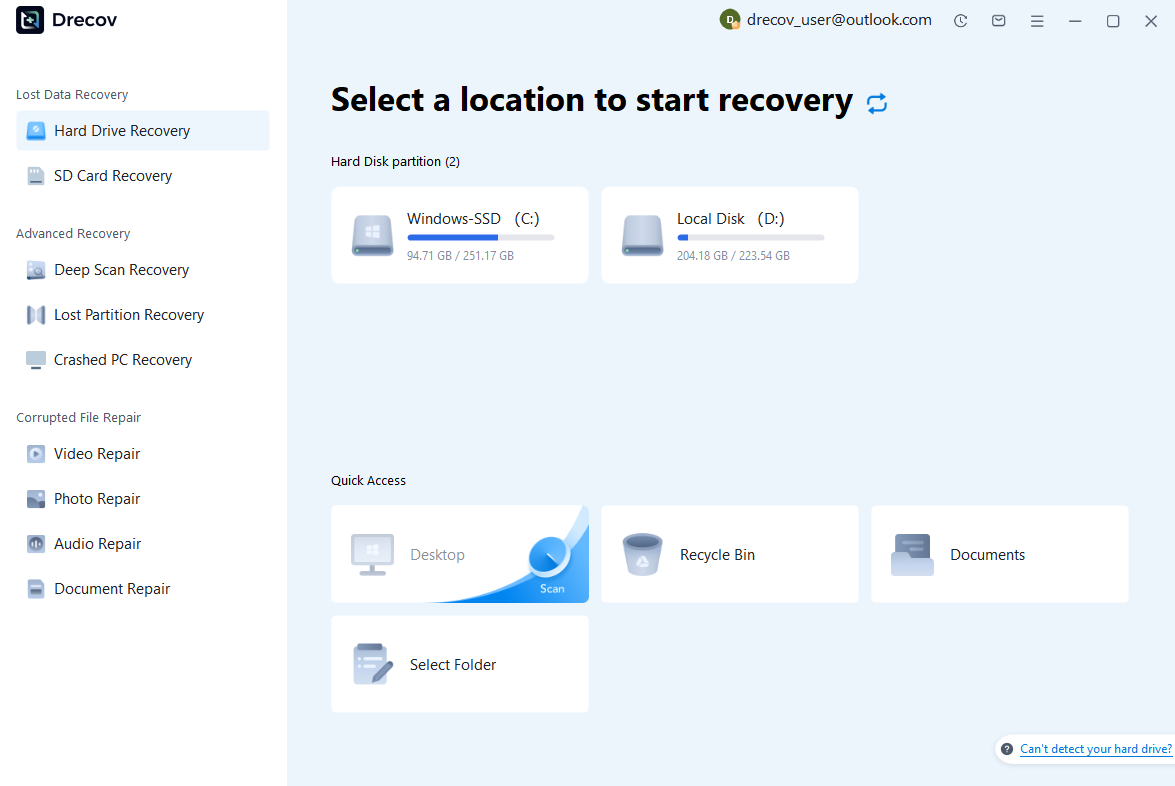
Step 1: Scan the Storage Device (SD Card / Hard Drive / USB)
Connect your device (SD card, HDD/SSD, or USB drive) to your computer and launch PandaOffice Drecov. Select the target device and start the scan. The software will perform a quick scan and deep scan to detect lost or deleted data.
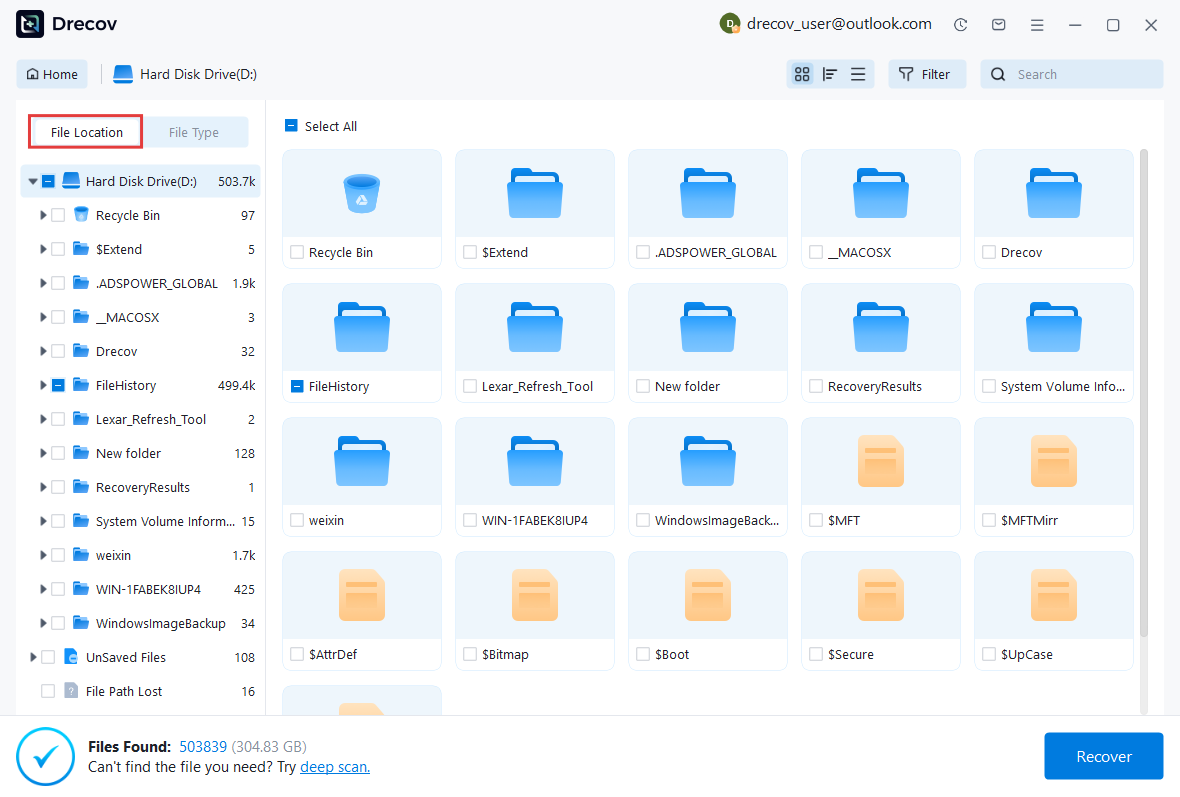
Step 2: Locate and Preview Lost Files
After scanning, browse the detected files and use the preview feature to check recoverable data. You can preview documents (Word, Excel, PDF), photos, and videos to ensure file integrity before recovery.
Step 3: Recover and Save to a New Location
Select the files you want to restore and click recover. Save all recovered data to a different drive or location (not the original device) to avoid overwriting lost data.

Why Choose PandaOffice Drecov Recovery Software?
PandaOffice Drecov offers a fast, secure, and user-friendly solution for recovering lost files across multiple scenarios. Whether you need email recovery, ZIP File Recovery, format data recovery, or help to recover deleted drafts Outlook, the software provides reliable recovery performance for both personal and business users.
PandaOffice Drecov supports recovery from formatted hard drives, SSDs, USB drives, SD cards, and external storage devices. Its advanced scanning engine can locate deleted archives, damaged ZIP files, lost Outlook drafts, and accidentally removed documents with high accuracy. For users searching for how to find deleted messages in Teams, PandaOffice Drecov can also help recover exported chat files, attachments, and related local cache data when available.
Key advantages include:
- Deep scan technology for complex data loss situations
- Support for emails, archives, videos, photos, and office documents
- Recovery from accidental deletion, formatting, corruption, and system crashes
- Easy preview before restoring files
- Compatible with Windows and multiple storage devices
Unlike complicated enterprise recovery tools, PandaOffice Drecov keeps the recovery process simple. Users can scan, preview, and restore files in just a few steps without technical expertise.
Whether you are dealing with lost Outlook drafts, corrupted ZIP archives, formatted drives, or missing communication data, PandaOffice Drecov provides an efficient and practical recovery experience designed to minimize downtime and protect important files.
Understanding OST Files and Outlook Data Storage
What Is an OST File and Why It Matters
An OST file allows Outlook users to work with mailbox content even when disconnected from the internet. It acts as a synchronized offline copy of server-based mailbox data.
Benefits of OST files include:
- Offline email access
- Faster mailbox performance
- Local caching of folders
- Improved synchronization efficiency
When Outlook reconnects to the server, changes made offline synchronize automatically.
Because Outlook relies heavily on OST files, corruption or synchronization issues can create situations where users believe they have lost outlook folders even though the information still exists on the mail server.
Understanding the role of OST files helps explain why mailbox content may appear differently across devices.
Where Is the Outlook OST File Located
Many users search for where is the outlook ost file located when troubleshooting synchronization issues.
Although file paths may vary slightly, Outlook typically stores OST files in the following location:
C:\Users\Username\AppData\Local\Microsoft\Outlook
This directory contains locally cached mailbox data for Exchange, Microsoft 365, and IMAP accounts.
Knowing where is the outlook ost file located can assist with:
- Backup verification
- Troubleshooting synchronization problems
- Identifying outdated data files
- Rebuilding local mailbox caches
If Outlook creates multiple OST files, verifying which file belongs to the affected account becomes especially important.
How to Access the OST Outlook File Location Safely
Accessing the ost outlook file location requires care because modifying Outlook data files improperly can create additional issues.
Best practices include:
- Close Outlook before accessing files.
- Avoid editing OST files directly.
- Create backups before troubleshooting.
- Verify account associations carefully.
- Use trusted recovery tools when necessary.
Users attempting to repair synchronization problems often focus exclusively on Outlook settings while overlooking the actual data files responsible for mailbox storage.
Reviewing the ost outlook file location can reveal whether Outlook is using outdated, damaged, or duplicated data files.
⚠️ Warning: Never delete an OST file unless you understand how Outlook will rebuild it and have verified that mailbox data exists on the server.
When OST File Corruption Causes Missing Folders
OST corruption is one of the more serious causes of missing Outlook content. Unlike simple display issues, corruption can interfere with Outlook’s ability to access mailbox structures correctly.
Potential causes include:
- Sudden power failures
- System crashes
- Storage device errors
- Malware activity
- Interrupted synchronization
Common symptoms include:
- Missing folders
- Empty mailbox sections
- Synchronization failures
- Search indexing problems
- Frequent Outlook crashes
When corruption occurs, Outlook may display incomplete folder structures even though data remains available elsewhere.
Diagnosing OST corruption early can prevent additional synchronization problems and reduce the likelihood of long-term mailbox issues.
Frequently Asked Questions About Lost Outlook Folders
How Can I Find a Lost Folder in Outlook Quickly?
The fastest method is usually searching for an email known to exist inside the missing folder. Opening the message often reveals the current folder location.
Why Is a Folder Lost in Outlook After Synchronization?
Synchronization conflicts, connection interruptions, mailbox policy changes, and OST corruption can all affect folder visibility after Outlook synchronizes with the mail server.
How Do I Find a Lost Folder in Outlook Desktop App?
Use Folder List view, Outlook Search, and Outlook Web App comparisons to identify whether the folder was moved, hidden, or affected by synchronization issues.
What Should I Do If My Lost Archive Folder in Outlook Cannot Be Found?
Check archive settings, verify connected PST files, review AutoArchive configurations, and inspect backup locations before assuming the archive has been permanently deleted.
Final Tips to Prevent Lost Outlook Folders in the Future
Discovering lost outlook folders can be stressful, especially when important emails, archives, and project information appear to vanish unexpectedly. Fortunately, most cases involve moved folders, synchronization issues, navigation pane problems, or data-file inconsistencies rather than permanent deletion.
By using Outlook Search, Folder List view, Outlook Web App comparisons, and data-file verification techniques, users can often locate missing folders without extensive recovery procedures. Understanding the ost outlook file location and knowing where is the outlook ost file located can further simplify troubleshooting when synchronization issues occur.
Regular backups, careful mailbox organization, and periodic profile maintenance remain the best ways to prevent future folder-loss incidents. Following these practices will help ensure that important Outlook data remains accessible, secure, and recoverable when unexpected problems arise.






