







Introduction to Extending the C Drive
Why Running Out of C Drive Space Is a Common Windows Problem
The C drive is the primary partition where Windows stores system files, updates, applications, temporary data, and user profiles. As a computer is used over time, these files continue to accumulate and consume available storage. Eventually, users may notice performance issues, update failures, or warning messages indicating that disk space is running low.
Many Windows users begin searching for how to extend c drive space when they encounter these issues. Expanding the system partition can help improve system responsiveness, allow future updates to install correctly, and reduce the risk of storage-related errors.
Unlike adding a new hard drive, extending an existing partition reallocates unused space from the same physical disk. Windows provides built-in tools for this task, and there are also third-party solutions available when the native utilities cannot complete the job.
Learning how to extend c drive properly helps maintain system stability while avoiding unnecessary reinstallations or complicated disk migrations.
Signs That Indicate You Need to Extend the C Drive
Several symptoms may suggest that your system partition needs additional capacity:
- Windows repeatedly displays low disk space warnings.
- Applications take longer than usual to launch.
- Windows updates fail because of insufficient storage.
- Temporary files and caches cannot be created properly.
- The system experiences slower boot times.
When these symptoms appear, it is usually a good time to evaluate your partition layout and determine whether extending c drive is the best solution.
Benefits of Learning How to Extend C Drive Space Efficiently
Increasing the size of the system partition offers several advantages:
- Better operating system performance
- More room for software installations
- Smoother Windows updates
- Reduced risk of storage-related crashes
- Improved management of system files
Understanding how to extend drive c allows users to optimize storage resources without replacing hardware.
Why the C Drive Becomes Full So Quickly
Large System Updates and Temporary Files
Modern Windows versions receive regular cumulative updates. These updates often create backup copies of system files before installing new components. Over time, these backups can consume many gigabytes of storage.
Temporary files generated by browsers, applications, and Windows services also contribute to disk consumption. Although some of these files are automatically removed, many remain on the drive indefinitely.
As a result, users frequently search for methods to extend the c drive after noticing that free space continues shrinking despite deleting personal files.
Growing Application and Game Installations
Software today requires significantly more storage than in previous years. Productivity suites, development tools, creative applications, and modern games can easily occupy tens or even hundreds of gigabytes.
By default, most applications install to the system partition. Consequently, even users who store personal files elsewhere may discover that their C drive is approaching capacity.
When software requirements continue to increase, learning how to extend the c drive becomes an effective long-term storage management strategy.
User Data Stored on the System Partition
Many users unknowingly save documents, downloads, photos, and videos directly to folders located on the C drive. Desktop, Downloads, Documents, and Pictures folders all reside on the system partition by default.
As these folders grow, available storage decreases. This gradual accumulation often goes unnoticed until Windows begins issuing storage warnings.
Insufficient Partition Planning During Windows Installation
Another common cause is allocating too little space during the initial Windows installation. For example, assigning only 80GB or 100GB to the system partition may have been adequate several years ago, but modern Windows environments frequently require much more capacity.
When disk space allocation is insufficient from the start, users eventually need to extend space in c drive to accommodate future requirements.
How to Extend C Drive Space in Windows 10 and Windows 11
Method 1: Extend C Drive Using Windows Disk Management
Test Environment
- Operating System: Windows 10 Pro 22H2
- Disk Type: GPT SSD 512GB
- Adjacent unallocated space available behind the C partition
- Administrator account used
Windows Disk Management is Microsoft’s built-in partition utility. It allows users to expand partitions without installing additional software.
Steps to Extend C Drive with Disk Management
1: Press Windows + X and select Disk Management.
2: Locate the C drive and verify that unallocated space exists immediately to its right.
3: Right-click the C partition.
4: Select Extend Volume.
5: The Extend Volume Wizard will appear.
6: Choose the amount of space you want to add.
7: Click Next and then Finish.
Windows will automatically allocate the selected unallocated space to the system partition.
After the operation completes, the C drive capacity should increase immediately without requiring a reboot.
Advantages and Limitations of This Method
Advantages include:
- Free and built into Windows
- No additional software required
- Easy for beginners
Limitations include:
- Requires adjacent unallocated space
- Cannot move partitions
- Extend Volume may be unavailable in many disk layouts
⚠️Warning: If the unallocated space is not directly next to the C partition, Disk Management may display the Extend Volume option in gray.
Method 2: Use DiskPart Command to Extend the C Drive
Test Environment
- Operating System: Windows 11 Pro 24H2
- Disk Type: GPT SSD 1TB
- Administrative privileges enabled
- Unallocated space available after the C partition
DiskPart is a command-line utility included with Windows. It offers more control over disk operations than the graphical interface.
How to Extend Drive C Using DiskPart
1: Open Command Prompt as Administrator.
2: Enter:
diskpart
3: Display available volumes:
list volume


4: Identify the C drive volume number.
5: Select the correct volume:
select volume X
Replace X with the actual volume number.
Step 6: Execute the extension command:
extend
DiskPart will immediately merge available adjacent unallocated space into the selected partition.
Common Errors and Troubleshooting Tips
If the extension fails, consider these possibilities:
- No adjacent unallocated space exists.
- The wrong volume was selected.
- Administrative permissions are missing.
- The partition structure prevents expansion.
DiskPart provides error messages that can help identify the underlying issue.
⚠️Warning: Always verify the selected volume before executing commands. Modifying the wrong partition may lead to unintended changes.
Method 3: Create Unallocated Space by Shrinking Another Partition
Test Environment
- Operating System: Windows 10 Home
- Disk Type: SATA HDD 1TB
- Secondary partition contains significant free space
One of the most common situations occurs when the disk contains no unallocated space at all. In this case, you must first create available space before attempting a c drive extend operation.
How Shrinking a Partition Helps Extend the C Drive
Suppose your disk contains:
- C Drive: 120GB
- D Drive: 800GB
If the D drive contains substantial unused storage, reducing its size can generate unallocated space.
To shrink a partition:
1: Open Disk Management.
2: Right-click the partition with available free space.
3: Select Shrink Volume.
4: Enter the amount to reduce.
5: Confirm the operation.
Windows will create unallocated space from the partition’s unused capacity.
However, the location of this newly created space is important. If it is not adjacent to the system partition, additional partition rearrangement may be required before you can successfully extend c drive.
Moving Unallocated Space Toward the System Partition
After shrinking a partition, the resulting unallocated space may not be positioned directly next to the C drive. Windows Disk Management cannot move partitions, which means the newly created space may still be unusable for expanding the system partition.
A typical disk layout might look like this:
- C Drive
- Recovery Partition
- D Drive
- Unallocated Space
In this situation, the Recovery partition prevents Windows from merging the unallocated area with the C drive. To resolve the issue, users may need to relocate partitions using advanced partition management tools or adjust the partition structure before proceeding.
Once the unallocated space becomes adjacent to the system partition, Windows Disk Management or DiskPart can usually complete the extension process successfully.
When This Method Is Most Useful
This approach works best when:
- The disk has sufficient unused storage.
- Additional physical drives cannot be installed.
- Existing partitions contain large amounts of free space.
- Users want to avoid reinstalling Windows.
Compared with purchasing new hardware, redistributing available storage is often faster and more cost-effective. For many users wondering how to extend c drive space, creating unallocated space from another partition is the first practical step.
Method 4: Extend the C Drive with Pandaoffice Drecov Partition Features
Test Environment
- Operating System: Windows 11 Pro 24H2
- Disk Type: NVMe SSD 1TB
- 16GB RAM
- Pandaoffice Drecov installed
- Secondary partition with available free space
In some cases, Windows tools cannot perform the required partition operations because unallocated space is not located adjacent to the system partition. Third-party partition management solutions may offer additional flexibility.
Steps for Extending C Drive with Pandaoffice Drecov
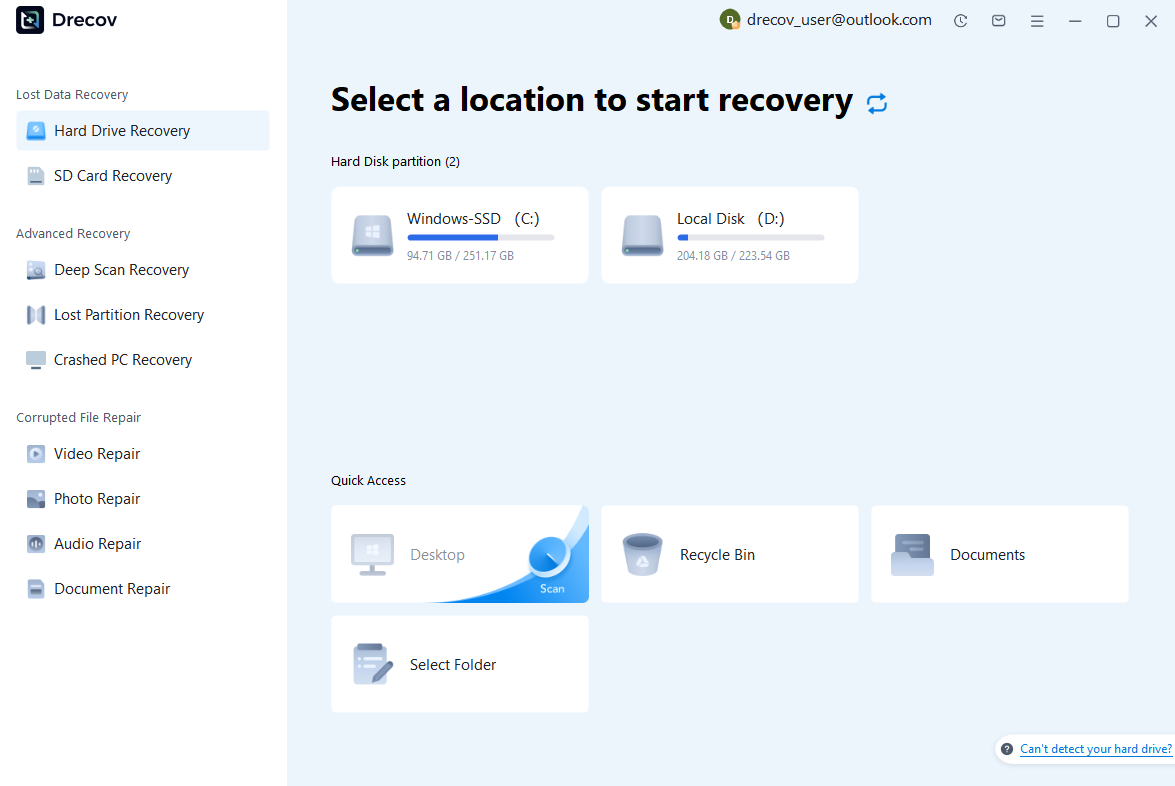
Step 1: Connect the Drive / USB)
Connect your device (SD card, HDD/SSD, or USB drive) to your computer and launch PandaOffice Drecov. Select the target device and start the scan. The software will perform a quick scan and deep scan to detect lost or deleted data.
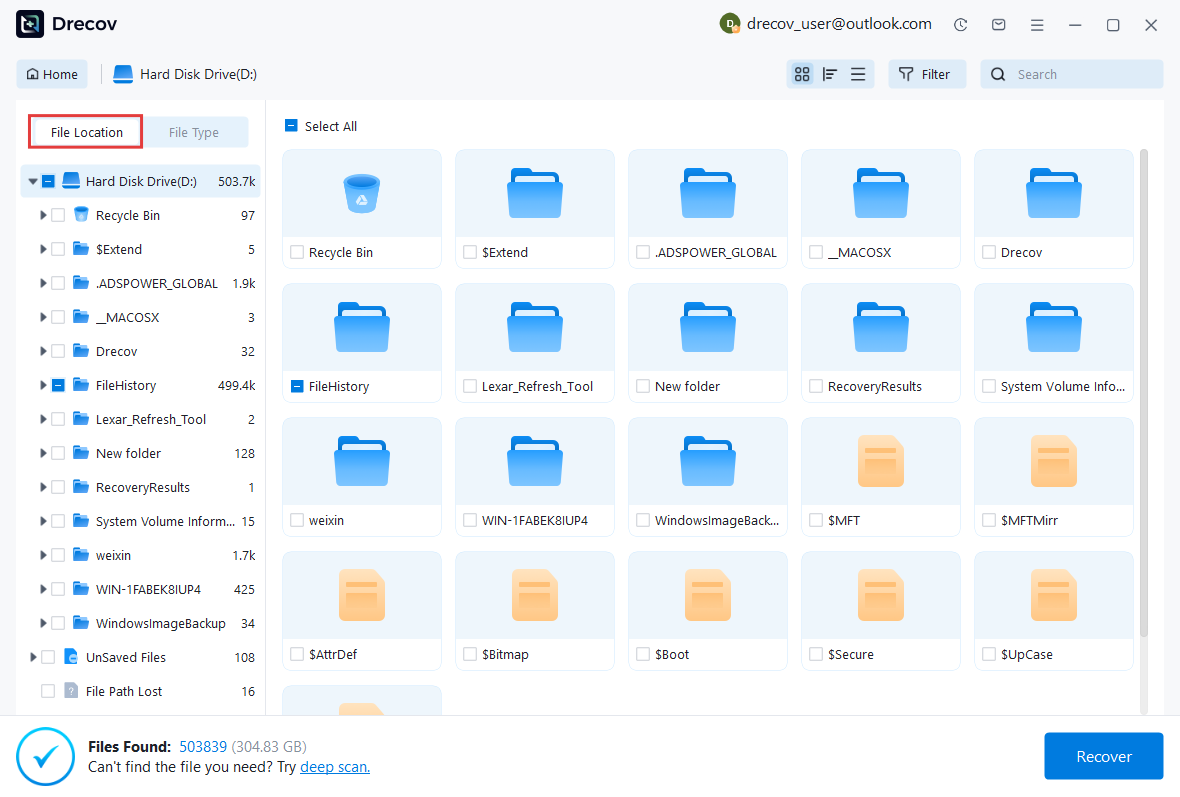
Step 2: Locate and Preview Lost Files
After scanning, browse the detected files and use the preview feature to check recoverable data. You can preview documents (Word, Excel, PDF), photos, and videos to ensure file integrity before recovery.
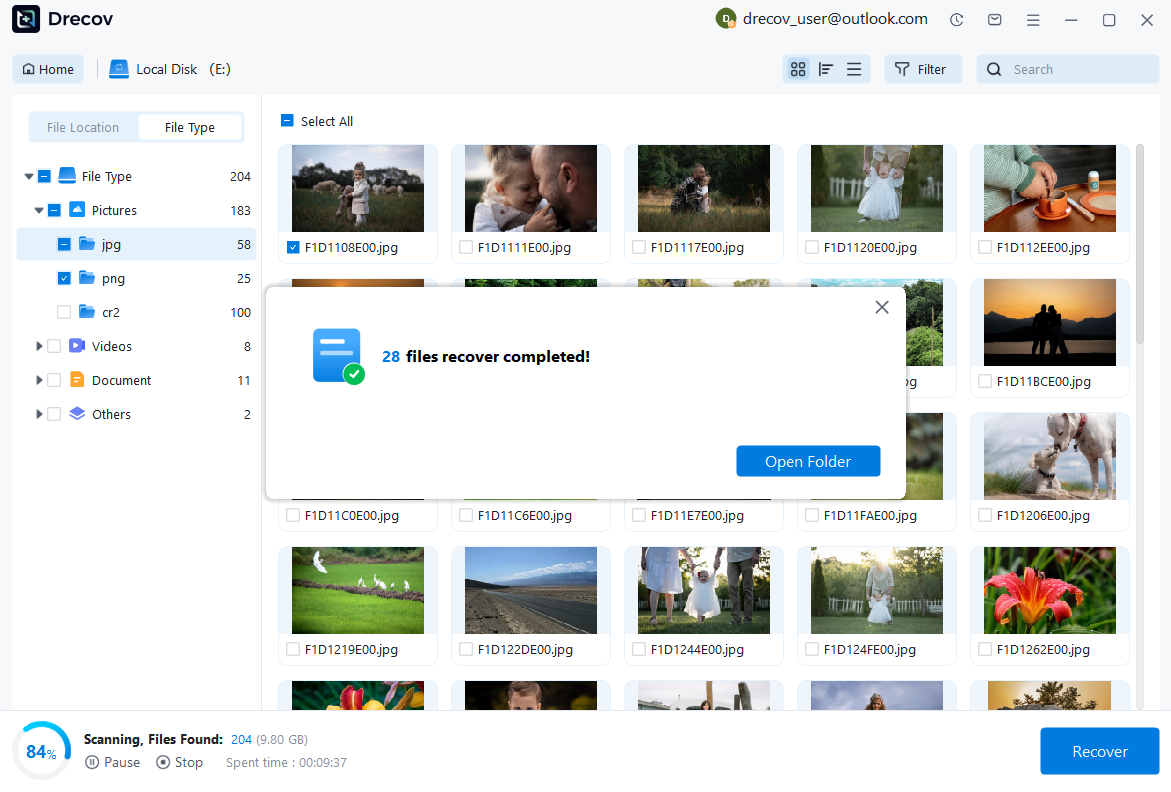
Step 3: Recover and Save to a New Location
Select the files you want to restore and click recover. Save all recovered data to a different drive or location (not the original device) to avoid overwriting lost data.
Why Choose PandaOffice Drecov Recovery Software?
PandaOffice Drecov offers a fast, secure, and user-friendly solution for recovering lost files across multiple scenarios. Whether you need email recovery, ZIP File Recovery, format data recovery, or help to recover deleted drafts Outlook, the software provides reliable recovery performance for both personal and business users.
PandaOffice Drecov supports recovery from formatted hard drives, SSDs, USB drives, SD cards, and external storage devices. Its advanced scanning engine can locate deleted archives, damaged ZIP files, lost Outlook drafts, and accidentally removed documents with high accuracy. For users searching for how to find deleted messages in Teams, PandaOffice Drecov can also help recover exported chat files, attachments, and related local cache data when available.
After recovery, test the file again. If the audio stream was damaged because of storage issues, a recovered version may play normally.
This method is particularly useful when only a few files exhibit audio problems while VLC works correctly with all other media.
Depending on the disk structure, the system may reboot to finish the process.
Advantages Compared with Native Windows Utilities
Users often prefer this method because it can:
- Handle more complex partition layouts.
- Move partitions when necessary.
- Simplify graphical partition management.
- Reduce manual command-line operations.
This can be particularly helpful when traditional Windows tools cannot complete an extend the c drive operation due to partition placement limitations.
⚠️Warning: Create a backup of critical files before modifying partition structures. Although partition operations are generally safe, unexpected interruptions can create risks.
Method 5: Migrate Data and Reallocate Space from Other Partitions
Test Environment
- Operating System: Windows 10 Enterprise
- SSD Capacity: 500GB
- Separate Data Partition Available
- Administrative Rights Enabled
Sometimes increasing the size of the system partition is not immediately necessary. Instead, relocating large files can free substantial storage without changing partition boundaries.
Transferring Files to Free Up System Partition Capacity
Start by identifying large files and folders stored on the C drive.
Common candidates include:
- Videos
- Downloads
- ISO files
- Backup archives
- Virtual machine images
- Game libraries
Move these files to another partition or storage device whenever possible.
You can also redirect default Windows folders:
- Open File Explorer.
- Right-click Documents, Downloads, or Pictures.
- Select Properties.
- Open the Location tab.
- Choose a new destination.
This strategy helps preserve available storage and reduces future pressure on the system partition.
Reorganizing Partition Layout for Better Storage Utilization
Storage management should be viewed as an ongoing process rather than a one-time fix.
Consider assigning separate partitions for:
- Operating system files
- Applications
- Personal documents
- Media collections
- Backups
A well-organized partition structure can reduce the need for frequent extending c drive operations in the future.
Long-Term Storage Management Recommendations
For sustainable storage performance:
- Remove unused applications.
- Delete temporary files regularly.
- Enable Storage Sense.
- Archive old data.
- Monitor free space monthly.
These practices help prevent the system partition from becoming critically full again.
Best Practices Before Extending the C Drive
Check Disk Health and File System Integrity
Before making partition changes, verify that the disk is functioning properly.
You can run the following command:
chkdsk C: /f
This scans the file system and repairs detected errors.
If the drive contains bad sectors or file system corruption, partition operations may be more likely to encounter issues.
Back Up Important Data Before Partition Changes
Even though modern partition management tools are reliable, no storage operation is completely risk-free.
Recommended backup options include:
- External hard drives
- Network storage devices
- Cloud backup services
- System image backups
A recent backup ensures that important information remains protected if unexpected problems occur.
Confirm Partition Style and Available Free Space
Understanding your disk configuration can simplify troubleshooting.
To check disk style:
- Open Disk Management.
- Right-click the disk.
- Select Properties.
- Open the Volumes tab.
You will see whether the disk uses:
- GPT (GUID Partition Table)
- MBR (Master Boot Record)
Knowing the partition style can help identify certain limitations during a c drive extend operation.
Understand GPT and MBR Limitations
GPT offers several advantages over MBR:
- Support for larger disks
- More partitions
- Improved reliability
Most modern Windows 10 and Windows 11 systems use GPT by default.
Users working with older MBR configurations may encounter restrictions that affect partition management.
⚠️Warning: Do not interrupt partition operations by shutting down the computer or disconnecting power. Unexpected interruptions can damage partition metadata.
Frequently Asked Questions About Extending C Drive
Can I Extend the C Drive Without Formatting the Disk?
Yes. Modern Windows tools and partition management software can typically increase partition size without formatting the disk or deleting existing files.
However, maintaining a backup remains strongly recommended before making any partition modifications.
Why Is the Extend Volume Option Greyed Out?
The most common reason is that no adjacent unallocated space exists behind the C drive.
Other possible causes include:
- Unsupported partition layouts
- Recovery partitions blocking expansion
- Disk configuration restrictions
Creating or relocating unallocated space often resolves the issue.
How Much Free Space Should the C Drive Have?
Although requirements vary, many experts recommend maintaining at least:
- 15–20% free storage on SSDs
- 20–25% free storage on HDDs
This helps Windows perform updates, create temporary files, and maintain optimal performance.
Can I Extend the C Drive on an SSD?
Yes. SSDs support partition expansion in the same manner as traditional hard drives.
The process remains largely identical whether the storage device is:
- SATA SSD
- NVMe SSD
- Traditional HDD
Is It Safe to Extend the System Partition While Windows Is Running?
In most situations, yes.
Windows Disk Management and many partition utilities can perform certain operations while the operating system is active. For more complex adjustments, a reboot may be required to complete changes safely.
Conclusion
Key Methods for Extending C Drive Space Safely
There are multiple ways to increase the capacity of the system partition. Depending on your disk layout, you can:
- Use Windows Disk Management.
- Use DiskPart commands.
- Shrink another partition to create unallocated space.
- Utilize Pandaoffice Drecov partition features.
- Move large files and reorganize storage allocation.
Each method addresses different storage scenarios and levels of technical experience.
Choosing the Right Approach Based on Your Disk Layout
The most effective solution depends on:
- Available unallocated space
- Partition arrangement
- Disk type
- User experience level
For simple situations, Windows tools are often sufficient. For more complex layouts, advanced partition management software may provide additional flexibility.
Final Thoughts on Managing Windows Storage Efficiently
Understanding how to extend c drive space is an important skill for maintaining Windows performance and stability. Whether you choose native utilities or advanced partition tools, careful planning and proper backups can help ensure a smooth experience.
By following the methods described above, users can confidently extend c drive, optimize storage allocation, and maintain sufficient free space for future system updates and application growth.






