If you are asking why are my videos not playing, test one known-good video and one failing video in two different players or devices. That small comparison reveals whether the problem follows a single file, a format, one application, or the whole system. Do not install a random codec pack or repair the only copy first. Preserve the original local file, record its size and source, and make changes to a duplicate.
What does the comparison test reveal?
Choose a short video that previously played on this computer and a failing item. Test both in the usual player, then use a second trusted player or another supported device. For browser video, test the same service in a private window and another network only when account and policy rules permit it. Record the result rather than changing several settings at once.
| Result | Most likely layer | Next useful action |
|---|---|---|
| Only one local file fails everywhere | Incomplete copy, unsupported stream, container damage, or file corruption | Check size/source and preserve the original |
| All files of one format fail in one player | Player or codec support | Update the player from its official source and inspect the media format |
| Every local file fails in every player | System media components, graphics driver, security policy, or storage access | Check errors, updates, and whether files can be copied normally |
| Local files play but websites fail | Browser, extension, DRM, service, account, or network | Use a clean browser test and check service status |
| Audio plays but picture is black | Video codec or hardware acceleration/graphics path | Test software decoding or a supported graphics driver update |
| Video begins but stops at the same timestamp | Incomplete or damaged media data is plausible | Test a source copy and inspect full file size |
A filename extension identifies a container, not necessarily the codec inside it. Two MP4 files can carry different video and audio streams. For MKV-specific cases, see how to inspect MKV playback and codecs. Avoid downloading a broad codec bundle from an unknown site; it can introduce conflicting filters or unwanted software.
Is the local video file complete?
Right-click the file, open Properties, and record its size, date, and location. A zero-byte file contains no video payload. A surprisingly small file may be an interrupted download, incomplete camera transfer, cloud placeholder, or truncated recording. If the file has a cloud status icon, make an offline copy through the provider’s normal download process before judging it.
Copy the file to another healthy drive. If the copy fails with a read or I/O error, storage access is part of the problem; stop repeated playback and protect other files from that device. If it copies cleanly, test the duplicate. A failure at the same timestamp on two devices suggests damage or incomplete source data more strongly than a player setting.
Do not rename an extension to convert a format. Changing .mov to .mp4 changes the label, not the streams. Use a reputable media-information tool to identify the container, video codec, audio codec, duration, and whether an index is readable. A missing-codec error such as 0xc00d5212 has a narrower path in the missing-codec troubleshooting article.
What should you change in the player or Windows?
Update the player through Microsoft Store or its official publisher. Resetting an application can remove preferences or libraries, so export or note important settings first. Try turning hardware acceleration off only as a comparison when the player offers that option. If software decoding works, investigate the supported graphics driver rather than leaving every application changed.
Install graphics drivers from Windows Update, the PC manufacturer, or the GPU manufacturer for the exact hardware. Create a restore point where appropriate and avoid unrelated driver-updater utilities. Success means the same test videos play, seek, pause, and resume after a restart without new errors.
If audio alone is missing, verify the selected output device and per-application volume. The article about no sound in YouTube and local video covers that separate branch. A working picture with muted audio is not evidence that the file was deleted.
Why do browser and streaming videos need a different path?
A webpage delivers media through a player, script, content-delivery network, account entitlement, DRM system, browser decoder, and network. Reload once, sign out only if credentials are available, and test a private window with extensions disabled. If private mode works, re-enable extensions one at a time. Ad blockers, privacy tools, download helpers, and security filters can all affect playback.
Clear data for the affected site rather than erasing the entire browser history first. Confirm the system clock, browser update, and protected-content settings. Test another supported browser. If all devices fail on the same service or title, check the provider’s official status information; local file recovery cannot fix a server-side resource.
An “HTML5 video not found” message often describes a missing or unreachable web resource rather than a deleted file on the PC. Use the focused HTML5 video-not-found checks for URL, server, cache, and format delivery problems.
When is the graphics or Windows media path responsible?
If known-good local videos fail across several players, restart Windows and test before changing components. Open Device Manager and check for a disabled or error-marked display adapter. Use Windows Update or the hardware manufacturer’s supported driver. Do not delete system codecs or copy DLL files from another computer.
Run the relevant built-in assistance from Microsoft’s Windows troubleshooter directory when it applies to the installed Windows version. Record its finding before accepting a repair. System File Checker may be appropriate when broader Windows components are damaged, but it cannot rebuild missing frames inside one video.
If video playback began failing after a graphics-driver update and software decoding works, a supported rollback can be a useful test. Verify the result with the same files, player settings, and restart. A different file beginning to work is not enough; the original reproducible set must pass.
When can Drecov help with a video that will not play?
Drecov is Windows data recovery software. It can help when the original local video was deleted, lost after formatting, or became inaccessible because a stable storage volume lost files. It cannot add a missing codec, repair a streaming server, bypass DRM, or guarantee that a partially overwritten video will be complete. A file that exists at the expected size but has internal corruption may need a separate file-repair method performed on a copy.
⚠ Warning: Install it on a drive different from the one where your data was lost to prevent overwriting.
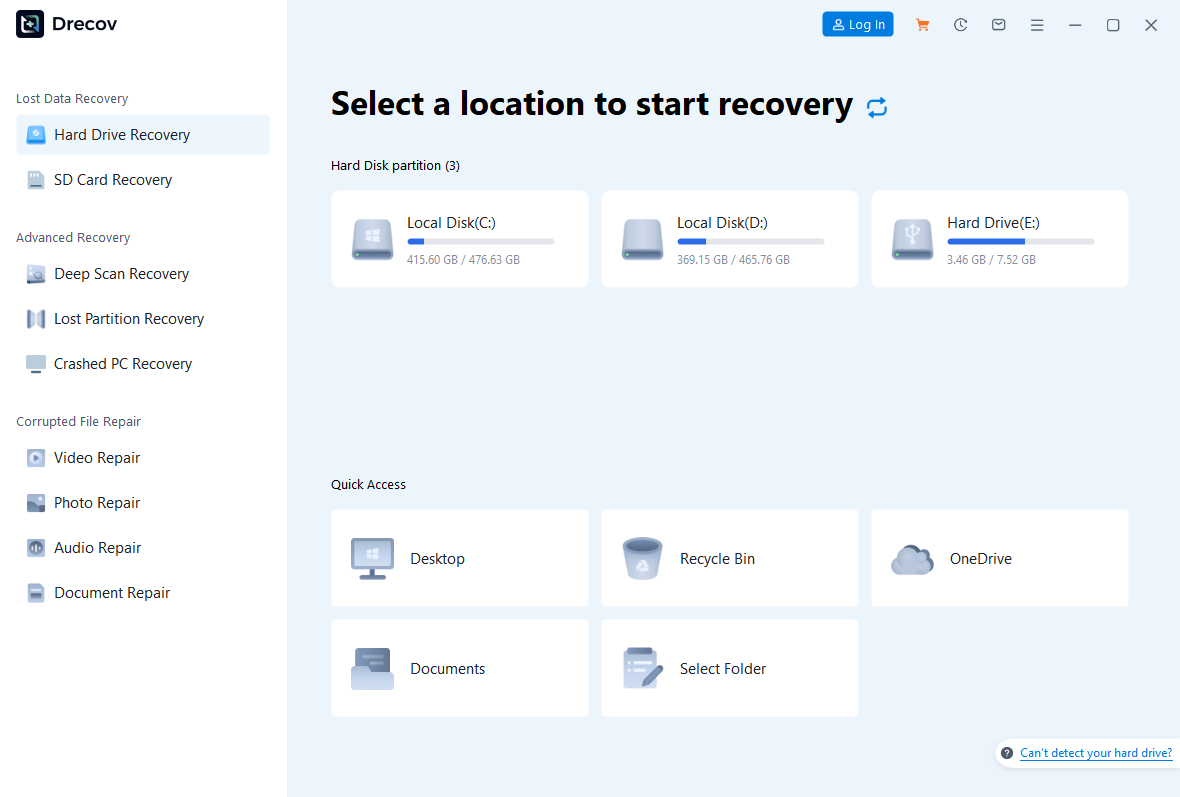
Step 1: Open Drecov and select the video’s original source
Stop recording, downloading, or copying to the device that held the missing video. Prepare another healthy drive with adequate space; video recovery may require substantial capacity. Do not install Drecov on the source. Open it and select the original camera card, external drive, or Windows partition by device and capacity. If the source clicks, disconnects, changes capacity, or freezes reads, stop and consider imaging or professional recovery.
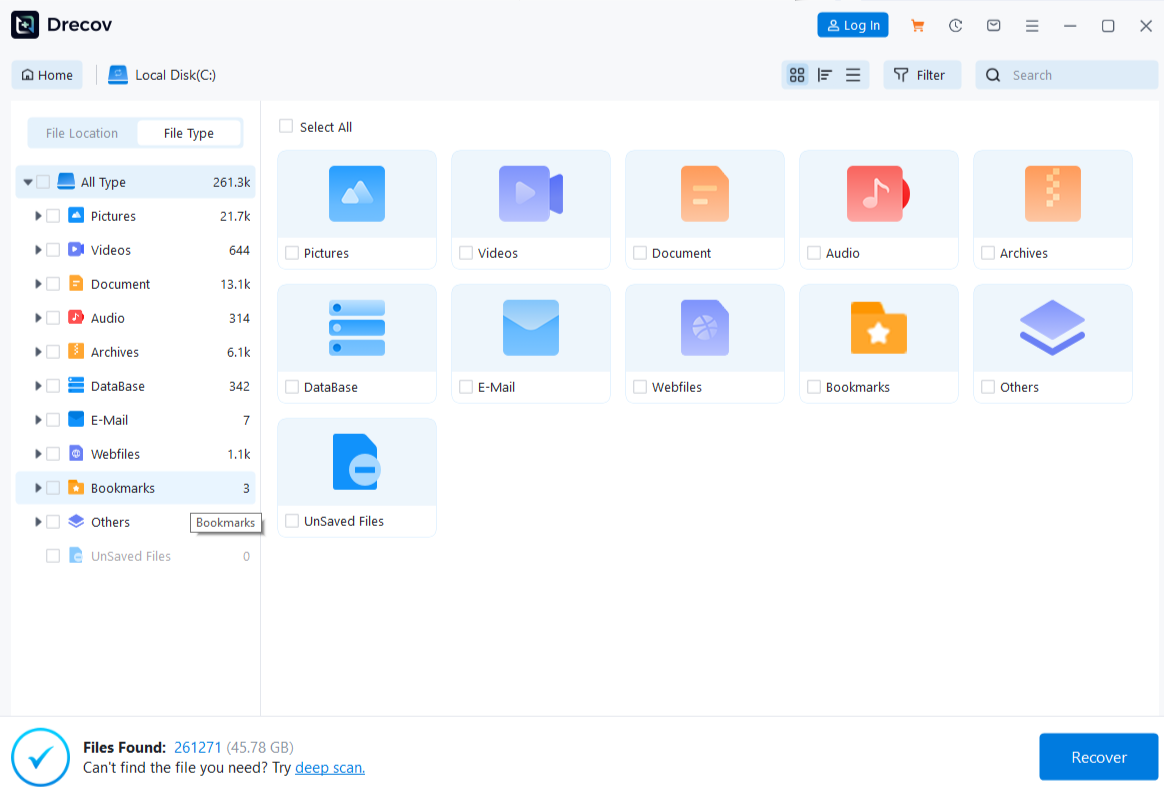
Step 2: Run Quick Scan before a deeper search
Start Quick Scan and inspect the former DCIM, Videos, Downloads, project, or export folder. If the target is absent and the device remains stable, use Deep Scan. Look for original camera clips and earlier exports, not only the final filename. Stop if the source begins producing errors or dropping offline.
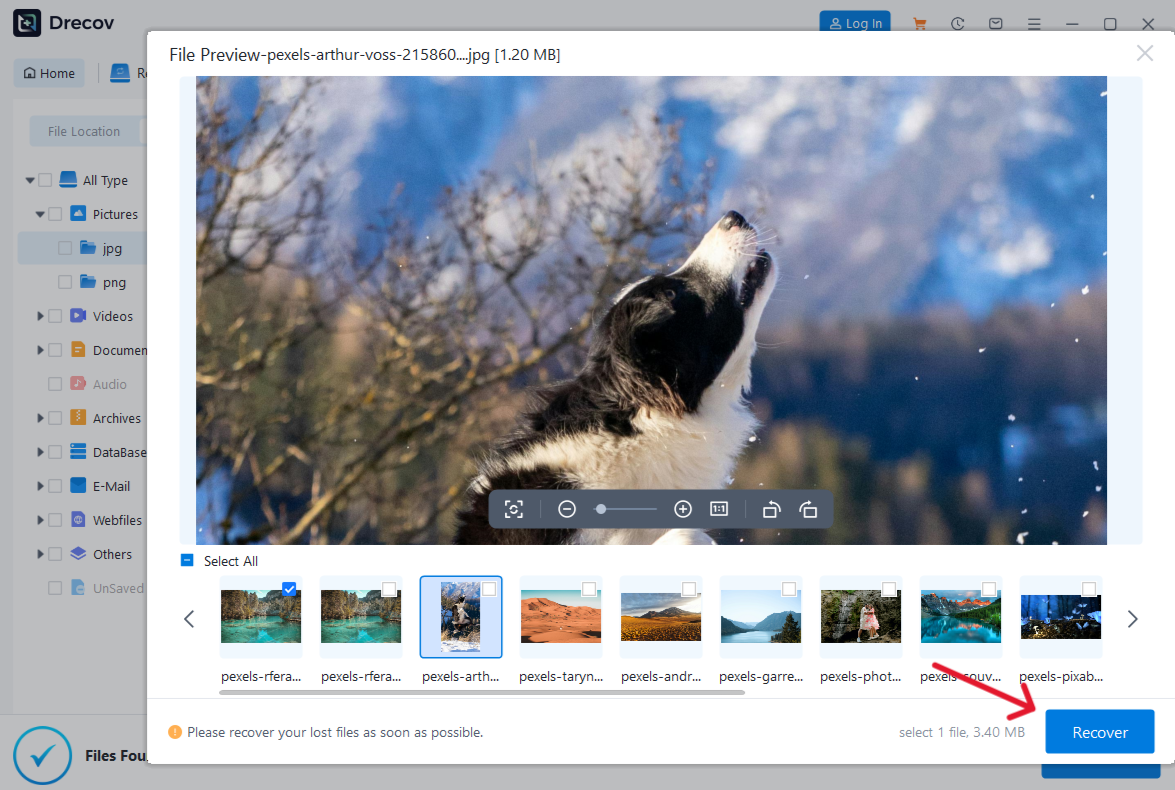
Step 3: Filter and preview several candidates
Filter by former path, filename, date, and video type. Preview supported candidates, but do not rely on a thumbnail or opening seconds. A container may open even when later media data is missing. Recover all plausible versions when the name or date changed during export.
Step 4: Recover to another drive and test the full duration
Save selected files to the separate healthy drive, never to the source. When the chosen destination appears empty, look inside its Drecov Folder or Recovery Folder. Test each recovered file in a trusted player, seek near the end, check audio synchronization, and compare duration and size with source records when available. Keep the recovery copy untouched before attempting video repair or re-encoding.
⚠ Warning: Install it on a drive different from the one where your data was lost to prevent overwriting.
How do you verify the fix instead of trusting one successful start?
Build a small test set: the original failing video, another file using the same format, and a known-good file using a different format. Play each from start to finish where practical, seek to several points, pause, resume, and confirm audio. Repeat after closing and reopening the player.
For browser video, replay after a browser restart and with extensions returned to the intended state. For a driver change, restart Windows and test hardware acceleration both as intended and under the comparison setting. For a recovered file, test from the healthy destination, not the failing source device.
Document the cause and the change that fixed it. “Installed codecs” is too vague; record the player version, identified stream, driver version, or recovered source. That information prevents the same problem from turning into a different set of guesses later.
Questions about videos that refuse to play
Why does a video play on my phone but not my PC?
The phone may support a codec or HDR profile that the PC player does not. Inspect the actual streams, update a trusted player, and test a supported decoder. The file is not necessarily damaged.
Can I repair a video by changing its extension?
No. An extension rename does not convert the container or codec. It can also hide the original format from software that would otherwise recognize it.
Why does the first half play but the second half freeze?
The file may be incomplete or damaged after a particular offset, or the player may fail on a stream feature. Test a source copy in another player and compare size and duration before repairing a duplicate.
Should I clear every browser setting?
No. Test a private window and another supported browser first. Clear only the affected site’s data when evidence points there, preserving passwords and unrelated history according to your backup and security needs.
Can Drecov fix a corrupt video?
Drecov recovers file data from stable storage; it is not a codec installer or guaranteed video-repair service. A recovered video may still be incomplete if sectors were overwritten or the original recording never finished writing.
When videos stop playing, let the failure follow the file, format, player, browser, or device before choosing a fix. Preserve the original, test one variable at a time, and use recovery only when the local video data was genuinely lost or inaccessible.
⚠ Warning: Install it on a drive different from the one where your data was lost to prevent overwriting.