







When system restore not working is the problem, the failure stage determines the answer. No restore points, an error before restart, a long stall, a rollback after restart, and WinRE refusing credentials are different conditions. System Restore normally targets system files, registry settings, drivers, and installed programs rather than personal documents, but a failed PC can still put local work at risk. Back up accessible files first. Then record the exact code and test the narrowest cause before moving to Reset or reinstall.
System Restore Not Working: Identify the Failure Stage
If the list is empty, confirm that System Protection was enabled for the Windows volume before the incident. Restore points are not retroactive backups. Cleanup tools, storage limits, feature updates, or disabled protection can remove them. Creating a new point now cannot recreate the earlier system state you wanted.
An error before the PC restarts often points to permissions, services, security software, or a damaged restore-point repository. A failure after restart may involve locked files, disk errors, driver state, or WinRE access. Photograph the code and percentage instead of describing every failure as a stuck restore.
Use Scan for affected programs before committing when System Restore reaches the selection screen. The report helps identify applications and drivers that may be removed or restored. Save license information and installers for business-critical software before proceeding.
Protect personal files before changing the recovery strategy
A restore that appears motionless can still be processing. Check whether storage activity continues and allow reasonable time before forcing power off. Repeated interruption can leave Windows in a harder state. A drive that clicks, disappears, or produces severe read delays is not an ordinary slow restore; stop and protect the storage.
BitLocker can require a recovery key in Windows Recovery Environment. Store the key on another device before restarting into WinRE. Do not disable encryption or format a partition simply because the recovery environment cannot unlock it automatically.
System Restore is not a personal-file backup and does not recover a deleted document by design. Conversely, file-recovery software does not roll back registry or driver changes. Keep these goals separate so a failed restore does not send you to the wrong tool.
Check restore points, protection settings, and free space
Open System Protection and confirm protection status, configured disk-space usage, and available restore points. Do not delete existing points while diagnosing. Low free space can limit point creation, but clearing the drive indiscriminately may also delete useful files.
Try System Restore from normal Windows when the system starts reliably. If Windows will not boot or ordinary restore fails, use WinRE > Troubleshoot > Advanced options > System Restore. Confirm the Windows installation and account rather than assuming drive letters match the desktop session.
Temporarily disconnect nonessential external drives and peripherals before one controlled retry. This reduces target confusion and driver variables. Keep the external backup destination disconnected after the backup to protect it from later reset or repair choices.
Run System Restore from the environment that fits the failure
If security software appears to block the process, use its documented temporary control only after preserving data and confirming the installer source. Do not permanently weaken protection or download registry fixes from unknown sites.
Use SFC or DISM only when evidence points to damaged Windows components and important files are already safe. These tools repair Windows; they do not restore deleted user data or stabilize a failing disk.
Move to Reset or reinstall only after recovery and backup verification. Review whether Keep my files applies, what applications will be removed, and whether the chosen process writes extensively to the system drive.
Recover inaccessible files with Drecov before reset
Drecov belongs in this workflow when System Restore failure leaves local files missing or inaccessible, or before Reset and reinstall would write over the system drive. On stable readable storage, Drecov can search documents, photos, videos, email data, audio, and archives using read-only recovery, Quick Scan, Deep Scan, filtering, preview, and recovery to another healthy device. Lost Partition Recovery is available when a partition entry is lost. Drecov does not repair Windows services, restore points, physical hardware, or overwritten content.
⚠ Warning: Install it on a drive different from the one where your data was lost to prevent overwriting.
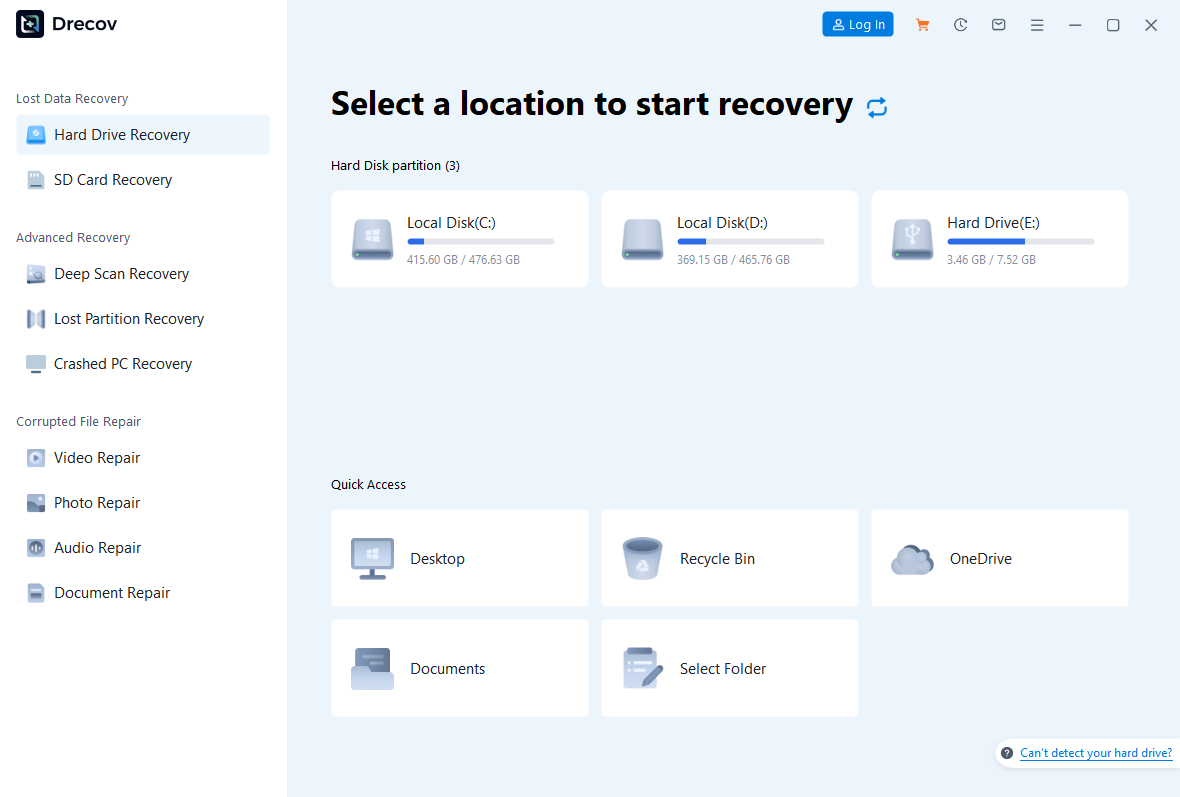
Step 1: Open Drecov and select the Windows location at risk
Before Reset, reinstall, or disk repair, stop adding files to the affected Windows partition. Attach a different healthy physical drive with adequate space. Open Drecov from a healthy installation and select the original user-data partition. If Windows no longer shows the partition, use Lost Partition Recovery rather than initializing or formatting it.
Step 2: Run Quick Scan for missing user files
Begin with Quick Scan and inspect the former Desktop, Documents, Pictures, and project folders. Filter by the filenames and dates that matter to the failed restore event. Keep Windows Update, cloud synchronization, and application reinstallers from writing to the source during this pass.
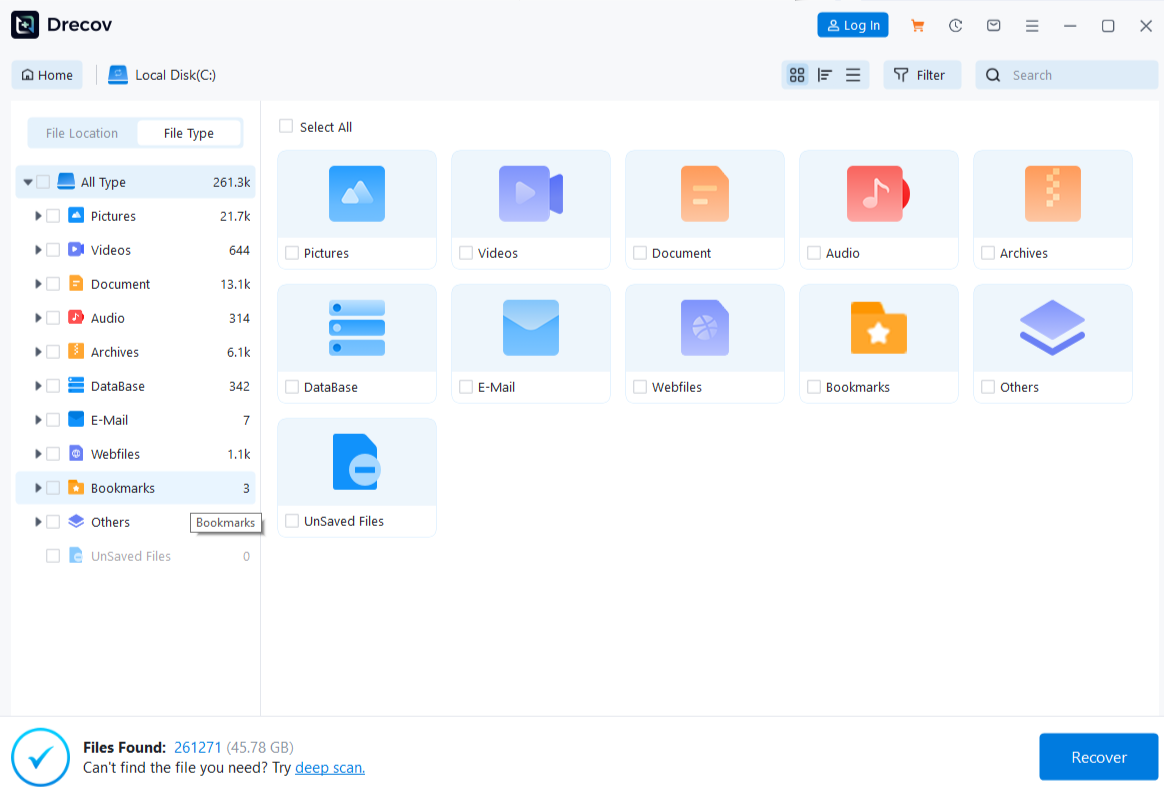
Step 3: Escalate to Deep Scan only after a stability check
If Quick Scan does not locate critical files, confirm that the disk remains detected at the correct capacity and reads without severe delays. Then use Deep Scan. A drive that clicks, disappears, or repeatedly stalls should be imaged or examined professionally instead of being subjected to another long scan.
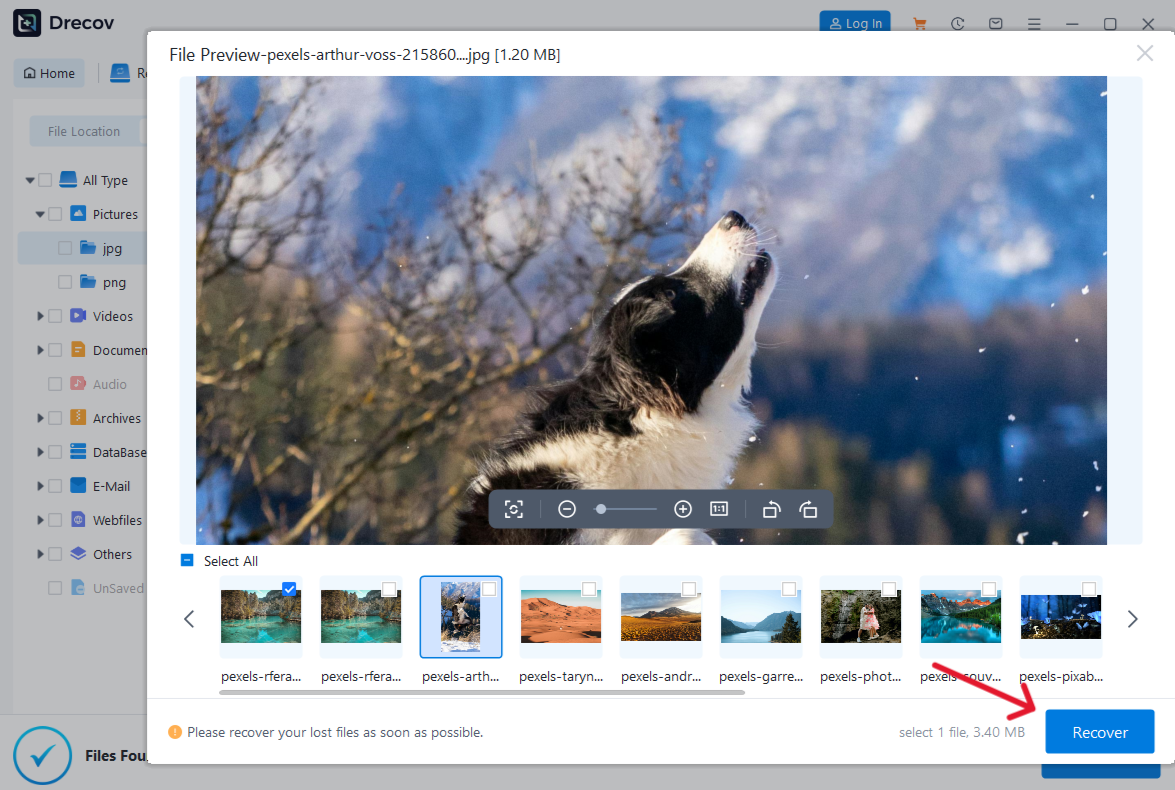
Step 4: Preview a cross-section before selecting recovery output
Use file type, former path, filename, and relevant modification dates to organize results. Preview representative documents, photos, and other supported files. One successful preview validates that sample only. Recover priority folders to the separate healthy drive, never to the Windows source partition.
Step 5: Verify personal data before Reset or reinstall
Check Drecov Folder or Recovery Folder if output is not visible where expected. Open several documents, inspect large media, compare folder counts, and create a second backup. Once the recovered set is demonstrably usable, return to System Restore diagnosis or choose Reset, repair, or reinstall with the data risk reduced.
Interpret the result and choose the next Windows tool
Restart twice and repeat the task that motivated the rollback. Confirm that the driver, update, or application behavior actually changed rather than relying on a completed message.
Open documents from the backup and recovered destination. Check several file types and a large file. A backup icon is not proof that its contents are usable.
Recheck Windows Update, device status, Event Viewer, storage detection, and available space. Preserve the restore error code if the underlying symptom returns.
Create a new restore point only after the system is stable. Keep a separate file backup because restore points and personal-file backups solve different failures.
Verify Windows after a successful rollback
Why are all my restore points gone?
System Protection may have been disabled, storage limits may have recycled points, cleanup may have removed them, or a major Windows change may have reset the repository.
Can System Restore delete my personal files?
It is designed not to affect personal files, but it can change apps, drivers, and system settings. Protect important files because a failing system or interrupted recovery still carries risk.
Should I keep retrying the same restore point?
Not without new evidence. Record the error, check source stability and WinRE conditions, then make one controlled change.
Does Drecov make System Restore work?
No. Drecov recovers local files. It does not create restore points or repair the Windows restore service.
Related reading: Drecov Windows data recovery, restore a computer to an earlier date, protect files when a PC will not boot, and use Windows recovery USB safely. Use Microsoft’s official System Restore instructions to confirm the supported Windows and WinRE paths.
Distinguish a restore failure from the original Windows fault
After a failed attempt, compare the original symptom with the new state. If the restore operation rolled back cleanly, the original driver, update, or application problem may simply remain. If Windows now shows a different boot error, preserve that message and avoid assuming it is progress. Check whether user files are still accessible and whether the disk remains stable. This separation prevents a recovery-tool error from replacing the actual fault you set out to solve.
Preserve evidence from the restore-point selection
Photograph the available point dates and the Scan for affected programs report. Record which point was selected, where System Restore was launched, the displayed error, and whether BitLocker requested a key. Those details make a second attempt purposeful. Without them, repeated restores can become an uncontrolled loop that changes applications and drivers without revealing why the first attempt failed.
Know when another restore point is worth trying
A second restore point is reasonable when it predates the suspected change, Windows still detects stable storage, and the first failure points to that particular snapshot rather than the restore service itself. Review affected programs again and keep the data backup disconnected. If multiple points fail with the same code, stop cycling through them. Preserve logs and choose the next diagnostic tool according to that evidence instead of consuming more time and changing more system state.
Conclusion
System restore not working is a stage-specific diagnosis, not an automatic reason to reset Windows. Preserve personal files, record the exact failure, verify restore-point availability, and choose normal Windows or WinRE deliberately. When local data is missing from stable storage, Drecov provides a recovery path before reset or reinstall. Confirm both recovered files and Windows behavior before trusting the result.






