







In practical terms, outlook email attachments not opening — When Outlook email attachments are not opening, do not begin by reinstalling Office or deleting the message. First save a copy of the email, note the attachment name and size, and determine whether the failure follows one file, one file type, one sender, or every attachment. That distinction reveals whether you are dealing with a damaged attachment, a missing associated application, a security restriction, a temporary-folder problem, or a broader Outlook fault. Preserve the original message before changing anything.
Outlook Email Attachments Not Opening: Start With Four Tests
Open another attachment of the same type from a trusted message, then open a different file type. If one PDF fails while other PDFs work, investigate that file. If every PDF fails but Word documents open, check the PDF application association. When all attachment types fail, Outlook, security policy, or its temporary storage deserves attention.
Use Outlook on the web for the same mailbox when available. A file that downloads and opens there points toward the desktop client, its cache, add-ins, or local associations. Failure in both places may indicate a damaged upload, mailbox rule, service restriction, or sender-side problem. Do not forward confidential material to a personal account merely as a test.
Compare the displayed size with the sender’s original. A zero-byte file, a suspiciously tiny attachment, or a message that shows only a cloud placeholder may not contain the expected payload. Ask the sender to verify the source file and attach a fresh copy under a new name rather than repeatedly resending the same damaged object.
Microsoft maintains a current official Outlook attachment troubleshooting page. Use its controls for your Outlook edition because classic Outlook and new Outlook do not expose every option in the same place.
Read the Exact Failure Instead of Guessing
A message such as ‘Previewer is not installed’ differs from ‘Access denied,’ ‘File is corrupt,’ or a blocked-extension warning. Record the complete wording. Also note whether the problem occurs during preview, Save As, download, or opening in the associated program. Those are separate handoff stages.
If Save As works, put the copy in a simple local test folder such as Documents, scan it with current security software, and open it from the target application. Avoid running executable or script attachments. A successful local open suggests an Outlook preview or temporary-path problem rather than damaged content.
A protected business device may block file types, untrusted locations, macros, or attachments from external senders. Do not bypass organizational controls by renaming an executable extension or disabling endpoint protection. Ask the administrator to confirm the policy and provide a sanctioned transfer route.
Encrypted messages, rights-managed files, password-protected archives, and cloud links require the correct identity and application. Recovery software cannot remove those access controls. Verify the signed-in account, link permissions, archive password, and expiration state before treating the attachment as lost.
Repair the Smallest Confirmed Layer
For one file type, repair or update the application that should open it and verify Windows Default Apps. Open the application first, then use File > Open on the saved copy. This produces a more useful application-specific message than double-clicking from Outlook.
For Outlook-only preview trouble, disable a suspect third-party add-in in a controlled test, restart Outlook, and re-enable it if the behavior does not change. Do not disable every security component at once. One change per test keeps the evidence readable and avoids leaving protection off.
When temporary attachment storage is implicated, close Outlook and all Office applications before clearing only documented temporary content. Preserve any unsaved files. Deleting broad profile folders or rebuilding the mail profile is disproportionate until basic file, web, application, and policy tests are complete.
If the Outlook data file or profile shows wider symptoms—missing folders, repeated prompts, search failure, or synchronization errors—export or protect local-only content first. Server mail may resynchronize, but POP mail, local archives, and detached files may exist only on the PC.
When the Attachment Was Saved Locally and Then Disappeared
Sometimes Outlook is healthy and the real loss happened after the user saved an attachment to Downloads, Desktop, or a project folder. Search the exact filename, extension, date, and sender. Check the browser or Outlook download path, Windows Recent items, Recycle Bin, File History, OneDrive version history, and the project’s document system.
Do not confuse a deleted saved copy with the attachment still stored inside the mailbox. If the message remains, use Save As again to a healthy location. If the message was deleted, inspect Deleted Items, Recoverable Items where available, retention, and backups before scanning a disk.
Useful background includes Drecov Windows recovery, recovering deleted email and local archives, restoring a deleted Outlook folder, and choosing a separate recovery destination.
Use Drecov for a Missing Local Copy, Not an Outlook Setting
PandaOffice Drecov is Windows data recovery software for PCs, HDDs, SSDs, external drives, USB drives, SD cards, and memory cards. Its read-only recovery mode, Quick Scan, Deep Scan, filtering, preview, and recovery to another healthy location help search for deleted or inaccessible local files. Lost Partition Recovery addresses data on a missing partition. It supports common documents, photos, videos, audio, email data, and archives.
Here, Drecov is relevant when a saved attachment, local Outlook archive, or exported message was deleted or became inaccessible on stable, correctly detected storage. It does not unblock a prohibited extension, repair an Outlook add-in, supply a missing password, download a cloud-only file, or guarantee recovery after overwrite or SSD TRIM. Stop if the source clicks, repeatedly disconnects, freezes the computer, changes reported capacity, or produces severe read errors. Repeated scans can worsen a physical problem. Seek controlled imaging or professional recovery instead.
⚠ Warning: Install it on a drive different from the one where your data was lost to prevent overwriting.
Recover the Former Attachment Without Writing Over It
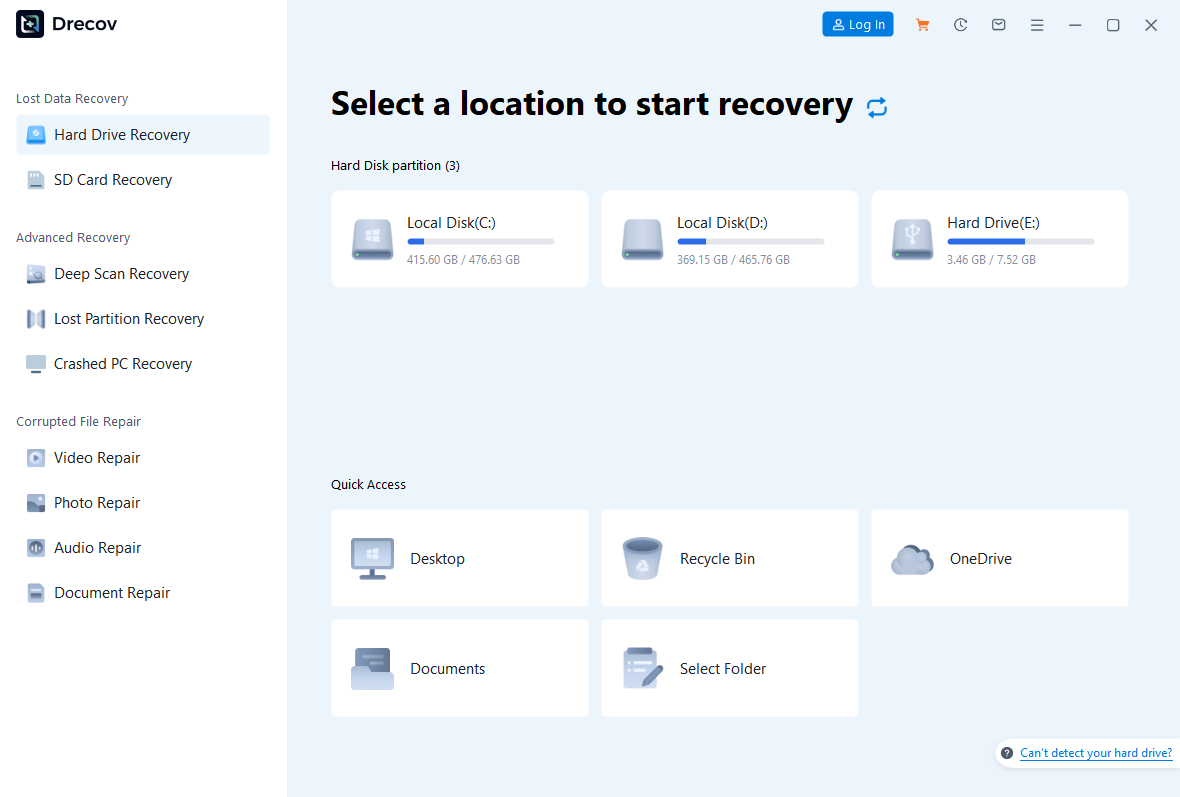
Step 1: Open Drecov and select the original save location
Connect a separate healthy destination and do not install Drecov on the affected partition. Open Drecov, then choose the drive or folder that previously held the attachment or local archive. If its entire partition is missing, use Lost Partition Recovery rather than initializing it.
Step 2: Run Quick Scan and narrow the recent loss
Start Quick Scan. Filter by filename, extension, size, date, and former path. Keep Outlook and synchronization clients closed if they could create new cache data on the source.
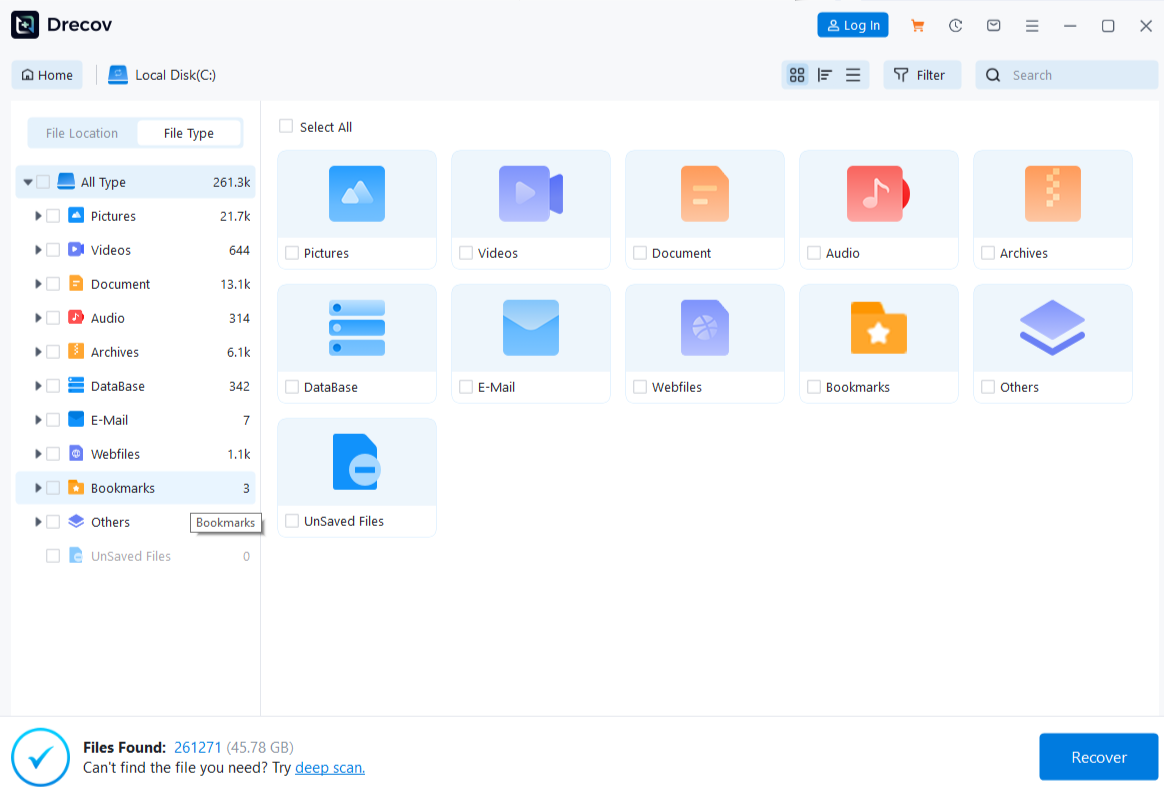
Step 3: Escalate to Deep Scan only on stable media
If Quick Scan does not reveal the wanted file and the disk remains consistently readable, run Deep Scan. Stop for new noises, disconnects, stalls, or detection changes.
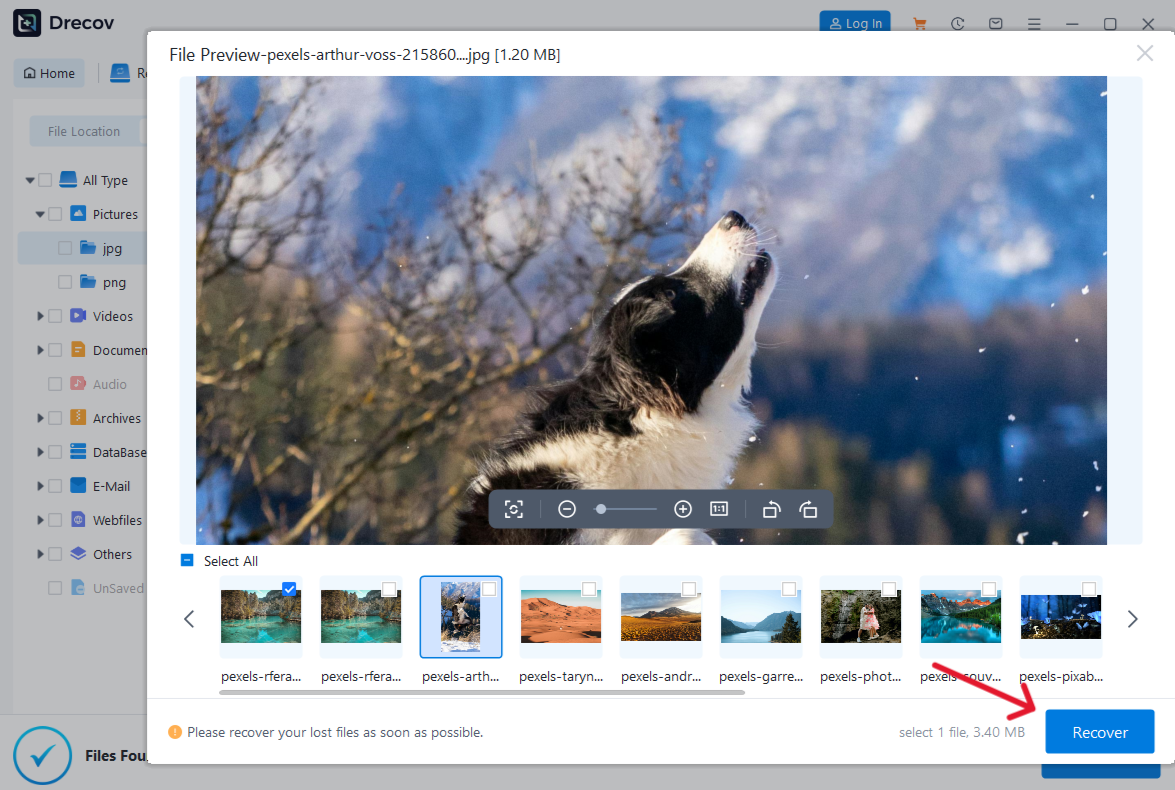
Step 4: Preview representative candidates and recover elsewhere
Preview supported files where possible, while remembering that a preview does not prove every page, embedded object, archive member, or signature is intact. Recover selected candidates to the healthy destination, never back to the source.
Step 5: Find the output and validate it safely
If the chosen output path appears empty, inspect Drecov Folder or Recovery Folder. Scan recovered attachments with current security software, open copies in the correct application, and verify content before repairing Outlook, rebuilding a profile, or clearing temporary data.
Confirm the Fix at the Same Stage That Failed
Retest the original stage: preview, Save As, download, or application open. Then test a second trusted attachment of the same type and one different type. This confirms that the remedy is not a one-file coincidence.
Keep the preserved message and recovered output until the file opens, its content is complete, and any dependent links or embedded objects behave as expected. For archives, test several members. For spreadsheets or documents, review formulas, pages, and media rather than accepting the first visible screen.
Finally, document the cause. A sender-side damaged file needs a fresh export; an association needs application maintenance; a policy block needs administrative handling; and a deleted local copy needs better destination and backup habits.
Handle Archives and Cloud Links Differently
- Avoid Temporary Caches: Once resolved, never use Outlook’s temporary folder for long-term storage. Save attachments into dedicated local folders with regular backups to prevent automatic cache cleanups from erasing your data.
- Diagnose ZIP Archives: If you are dealing with outlook email attachments not opening, note that compressed files add extra diagnostic layers. Save the archive locally, scan it, and check its integrity; if a single internal file is corrupted, request a fresh copy from the sender rather than troubleshooting Outlook settings.
- Distinguish Cloud Links from Files: Cloud sharing links (SharePoint/OneDrive) rely on signed-in user permissions, sharing policies, and link expiration. Copying link text is not the same as securing the file—confirm access rights with the owner and download an offline copy when permitted.
- Account for Transfer Limits: Large files may fail to download or open due to proxy, transport, or mailbox size limits, resulting in corrupted partial files. Compare message sizes in Outlook on the web and use sanctioned cloud links instead of splitting files.
Conclusion
Outlook email attachments not opening is a symptom with several handoff points. Test the file, type, web client, local application, and policy before making broad changes. If the message still contains the attachment, save a fresh copy. If a genuine local copy or archive was deleted, Drecov can scan stable Windows storage and recover candidates to another device, after which the file must still be verified in its proper application.
⚠ Warning: Install it on a drive different from the one where your data was lost to prevent overwriting.






