







In the modern digital landscape of 2026, data compression remains the backbone of file sharing and storage efficiency. Whether you are receiving a massive architectural project or a collection of family photos, you will inevitably encounter compressed folders. Knowing how to extract zip files on windows is a fundamental skill that every user—from casual students to high-level data recovery experts—must master.
However, the process isn’t always as simple as a double-click. Sometimes files become corrupted during the compression process, or they disappear entirely due to accidental deletion or extraction errors. In this educational article, we will explore the technical nuances of ZIP files, provide step-by-step instructions for unzipping, and introduce professional recovery methods using PandaOffice Drecov.
Understanding the Architecture of ZIP Files
Before we dive into the “how-to,” we must understand what a ZIP file actually is. A ZIP file is a “container” that uses lossless data compression. By using mathematical algorithms, it identifies patterns in your data and shrinks them, allowing multiple files to exist within a single, smaller package.
On Windows 11 and the latest 2026 builds of Windows 12, the operating system treats these archives as “Compressed Folders.” This integration is seamless, yet many users still struggle with the distinction between “viewing” a file inside a ZIP and actually “extracting” it for use. If you only view a file, any changes you make might not be saved, which is a leading cause of data loss in professional environments.
How Do I Unzip a File on Windows Using Native Tools
For the vast majority of users, third-party software is unnecessary. Windows has built-in capabilities that have been refined over decades. If you are asking yourself, how do i unzip a file on windows without installing extra bloatware, the File Explorer method is your best friend.
The File Explorer Extraction Method
This method is the most reliable for standard .zip archives. It ensures that the file permissions and directory structures remain intact.
- Step 1: Locate the ZIP file in your File Explorer. You can usually identify it by the “zipper” icon on the folder.
- Step 2: Right-click the file to open the context menu.
- Step 3: Select “Extract All…” from the list. A new dialog box will appear.
- Step 4: Choose your destination path. By default, Windows suggests creating a new folder with the same name as the ZIP file in the current directory.
- Step 5: Ensure the box “Show extracted files when complete” is checked, then click “Extract.”
How to Unzip a File: Advanced Shortcuts and Power User Tips
Efficiency is key when handling large volumes of data. If you are a power user looking for how to unzip a file with minimal clicks, Windows 2026 offers several hidden shortcuts.
The Drag-and-Drop Shortcut
Many users don’t realize they can bypass the “Extract All” wizard entirely.
- Step 1: Double-click the ZIP file to open it like a regular folder.
- Step 2: Select the files or folders you need inside.
- Step 3: Simply drag them out of the ZIP window and drop them onto your Desktop or another folder.
- Step 4: Windows will automatically perform the extraction in the background.
Using the Ribbon Menu
In the updated Windows 2026 UI, the File Explorer ribbon has a dedicated “Compressed Folder Tools” tab.
- Step 1: Click once on the ZIP file to select it.
- Step 2: Look at the top ribbon menu; a pink or blue tab labeled “Extract” will appear.
- Step 3: Click “Extract All” from this menu to begin the process.
How to Unzip Files Using Third-Party Software (7-Zip & WinRAR)
While native tools are great, they sometimes struggle with encrypted archives or alternative formats like .7z and .rar. If you need to know how to unzip files that are password-protected or split into multiple volumes, professional archive managers are required.
Using 7-Zip (Open Source Excellence)
7-Zip is the gold standard for data recovery professionals because of its high compression ratio and support for almost every archive type.
- Step 1: Download and install 7-Zip from the official 7-Zip website.
- Step 2: Right-click your compressed file.
- Step 3: Hover over the “7-Zip” menu and select “Extract Here” (to put files in the current folder) or “Extract to [Folder Name]” (to keep things organized).
- Step 4: If the file is encrypted, enter the password when prompted.
Technical Troubleshooting: Why Extraction Fails
Sometimes, you follow every step on how to extract zip files on windows, but you encounter an error message like “Compressed (zipped) Folder is invalid” or “Path too long.”
The “Path Too Long” Error
Windows has a legacy character limit for file paths (usually 260 characters). If your ZIP file contains deeply nested folders, the extraction will fail.
- The Fix: Move the ZIP file to the root of your drive (e.g.,
C:\) before extracting.
Archive Corruption
If a download was interrupted, the ZIP header might be damaged. This is a nightmare for data integrity. If the native “Extract All” fails, try using 7-Zip’s “Test” feature to identify which specific file inside the archive is broken.
Data Recovery: Restoring Lost or Deleted ZIP Files
What happens if you accidentally deleted a ZIP file before extracting it? Or worse, what if the extraction process crashed and wiped both the source and the destination files? In the world of data recovery, we call this a “Write Conflict.”
This is where PandaOffice Drecov becomes your most valuable tool. It is a specialized data recovery suite designed to handle the complexities of compressed file structures.
⚠ Warning: Install it on a drive different from the one where your data was lost to prevent overwriting.
Step-by-Step Recovery with PandaOffice Drecov
If you have lost your ZIP files, follow these steps immediately. The faster you act, the higher the chance of a 100% recovery.
Step 1: Select the Storage Location
Open PandaOffice Drecov. On the main interface, you will see a list of your hard drives and external partitions. Select the drive where the ZIP file was last seen (usually the C: drive or a USB stick) and click “Scan.”

Step 2: Deep Scan for Archive Fragments
The software will run a “Quick Scan” first, but for ZIP files, it is often better to let the “Deep Scan” complete. This process looks for the specific “PK” header signature that identifies ZIP archives on a binary level.
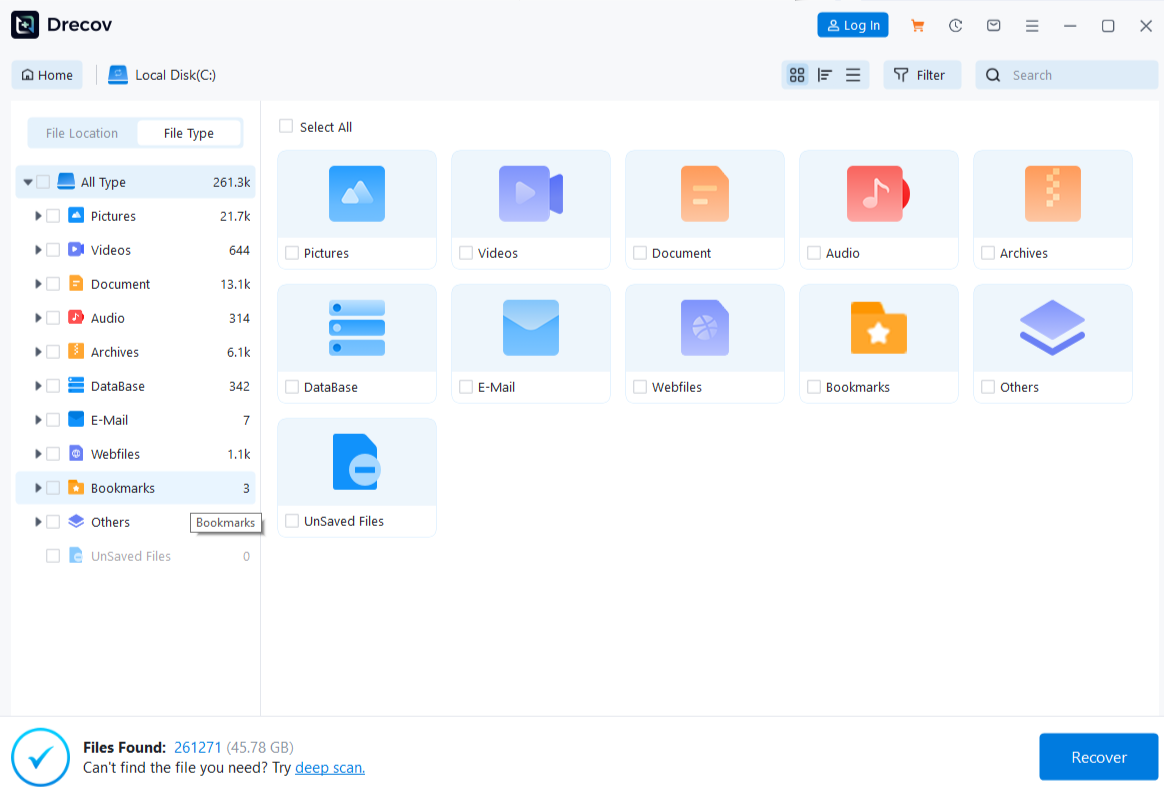
Warning: Do not save any new data to the drive during this process. Every new file you save could overwrite the “deleted” ZIP file sectors.
Step 3: Filter by File Type
Once the scan is finished, don’t sift through thousands of files. Use the Filter sidebar on the left. Select “Archives” and then specifically check “ZIP.”
Step 4: Preview and Verify Integrity
Click on the found ZIP file. PandaOffice Drecov offers a unique “Pre-Extraction Preview” that allows you to see the file names inside the deleted ZIP before you even recover it. This ensures you aren’t wasting time on a corrupted fragment.
Step 5: Recover to a Safe Location
Select the files and click “Recover.” > Key Point: Always save your recovered files to a different drive (e.g., from C: to an external D: drive) to avoid permanent data corruption.
Internal Resources for Enhanced Data Management
Mastering your files goes beyond just unzipping. To truly protect and manage your digital life in 2026, consider these expert guides:
- Media Management: If you are unzipping large video archives, learn how to download video from browser firefox 2026 guide to keep your collection organized.
- System Safety: Sometimes extraction errors can cause system instability. Know how to restore computer to an earlier date on windows as a backup plan.
- Cloud Coordination: If your ZIP files are disappearing from synced folders, here is how to disable a folder from onedrive recover lost files.
- Browser Data: Often, we download ZIPs containing browser backups. Find out where is the firefox bookmarks location find your data instantly.
Best Practices for Handling ZIP Files on Windows
To avoid ever needing data recovery services, follow these industry best practices for how to extract zip files on windows:
- Always Extract, Never Just Run: Never run an
.exeor open a.docxdirectly from inside a ZIP. Windows creates a temporary copy that is often deleted when you close the program, leading to lost work. - Virus Scan First: ZIP files are the #1 delivery method for malware. Always right-click and “Scan with Windows Defender” before unzipping.
- Check for Sufficient Space: Before unzipping a 50GB archive, ensure you have at least 100GB of free space. The extraction process needs “breathing room” to move bits and bytes around.
- Use Official Tools: For system-critical files, use official documentation from Microsoft Support to ensure you are using the correct OS features.
Comparison of Extraction Methods
| Method | Best For | Speed | Complexity |
| Native “Extract All” | General use, basic ZIPs | Fast | Low |
| 7-Zip / WinRAR | Encryption, .RAR, .7z | Fastest | Medium |
| Command Line (PowerShell) | Automating 100+ ZIPs | Immediate | High |
| PandaOffice Drecov | Corrupted or deleted ZIPs | Thorough | Medium |
How to extract zip Files on Windows FAQs
1. Why does Windows say my ZIP file is empty when I know it isn’t?
This usually happens due to a permissions error or a “Blocked” file status. Right-click the ZIP, go to Properties, and click “Unblock” at the bottom of the General tab.
2. Can I unzip a file on Windows without the “Extract All” option?
Yes, you can use the command line. Open PowerShell and type: Expand-Archive -Path "C:\path\to\file.zip" -DestinationPath "C:\extracted".
3. Is there a limit to how many files I can unzip at once?
Windows native tools can handle thousands of files, but the system may slow down significantly. For bulk unzipping, 7-Zip is much more efficient.
4. How do I unzip a file that has a password?
Windows native File Explorer supports basic ZIP passwords. When you click “Extract All,” it will prompt you for the key. If it’s a “Secure ZIP” (AES-256), you must use 7-Zip or WinRAR.
5. How can I recover a ZIP file that was replaced by another file with the same name?
This is a “Snapshot” recovery. Use PandaOffice Drecov to scan for “Previous Versions” or “Shadow Copies” of the disk sectors where the original ZIP was stored.
Conclusion
Mastering how to extract zip files on windows is more than just a convenience; it is a gateway to professional data management. Whether you utilize the simple built-in tools of Windows 2026 or the advanced capabilities of 7-Zip, the goal remains the same: protecting the integrity of your information.
If things go wrong—if a file vanishes or an archive refuses to open—remember that your data is rarely truly gone. With tools like PandaOffice Drecov, the complex world of binary fragments becomes manageable, allowing you to recover what matters most. By following the steps outlined in this guide, you are now equipped to handle any compressed file challenge the digital world throws at you.






