







This message means Windows could not load the registry-backed profile assigned to the account. It does not automatically mean the password is wrong, nor does it prove that files under the old user folder have been erased. A temporary-profile notification, a blank desktop, and a complete refusal to sign in are different outcomes and lead to different next steps.
Read the Sign-In Result Before Editing Anything
Restart once and note the exact account name, error wording, and whether another administrator account still works. If Windows signs you into a temporary profile, do not organize files there as if it were permanent. Microsoft warns that changes made in a temporary profile may disappear at sign-out, so copy new work to external storage immediately.
From a working administrator account or Windows Recovery Environment, inspect C:\Users without renaming or deleting folders. Compare folder sizes, timestamps, and familiar subfolders such as Desktop, Documents, Pictures, Downloads, and AppData. A large old folder beside a nearly empty new one is evidence of a profile mapping problem rather than wholesale data loss.
Preserve the Old Profile While It Is Still Reachable
Before changing registry values, copy readable personal folders to a healthy external drive and open samples from the copy. Preserve BitLocker recovery information if encryption is enabled. Do not use a cleanup utility against the old profile, because caches, mail stores, browser databases, and application projects can live in AppData even when they are not visible in ordinary libraries.
Safe Mode can separate a transient service or startup conflict from persistent profile damage. Sign in with the account if possible, then restart normally and test again. If only one account fails while another works, the system-wide sign-in stack is probably functioning; focus on that account’s profile path, permissions, and registry association.
Try Low-Risk Account Checks First
A system restore point may reverse a recent configuration change, but it is not a personal-file backup. Review the restore point date and keep the copied profile data before using it. Avoid repeated repair tools when the system disk freezes, vanishes, or reports read errors; those symptoms require storage triage rather than more account edits.
Advanced registry repairs often examine ProfileList entries and ProfileImagePath values. Record the original keys and export the relevant branch before editing. A .bak-suffixed entry can be meaningful, but blindly renaming keys from an online recipe may attach the account to the wrong folder or make rollback harder. Match the SID, username, and actual folder before any change.
Repair a Mislinked Profile Deliberately
If permissions alone are wrong, restore access through an administrator account while preserving ownership history where possible. Do not grant Everyone full control to the entire profile as a shortcut. Broad permissions expose private browser, mail, and credential-related data and may create new application failures.
When the profile cannot be made reliable, create a new local or Microsoft account, sign in once so Windows builds its folder, and then copy only user data. Move documents, media, project folders, browser exports, and application data that the vendor explicitly supports. Do not copy the damaged NTUSER.DAT or the entire old AppData tree over the clean profile.
Create a Clean Account When the Profile Is Genuinely Damaged
Test the new account before removing anything: launch the applications that matter, confirm OneDrive or other sync identities, check mail archives, open current projects, and verify Desktop and Documents locations. Keep the old folder and external backup until several normal restarts have passed.
If the expected folder is absent, empty, or was deleted during repair, stop writing to the system drive. Installing tools, downloading updates, or creating another large profile on the same partition may overwrite recoverable space. SSD TRIM can also reduce recovery prospects, so early restraint matters more than repeated scans.
Recover Missing Profile Files With Drecov
Drecov is appropriate for a stable Windows disk that is recognized normally but has logically missing profile files. It does not repair the User Profile Service, reset passwords, or fix a failing SSD. Its role is to extract recoverable documents, photos, archives, mail data, and other supported files to a different healthy destination before the account is rebuilt.
Open Drecov and select the original Windows partition or the former profile location; do not install it on that partition. Start Quick Scan, browse the old C:\Users path, and search by filenames or file types. If needed and the disk remains stable, continue with Deep Scan, filter the results, and preview representative files before choosing them.
⚠ Warning: Install it on a drive different from the one where your data was lost to prevent overwriting.
Use neighboring guidance only when the evidence matches: see rebuilding Windows profile paths, Windows Search troubleshooting, or startup repair safety. If a separate event has actually deleted local files, PandaOffice Drecov provides a Windows recovery path; it is not a substitute for diagnosing the problem described here. Current platform-specific facts are documented in the Microsoft sign-in troubleshooting.
Recover selected items to an external or otherwise healthy disk, never back to the source. If output is not where expected, inspect the Drecov folder or Recovery folder. Open a sample from every important category and compare sizes and dates before registry repair, profile deletion, reset, or Windows reinstallation.
Build a Reproducible Case Before Escalating
Create a short case record covering profile folder, SID mapping, and temporary-profile state. Include the exact wording, time, account or device involved, and the last known-good state. Reproduce the symptom once with the fewest variables possible. This record is more useful than a collection of screenshots taken after several settings have already changed.
Before creating or deleting accounts, preserve the current working material and note how to undo the change. Apply one action that directly matches the evidence, then repeat the same test. If access becomes worse or a new error appears, stop and roll back instead of adding another speculative fix.
Compare scope around profile folder, SID mapping, and temporary-profile state: one file versus every file, one account versus every account, and one device versus the whole computer. A narrow failure deserves a response narrower than creating or deleting accounts. Broad resets can erase useful evidence and create extra work without resolving this boundary.
Verification must include a test file that survives sign-out and restart. Observe the result long enough to catch delayed recurrence. Keep backups, logs, and the previous configuration until the corrected state survives ordinary work; an isolated successful click is not a completed diagnosis.
Step 1: Open Drecov and select the original loss location
For the The User Profile Service Failed the Sign-In loss branch, use the stable source that actually held the missing files. Keep installation away from that source, and prepare another healthy device for recovered output in this case.
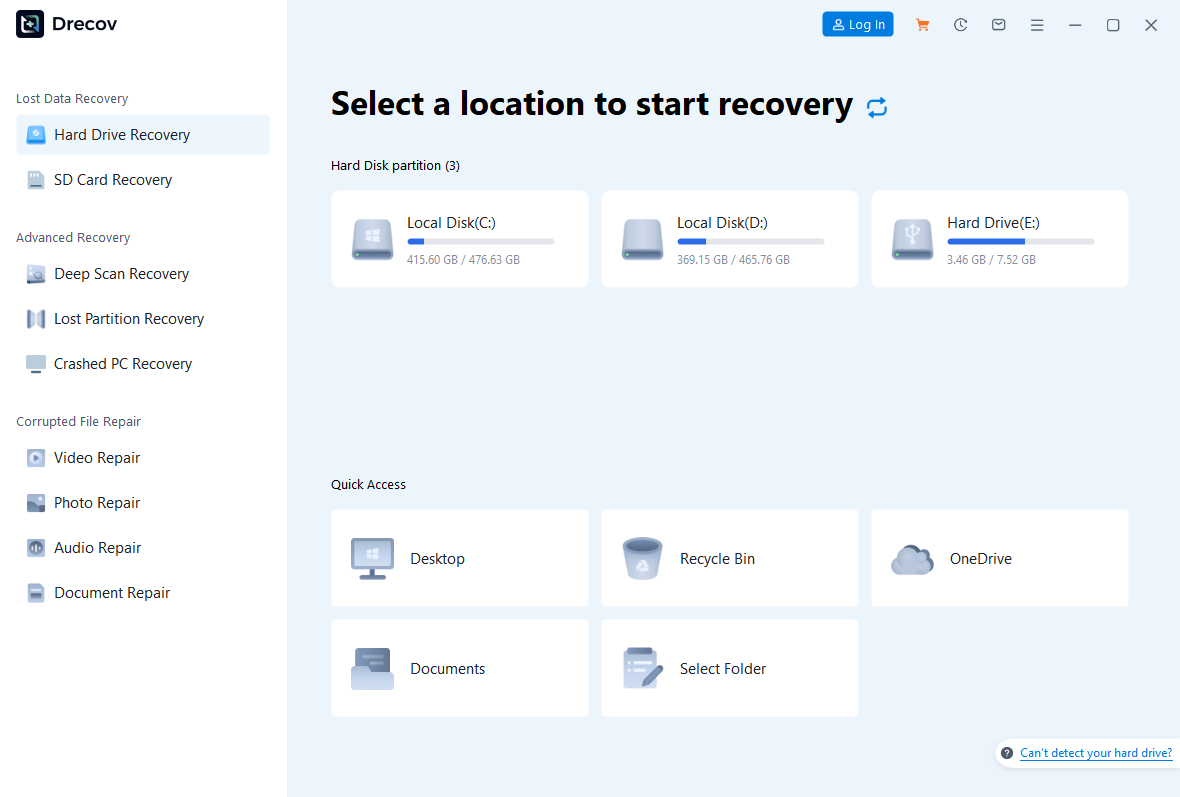
Step 2: Run Quick Scan and review the likely paths
Begin the The User Profile Service Failed the Sign-In search with Quick Scan. Browse its relevant former folder structure; then narrow candidates by available filename, date, location, and file-type filters.
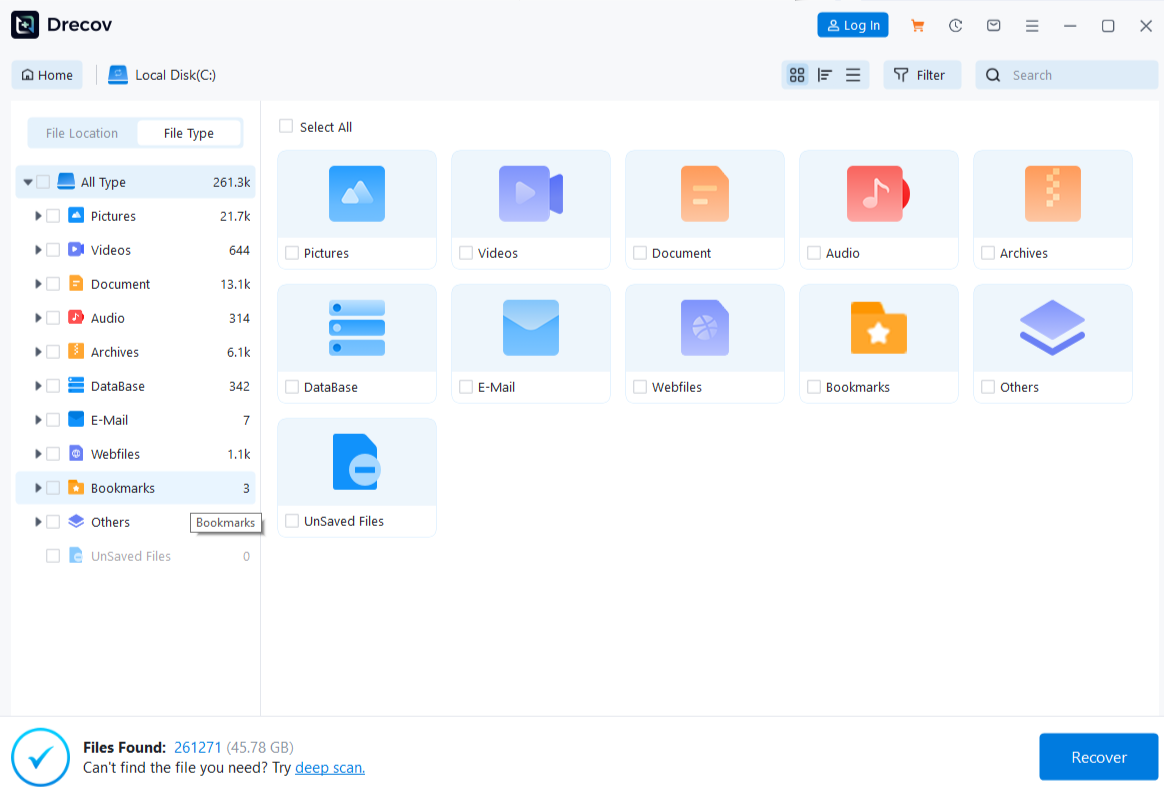
Step 3: Continue with Deep Scan only on stable media
Run Deep Scan for this The User Profile Service Failed the Sign-In case only when required files remain absent and the device stays connected without severe read errors. Physical instability ends direct scanning.
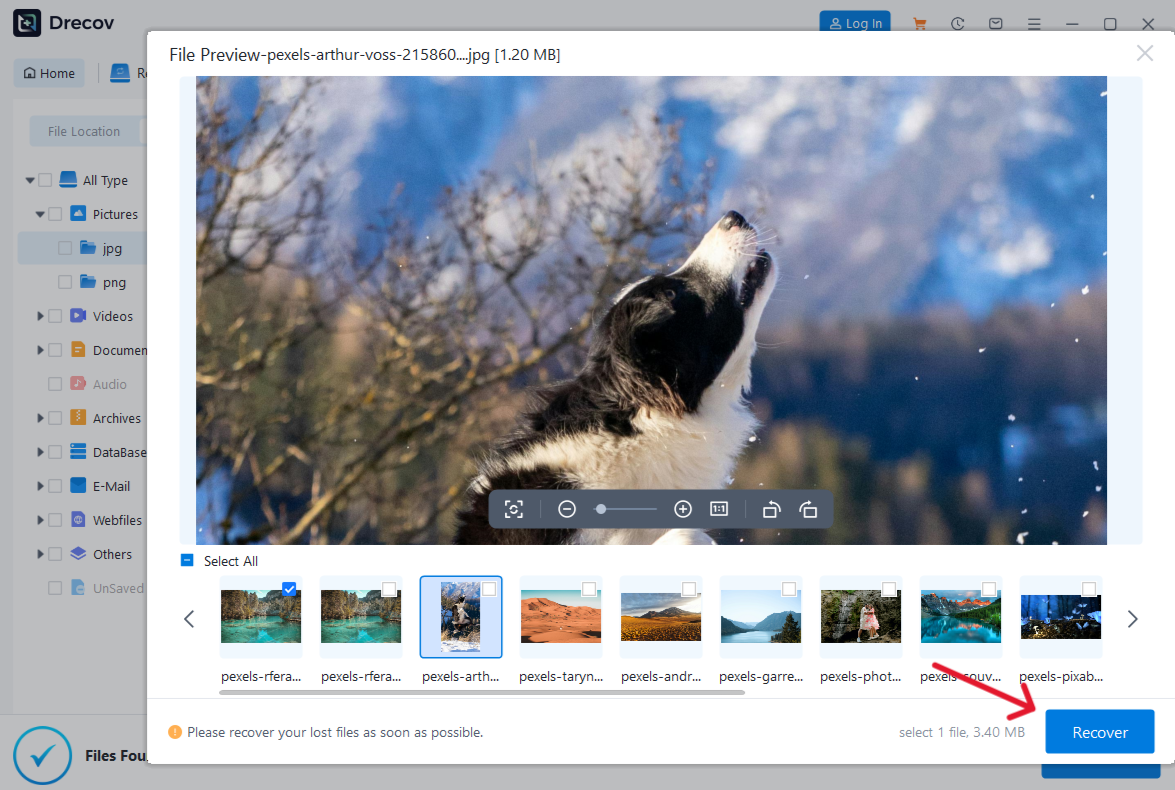
Step 4: Preview representative candidates
Preview several supported candidates related to The User Profile Service Failed the Sign-In before selecting the set. A readable sample provides useful evidence without certifying every page, frame, attachment, or linked object.
Step 5: Recover to another healthy device and verify
Save this The User Profile Service Failed the Sign-In recovery set away from the source. If output seems absent, check the Drecov folder or Recovery folder; open representative samples before any repair or deletion.
⚠ Warning: Install it on a drive different from the one where your data was lost to prevent overwriting.
the user profile service failed the sign-in FAQs
Will restarting delete my old profile?
An ordinary restart does not normally delete it, but work created inside a temporary profile can be lost at sign-out. Save that work externally first.
Should I rename the profile folder?
Not before confirming the SID and ProfileImagePath mapping. Renaming the folder alone can leave Windows pointing to a path that no longer exists.
Can System Restore recover my documents?
System Restore targets system state, not personal-file backup. Preserve documents separately and use recovery methods when files are actually missing.
Why does another account still work?
That result narrows the fault to one profile, its permissions, or its registry mapping rather than the entire sign-in service.
When should I stop DIY repair?
Stop when the system disk disconnects, reports severe read errors, changes capacity, or contains irreplaceable data that has not been imaged.
Conclusion
A successful sign-in is not enough. Confirm that the correct profile path is active, newly created files remain after sign-out, cloud clients use the intended account, and applications find their data. Only after the backup and new profile pass those checks should the obsolete account or folder be considered for removal.
⚠ Warning: Install it on a drive different from the one where your data was lost to prevent overwriting.






