







When Google Drive does not sync, do not begin by unlinking the account or deleting its cache. First copy every locally edited file that has not reached drive.google.com to a neutral healthy folder outside the managed Drive path. Record the account, affected folder, status icon, and exact error so local and cloud states are not accidentally reversed.
Protect Files That Have Not Reached the Cloud
Open Drive for desktop from the taskbar and inspect activity and errors. Compare the same folder in the web interface. A local-only file, cloud-only file, and conflicting pair each require a different decision. Use timestamps and content, not just filenames, to identify the newest complete version.
Check that the intended Google account is active. Shared-drive membership, ownership, or edit permission may have changed even though the desktop app is healthy. Ask the owner to restore access rather than repeatedly moving the item in and out of the sync folder.
Read the Sync Status Instead of Guessing
Network and proxy restrictions can stop communication while leaving cached files visible. Test a normal browser upload to the same account and review firewall or proxy policy. Avoid disabling enterprise security controls; involve the administrator when the device is managed.
Both Google storage and local disk space matter. A full cloud quota can block uploads, while a full system disk can prevent cache or mirrored-file updates. Free space by moving verified unrelated data, not by deleting unknown Drive cache directories.
Separate Account, Network, and Storage Limits
Drive for desktop offers Stream and Mirror modes. Stream minimizes local storage and downloads content on demand; Mirror keeps a full local copy. Google advises ensuring recent changes have synchronized before switching modes, especially from Mirror to Stream, because unsynced local changes can otherwise be lost.
Shared drives use streaming behavior, while folders from the computer are handled differently. Identify which category contains the problem before following a path-reset instruction. A drive letter conflict on Windows can also prevent the streamed location from mounting.
Understand Stream and Mirror Before Moving Folders
For one failed file, inspect invalid characters, path length, open application locks, permissions, ownership, and whether the cloud item was deleted or unshared. Google notes that some failed items may be moved to Lost and Found. Copy anything valuable there before disconnecting the account because that folder can be removed during disconnection.
Do not use third-party cleaners on Drive configuration or cache while changes are pending. Google warns that cleaner applications can alter configuration and contribute to data loss. Restarting Drive is low risk; disconnecting, reinstalling, or changing the sync root requires a protected copy first.
Resolve File-Level Conflicts Deliberately
If the web copy is correct and local placeholders are stale, refresh or rebuild the local connection after preserving local-only work. If the local copy is correct, upload a renamed verified copy before deleting the conflicting cloud item. Keep both until collaborators confirm the intended version.
Drecov cannot restore cloud-only Google Docs content from a Windows disk or repair Google’s service. It is relevant when a locally stored or mirrored file was deleted from a stable recognized Windows drive and is absent from Drive trash, version history, backups, and Lost and Found.
⚠ Warning: Install it on a drive different from the one where your data was lost to prevent overwriting.
Recover a Missing Local Copy With Drecov
Stop using the source partition and prepare another healthy destination. Open Drecov, select the original local loss location, and run Quick Scan. Search by filename, former Drive path, date, and type; preview representative files. If necessary and the drive remains stable, continue with Deep Scan.
Recover selected files to the separate destination, never into the active sync root or back to the source. Check the Drecov folder or Recovery folder if output is not where expected. Open and verify the files offline before uploading copies to Drive, so a corrupt result is not propagated to collaborators.
⚠ Warning: Install it on a drive different from the one where your data was lost to prevent overwriting.
Use neighboring guidance only when the evidence matches: see missing synced Google Drive folder, Google Drive file recovery options, or moving data between OneDrive and Google Drive. If a separate event has actually deleted local files, PandaOffice Drecov provides a Windows recovery path; it is not a substitute for diagnosing the problem described here. Current platform-specific facts are documented in the Google’s Drive for desktop troubleshooting.
Build a Reproducible Case Before Escalating
Create a short case record covering local copy, web copy, account, mode, and pending queue. Include the exact wording, time, account or device involved, and the last known-good state. Reproduce the symptom once with the fewest variables possible. This record is more useful than a collection of screenshots taken after several settings have already changed.
Before unlinking or changing sync mode, preserve the current working material and note how to undo the change. Apply one action that directly matches the evidence, then repeat the same test. If access becomes worse or a new error appears, stop and roll back instead of adding another speculative fix.
Compare scope around local copy, web copy, account, mode, and pending queue: one file versus every file, one account versus every account, and one device versus the whole computer. A narrow failure deserves a response narrower than unlinking or changing sync mode. Broad resets can erase useful evidence and create extra work without resolving this boundary.
Verification must include a two-direction test after restart. Observe the result long enough to catch delayed recurrence. Keep backups, logs, and the previous configuration until the corrected state survives ordinary work; an isolated successful click is not a completed diagnosis.
This page intentionally does not absorb cloud-only content recovery. Those tasks have different evidence and expected answers. Keeping that boundary clear protects users from irrelevant commands and prevents a seemingly related symptom from turning into an unsafe all-purpose repair sequence.
Check the Details That Common Fix Lists Miss
A clean comparison is more valuable than another reset. Note whether the symptom began after an update, account change, new peripheral, power event, synchronization conflict, or application crash. Compare that moment with local copy, web copy, account, mode, and pending queue. A change that immediately precedes the failure is a hypothesis to test, not automatic proof of cause.
Keep original material available while testing. Copy readable files, export settings when the application supports it, and record current versions before unlinking or changing sync mode. Screenshots are useful for messages, but plain-text logs, filenames, timestamps, and version numbers are easier to compare after a restart.
Use a known-good control that resembles the failing case. That may be another account, file, device, cable, application, or network. The control must change one meaningful variable while leaving the rest of local copy, web copy, account, mode, and pending queue intact. Otherwise, success cannot identify which difference mattered.
Negative evidence matters for local copy, web copy, account, mode, and pending queue. When the problem does not follow the tested file, account, or device, avoid modifying that item further. When it follows consistently, a system-wide response may still be excessive until a two-direction test after restart has been observed. This boundary removes many implausible causes.
Before accepting the result, perform a two-direction test after restart. Then inspect logs or status indicators for warnings that did not reach the screen. A workaround that merely suppresses the message is weaker than a correction that restores normal behavior without disabling security, backup, updates, or verification.
Document what remains uncertain. If escalation is needed, provide the original symptom, protected-copy location, steps already tested, and observations about local copy, web copy, account, mode, and pending queue. That package helps support staff avoid repeating risky work and makes it clear that cloud-only content recovery was deliberately kept outside this repair path.
Additional Checks for This Specific Case
Collaboration adds a final identity check. A shortcut, shared-drive item, and file owned by another account can appear in similar folders while carrying different rights. Confirm the owner and target location in the web interface. When a teammate expects your changes, upload a clearly named safety copy and ask them to verify it before removing either version.
⚠ Warning: Install it on a drive different from the one where your data was lost to prevent overwriting.
Step 1: Open Drecov and select the original loss location
For the Google Drive Does Not Sync? Protect Pending Files First loss branch, use the stable source that actually held the missing files. Keep installation away from that source, and prepare another healthy device for recovered output in this case.

Step 2: Run Quick Scan and review the likely paths
Begin the Google Drive Does Not Sync? Protect Pending Files First search with Quick Scan. Browse its relevant former folder structure; then narrow candidates by available filename, date, location, and file-type filters.

Step 3: Continue with Deep Scan only on stable media
Run Deep Scan for this Google Drive Does Not Sync? Protect Pending Files First case only when required files remain absent and the device stays connected without severe read errors. Physical instability ends direct scanning.
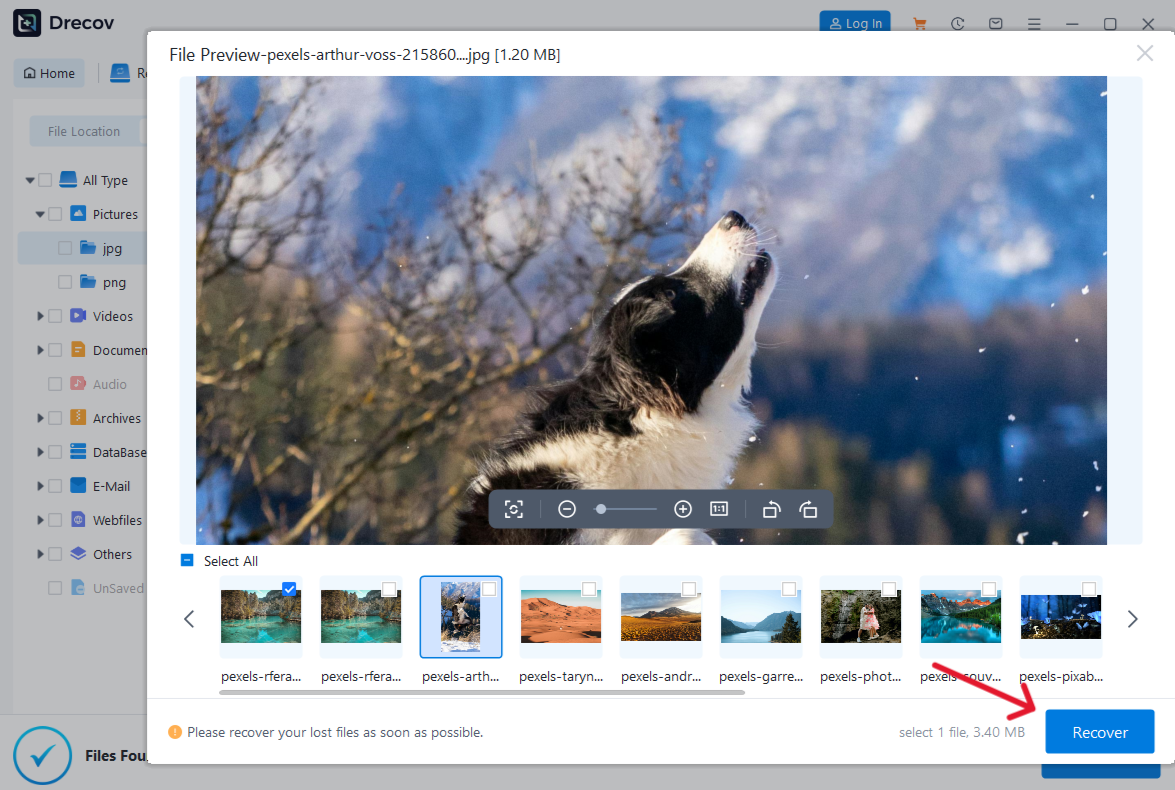
Step 4: Preview representative candidates
Preview several supported candidates related to Google Drive Does Not Sync? Protect Pending Files First before selecting the set. A readable sample provides useful evidence without certifying every page, frame, attachment, or linked object.
Step 5: Recover to another healthy device and verify
Save this Google Drive Does Not Sync? Protect Pending Files First recovery set away from the source. If output seems absent, check the Drecov folder or Recovery folder; open representative samples before any repair or deletion.
⚠ Warning: Install it on a drive different from the one where your data was lost to prevent overwriting.
Five Questions About Drive Sync
Should I disconnect my account first?
No. Copy unsynced files and inspect Lost and Found first; Google warns that the folder may be deleted when the account is disconnected.
What is the difference between Stream and Mirror?
Stream keeps most content online and downloads on demand; Mirror maintains local copies and uses more disk space.
Why does one file refuse to sync?
Permissions, ownership, an open handle, invalid path, corruption, deletion, or conflicting cloud changes may affect that item alone.
Can Drecov recover a Google Doc?
Not cloud-only document content. It can search for locally stored supported files that were deleted from stable Windows storage.
How do I prove sync works again?
Create, upload, download, and edit a harmless test file in both directions, then repeat after restarting Drive for desktop.
Conclusion
After repair, create a small test file locally, confirm it appears on the web, edit it on the web, and confirm the change returns to the desktop. Test after a restart and inspect remaining error activity. Only then remove protected duplicates or old sync roots.
⚠ Warning: Install it on a drive different from the one where your data was lost to prevent overwriting.






