







PFN list corrupt is bug check 0x4E. Preserve crash evidence, test memory and drivers, and protect local files before reset or reinstall. Use dump patterns, RAM diagnostics, driver history, and controlled retesting to isolate PFN_LIST_CORRUPT while keeping local data safe. Begin with 0x4e repeats with one module, preserve irreplaceable local data, and change one condition at a time so the result remains meaningful. This guide explains “pfn list corrupt” with practical checks that protect important files before system or storage changes.
Understand What the PFN Stop Code Actually Says
PFN_LIST_CORRUPT is bug check 0x4E. The page frame number list tracks physical memory pages, and the stop means Windows detected corruption in that accounting data. The code does not by itself decide whether RAM, a driver, storage corruption, or another hardware path caused it. memory-management BSOD The fact behind 0x4e repeats with one module is documented in the official source for this topic.
| Evidence | Meaning | Next decision |
|---|---|---|
| 0x4E repeats with one module | Driver involvement is plausible | Verify provider and change history |
| Different BSOD codes rotate | Memory or broad instability | Test RAM and power |
| Crash follows sleep | Power transition or driver | Compare supported rollback |
| Errors start after adding RAM | Module, slot, or settings | Return to supported configuration |
| Disk events occur nearby | Storage can corrupt loaded data | Protect files and inspect disk path |
| Windows cannot remain booted | Data access is at risk | Recover before reset |
Evidence-Based Diagnostic Walkthrough
Each observation below narrows one decision for 0x4e repeats with one module. Retest the original symptom after the matching action before escalating, with 0x4e repeats with one module used as the comparison point.
0x4E repeats with one module
Read this result in context: driver involvement is plausible. Verify provider and change history and record the new timing, message, or detection state. For 0x4e repeats with one module, preserve readable data before any test that writes, removes access, changes boot behavior, or places sustained load on the device.
Different BSOD codes rotate
Treat this observation as a branch: memory or broad instability. Test RAM and power and record the new timing, message, or detection state. For different bsod codes rotate, preserve readable data before any test that writes, removes access, changes boot behavior, or places sustained load on the device.
Crash follows sleep
Use this evidence to narrow the cause: power transition or driver. Compare supported rollback and record the new timing, message, or detection state. For crash follows sleep, preserve readable data before any test that writes, removes access, changes boot behavior, or places sustained load on the device.
Errors start after adding RAM
Let this finding limit the next action: module, slot, or settings. Return to a supported configuration and compare 0x4e repeats with one module after restart. For errors start after adding ram, preserve readable data before any test that writes, removes access, changes boot behavior, or places sustained load on the device.
Disk events occur nearby
Connect this symptom to the safest test: storage can corrupt loaded data. Protect files and inspect disk path and record the new timing, message, or detection state. For disk events occur nearby, preserve readable data before any test that writes, removes access, changes boot behavior, or places sustained load on the device.
Windows cannot remain booted
Interpret this state before changing anything: data access is at risk. Recover before reset, then record how 0x4e repeats with one module changes afterward. For windows cannot remain booted, preserve readable data before any test that writes, removes access, changes boot behavior, or places sustained load on the device.
Save Crash Evidence and Personal Files
Keep minidumps, photographs, event times, and a list of recent hardware, firmware, security, and driver changes. Copy unique files before prolonged stress tests. Avoid changing RAM timings and multiple drivers together because the result becomes impossible to interpret. storage evidence Define success for save crash evidence and personal files and identify the condition that ends DIY work. A changed message alone does not prove the underlying device, file, application, or Windows installation is healthy, with 0x4e repeats with one module used as the comparison point.
Recover Data When Repeated 0x4E Crashes Block Access
Use Drecov only when local files are inaccessible and the source disk remains stable. For this 0x4e repeats with one module situation, PandaOffice Drecov provides a read-only Windows recovery workflow with Quick Scan, Deep Scan, filters, supported-file preview, Lost Partition Recovery, and a selectable healthy destination. It cannot repair hardware or recreate overwritten data.
⚠ Warning: Install it on a drive different from the one where your data was lost to prevent overwriting.
Step 1: Choose With the Original Loss Location
Open PandaOffice Drecov from healthy Windows and select the stable system disk through another working Windows computer. Install and run the software away from the partition that lost data, with 0x4e repeats with one module used as the comparison point. A source showing disk events occur nearby or severe instability should be imaged or referred to a professional instead of scanned repeatedly.
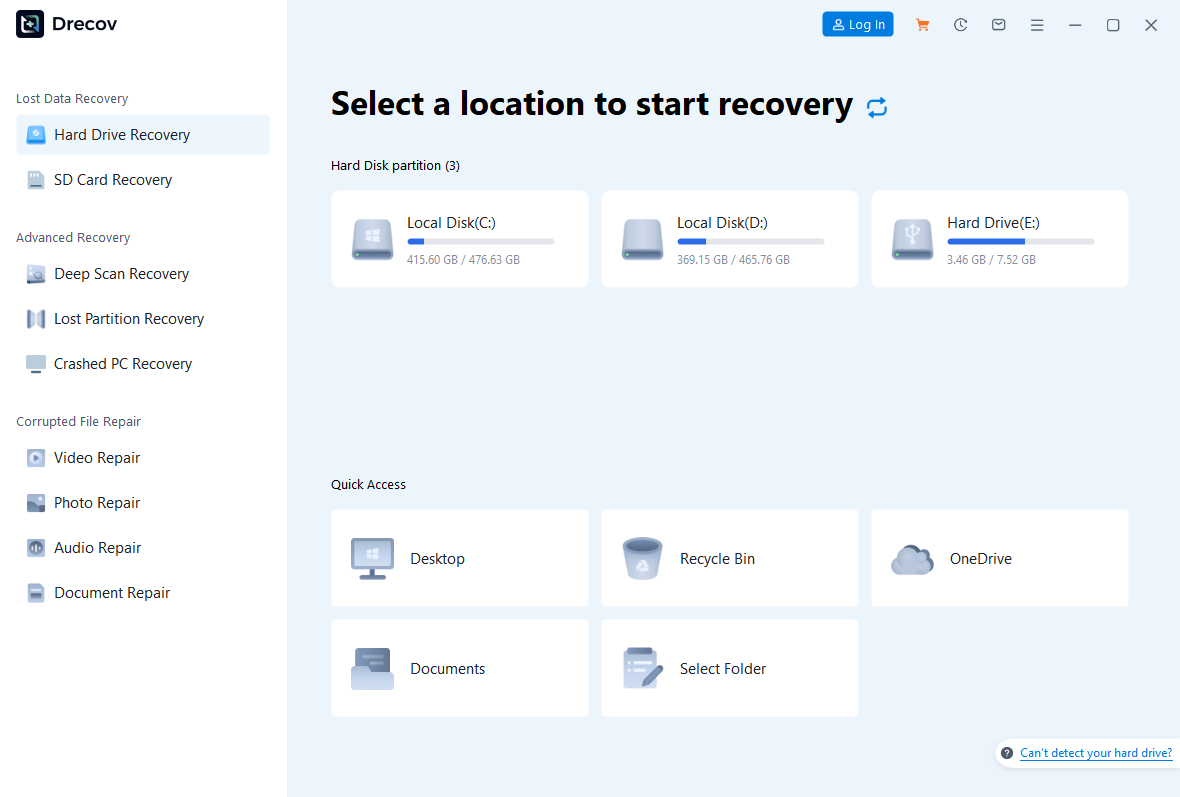
Step 2: Expand From Quick Scan to Deep Scan
Use Quick Scan for recent deletion or a newly missing path. Continue to Deep Scan only if crash follows sleep leaves required data absent and the device stays stable. Choose Lost Partition Recovery when a partition entry vanished; do not create a replacement volume first, with 0x4e repeats with one module used as the comparison point. Find user folders and current projects by name, path, date, and file type.

Step 3: Confirm With Preview and a Separate Destination
Preview files that represent the important result set, including the types central to this topic, with 0x4e repeats with one module used as the comparison point. Save the selection to another healthy physical device rather than the source, with 0x4e repeats with one module used as the comparison point. When original paths cannot be reconstructed, review the Drecov folder or Recovery folder, with 0x4e repeats with one module used as the comparison point. Open documents and test archives before any Windows reset or reinstall.

Isolate Memory, Drivers, and Storage in Separate Tests
Read More Than One Dump
A recurring stack or module is stronger than a single name. Compare several crashes and the first failure after a clean boot. Before read more than one dump, note the starting condition and expected result. If that specific method leaves the symptom unchanged, avoid repeating it and use the new evidence to select a narrower branch, with 0x4e repeats with one module used as the comparison point. Keep a log or harmless test item for read more than one dump so the outcome can be compared after restart.
Return Memory to Supported Defaults
Disable overclocking or unsupported profiles and reseat modules only when safe and documented. Test one supported configuration at a time. Before return memory to supported defaults, note the starting condition and expected result. If that specific method leaves the symptom unchanged, avoid repeating it and use the new evidence to select a narrower branch, with 0x4e repeats with one module used as the comparison point. Keep a log or harmless test item for return memory to supported defaults so the outcome can be compared after restart.
Run Memory Diagnostics
Use Windows Memory Diagnostic and a longer suitable test when crashes persist. Record which module and slot were present for each failure. Before run memory diagnostics, note the starting condition and expected result. If that specific method leaves the symptom unchanged, avoid repeating it and use the new evidence to select a narrower branch, with 0x4e repeats with one module used as the comparison point. Keep a log or harmless test item for run memory diagnostics so the outcome can be compared after restart.
Audit Recent Drivers
Roll back the change that matches the first crash or install a supported vendor package. Do not use an unknown bulk updater. Before audit recent drivers, note the starting condition and expected result. If that specific method leaves the symptom unchanged, avoid repeating it and use the new evidence to select a narrower branch, with 0x4e repeats with one module used as the comparison point. Keep a log or harmless test item for audit recent drivers so the outcome can be compared after restart.
Check Storage Evidence Separately
Disk, controller, or file-system errors can corrupt data read into memory. Recover first if the drive becomes unstable, then diagnose the path. Before check storage evidence separately, note the starting condition and expected result. If that specific method leaves the symptom unchanged, avoid repeating it and use the new evidence to select a narrower branch, with 0x4e repeats with one module used as the comparison point. Keep a log or harmless test item for check storage evidence separately so the outcome can be compared after restart.
Demand Repeatable Stability
Use normal memory settings, restart repeatedly, and reproduce the former trigger with nonessential data. Review for new 0x4E dumps and related WHEA or disk events. A quiet desktop is not equivalent to a passed workload. Windows repair commands Repeat the original low-risk action tied to demand repeatable stability. Keep the protected copy until results remain consistent and representative recovered files pass their content checks, with 0x4e repeats with one module used as the comparison point.
- Calling every 0x4E crash bad RAM
- Replacing drivers in bulk
- Stress-testing while important files exist only locally
- Ignoring storage events near the crash
- Reinstalling before checking hardware
PFN_LIST_CORRUPT Questions
What is a PFN list?
It is Windows memory-management bookkeeping for physical page frames.
Does 0x4E prove RAM failed?
No. RAM is important to test, but drivers and other corruption paths can contribute.
Can SFC repair the PFN list?
SFC repairs protected system files, not defective memory or a faulty driver.
Should I reset Windows?
Only after files are safe and hardware and driver evidence has been checked.
Does Drecov fix PFN_LIST_CORRUPT?
No. It recovers files from stable storage when crashes prevent normal access.
Conclusion
PFN list corrupt requires evidence from repeated dumps, supported memory settings, diagnostics, and driver history. Protect local work before stress testing or reinstalling. When stable storage is inaccessible because Windows cannot stay running, Drecov can recover files to another healthy device; it does not repair RAM, drivers, or bug check 0x4E.






