







A machine check exception means the processor reported a serious hardware condition to Windows. It does not identify one failed part by itself. Heat, unstable voltage, overclocking, memory, CPU, motherboard, power, firmware, or another hardware path may be involved. If Windows still starts, protect irreplaceable files before stress tests, firmware changes, component swaps, or repeated crash cycles. If a drive clicks or disappears, stop and treat that storage device as a separate physical-risk case.
What the Machine Check Exception Actually Tells You
The processor records machine-check information when hardware detects an error it cannot safely ignore. Windows may stop to prevent continued execution with unreliable state. The visible phrase is therefore a category of evidence, not a diagnosis of a particular component.
A single event after a power interruption differs from a repeatable crash under load. Note the stop message, time, workload, temperatures, recent upgrades, BIOS changes, and whether Windows created a dump. Those details form a useful timeline without forcing the computer through the failure again.
Do not download random DLL files or registry cleaners. They cannot correct an electrical, thermal, or silicon fault. Begin with stability, evidence, and a protected copy of important data.
Choose the Safe Branch From the Current State
If the computer reaches Windows and remains stable at idle, copy the most valuable user files first. Use ordinary file copying when it completes without errors. Avoid a huge all-at-once job if the system resets under sustained load; smaller verified groups expose less data to an interrupted transfer.
When crashes occur only during gaming, rendering, or benchmarking, stop the workload. Return CPU, GPU, and memory settings to vendor defaults. Remove undervolting and overclock profiles. Do not start another stress test until essential files have a verified copy.
A machine that resets in firmware, fails before Windows, smells hot, or shows power irregularities needs hardware attention. Repeated boot attempts add heat and may worsen an unstable power or storage condition. Power down and seek qualified diagnosis when basic non-invasive checks are unsafe.
Create a File Checkpoint Before Hardware Tests
Start with documents, active projects, financial records, photos, and unique exports. Copy them to a healthy external device or confirmed cloud destination. Open samples from the destination rather than trusting the progress bar. Record any file that fails to copy.
If BitLocker protects the Windows drive, preserve the recovery key through an approved account or printed record. Motherboard firmware changes and hardware replacement can trigger recovery-key requests. A backup that cannot be unlocked is not an adequate checkpoint.
Do not run CHKDSK merely because the computer crashed. A machine check exception is not proof of file-system damage, and CHKDSK writes metadata. Address accessible data and hardware stability before any write-heavy repair.
Use Drecov Only on Stable, Detectable Storage
PandaOffice Drecov is Windows data-recovery software for PCs, HDDs, SSDs, external drives, USB devices, SD cards, and memory cards. It can search for supported documents, photos, video, audio, email, and archives using read-only recovery mode, Quick Scan, Deep Scan, filters, preview, and recovery to another healthy location. Lost Partition Recovery is available when a partition disappears.
⚠ Warning: Install it on a drive different from the one where your data was lost to prevent overwriting.
Here, Drecov has a narrow role: recovering files that became deleted, inaccessible, or lost after crashes when the source storage remains stable and correctly detected. It cannot repair a processor, memory module, motherboard, power supply, thermal problem, or physically failing drive. Stop scanning if a disk clicks, repeatedly disconnects, reports changing capacity, or causes severe read stalls.
Drecov Steps After a Stable Machine Check Exception
Step 1: Open Drecov and select the original data location
Prepare a healthy external destination first. Do not install Drecov on the partition that held the missing files. Open Drecov from stable Windows or a suitable safe setup, then select the original folder, partition, or detectable device. Use Lost Partition Recovery only if the partition itself is gone.
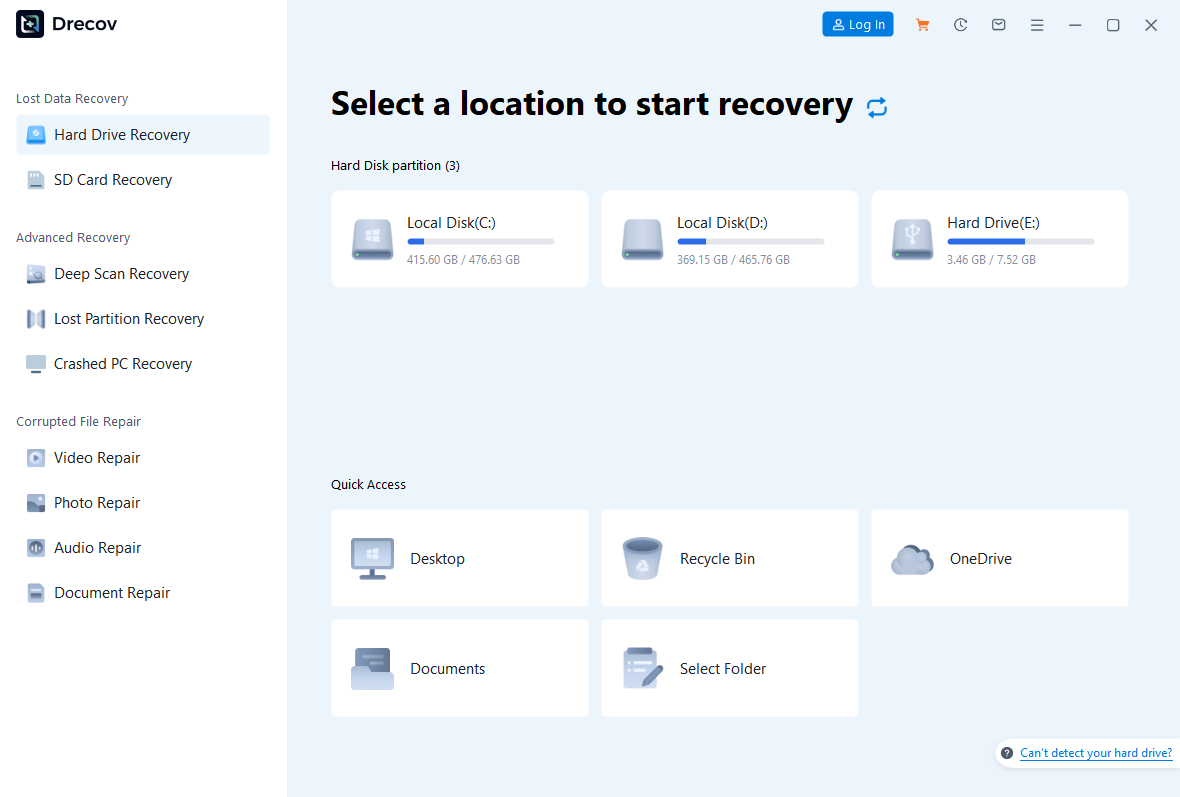
Step 2: Run Quick Scan and inspect the former paths
Begin with Quick Scan. Check the user profile, project folders, Desktop, Documents, and the exact location involved before the crash. Keep the computer at stock settings and stop if instability returns.

Step 3: Use Deep Scan only while the source remains reliable
If Quick Scan misses the target and the device reads consistently, continue with Deep Scan. Deep scanning increases read activity. End the session if disconnects, clicks, overheating, or escalating errors appear.

Step 4: Filter and preview representative candidates
Filter by file type, former path, name, date, and size. Preview several supported files. A preview helps identify readable candidates but cannot certify every worksheet, frame, archive member, or linked project asset.
Step 5: Recover elsewhere and verify before repairs
Recover to the healthy destination, never back to the source. Check Drecov Folder or Recovery Folder if output is not where expected. Open samples, compare sizes, and make a second copy before stress tests, firmware updates, component swaps, reinstalling Windows, or formatting.
Test One Hardware Variable at a Time
After data is protected, load firmware defaults and observe normal use before stress testing. Check cooling airflow, fan operation, dust blockage, and temperatures with trusted tools. Never open a power supply; stored electrical energy is dangerous.
Reseat or isolate components only if you understand the hardware and have powered down safely. Recent RAM, GPU, storage, or power changes deserve attention. Change one variable, document the result, and avoid interpreting one successful boot as proof of stability.
Memory diagnostics can reveal some RAM faults, but a pass does not clear every controller, board, voltage, or intermittent error. Professional testing is appropriate when the crash is repeatable, hardware is under warranty, or safe isolation is not possible.
Verify the Result Instead of Declaring an Early Win
A useful validation period includes cold starts, idle time, normal applications, and the workload that previously triggered the event. Watch for corrected hardware warnings, new stop codes, thermal spikes, and storage errors. Do not immediately combine several demanding tests.
Confirm that protected files remain readable after the system has stabilized. Reopen documents, inspect media at several positions, and test archives. Keep the backup separate while diagnosis continues.
If the machine check exception returns at default settings, stop treating it as a software nuisance. Collect timestamps and service information, then arrange hardware support rather than repeatedly forcing crashes.
Questions About Machine Check Exception
Is a machine check exception always the CPU?
No. The processor reports the event, but memory, board, power, cooling, firmware, or another hardware path can contribute.
Can reinstalling Windows fix it?
A reinstall may remove a software variable, but it cannot repair faulty hardware. Protect files and test stability first.
Should I run a stress test immediately?
No. Back up accessible data and return settings to defaults before adding heavy load to an unstable machine.
Can Drecov fix the blue screen?
No. Drecov recovers lost data from stable detectable storage; it does not repair hardware or Windows stop codes.
Related reading includes Drecov for Windows recovery, advice for protecting files after Windows crashes, the System Service Exception workflow, and memory-focused PFN checks. Microsoft defines the architecture behind these reports in its WHEA reference.
Separate a Crash Record From Storage Damage
A machine check exception can interrupt a save and leave an application file incomplete. That does not automatically mean the disk failed. Compare the file’s size with a backup and inspect the storage health separately. If ordinary copies complete cleanly and the disk remains consistently detected, logical recovery may be reasonable after the system is stabilized.
Conversely, a storage device that vanishes, clicks, or changes capacity should not be cleared by a successful memory test. Stop reading that device. Hardware faults can coexist, and forcing a long scan through unstable storage may reduce the chance of later professional recovery.
Keep crash dumps, timestamps, and diagnostic results on the backup destination, not only on the troubled computer. They help a technician correlate the event with temperatures, component changes, and firmware versions. Avoid deleting logs with cleanup software while diagnosis is active.
If the PC must be transported, shut it down rather than leaving it in sleep. Disconnect nonessential external devices after recording where they were attached. For a desktop, do not move components while power is connected. These precautions protect both data and the integrity of later tests.
Once service is complete, compare the hardware configuration and firmware settings with the recorded baseline. Restore files from the verified backup, then monitor normal workloads. Keep the original backup unchanged until the computer has remained stable and the restored projects have passed application-level checks.
A written baseline keeps later diagnosis disciplined.
Conclusion
A machine check exception is a hardware-reported stability warning, not permission to try random repairs. Protect accessible files, preserve BitLocker information, return experimental settings to defaults, and test one variable at a time. If crashes caused real file loss on stable, detectable storage, Drecov can scan for candidates and recover them to another healthy device. Repeated crashes, power symptoms, or unstable disks require hardware-focused help.






