







Understanding AI Photo Recovery Technology
How AI Improves Photo Recovery Accuracy
The concept of an AI photo recovery tool has evolved from traditional file retrieval to intelligent reconstruction and enhancement. Instead of only scanning storage sectors, AI-powered systems analyze image patterns, metadata, and pixel structures to improve recovery success rates.
AI can assist in two major ways. First, it enhances the ability to locate lost files through intelligent scanning and classification. Second, it helps reconstruct damaged or partially overwritten images by predicting missing visual information.
Unlike conventional recovery methods, AI-driven approaches can identify fragmented image data and reassemble it more effectively. This is especially useful when dealing with corrupted SD cards, formatted drives, or incomplete file systems.
Another key advantage is automation. AI reduces manual effort by automatically sorting recoverable files, filtering duplicates, and highlighting high-quality recoverable images. This makes it easier for users to quickly find important photos.
However, AI is not a magic solution. If data has been completely overwritten, recovery may still be impossible. That’s why combining AI enhancement with proper recovery tools is essential.
Why Photos Get Lost or Damaged
Common Causes Behind Photo Loss
Before choosing an AI photo recovery tool, understanding the root causes of data loss can significantly improve recovery success.
One of the most common reasons is accidental deletion. Users may mistakenly remove photos from cameras, SD cards, or storage devices without realizing their importance. In such cases, the data still exists temporarily until overwritten.
Another major cause is formatting. When a storage device is formatted, the file system is reset, but the underlying data may remain recoverable with advanced tools.
Device corruption is also a frequent issue. SD cards and USB drives can become unreadable due to improper ejection, file system errors, or physical damage. This often leads to inaccessible photos rather than complete deletion.
Virus attacks and software crashes can also result in photo loss. Malicious programs may delete or hide files, while system failures can interrupt file-saving processes, leading to incomplete or corrupted images.
⚠️ Warning: Continuing to use a device after data loss can overwrite recoverable data and reduce the chances of successful recovery.
AI-Based Photo Recovery Methods Using Advanced Tools
Method 1: Recover Photos with Disk Drill
Disk Drill uses intelligent scanning algorithms that mimic AI logic to identify lost photos based on file signatures and storage patterns.
Test Environment:
Windows 11 PC, 64GB SD card (formatted), JPEG and RAW photo files
Steps:
- Install and launch Disk Drill on your computer
- Insert the SD card or connect your storage device
- Select the target drive from the device list
- Click “Search for Lost Data” to start scanning
- Wait for both quick scan and deep scan to complete
- Use filters like “Pictures” to narrow results
- Preview recoverable photos
- Select files and click “Recover” to save them
This method is effective for recovering deleted or formatted photos with minimal effort.
Method 2: Deep Recovery with PhotoRec
PhotoRec applies pattern recognition to recover files without relying on file systems, making it powerful for damaged drives.
Test Environment:
Windows 10, corrupted USB drive, mixed image formats
Steps:
- Download and extract PhotoRec
- Launch the application (command-line interface)
- Select the target disk from the list
- Choose the partition type
- Select file formats (e.g., JPG, PNG)
- Choose a destination folder
- Start scanning for recoverable files
- Wait until the recovery process completes
This approach is particularly useful when file systems are severely damaged.
Method 3: Smart Reconstruction via Stellar Photo Recovery
Stellar Photo Recovery combines deep scanning with intelligent reconstruction to recover partially damaged images.
Test Environment:
MacBook, formatted SD card from DSLR camera
Steps:
- Install Stellar Photo Recovery
- Open the software and select “Photo Recovery”
- Choose the storage device
- Enable “Deep Scan” for better results
- Start scanning
- Preview recovered files
- Use filters to locate specific photos
- Recover selected images
This method is ideal for photographers working with RAW files.
Method 4: Organized Recovery with Remo Recover
Remo Recover uses intelligent indexing to categorize files, making recovery more efficient.
Test Environment:
Windows 11 laptop, deleted photos from external HDD
Steps:
- Install and open Remo Recover
- Select the drive containing lost photos
- Start scanning process
- Wait for completion
- Browse results using file type categories
- Preview files before recovery
- Select required photos
- Save them to a secure location
This tool is useful when dealing with large amounts of data.
Method 5: AI Photo Repair Using Adobe Photoshop
Adobe Photoshop provides AI-powered features to reconstruct damaged or incomplete images.
Test Environment:
Windows PC, partially corrupted image file
Steps:
- Open the damaged image in Photoshop
- Use “Neural Filters” for AI enhancement
- Apply “Content-Aware Fill” to missing areas
- Use “Remove Tool” for imperfections
- Adjust sharpness and clarity
- Export the repaired image
This method works best for repairing rather than recovering files.
Method 6: AI Enhancement with Remini
Remini uses deep learning to restore blurry or low-quality images.
Test Environment:
iPhone, low-resolution and blurred photos
Steps:
- Install and open Remini
- Upload the photo you want to enhance
- Select “Enhance” mode
- Wait for AI processing
- Compare before and after results
- Save the improved image
This tool is ideal for restoring old or degraded photos.
Method 7: Recover Lost Photos with Pandaoffice Drecov
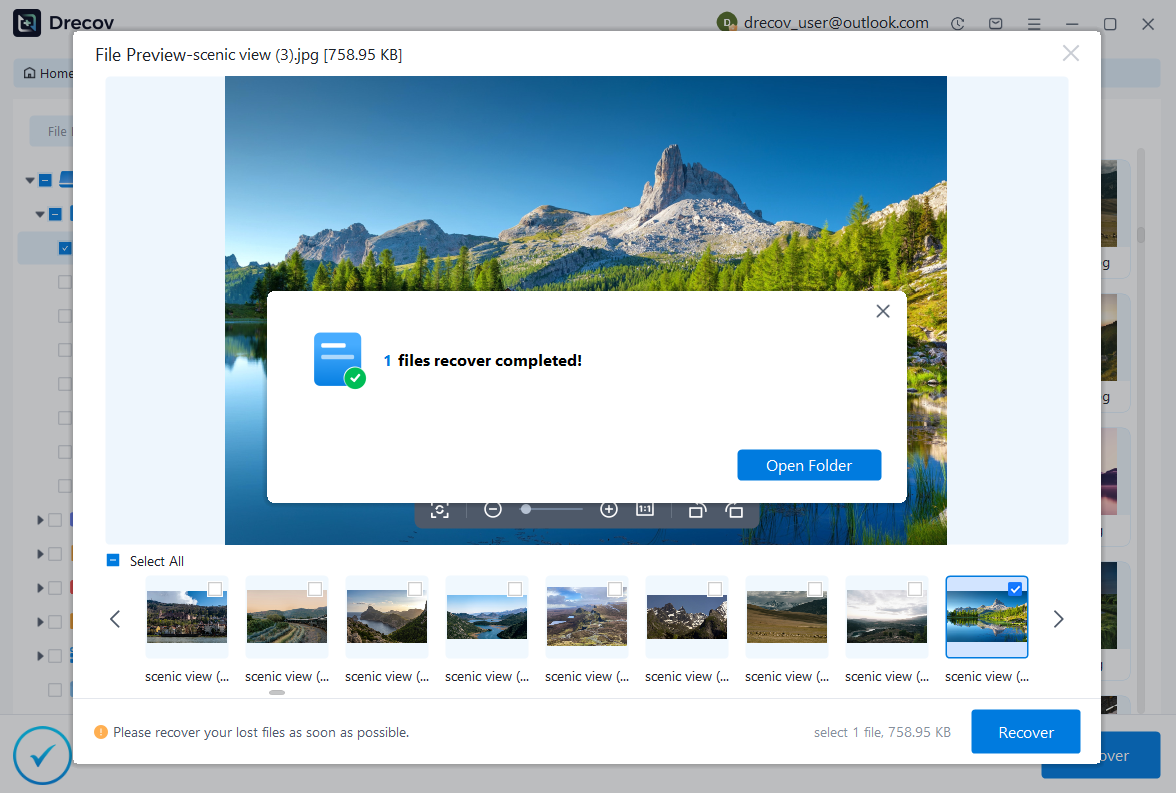
Download DrecovUnlike AI enhancement tools that focus on improving image quality, Pandaoffice Drecov is designed specifically for data recovery from storage devices. It helps retrieve deleted, formatted, or inaccessible photos before any AI processing is applied.
This makes it an essential step in the overall workflow when using an AI photo recovery tool, because you must first recover the original files before enhancing them.
Test Environment:
Windows 11 PC, 64GB SD card (accidentally deleted photos), file formats: JPG, PNG
Steps:
- Install Pandaoffice Drecov on your computer
- Connect the storage device (SD card, USB, or external drive)
- Launch the software and select the target drive
- Start a scan (quick scan begins automatically)
- Allow the deep scan to run for more complete results
- Browse recovered files by file type or original path
- Preview images to confirm they are intact
- Select the photos you want and click “Recover”
- Save them to a different drive to avoid overwriting


Why Choose PandaOffice Drecov?
When it comes to reliable file data recovery, PandaOffice Drecov offers a balanced combination of performance, ease of use, and broad compatibility. Whether you’ve lost important business files or personal memories, it provides an efficient way to restore data from various loss scenarios, including system crashes, accidental deletion, and formatted drives.
For users looking for advanced Photo Data Recovery Software, PandaOffice Drecov supports a wide range of image formats and storage devices. It can recover high-quality photos from SD cards, cameras, and internal drives while preserving original resolution and file structure. This makes it especially useful for photographers and everyday users alike.
If you are dealing with storage device issues, its external hard drive recovery capability ensures that data can be retrieved from USB drives, HDDs, and SSDs with minimal effort. The software performs deep scans to locate hidden or lost files, even in complex situations like partition loss.
In addition, PandaOffice Drecov excels in Document Recovery, helping users restore essential files such as Word, Excel, and PDFs. It also supports powerpoint recovery, allowing you to retrieve unsaved or deleted presentation files quickly—ideal for professionals working under tight deadlines.
This method is especially useful when photos are lost due to deletion, formatting, or system errors. After recovery, users can further process images using AI-based tools such as enhancement or repair software.
⚠️ Warning: Never save recovered files back to the same device, as this may overwrite other recoverable data.
Comparison of 7 AI Photo Recovery Methods: Features, Pros, Cons & Ratings
| Method / Tool | Core Function | Advantages | Limitations | Best Use Case | Recommendation ⭐ |
|---|---|---|---|---|---|
| Disk Drill | Deep scan + file recovery | Easy to use, supports many formats, fast scanning | Limited free recovery, not AI-native | Recover deleted photos from drives | ⭐⭐⭐⭐☆ |
| PhotoRec | Raw file recovery (open-source) | Completely free, powerful deep recovery | No preview, complex interface | Advanced users recovering raw data | ⭐⭐⭐☆☆ |
| Stellar Photo Recovery | Media-focused recovery | High success rate, supports cameras & SD cards | Paid version required for full recovery | Professional photographers | ⭐⭐⭐⭐☆ |
| Remo Recover | Partition & file recovery | Recovers formatted and lost partitions | Slower scanning, UI not modern | Recover from corrupted drives | ⭐⭐⭐☆☆ |
| Adobe Photoshop | AI-based photo repair & enhancement | Advanced AI tools (Generative Fill, restoration) | Cannot recover deleted files | Fix damaged or low-quality photos | ⭐⭐⭐⭐☆ |
| Remini | AI photo enhancement | Excellent for face recovery, mobile-friendly | Limited control, subscription-based | Restore blurry portraits | ⭐⭐⭐⭐☆ |
| Pandaoffice Drecov | Data recovery from storage devices | Efficient scanning, simple workflow, good preview | Not an AI enhancement tool | Recover deleted/lost photos before AI processing | ⭐⭐⭐⭐⭐ |
Frequently Asked Questions About AI Photo Recovery Tool
Can an AI photo recovery tool recover permanently deleted photos?
In many cases, yes. When photos are deleted, they are not immediately erased from the storage device. Instead, the space they occupy is marked as available. An AI photo recovery tool can scan these areas and recover files before they are overwritten. However, if new data has replaced the old files, recovery becomes much more difficult or even impossible.
Is AI better than traditional photo recovery methods?
AI enhances traditional recovery rather than replacing it. Traditional tools focus on locating file data, while AI helps improve accuracy, organization, and even image reconstruction. Combining both approaches yields the best results.
Can I recover photos from a physically damaged device?
If the damage is logical (file system corruption), recovery tools can help. However, if the device has physical damage (e.g., broken chips), professional repair services may be required before any recovery attempt.
How to choose the best AI photo recovery tool?
Look for tools that offer deep scanning, preview features, support for multiple file formats, and intelligent filtering. Ease of use and compatibility with your device are also important factors.
Are AI-enhanced photos the same as original photos?
Not exactly. AI can reconstruct and improve images, but it may not perfectly restore every original detail. It is best used to enhance partially recovered or low-quality images.
Conclusion: Choosing the Right AI Photo Recovery Strategy
Recovering lost images is no longer limited to simple file scanning. With the development of the AI photo recovery tool, users now have access to smarter, faster, and more efficient recovery solutions.
The key to success lies in understanding the situation and choosing the right method. If files are simply deleted, tools like Disk Drill or Remo Recover can quickly restore them. For severely damaged storage, deeper solutions such as PhotoRec or Stellar Photo Recovery are more suitable. When images are partially corrupted, AI-powered tools like Adobe Photoshop and Remini can significantly enhance the results.
For users dealing with complex scenarios such as formatted drives or mixed data loss, Pandaoffice Drecov offers a balanced solution by combining deep scanning with intelligent file organization.
In practice, the most effective strategy is often a combination of recovery and enhancement. First, retrieve as much data as possible using recovery software. Then, apply AI tools to improve image quality and repair imperfections.
⚠️ Warning: The success of photo recovery largely depends on how quickly you act after data loss. Delays or improper handling can reduce recovery chances significantly.
By following the methods and best practices outlined in this guide, you can maximize your chances of restoring valuable memories and important visual data with confidence.






