







On Windows, Baldur’s Gate 3 normally stores campaign saves inside the signed-in user’s Local AppData folder. The usual path is %LocalAppData%\Larian Studios\Baldur’s Gate 3\PlayerProfiles\Public\Savegames\Story. That answer is only the starting point, however. Another Windows account or game profile may hold the active folder. Steam or GOG cloud synchronization can also introduce a second copy. Before deleting anything or forcing a cloud-sync decision, copy every plausible save folder to a separate location.
Open the BG3 Save File Location Without Browsing Hidden Folders
Press Windows+R, paste %LocalAppData%\Larian Studios\Baldur’s Gate 3\PlayerProfiles, and press Enter. The environment variable opens Local AppData for the account currently signed in. This is safer than guessing a path under C:\Users. If Windows asks which program should open the entry, check that you copied the path exactly and did not include quotation marks.
Open the profile folder, then continue to Savegames\Story. BG3 saves are stored as folders rather than as one isolated file. A campaign entry can contain more than the first file you notice, so copy the entire named folder when making a backup. Do not move the live folder yet. A copy gives you a reference that remains available if a later cloud-sync prompt chooses the wrong version.
If the path does not exist, return to PlayerProfiles and look for more than one profile. The folder named Public is common, but the active game may be using a different profile. You can also consult the related explanation of how to open AppData safely before changing hidden-file settings.
Which Folder Contains the Campaign You Actually Played?
A folder’s presence does not prove that it contains the current campaign. Compare its modified date with the last time you successfully saved in the game. Then open the most recent campaign folder and examine the timestamps and sizes of its contents. A folder last changed weeks ago is probably an old profile or a dormant copy, even if its name looks familiar.
Check the Windows account first
Each Windows user has a separate Local AppData tree. If BG3 was played from another account, the expected saves may be under that user’s profile. Sign in to the correct account when possible, or inspect its folder only with appropriate permission. Avoid taking ownership of an entire user directory merely to search for one game folder; permission changes can create unrelated access problems.
Match the profile, campaign, and timestamps
Do not judge a save solely by the campaign name. Similar names can appear after starting over, testing mods, or restoring an older backup. Preserve all candidates first. If the game still launches, note the character or campaign in the Load Game screen. Compare its latest save time with the folders on disk. This timestamp check is more reliable than copying whichever folder appears first.
Keep complete folders together
Copy each candidate to a clearly labeled backup directory on another drive. Include the profile level above Savegames when practical, because profile settings can help explain which folder was active. Add the date to your backup folder name, but leave the original filenames unchanged. Renaming files inside a save may stop the game from recognizing an otherwise intact set.
Resolve Steam or GOG Cloud Conflicts Without Sacrificing a Good Copy
Cloud synchronization can protect a campaign. It can also present two legitimate versions after offline play, a Windows reinstall, or a session on another PC. Never choose “local” or “cloud” based only on which label sounds safer. First close the game, copy the local profile tree, and record the timestamps shown by the sync client. The newer copy is often desirable, but not always. A recently emptied or rolled-back folder can be newer than the last good campaign.
If a conflict dialog appears, preserve both versions whenever the client offers that choice. Otherwise, cancel the decision and make a manual local backup before continuing. Launching repeatedly while synchronization is unresolved can replace files on both sides. After protection, test one candidate with cloud sync temporarily paused. Load the campaign, travel or perform another harmless in-game action, and create a new test save. Close the game normally and confirm that the new timestamp appears in the expected Story folder.
Remember that mods, game patches, and load-order changes can prevent a save from loading even when the files remain present. That is not the same as deletion. Keep the original save folder untouched while testing the matching game build and mod configuration. Recovery software is appropriate when folders were deleted or became inaccessible, not when an intact save needs a compatible mod setup.
When the Save Folder Is Missing Rather Than Merely Misplaced
Start with the least invasive sources. Check the Recycle Bin, any manual backup drive, File History, and cloud version history. If the folder is present but older than expected, look for another Windows profile before scanning the disk. The article on how to restore a previous file version explains Windows’ built-in option and its limits.
If a campaign folder was actually deleted, stop installing games, downloading updates, or creating new saves on the affected Windows volume. Those actions can reuse the disk space that held the missing data. SSDs add another complication: TRIM may make deleted data unavailable sooner, so no recovery result should be promised. On a drive that clicks, repeatedly disconnects, changes capacity, or reports severe read errors, stop direct scanning. Imaging by a specialist is safer than forcing a failing device through repeated reads.
PandaOffice Drecov is Windows data recovery software for logical loss. It supports PCs, hard drives, SSDs, external drives, USB devices, SD cards, and memory cards. Its read-only recovery mode can search for photos, videos, documents, emails, audio files, and archives. For deleted BG3 data, it can scan the original Windows location and filter the results. You can preview supported files and restore selected data to a healthy destination. Lost Partition Recovery and Crashed PC Recovery cover related logical-loss situations. Drecov does not repair hardware, fix a mod conflict, reconstruct overwritten bytes, or guarantee that a deleted save remains recoverable.
⚠ Warning: Install it on a drive different from the one where your data was lost to prevent overwriting.
Recover Deleted BG3 Saves with Drecov
Step 1: Open Drecov and select the original Windows volume
Prepare another healthy drive for recovered output. Do not install Drecov on the partition that contained the missing BG3 saves. Open the program and select the original volume that held the affected Windows profile. If the volume is not stable enough to remain connected, stop here rather than treating software scanning as a hardware repair.

Step 2: Run Quick Scan and inspect the former profile path
Begin with Quick Scan. Browse toward the former Larian Studios\Baldur’s Gate 3\PlayerProfiles location and compare folder names, dates, and sizes. A recognizable path is useful evidence, but select the complete campaign folder rather than one convenient file.

Step 3: Use Deep Scan only while the source remains stable
Move to Deep Scan when Quick Scan does not reveal the expected campaign and the source shows no signs of physical instability. A broader search may surface older candidates whose original folder structure is incomplete. Stop if the disk begins dropping offline or producing new read errors.
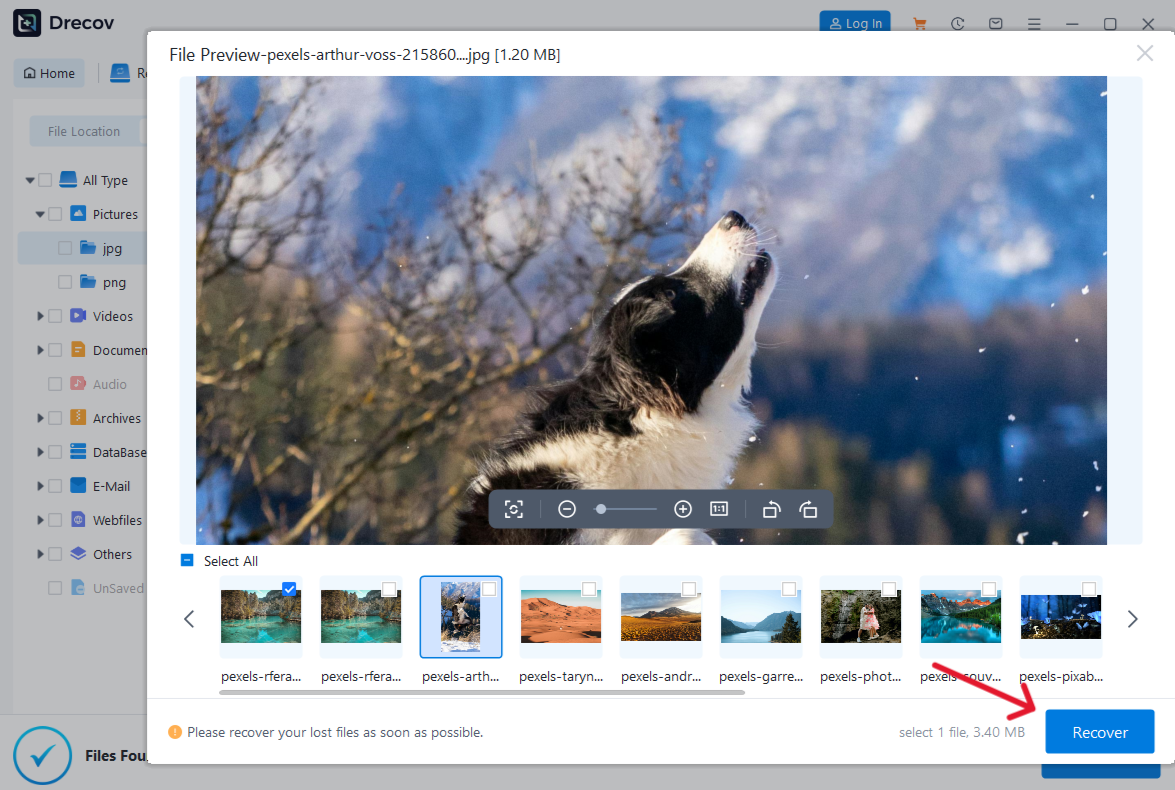
Step 4: Filter candidates and preview representative files
Use the former path, filename, file type, size, and modification date to narrow the result set. Preview supported representative files where available. Preview confirms only the displayed sample; it cannot prove that every member of a multi-file save folder is complete. Recover more than one plausible campaign version when space allows.
Step 5: Recover elsewhere and verify before replacing anything
Send the selected folders to the healthy destination, never back to the source volume. If output is not where expected, check Drecov Folder or Recovery Folder. Open the recovered set on the destination and compare its contents before copying a test candidate into the live BG3 profile. Keep the untouched recovery output until the campaign loads, changes area successfully, and creates a new save.
⚠ Warning: Install it on a drive different from the one where your data was lost to prevent overwriting.
Validate a Restored Campaign Before Re-enabling Sync
Work with a copy of the recovered campaign. Keep cloud sync paused during the first launch so an older remote version cannot immediately replace it. Confirm the character, play time, location, and quest state rather than accepting the first successful loading screen. Travel to another area, create a distinct test save, exit normally, and verify that the expected local folder receives a new timestamp.
If recent progress is absent, repeat the test with the next plausible candidate. Do not merge files from different save folders. Mixing individual files can create a combination the game never produced. Once a candidate passes, preserve it on a separate drive. Only then decide whether it should become the local or cloud version. For broader deletion cases, see the practical methods to recover deleted files.
Larian’s community guidance also confirms the Windows profile structure used for BG3 saves; consult the Larian support discussion when checking the path. The decisive evidence remains the campaign that loads correctly and produces a new save in the folder you identified.
Conclusion
The useful answer to “where are BG3 saves stored” is not just a path. Open the Local AppData profile, identify the account and campaign by timestamps, copy complete folders, and protect both sides of any cloud conflict. If the correct local folder was deleted, Drecov can scan the original stable Windows volume and recover candidates to another drive. Verify the recovered campaign offline before replacing live files or turning synchronization back on.
⚠ Warning: Install it on a drive different from the one where your data was lost to prevent overwriting.





